Search results for The

I love a newborn elephant as much as the next person, probably quite significantly more, but must we get all stupid and say that she likes pink? Must we, Zooborns? Really? Sigh.

Sent in by Chloe Angyal at Feministing. Thanks Chloe!

Pink, by the way, has only been associated with female humans for the last 60 years or so, and only in parts of the world.  See, for example, our posts on a vintage Father’s Birthday card and advice for mothers. (And, while we’re at it, this art project is pretty stunning.)  I’m pretty sure elephants, even girl ones, are indifferent.

Lisa Wade, PhD is an Associate Professor at Tulane University. She is the author of American Hookup, a book about college sexual culture; a textbook about gender; and a forthcoming introductory text: Terrible Magnificent Sociology. You can follow her on Twitter and Instagram.

Every once in a while we here at SocImages pick a fight and a couple of years ago we sunk our teeth into satire and didn’t let go. Satirical humor is often used to expose prejudice and bigotry and it can be damn effective, as many viewers of The Colbert Report will testify.  But it’s also a risky strategy.  It makes fun of by doing; so, for example, it exposes racism by being extremely, over-the-top, no-one-will-ever-believe-we’re-serious racist. Except for… someone might think you’re being serious.  In fact, a significant proportion of political conservatives viewing The Colbert Report believe that he is conservative like them. They recognize that he’s trying to be funny, but they don’t think he’s joking.

In our effort to think more critically about satire, we covered Amy Sedaris’ hipster racism, Ellen DeGeneres’ CoverGirl commerciala New Yorker cover depicting Obama as a Muslim, covers of the National Review featuring Bill Clinton and Sonia Sotomayor, and board games.  We also featured Jay Smooth’s commentary on Asher Roth using the phrase “nappy headed hos.”

Now Anita Sarkeesian, of Feminist Frequency, offers another illustration of how satire doesn’t always work the way progressives would like it to.  She takes on TV commercials, arguing that ironic racism and sexism is still racism and sexism. Ironic advertising, she argues, allows marketers to “…use all the racist, sexist, misogynist imagery they want, and simultaneously distance themselves from it with a little wink and a nod.”  You be the judge:

Lisa Wade, PhD is an Associate Professor at Tulane University. She is the author of American Hookup, a book about college sexual culture; a textbook about gender; and a forthcoming introductory text: Terrible Magnificent Sociology. You can follow her on Twitter and Instagram.

The U.S. economy is in trouble and that means trouble for the world economy.

According to a United Nations Conference on Trade and Development report, “Buoyant consumer demand in the United States was the main driver of global economic growth for many years in the run-up to the current global economic crisis.”

Before the crisis, U.S. household consumption accounted for approximately 16 percent of total global output, with imports comprising a significant share and playing a critical role in supporting growth in other countries.

…as a result of global production sharing, United States consumer spending increas[ed] global economic activities in many indirect ways as well (e.g. business investments in countries such as Germany and Japan to produce machinery for export to China and its use there for the manufacture of exports to the United States).

In short, a significant decline in U.S. spending can be expected to have a major impact on world growth, with serious blow-back for the United States.

There are those who argue that things are not so dire, that other countries are capable of stepping up their spending to compensate for any decline in U.S. consumption. However, the evidence suggests otherwise.As the chart below (from the report) reveals, consumption spending in the U.S. is far greater than in any other country; it is greater than Chinese, German, and Japanese consumption combined.

consumption.jpg

Moreover, there is little reason to believe that the Chinese, German, or Japanese governments are interested in boosting consumer spending in their respective countries.  All three governments continue to pursue export-led growth strategies that are underpinned by policies designed to suppress wage growth (lower wages = cheaper goods = stronger competitiveness in international markets).  Such policies restrict rather than encourage national consumption because they limit the amount of money people have to spend.

For example, China is the world’s fastest growing major economy and often viewed as a potential alternative growth pole to the United States.  Yet, the Economist reveals that the country’s growth has brought few benefits to the majority of Chinese workers.

picture1.jpg

According to the U.S. Bureau of Labor Statistics, despite several years of wage increases, Chinese manufacturing workers still only earn an average of  $1.36 per hour (including all benefits).  In relative terms, Chinese hourly labor compensation is roughly 4 percent of that in the United States.   It even remains considerably below that in Mexico.

Trends in Germany, the other high-flying major economy, are rather similar. As the chart below shows, the share of German GDP going to its workers has been declining for over a decade.  It is now considerably below its 1995 level.  In fact, the German government’s success in driving down German labor costs is one of the main causes of Europe’s current debt problems — other European countries have been unable to match Germany’s cost advantage, leaving them with growing trade deficits and foreign debt (largely owed to German banks).

germany.jpg

The Japanese economy, which remains in stagnation, is definitely unable to play a significant role in supporting world growth.  Moreover, as we see below, much like in the United States, China, and Germany, workers in Japan continue to produce more per hour while suffering real wage declines.

japan.gif

For a number of years, world growth was sustained by ever greater debt-driven U.S. consumer spending.  That driver now appears exhausted and U.S. political and economic leaders are pushing hard for austerity.  If they get their way, the repercussions will be serious for workers everywhere.

Our goal should not be a return to the unbalanced growth of the past but new, more stable and equitable world-wide patterns of production and consumption.  Achieving that outcome will not be easy, especially since as the United Nations Conference on Trade and Development’s World Investment Report 2011 points out, transnational corporations (including their affiliates) currently account for one-fourth of global GDP.Their affiliates alone produce more than 10 percent of global GDP and one-third of world exports.  And, these figures do not include the activities of many national firms that produce according to terms specified by these transnational corporations.   These dominant firms have a big stake in maintaining existing structures of production and trade regardless of the social costs and they exercise considerable political influence in all the countries in which they operate.

Emma M.H. sent in a new example of marketers attempting to masculinize beauty/hygiene products to make them more acceptable to men. The ad for Dove’s Men + Care Canadian body wash line, refers to men’s skin as “man hide,” similar to tough, totally manly cowhide, and thus in need of a good moisturizing now and again, just like your work gloves:

For other examples of making it safe for men to use body care products, see our posts on Brut’s slapping game, a post with several examples, and Allie Brosch’s awesome satire of this type of marketing (as well as all the links at the bottom of that post).

Photography projects can draw our attention, poignantly, to class inequality.  Consider Vivian Mayer’s vintage photographs of New York and Chicago, for example, or Peter Menzel’s What We Own series.  We need these projects because most of us are in class-segregated occupations and neighborhoods, not to mention a profoundly unequal world.

Photographer James Mollison has embarked on a similar project, Where Children Sleep, sent in by Kristina Killgrove, an anthropologist at Vanderbilt University, Yvette M., Amanda B., Dmitriy T.M., and my sister, Keely.  Mollison has documented children and their bedrooms around the world.  It’s heartbreaking to see how much some children have, and how little others do.


See the pictures, with details about the children, at the New York Times.

Lisa Wade, PhD is an Associate Professor at Tulane University. She is the author of American Hookup, a book about college sexual culture; a textbook about gender; and a forthcoming introductory text: Terrible Magnificent Sociology. You can follow her on Twitter and Instagram.

Katrin sent along a vintage (apparently 1957) Pepsi commercial I thought you might enjoy, as it has all the classics: lightly mocking tone about women’s supposed competitiveness with one another and obsession with shopping, reminder that attractive = thin, and presentation of marriage as the ideal, ultimate victory for all women:

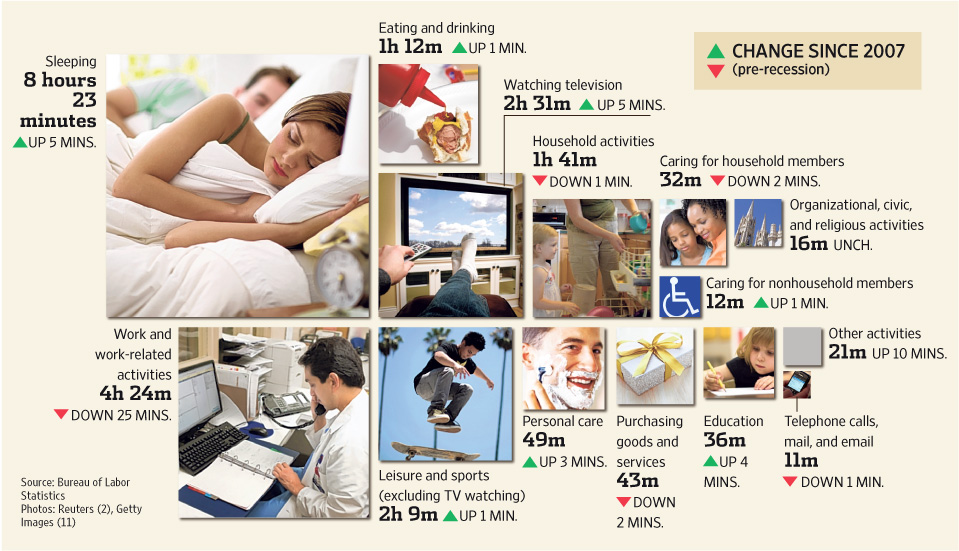
Sangyoub Park let us know that the Bureau of Labor Statistics has released the results of the 2010 American Time Use Survey, a study that looks at what we do with our time. They haven’t released any charts of the 2010 data yet, but the Wall Street Journal posted an article with an image that summarizes the changes since 2007, before the recession began. Not surprisingly, on average Americans are spending less time working and more time sleeping and watching TV, among other activities:

Keep in mind those numbers are daily averages that even out activity that is often not evenly distributed in real life (such as work, where weekly hours worked are averaged across all 7 days).

These changes seem insignificant when you look at them; so what if Americans are, on average, sleeping 5 extra minutes a day, or spending 2 minutes less buying things? But when aggregated across the entire U.S. population aged 15 years or older, these add up to major shifts in family and work life as well as economic activity.

There’s a video to accompany the story:

Finally, they have an interactive website where you can enter your own time use in major categories (to the best you can estimate it) and see how you compare to national averages.

We’ll follow up with more detailed posts once the BLS starts posting relevant charts.

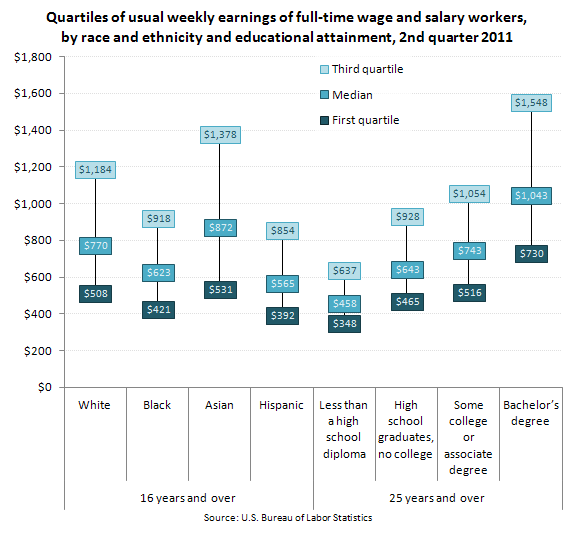
Kelsey C. sent in a some great data from the Bureau of Labor Statistics that helps illustrate why variance matters as much as a measure of the average.  The figure shows the median income by race and education level, as well as the typical earnings of each group’s members in the third quartile (or the 75th percentile) and first quartile (or the 25th percentile).  What you see is that the median earnings across these groups is different, but also that the amount of inequality within each group isn’t consistent.  That is, some groups have a wider range of income than others:

So, Asians are the most economically advantaged of all groups included, but they also have the widest range of income.  This means that some Asians do extremely well, better than many whites, but many Asians are really struggling.  In comparison, among Blacks and Hispanics, the range is smaller.  So the highest earning Blacks and Hispanics don’t do as well relative to the groups median as do Whites and Asians.

Likewise, dropping out of high school seems to put a cap on how much you can earn; as education increases it raises the floor, but it also raises the variance in income. This means that someone with a bachelors degree doesn’t necessarily make craploads of money, but they might.

Lisa Wade, PhD is an Associate Professor at Tulane University. She is the author of American Hookup, a book about college sexual culture; a textbook about gender; and a forthcoming introductory text: Terrible Magnificent Sociology. You can follow her on Twitter and Instagram.