
Cross-posted at Scientopia.
The U.S. Department of Commerce just released a report on the continuing gender gap in STEM jobs – that is, science, technology, engineering, and math. While women make up roughly half of the total paid workforce, they still held only a quarter of STEM jobs as of 2009:
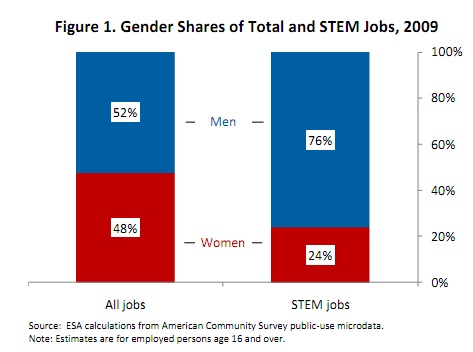 In fact, we saw no change in the gender make-up of STEM fields between 2000 and 2009.
There is significant variation in the gender composition within the STEM category, however. At the high end, women hold 40% of jobs in the physical and life sciences; the low point is engineering, where only 14% of employees are women. And the proportion of women in computer science and math jobs actually fell between 2000 and 2009, from 30% to 27% of workers.
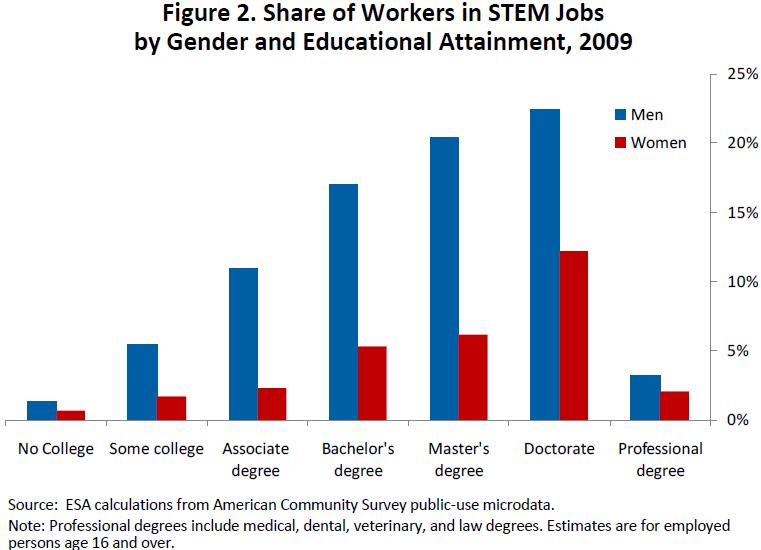
This isn’t simply because of differences in education, either. Here we see the proportion of both men and women in STEM jobs at various educational levels; while increased education correlates with a higher likelihood of having a STEM job for both groups, women are significantly less likely than men at every educational level to have a STEM job:
 The gender disparity in STEM jobs is especially noteworthy because, on average, STEM occupations pay significantly more than other private-sector jobs, and the gender gap in pay is actually lower than in non-STEM sectors:
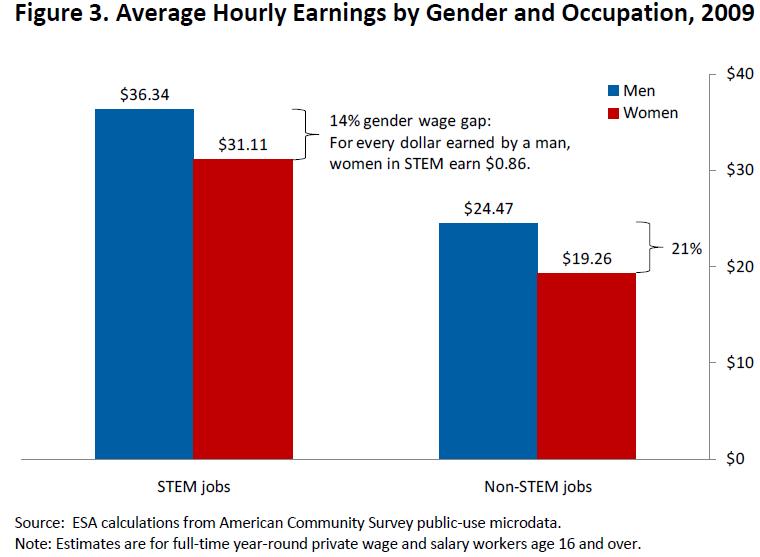
If we look only at women with bachelor’s degrees, women who earn STEM degrees and work in STEM jobs earn, on average, 29% more than other women.
So the underrepresentation of women in STEM jobs means that women are missing out on some of the best-paying occupations in the U.S.; in fact, this type of gender-segregation of jobs is one of the leading causes of gender gap in yearly and lifetime earnings.
The authors of the report don’t go into detail about potential causes of the gender gap in STEM careers, though they note that among those earning STEM degrees in college, women are significantly less likely than men to hold jobs in related STEM fields. They suggest this might be because STEM jobs are relatively unaccommodating to those who take time off for family obligations (disproportionately women), because of a lack of female role models in STEM fields (including as college professors), or because of gender stereotyping about math or science aptitude (like this, or this if you prefer a t-shirt) that pushes women away from STEM degrees and careers. [UPDATE: Broken links fixed!]
The complex interplay of factors that lead to a gender gap in who holds STEM-sector jobs provides significant challenges to increasing the proportion of women in these occupations — as indicated by the lack of change over the past decade. But particularly as we see increasing economic divergence between well-paid tech and information sector and low-paid service sector jobs, addressing the underrepresentation of women in STEM jobs will be essential as part of any effort to improve women’s lifetime earnings potential and overall economic outlook.
Comments 22
Anonymous — August 4, 2011
EDIT: Brain fart, thought STEM was a government agency for a sec.
Steve Pan — August 4, 2011
Yeah well we all know men are problem solvers because out in the jungle we had to rig elaborate hunting devices while women are not suited to math because they gathered berries and nuts (which is like going shopping today!!) and are more caring and less math oriented :rolleyes:
engr — August 4, 2011
As an anecdotal case of anti-women attitudes in STEM, I had a female friend, one of the few in the program, who was told by a male professor, who was kind of an ass in general, that women didn't belong in engineering, she then went on to graduate at the top of the class and get a job at a govt research lab.
K00kyKelly — August 4, 2011
The Why So Few Women in STEM report offers an evidence based look at several factors that contribute to the gender gap. Also, lots of pretty graphs!
K00kyKelly — August 4, 2011
"the proportion of women in computer science and math jobs actually fell between 2000 and 2009, from 30% to 27% of workers."
The crazy thing is that computer science was dominated by women when it was first started. This blog post, Researcher reveals how “Computer Geeks” replaced “Computer Girls", gives some of the history behind the first programmers and claims that as long as programmers are considered anti-social it will stay male dominated. There is another factor - as programming became considered more important it became more sexist. Today the many cultures that surround computers are typically sexist - from gaming to tinkering women get the message that they aren't welcome.
Programming is one of the rare cases where the job opportunities were not always male dominated. Many of the other STEM fields have been male dominated throughout history.
I. — August 5, 2011
I already knew that there are barriers in our socialization for women pursuing STEM jobs, but I'm really surprised by some of the comments here about women encountering prejudice while actively pursuing a university degree (and beyond) in these fields. I come from a family of scientists - my parents are chemists, my brother is a physicist, and my sister-in-law is a biologist.
If I include their/my social circle, suffice to say I'm surrounded by plenty of people with STEM careers of both genders. The women have never spoken of encountering these kinds of issues in academia and research settings, and I've never heard any of the men disparaging women as "lesser" scientists. Although the comments here suggest otherwise, I think (or at least hope) that they must be anomalies WITHIN the STEM community, if we can call it such. If anything, my social environment shows me that among scientists, female scientist are judged by the quality of their work/research, nothing more, nothing less, just as the male ones are.
Tegan Mulholland — August 6, 2011
My graduating class in computer science was only 12% female, despite the fact that our professors were about 40% female. I don't know why there are so few female programmers, although as a woman that's already in it, I like the culture and I'm resistant to making it less geeky to attract more other women.
I work with a lot of immigrants, as well as teams in India and China. There is a higher representation of women in software development in Asia, especially India, and a lower representation in Eastern Europe. In the U.S., many programmers are geeks who would do it for fun as a hobby if we couldn't get paid. In my experience, people who grew up in Asia look at it more as a lucrative career, and women are encouraged to go into these lucrative careers as well as men. And since there's more of a cultural focus on working hard than some idea of being intrinsically "smart," not so many women are intimidated out of the field because they think they might not be naturally good enough at it.
Adam Ness — August 8, 2011
This is a disconcerting trend, and one that I really hope can be addressed. I was at a "Hackathon" this weekend, which is about one of the STEM-Geekiest events that I know of ( 40 people, sitting in a room brainstorming and implementing interesting software projects in a timescale of 6-8 hours of work ). In a room full of 40 young, energetic, creative, technically competitive people, there was 1 woman. And this was in Santa Monica, California: hardly known for it's gender stereotype enforcement.
I agree with many of the comments that "de-geeking" the STEM space is not going to be the right solution. Geekery is actually vital, as it skates that edge between creativity and logic that is important to advancing all of the disciplines involved in STEM. We do need to find ways to invite more women into the field, and foster their growth as members of the community.
Carole — August 9, 2011
For my experiences as a woman programmer starting in the 70's and my transformation into an aerospace engineer, see my article at Girls Can't What! http://www.girlscantwhat.com/yes-i-am-a-rocket-scientist/