Search results for The

Geographer Derek Watkins put together an interesting visualization of the expansion of the U.S. by showing the distribution of post offices between 1700 and 1900. The distribution of post offices reflects a number of important social and political events — the sudden emergence of post offices on the West Coast in the late 1840s, around the time of the gold rush and California becoming a state, patterns in Kansas and Nebraska in the 1870s clearly showing how population growth followed railroad lines, and so on:

Posted: Visualizing US expansion through post offices. from Derek Watkins on Vimeo.

You can read Watkins’s caveats about the data (it doesn’t include closures of some post offices during that time, and he was unable to determine the location of about 10% of post office branches) here. Thanks to Jeremy Freese, at Scatterplot, for posting it!

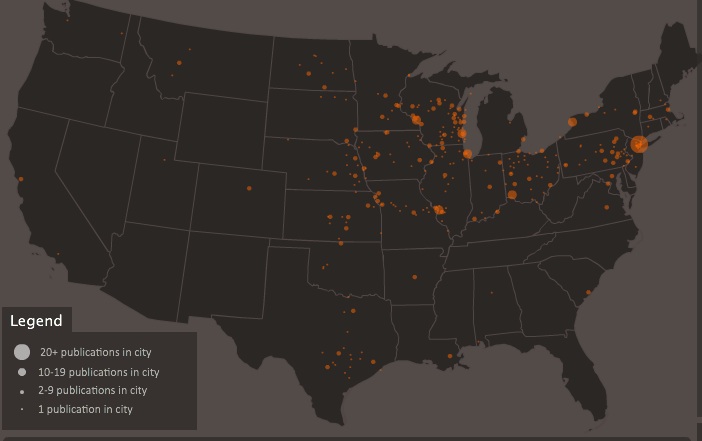
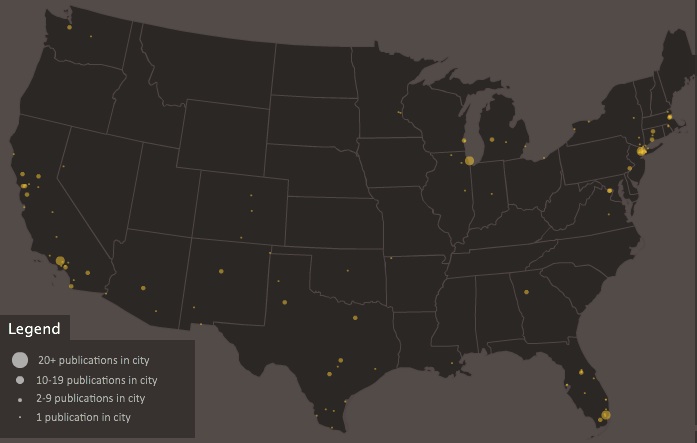
Dmitrity T.M. and Larry Harnisch (of The Daily Mirror) let us know that Stanford University’s Rural West Initiative put together a map showing the spread of newspapers across the U.S. between 1690 and 2011, based on Library of Congress listings. The results illustrate many of the same major social and political changes and trends as the post office map:

The Growth of US Newspapers, 1690-2011 from Geoff McGhee on Vimeo.

The website allows you to see the map for any individual year, and awesomely, you can filter by language, illustrating a number of periods of high immigration and common destination locations. Here’s the map of German-language newspapers in 1900:
And Spanish today:
This Course Guide is in progress and will be updated as I have time.

Disclaimer: If you’re thinking about writing a course guide.  I totally overdid it on this one!  It doesn’t have to be nearly this extensive.


Course Guide for
INTRODUCTION TO SOCIOLOGY

(last updated 5/2012)

Developed by Gwen Sharp
Nevada State College


C. Wright Mills and the Sociological Imagination

Intersection of biography and history as illustrated by:

“the capacity for astonishment is made lively again”

Karl Marx/Marxist analysis

Emile Durkheim

[Because the course guide has gotten to be so long, I’m putting the rest of it after the jump.]

more...

HAPPY SEPTEMBER!

News, Publications, and Appearances:

We are super grateful to Karen McCormack for her positive and insightful review of SocImages in Visual Sociology.  Thanks so much Karen!

We’re pleased to report that our short essay on Banal Nationalism was published in Contexts magazine this month.

Guest Blogger Christina Barmon made a big splash this month with her post, To Sit or Not to Sit: Gendering How We Pee.  Maybe we can get it up to 500 Facebook likes today!  If you’d like to be a part of our Guest Blogger Team, with access to the best reader submissions, send us a note at socimages@thesocietypages.org.

Contributor Caroline Heldman made nine appearances on Fox and the Fox Business channel this month, in addition to writing a fantastic series marking the anniversary of Hurricane Katrina and kicking off our Election 2012 Sexism Watch.

Lisa was also quoted in an Inside Higher Ed article about the American Sociological Association’s annual conference in Las Vegas.  And she chatted for a few minutes about the sexualization of girls with sexologist Logan Levkoff on CKNW’s Bill Good Show.

Course Guides:

Classes are in full swing for the SocImages team!  Gwen is getting started on a Course Guide for Introduction to Sociology, a list of topic-specific quality SocImages material arranged in a way that we hope instructors will find familiar and convenient.  We’d love to see more!  If you are teaching this semester and would like to be forever inscribed on our pages as a generous soul, check out our Instructors Page for more information.

Featured Reader!

This is a shout out to our long-time reader and prolific idea submitter, Katrin.  Katrin is at the University of Cambridge in Politics, Psychology, Sociology, and International Studies, researching climate change. She stumbled across the blog while searching some OECD statistics… and says she then spent the entire rest of the day flicking through ALL the other posts.  She’s also a Shakesville superfan, as we are.

Social Media ‘n’ Stuff:

Finally, this is your monthly reminder that SocImages is on Twitter and Facebook.  Learn more about your editors at Lisa’s and Gwen’s websites.  And a bunch of us are having fun on twitter: @lisadwade@gwensharpnv@familyunequal@carolineheldman, and @jaylivingston.

If I ran the Federal scary anti-smoking image warning program, I might show smokers the list of health-related terms that show up most in the states with the highest cigarette smoking rates.

If you take the smoking rates by state, and throw them into the Google Correlate hopper, you can see the 100 search terms that are most highly correlated with that reported smoking behavior. That is, the terms that are most likely to be used in high-smoking states and least likely to be used in the low-smoking states.

Is the result just a lot of noise? Maybe, but I don’t think so. Here are the smoking-related terms in the top 100:

  • camel no 9
  • cigarette coupon
  • cigarette coupons
  • marlboro coupons
  • my time to quit
  • safe cigarettes
  • stopping smoking
  • time to quit
  • fire safe cigarettes
  • ways to stop smoking

So that’s good for face validity — a list of random search terms isn’t likely to have all those smoking terms on it.

But after the smoking terms, the thing that jumps out is the health-related terms. We know from the Google flu tracker that people search for their symptoms. So these caught my eye.

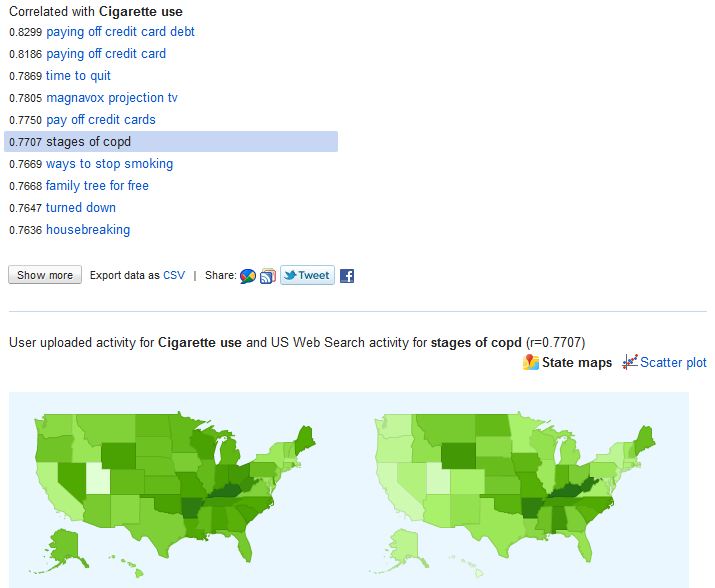
Here is a screen shot of the first page of results:

I selected “stages of copd” as the term to map. The map on the left is the smoking rates; the one on the right is the relative frequency of searches for “stages of copd.” That is, chronic obstructive pulmonary disease, a nasty disease the most common cause of which is smoking.

Here is the complete list of health-related terms among the top-100 correlates with smoking rates:

Lymph node swelling, which is implicated in the jaw and neck searches, most often reflects infection — which smoking causes.

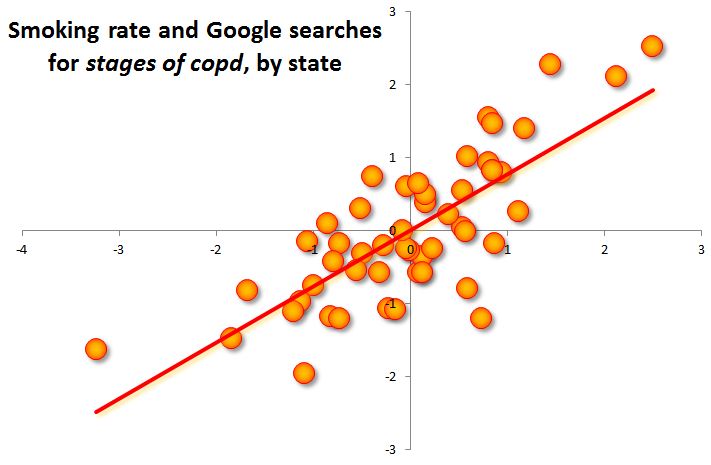
How strong are the connections? They’re not the strongest I’ve seen on Google Correlate. The “stages of copd” search is correlated with smoking rates at .77 on a scale of 0 to 1. It’s not uncommon to find correlations of .93 (which is the relationship between “quiche” and “volvo v70 xc”).

But considering the smoking rates come from a sample survey (the National Survey on Drug Use and Health) which includes random error, and states are somewhat arbitrary geographic units, that correlation seems pretty high to me. Here’s the scatterplot:

What is the correlation causality story here? I can’t say. But the simplest explanation is that these are the terms smokers (and maybe those who know or care for them) are most likely to Google relative to non-smokers — not that they are the most common searches smokers do, of course, but the searches that differentiate them from non-smokers. The simplest explanation is the best place to start.

I like this list of conditions because in my experience smokers sometimes have the attitude of “you have to die of something.” But it’s not just the chance of dying that smoking increases — it’s a lot of possible forms of suffering along the way.

——————————

The Google Correlate tool is showing the great potential for using Internet search activity to investigate layers of behavior and meaning behind other observable social phenomena, such as race/ethnic compositionhealth behavior, and family patterns.

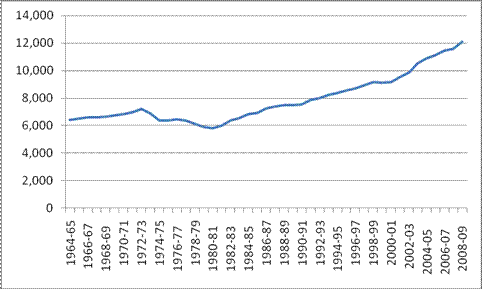
Whether you are in college or not, fall semester 2011 is upon us. Below, courtesy of Everyday Sociology, is a graph illustrating the rising cost of college, controlled for inflation.

Public College/University Tuition, Room and Board (held constant in 2007-2008 dollars):

Consequent to this increase, the average student in 2008 graduated with twice the debt as a student in 1996, from $12,750 to $23,200.

The pay-off of a college education, however, is higher than ever. So why don’t more people go?

In the seven-and-a-half minute video below, UC Berkeley Professor Michael Hout gives a history of higher education putting all of this in perspective. The answer is class-specific and how different classes think about debt and possibility. More:

Lisa Wade, PhD is an Associate Professor at Tulane University. She is the author of American Hookup, a book about college sexual culture; a textbook about gender; and a forthcoming introductory text: Terrible Magnificent Sociology. You can follow her on Twitter and Instagram.

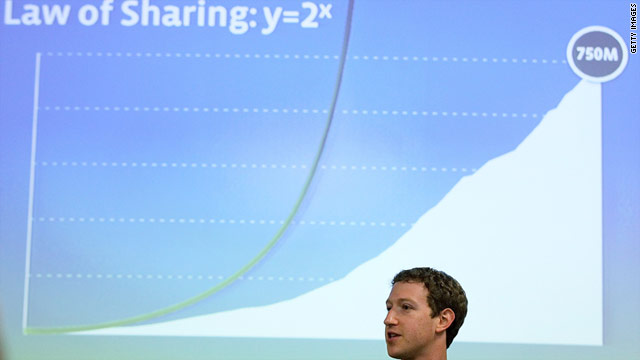
That’s Facebook founder Mark Zuckerberg and, behind him, his “law of information sharing.” The equation and graph illustrate, in his own words:

…that next year, people will share twice as much information as they share this year, and next year, they will be sharing twice as much as they did the year before.

The norms surrounding privacy are changing and new apps and services for us to display ourselves are being invented. Because of this, Zuckerberg predicts that we will share more and new types of information as time passes.

Facebook and the rest of social media (Twitter, Tumblr, Google+ and so on) need us to share more and more information. Facebook, for instance, uses our personal information to attract advertisers who want to better “target” their advertisements to us. Change your relationship status to “engaged” and you may be quickly targeted with wedding ads.

So what? 

Karl Marx said that we are “exploited” when we are not paid in wages the full value of our labor (our bosses, instead, skim some off the top).  Since our sharing makes Facebook valuable, it is our work that makes it the digital goldmine that it is (valued at around $84 billion). We, in turn, are paid no wages at all.

Should the average Facebook user feel exploited? 

Facebook users get non-monetary rewards from using the site, such as self-expression and socializing with others.  Perhaps personal connection or social attention is just another type of currency, one that Marx didn’t fully account for.  Then again, Marx never argued that workers weren’t compensated at all, only that their compensation was not equal to the value they brought to the employer.

So, what do you think? Is Facebook exploitative? Are monetary and social currencies fundamentally different?

Does a Marxist analysis work on Facebook? Or do we need a different theory to make sense of it all?

——————————

Nathan Jurgenson is a graduate student in sociology at the University of Maryland and co-edits the Cyborgology blog.

If you would like to write a post for Sociological Images, please see our Guidelines for Guest Bloggers.

Sociology PhD candidate Kjerstin Gruys recently guest posted about her effort to shun mirrors for one year in the hopes of improving her body image.  As any really interesting and challenging project should, it’s begun to get some major media coverage, including a story at Yahoo News.  When a political project starts getting mass media attention, though, it risks being contextualized and even co-opted by the status quo.  This is a case in point.

Interspersed among the article about Gruys’ project are links, an effort on the part of the website to get readers to spend more time on its pages and the pages of its advertisers.  These are probably randomly generated according to the content of the article.  So, since Gruys’ project is about her feelings about her body and avoiding mirrors for six months before and after her wedding day, the links center around beauty and weddings.  The first two links nestled in among the first few paragraphs read “Are you Satisfied with Your Face?” and “A Wedding Dress to Fit Your Body Shape.”

By publicizing her project, Kjerstin is trying to make the personal political.  But one of the only means of drawing awareness to her work includes losing control of how it’s talked about and delivered.  While she wants women to feel better about themselves, and some may be inspired by her project, in some ways this is also another instance of the mass media reminding women to think about the appearance of their face and body. The inserted links, further, can be read as upholding the very standards that Gruys is trying to combat.  And in at least some cases, they do. The “Are you Satisfied with Your Face?” link, in this vein, goes to a site sponsored by super-beauty project corporation L’Oreal.

Thanks to my student, Kirsten Easton, for sending along this link!

Lisa Wade, PhD is an Associate Professor at Tulane University. She is the author of American Hookup, a book about college sexual culture; a textbook about gender; and a forthcoming introductory text: Terrible Magnificent Sociology. You can follow her on Twitter and Instagram.

Presidential hopeful and U.S. Congressman Ron Paul (R-TX) made the news over the weekend arguing, among other things, that the Federal Emergency Management Agency (FEMA) is unnecessary or, even worse, creates a kind of moral hazard in populations who come to depend on Federal relief efforts. In remarks reported Friday, Rep. Paul said that Hurricane Irene should be handled “like 1900,” the year that a large storm killed approximately 8,000 individuals in Galveston and a few thousand more onshore, when it struck the low-lying island and nearby small communities on the Texas coast.

It is certainly true that the Federal response to the destruction of Galveston was relatively minor. Systematic Federal management and provision of aid to individuals in disaster crystallized in response to the Mississippi River’s catastrophic flooding in 1927.  In 1900, it was limited for the most part to President McKinley sending surplus Army tents to house the newly homeless residents of Galveston, and loaning some ships to transport relief goods.

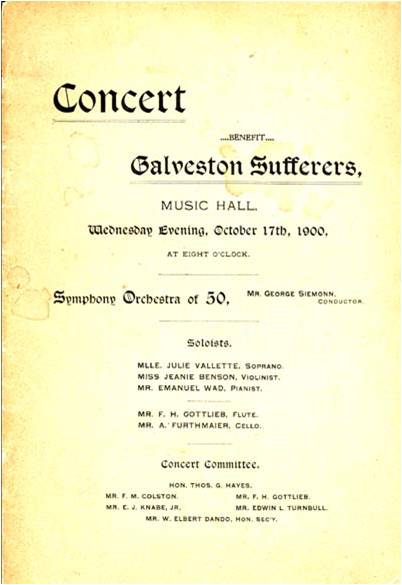
The nation as a whole, on the other hand, quickly mobilized relief donation efforts through newspapers, state and city governments, and the dense network of fraternal organizations that characterized American civil society in 1900. The nation’s response was along the lines of the civic and political institutions of the time, with all that entailed.

[Credit: Rosenberg Library’s Galveston and Texas History Center archives]

So, for instance, some of the citizens of Galveston who survived the storm were given liquor for their nerves and pressed into service at gunpoint by local authorities to clear dead and putrefying bodies from the wreckage; some were later partially compensated for their time with a small sum of money. Property owners, however, were exempted from mandatory clearing of debris and corpses.

Voluntary associations – often segregated by gender, race, ethnicity, and class – took care of their own members as best they could, but the broader distribution of relief supplies arriving from other areas was handled by committees of Galveston’s social and economic elites, based on their knowledge of their city’s political districts. Distribution efforts throughout the Texas coast were controversial enough that hearings were held by the Texas State Senate to investigate reports of improper relief distribution, some of which were borne out by testimony but none of which were pursued.  Survivors’ letters suggest that in some cases the nicer relief goods – the distribution of which was handled by committees of Galveston’s social and economic elites on the basis of what they knew about their city’s political districts – went to the wealthier victims’ districts, when they weren’t re-routed by less wealthy and somewhat disgruntled Galvestonians tasked with actually lugging the supplies around the city.  And Galveston’s African-American community was wholly shut out of the rebuilding process and denied a seat on the Central Relief Committee, despite efforts to secure a place in helping shape the collective destiny of the city. This is hardly surprising: poorer Americans tend to suffer disproportionately in most disasters, and are often left out of planning and rebuilding efforts.

There is much to be said for the response of Galveston’s Central Relief Committee. Under their leadership the city built the seawall that helps protect the city to this day and they initiated a series of successful municipal reforms that became widespread during the Progressive era. But we should not let unexamined nostalgia blind us to the realities of the situation in Galveston in the months after the 1900 storm.

Nor should we forget that the techniques that might have been more or less appropriate in 1900 were attuned to a society that has since changed quite a bit. It would be hard to imagine contemporary Americans pressed into service to clear bodies, barring a truly exceptional event. And despite its shortcomings, American culture is on the whole more egalitarian in 2005 than it was in 1900.

But the dense network of associations through which much assistance flowed to the city simply does not exist in the contemporary U.S. for a variety of reasons, none of which are reducible to the growth of the Federal government.  Instead, Americans support each other in crises by way of donations to highly professionalized and technically adept disaster relief organizations like the Red Cross, and by maintaining government organizations charged with preparing for the worst disasters and catastrophes with their tax dollars.

This makes sense in part because contemporary cities and the economic arrangements which undergird them are much more complex beasts than they were in 1900. The following chart property damage and deaths caused by major disasters over the 20th century:

[Source: The Federal Response to Hurricane Katrina: Lessons Learned, p. 6.]

The overall trend is toward less lethal but much costlier disasters, which in turn causes significant disruptions to the ordinary functioning of local businesses and municipal governments that depend on tax revenues from those businesses. This necessitates more Federal involvement, as cities and state governments struggle to get their own houses in order, and to pay for the resources and technical know-how needed to rebuild infrastructure, modern dwellings, and businesses. As Lawrence Powell, a historian at Tulane University in New Orleans, asked of the influx of well-meaning volunteers in response to Katrina, “Can the methods of a nineteenth-century barn raising drag a twenty-first-century disaster area from the mud and the muck?”.

The 20th century history of Federal disaster policy can be described as a cycle of expansion and contraction. Increasingly complex disasters draw forth ad hoc solutions, which are then formalized and later institutionalized until they grow unwieldy and are periodically consolidated in efforts to provide more efficient, systematic, and effective services that are less prone to fraud or waste.

Small and big business, social movement organizations, academics, professionals, voluntary associations and NGOs have all helped shape the trajectory of that cycle, as when civil rights organizations successfully lobbied Congress and the Red Cross after Hurricane Camille in 1969 to provide a baseline of minimum assistance to hurricane victims, rather than the older policy that granted aid on the basis of pre-disaster assets (and which thus tended to favor wealthier victims on the basis that they had lost more than had the poor).

In recent decades, this has tended toward deregulation of coastal development in deference to free market ideals and a Congressional movement in the mid 1990s that sought to pay for disaster relief by, in large part, cutting social service programs that serve the poor. (See Ted Steinberg’s Acts of God for one good historical and political economic critique of U.S. disaster policy.)

How Federal disaster mitigation efforts can be more efficient, just, or effective is certainly a worthy conversation to hold. How best to arrange – and pay for – social relationships around economic, ecological, and technological risk is also an excellent topic for deliberation and debate. But to seriously argue that we should strive to make our disaster response regime more like that enjoyed by Americans in the early half of the twentieth century is, for lack of a better word, silly.

(For that matter, it’s hard to understand what Rep. Paul means by his call for more control by the States; the decision to request the involvement of the Federal government and FEMA already rests with the State governors, as per the Stafford Act.)

Former generations of Americans saw a patchwork of state government solutions as inadequate to managing modern disasters, particularly those that overwhelm municipal or State governments. They built Civil Defense agencies, the Office of Emergency Preparedness, and later FEMA in an effort to combine accountability and economies of scale and expertise, and to ensure that in times of disaster Americans could count on their Federal government to marshal tools and talent when local and State governments are overwhelmed and help is asked.

And as my own research shows, the efforts of these state organizations have long been understood by victims and outside observers alike as expressing and relying on bonds of fellow citizenship and civil solidarity. That in recent decades this legacy has been tarnished with cronyism and mismanagement from above says more about those political actors and the institutions of American electoral politics than it does about the inherent worth of Federal disaster management organizations.

——————————

Brady Potts is a lecturer in the Department of Sociology at the University of Southern California. His current research focuses on the history of public discourse and narratives around risk and hurricane disasters, and the role of civic culture in American disaster response.

If you would like to write a post for Sociological Images, please see our Guidelines for Guest Bloggers.