Search results for The

Social justice scholars and activists suspect the recent push by many states to require government issued photo identification at the polls is a de facto strategy to suppress voter turnout amongst the poor.

The work of Symbolic Interactionist Michael Schwalbe helps us understand how prejudices like these institutionalize themselves in our democracy.  Powerful elites always define themselves as intellectually and morally superior to lower class others.   In viewing themselves as the guardians of our republic, these elites view it their personal responsibility to protect our democracy from the undue and corrosive influence of the poor who are implicitly thought unworthy of democratic rights.  For example, elites argue the poor are likely to succumb to what congressional Republican Paul Ryan describes as “the good politics and rotten economics of class warfare.”  By constructing the poor as contaminating our democratic process, restraints on voting are justified and rationalized.

In a satirical critique of a 2006 New York Times editorial about how many other Western democracies have gone to great lengths to maximize voter turnout, comedian Stephen Colbert draws upon the supposed intellectual and moral superiority of the wealthy to explain why America should only encourage the rich to vote “because they must know something, they got all that money.”  Colbert argues that we should keep the disadvantaged from the polls “because the poor don’t have much to offer democracy.”  By revealing the class prejudices many hold about both the wealthy and the poor, Colbert uses satire to reveal the real logic driving changes in how we vote.

————————

Jason Eastman is an Assistant Professor of Sociology at Coastal Carolina University who researches how culture and identity influence social inequalities.

If you would like to write a post for Sociological Images, please see our Guidelines for Guest Bloggers.
Last month I wrote about gender differences in notions of health in a 1922 public health campaign designed to teach American teens about sex.

Today, we might not recognize that any of these recommendations had anything to do with sex. But in fact, they many of them were about masturbation.  At this time, fewer physicians thought that it would cause madness, epilepsy, homosexuality, or gout, but they still believed that it would encourage depravity and a lack of self-discipline.

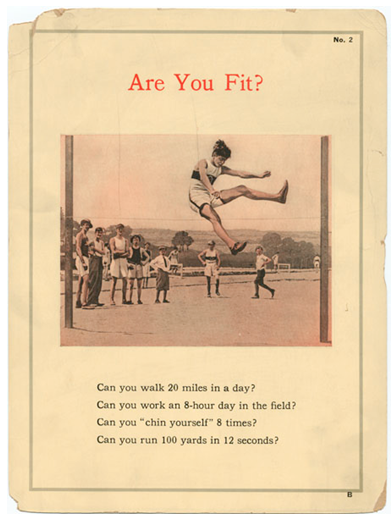
To encourage a healthy sexuality, they advised lots of exercise. Exercise was believed to teach self-control. It was also considered a good outlet for “energy,” leaving one to worn out to masturbate.

TEXT:

Can you walk 20 miles in a day? Can you work an 8-hour day in the field? Can you “chin yourself” 8 times? Can you run 100 yards in 12 seconds?

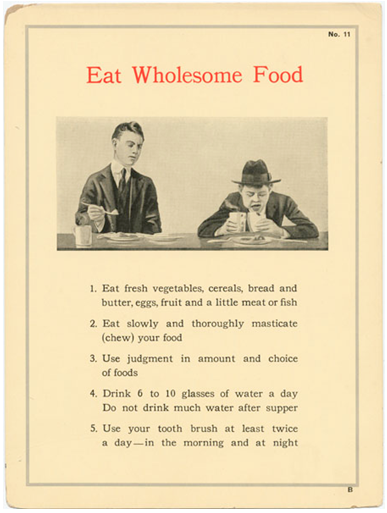
They promoted a healthy diet.  Too much meat and too much spice were thought to encourage masturbation.

TEXT:

1. Eat fresh vegetables, cereals, bread and butter, eggs, fruit and a little meat or fish. 2. Eat slowly and thoroughly masticate (chew) your food. 3. Use judgment in amount and choice of foods. 4. Drink 6 to 10 glasses of water a day. Do not drink much water after supper. 5. Use your tooth brush at least twice a day — in the morning and at night.

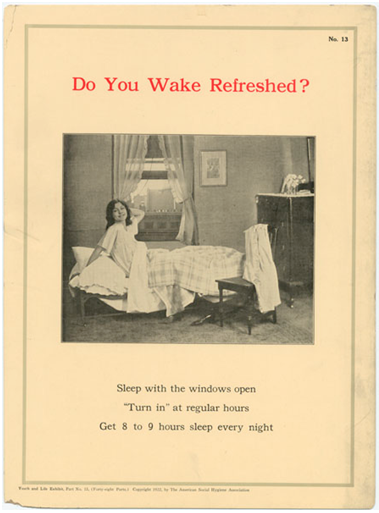
People were also advised to sleep in well-ventilated rooms and to wear loose clothes that did not cause any friction:

TEXT:

Sleep with the windows open. “Turn in” at regular hours. Get 8 to 9 hours sleep every night.

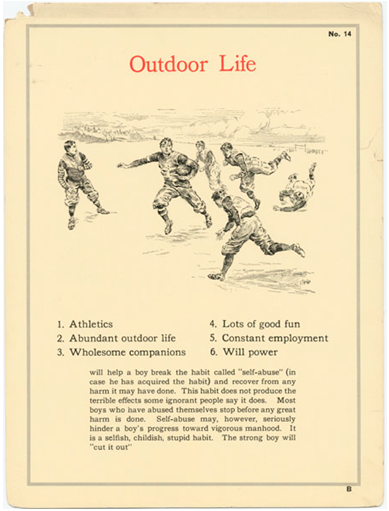
Interestingly, only the boys’ posters actually discuss masturbation directly (self-abuse).

TITLE: Outdoor Life (avoid self-abuse)

TEXT:

1. Athletics. 2. Abundant outdoor life. 3. Wholesome companions. 4. Lots of good fun. 5. Constant employment. 6. Will power will help a boy break the habit called “self-abuse” (in case he has acquired the habit) and recover from any harm it may have done. This habit does not produce the terrible effects some ignorant people say it does. Most boys who have abused themselves stop before any great harm is done. Self-abuse may, however, seriously hinder a boy’s progress toward vigorous manhood. It is a selfish, childish, stupid habit. The strong boy will “cut it out.”

The posters are held at the Social Welfare History Archives at the University of Minnesota Libraries.

——————————

Christina Barmon is a doctoral student at Georgia State University studying sociology and gerontology.

If you would like to write a post for Sociological Images, please see our Guidelines for Guest Bloggers.
Gay men and bisexual men still represent a disproportionate number of HIV cases in the United States (CDC).  In addition, African-American and Latino men are significantly more likely than white men to be diagnosed with HIV and die from AIDS-related illnesses.  Numerous HIV prevention campaigns are thus aimed at these populations.

It’s important to try to reduce the HIV among these populations, but we also need to think critically about how prevention strategies reinforce stigmatization.

For example, this ad from a western Massachusetts clinic uses the phrase “man up, get tested” — taking care of yourself by getting tested for HIV is linked to your masculinity.  What’s interesting is that by including only men of color in the photo, the ad suggests that black and Latino men are particularly obsessed with their masculinity, more so, perhaps, than white men.  It also potentially reinforces stereotypes about black men as hyper-sexualized and Latino men as machismo.

Second, a New York City campaign released in late 2010 uses fear to reach young gay men who are often thought to be complacent about the consequences of HIV disease now that life-saving medications are widely available in the U.S. and people can live with the virus for decades.  Gay and bisexual men are encouraged to use condoms through a commercial that reminds viewers “it’s never just HIV” by featuring a close-up photo of anal cancer among other (potential) HIV/AIDS related illnesses.  The video was applauded for its frank depiction of risk in the face of public apathy about the dangers of HIV/AIDS while simultaneously condemned for sensationalizing and stigmatizing gay sex:

In the face of stark HIV/AIDS inequalities among gay men and people of color, it’s clear that new prevention strategies are needed.  At the same, however, we also need to think about how we reinforce damaging and stigmatizing ideas about race, gender, and sexuality.

——————————

Christie Barcelos is a doctoral student in Public Health/Community Health Education at the University of Massachusetts Amherst.

If you would like to write a post for Sociological Images, please see our Guidelines for Guest Bloggers.
Last year Raquel Nelson was crossing the street with her 4-year-old son who was struck by a driver who fled the scene. Her son died and Nelson — just to be clear, the mom, not the driver of the car — was convicted of homicide by vehicle and reckless conduct (source). Nelson, you see, was jaywalking.  Her apartment complex was directly across the street from the bus stop and a half-mile from the nearest crosswalk.  None of the jurors on her case had ever taken public transportation.

(source)

There was a chorus of opposition to her trial and conviction and, likely in part because of the uproar, the judge gave her a probation instead of jail time. He also offered her a new trial; it begins this month.

In the meantime, Nelson’s tragedy drew attention the many neighborhoods that are unsafe for pedestrians. Transportation for America is collecting photographs of streets designed and maintained with cars in mind, but unsafe for pedestrians and those using public transportation. Here are a few examples from their flickr stream:

Lisa Wade, PhD is an Associate Professor at Tulane University. She is the author of American Hookup, a book about college sexual culture; a textbook about gender; and a forthcoming introductory text: Terrible Magnificent Sociology. You can follow her on Twitter and Instagram.

Cross-posted at Jezebel.

At least that’s what Skinny Water is promising in their latest advertisement. The ad shows a woman facing a throng of cameramen snapping her picture, elegant earrings dropping to the top of the headline which says: “Skinny Always Gets the Attention.” Take a look:

Below the headline and photo of the various flavors, it also says “Zero calories, Zero sugar, Zero Carbs, Zero Guilt.” With all that’s not in this water, you might wonder what it does offer. The website tells me that depending on the flavor of water, they’ve added vitamins B3, B5, B6, B12, C, A, and E. They’ve also thrown in magnesium, folic acid, calcium and/or potassium.

Despite paltry efforts to market itself as healthy, Skinny Water is instead perpetrating the cultural message that the best — or only — way to ensure that women get attention is by being skinny. This of course positions them well to try to push their product on those women who have been pulled into this lie.

In fact, Skinny Water is doing precisely the opposite of what a health-conscious company and product should be doing. Promoting the idea that those who are skinny deserve attention more than others creates communities that support harmful diet-related behaviors and disordered eating for the goal of a wispy appearance. Not to mention reinforcing the ever-present undercurrent of bias against the overweight — or even normal weight! — it reinforces the idea that women’s size and appearance is the most important thing about them.

In defiance of that, let’s remind ourselves why Skinny Water is wrong. While the website details the added vitamins and dietary minerals of each drink, it’s far better to get your needed supplements through a healthy diet rich in cruciferous  and dark and leafy vegetables, fruits, whole grain and lean proteins. Washed down, in fact, by regular old water that keeps you hydrated and helps your body process and absorb nutrients. Skinny Water is telling its buyers that by adding these vitamins and minerals to their product, one can, perhaps, eschew a calorie-free but vitamin-rich manipulated water diet. For example, the “Power,” “Sport” and “Fit” drinks are all fortified with calcium, magnesium, and potassium – to help activate metabolic enzymes, keep your blood regulated, and support strong bones and teeth. Do you know what else can do that?  Bananas, yogurt, kale, almonds and cashews, and quinoa.

These are madly marketed products that don’t substitute for a healthy, well-rounded diet. Instead, they capitalize on the now-entrenched notion that women care more about being skinny than anything else.

UPDATE: Jezebel reports that this advertisement has been retired by Skinny Water, thanks to objections from consumers.

——————————

Larkin Callaghan is a doctoral student at Columbia University studying health behavior and education. She is particularly concerned with gender disparities in access to healthcare and prevention services, and has done research on adolescent female sexual health, how social media operate as an educational platform, and differences by gender in the effectiveness of brief health interventions. You can follow her on TwitterTumblr, and at her blog.

If you would like to write a post for Sociological Images, please see our Guidelines for Guest Bloggers.
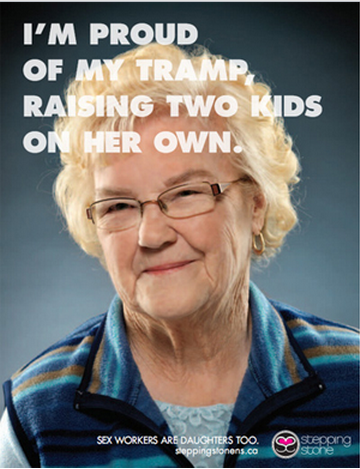
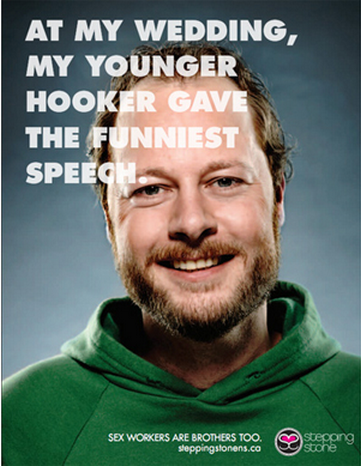
Katrin sent in a link to a series of ads created by an organization called Stepping Stone Nova Scotia. Their mission is to advocate on behalf of, and offer resources and services to, prostitutes in the Maritime Provinces of Canada.

The ads, as you can see, depict quotes by friends or family members of prostitutes (“I’m proud of my tramp, raising two kids on her own”) which are intended to humanize sex workers; the bottom of each ad reads “Sex workers are brothers/daughters/mothers too.” They’re also intended to shock the reader into really thinking about prostitutes. The juxtaposition of words like “tramp” and “hooker” with the white middle-class faces of the speakers makes the viewer question our culture’s ease with using those terms, and forces us to see the person behind the prostitute.

Stepping Stone’s executive director, Rene Ross, points out that every time a prostitute is killed—sex workers have a mortality rate 40 times higher than the Canadian national average—media accounts emphasize that the victim was a prostitute, but not that she (or he) was also a mother, daughter, friend or, for example, animal lover. By thinking of sex workers only in terms of their stigmatized occupation, we don’t have to care about them as people.

In New Mexico, where I live, the remains of eleven women (and the unborn fetus of one) were found buried on a mesa outside of Albuquerque in 2009. The women had disappeared between 2003 and 2005, and most, according to police, were involved with drugs and/or prostitution. Why did it take the police so long to find the bodies of these women, and why do their murders still remain unsolved? Some observers have suggested that because the women were—or were alleged to be—prostitutes, there was less pressure to find them after they went missing, or to solve their murders once their bodies were found. As long as the victims were sex workers, then the non-sex worker public can feel safe in the knowledge that they are not at risk. We know that prostitution is dangerous, so it’s expected that some of them will die grisly deaths, and be buried like trash on a mesa outside of town.

I love the motivation behind the ads, and they do make me smile. I hope they have the effect that Stepping Stone intends—making people think of prostitutes as people, not trash. But they’re also funny, and I wonder if they won’t also have an unintended effect, of making prostitutes seem like a joke.

This week I watched the Comedy Central Roast of Charlie Sheen. During the roast, most of the jokes dealt with his well-known history with drug use and prostitution, and “prostitute,” “hooker” and “whore” were used as punch lines in the majority of the jokes, and each “whore” reference incited additional laughter. Sure, many of the women that Sheen paid to have sex were doubtless “high class” call girls, paid well, and not living on the street. But we also know that at least some of these women, as well as the non-prostitute females in his life, were subject to violence and threats of violence. He is alleged to have beaten, shot, shoved, and thrown to the floor a number of women over the years, but because many of these women were sex workers (or porn stars, which is the next best thing), the women were “asking for it.”

Let’s hope that Stepping Stone’s campaign does some good, making us think about sex workers as people, rather than punch lines and faceless victims.

——————————

Margo DeMello has a PhD in cultural anthropology and teaches anthropology, cultural studies, and sociology at Central New Mexico Community College. Her research areas include body modification and adornment and human-animal studies.

If you would like to write a post for Sociological Images, please see our Guidelines for Guest Bloggers.

Shamus Khan posted a link to a great slideshow put together by the Business Insider that summarizes the current state of our economy. It’s a one-stop illustration of, in their words, “What the Wall Street protestors are so angry about,” and definitely worthy of clicking over to see the whole thing. I’m posting just a few of the images here.

The median length of unemployment for those who lose their jobs is now over 20 weeks:

About 45% of the currently unemployed have been without a job for at least 27 weeks — six to seven months without a job:

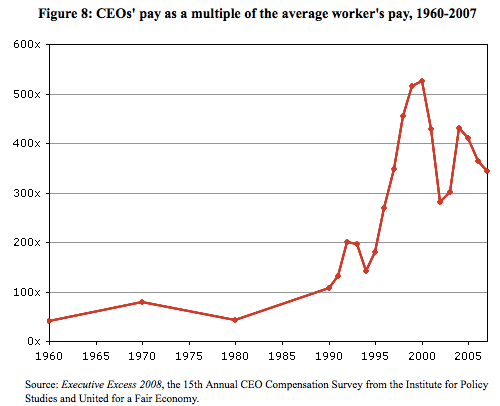
CEO pay is now roughly 350 times higher than the average worker’s:

And CEO pay has grown dramatically since the early ’90s, though production workers’ pay has barely budged and the minimum wage has actually dropped if you adjust for inflation:

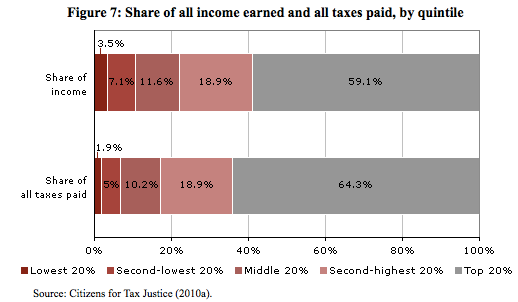
We often hear that the extremely wealthy pay a very disproportionate amount of U.S. taxes. It is true that they pay a large share. But it’s not so imbalanced compared to how much of all income they earn. For instance, the richest 20% of earners receive 59.1% of all U.S. income but pay 64.3% of taxes:

There’s much, much more in the full slideshow; go check it out.

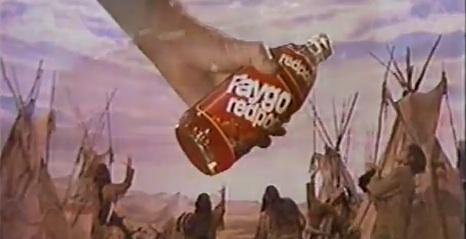
Andrew Francis D. sent in this 1970s commercial for Faygo soda that appropriates elements of Native American culture, presenting them as part of a ridiculous caricature (“Running Pudgy”?):

For other examples, see our posts on the stoic Indian in marketing, advertising with Eskimos, a parody of Native Americans in ads, confusing the Sioux with Robin Hood, Sambazon’s Warrior Up campaign, Levi’s brochure of “American Indian lore,” and appropriating Native cultures in fashion.