Search results for The

HAPPY October! Here are some highlights from last month…

New Contributor:
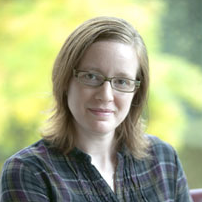
We’re pleased to announce that Wendy Christensen, visiting Assistant Professor at Bowdoin College, has joined us as a regular contributor. She studies the families of men and women in the armed forces, especially the ways that the military “recruits” family members into support roles.  Her first post on war-themed advertisingwas picked up by BoingBoing! Keep your eye out for posts or follow her on twitter.

News, Publications, and Appearances:

Thanks to Rebecca Pardo and the team at Impact,  I had the super fun experience of talking about hook up culture on MTV Canada last week.  That’s a first for me!

I also got to play a part in a CNN story about the difference between nerds and hipsters. Great idea for a story and well written by Aaron Sagers.

Contributor Caroline Heldman continues to report on the cheerleader who was forced to cheer for the man who she alleges sexually assaulted her.  After losing a court case against the school, she was required to pay the school’s $35,000 in legal fees.  An outcry led to an overturning of that requirement.  More at Ms. magazine.

I’m looking forward to visiting Pacific Lutheran University this month (October 25-26). I’ll be talking about both hook up culture and my research about U.S. discourses on “female genital mutilation.” I’d love to see you there!

I’ve also just scheduled talks at the University of Massachusetts – Amherst and Harvard in March.  More on those later!

We were also linked from Andrew Sullivan’s Daily Dish, FeministingThe Frisky, and BoingBoing (as mentioned above).  We bask in the attention.

Progress on Course Guides:

Mary Nell Trautner — University at Buffalo, SUNY — has developed a fantastic new Course Guide for instructors teaching Sociology of Gender. We hope you think it’s as awesome as we do!

Gwen is also hard at work on her Introduction to Sociology Course Guide and I’m working on a Research Methods guide that’ll be ready soon.

We’d like to collect as many Course Guides as we can, even different takes on the same course.  So, if you’re interested in writing on, please see our Instructors Page. There’s other good stuff for instructors there too.

Best of September:

Our fabulous intern, Norma Morella, collected the stuff ya’ll liked best from last month.  Here’s what she found:

Social Media ‘n’ Stuff:

Finally, this is your monthly reminder that SocImages is on Twitter and Facebook.  Gwen and I and most of the team are also on twitter:

The media likes to talk about markets as if they were just a force of nature.  In fact, markets and their outcomes are largely shaped by political power.  In a capitalist system like ours, that power is largely used to advance the interests of those who own and run our dominant corporations.

Thanks to Bloomberg News we have yet another example of this reality.  In brief, as a result of Congressional and media pressure the Federal Reserve was recently forced to reveal its lending activity for the period August 2007 through April 2010.   Bloomberg News examined these Federal Reserve records and found that the Fed secretly provided selected banks, brokerage houses, and even non-financial firms (such as General Electric and Ford) with at least $1.2 trillion in loans, often with minimal collateral required and at below market interest rates.

This money was given through more than a dozen lending programs.  Many firms tapped multiple programs through multiple subsidiaries. Bloomberg arrived at its total by focusing on the seven largest programs, which included the Fed’s discount window and six temporary lending facilities (the Asset-Backed Commercial Paper Money Market Mutual Fund Liquidity Facility; the Commercial Paper Funding Facility; the Primary Dealer Credit Facility; the Term Auction Facility; the Term Securities Lending Facility; and so-called single- tranche open market operations).

If you like visuals, here is a 5 minute video that provides a good summary of what Bloomberg gleaned from its examination.

UPDATE: Embedding was disabled, but you can watch it here.

Bloomberg also has an interactive site that allows you to chart who got what and over what period.

Some of the highlights are as follows:

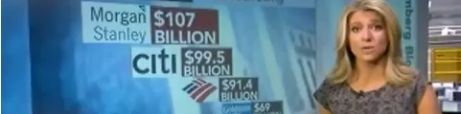
The largest borrower, Morgan Stanley, got as much as $107.3 billion, while Citigroup took $99.5 billion and Bank of America $91.4 billion . . .

Almost half of the Fed’s top 30 borrowers, measured by peak balances, were European firms. They included Edinburgh-based Royal Bank of Scotland, which took $84.5 billion, the most of any non-U.S. lender, and Zurich-based UBS AG, which got $77.2 billion. . . .

The $1.2 trillion peak on Dec. 5, 2008 — the combined outstanding balance under the seven programs tallied by Bloomberg — was almost three times the size of the U.S. federal budget deficit that year and more than the total earnings of all federally insured banks in the U.S. for the decade through 2010, according to data compiled by Bloomberg.

The Federal Reserve fiercely resisted making its records public, arguing that doing so would stigmatize those institutions that received loans.  A group of the largest commercial banks actually petitioned the Supreme Court in an unsuccessful effort to keep the loan information secret.

Perhaps one reason that the Federal Reserve and the banks were reluctant to have these records made public is that they raise significant questions of conflict of interest.  According to a statement by Vermont Senator Bernie Sanders:

…the Fed provided conflict of interest waivers to employees and private contractors so they could keep investments in the same financial institutions and corporations that were given emergency loans.

For example, the CEO of JP Morgan Chase served on the New York Fed’s board of directors at the same time that his bank received more than $390 billion in financial assistance from the Fed.  Moreover, JP Morgan Chase served as one of the clearing banks for the Fed’s emergency lending programs.

In another disturbing finding, the GAO said that on Sept. 19, 2008, William Dudley, who is now the New York Fed president, was granted a waiver to let him keep investments in AIG and General Electric at the same time AIG and GE were given bailout funds.  One reason the Fed did not make Dudley sell his holdings, according to the audit, was that it might have created the appearance of a conflict of interest.

Another reason may be that the Federal Reserve didn’t want it known that it was deviating from its past practice of requiring borrowers to provide secure collateral, which was normally either Treasuries or corporate bonds with the highest credit rating, and never stocks.  For example:

Morgan Stanley borrowed $61.3 billion from one Fed program in September 2008, pledging a total of $66.5 billion of collateral, according to Fed documents. Securities pledged included $21.5 billion of stocks, $6.68 billion of bonds with a junk credit rating and $19.5 billion of assets with an “unknown rating,” according to the documents. About 25 percent of the collateral was foreign-denominated.

Moreover, as Bloomberg News also reported, many Fed loans were made at below market interest.

On Oct. 20, 2008, for example, the central bank agreed to make $113.3 billion of 28-day loans through its Term Auction Facility at a rate of 1.1 percent, according to a press release at the time.

The rate was less than a third of the 3.8 percent that banks were charging each other to make one-month loans on that day. Bank of America and Wachovia Corp. each got $15 billion of the 1.1 percent TAF loans, followed by Royal Bank of Scotland’s RBS Citizens NA unit with $10 billion, Fed data show.

These loans were absolutely critical to the survival of our leading companies.  A case in point:

Citigroup was in debt to the Fed on seven out of every 10 days from August 2007 through April 2010, the most frequent U.S. borrower among the 100 biggest publicly traded firms by pre- crisis market valuation. On average, the bank had a daily balance at the Fed of almost $20 billion.

These loans are also a key reason that our post-Great Recession economy remains largely unchanged in structure.  In other words, it was the exercise of political power, rather than so-called market dynamics or efficiencies, that explains the financial industry’s continuing profitability and economic dominance.

Now imagine if we had a state that engaged in transparent planning and was committed to using our significant public resources to reshape our economy in the public interest.  As we have seen, state planning and intervention in economic activity already goes on.  Unfortunately, it happens behind closed doors and for the benefit of a small minority. It doesn’t have to be that way.

Super thanks to Rebecca Pardo for inviting me to be part of a segment on hook up culture for MTV News!  She and her team did such a wonderful job of editing and illustrating the interview.  I’m so tickled to be on MTV and excited to share it here!

The gist? College students are having sex, but not as much as you might think. And most of them are kind of disappointed about the whole thing. All in three minutes!

For a longer and decidedly less MTV-y approach to this topic, feel free to watch a 40-minute version of the talk taped at Franklin and Marshall College (slideshow and transcript if you’d rather read).

Lisa Wade, PhD is an Associate Professor at Tulane University. She is the author of American Hookup, a book about college sexual culture; a textbook about gender; and a forthcoming introductory text: Terrible Magnificent Sociology. You can follow her on Twitter and Instagram.

A couple of years ago I posted a segment from Sesame Street featuring Jesse Jackson leading kids in a chant of “I am somebody,” including the lines “I may be poor” and “I maybe on welfare.” I wrote about the changes in public discourse about welfare since the 1970s, and how surprising the segment seems now.

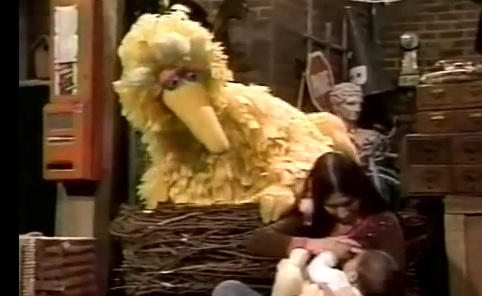
Aliyah C. sent in two more Sesame Street videos that illustrate changing norms, particularly regarding what we think it’s acceptable to expose children to. In both cases, a woman is breastfeeding her child in public (in the first case, openly; in the second, covered by a blanket) and explains to an onlooker that the baby is drinking milk from her breast:

Despite the fact that breastfeeding is widely hailed now as the ideal method of feeding babies, Aliyah said it was hard for her to imagine the topic being treated so casually on a children’s show now, or a woman using the word “breast” on Sesame Street without the show facing a lot of outrage.

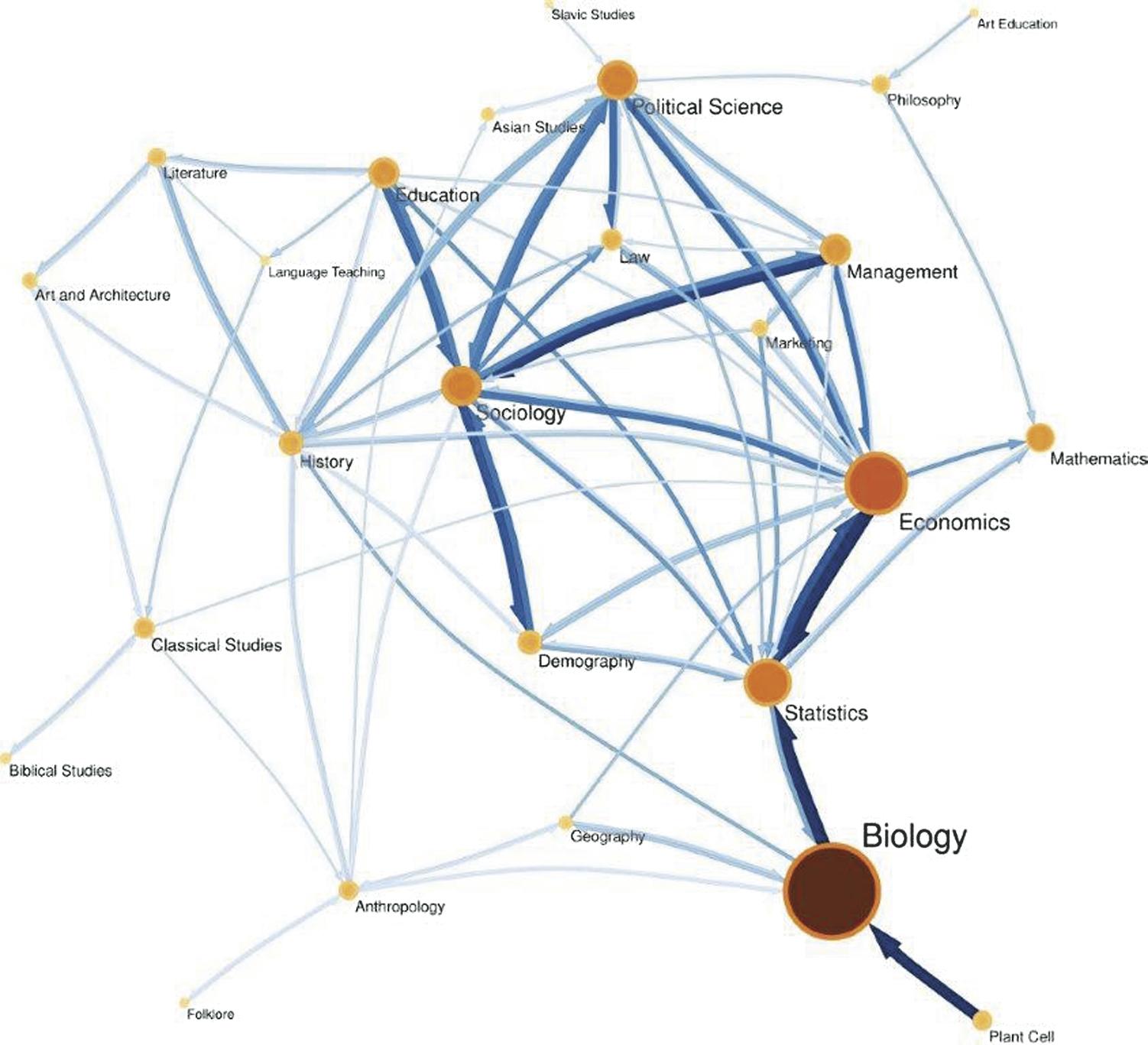
Academic disciplines sometimes seem isolated from each other.  Like seems to speak to like.  This, it is sometimes worried, may lead to stultifying agreement within fields. Meanwhile, each field solves the same problem in different ways, unbeknownst to the next.

It simply isn’t true, it turns out, that scholars don’t cite research in other fields.  Nor do all fields have the same level of insularity.  Illustrating this is the network map below, featured by the Chronicle of Higher Education.  The connections between disciplines represent how often academic articles published by scholars in each field link to other fields.  The results are pretty interesting:

Lisa Wade, PhD is an Associate Professor at Tulane University. She is the author of American Hookup, a book about college sexual culture; a textbook about gender; and a forthcoming introductory text: Terrible Magnificent Sociology. You can follow her on Twitter and Instagram.

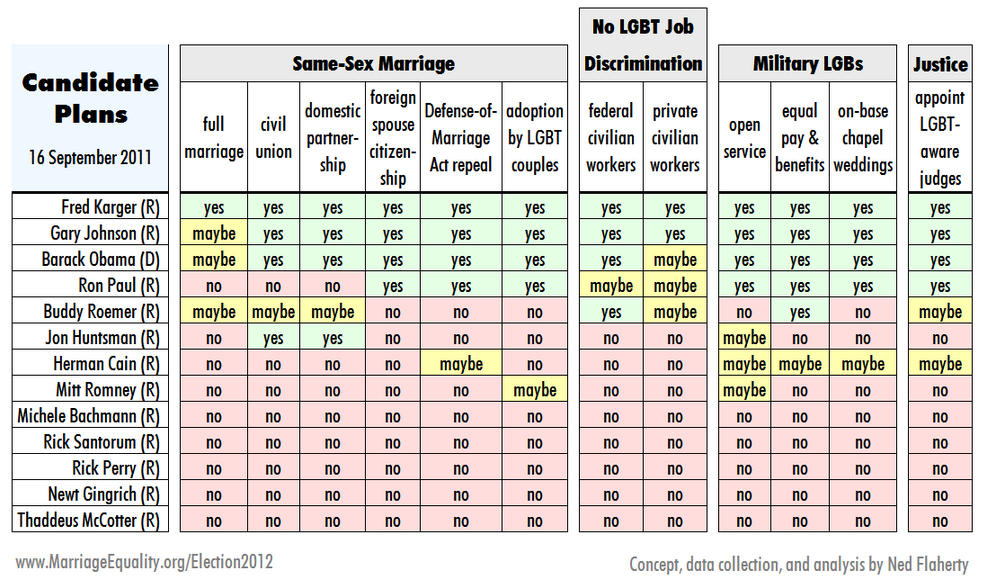
The chart below summarizes the position on 12 rights for gay, lesbian, and bisexual Americans held by Barack Obama and 12 candidates for the Republican Presidential Election:

Data collected by Ned Flaherty for Marriage Equality USA.

Lisa Wade, PhD is an Associate Professor at Tulane University. She is the author of American Hookup, a book about college sexual culture; a textbook about gender; and a forthcoming introductory text: Terrible Magnificent Sociology. You can follow her on Twitter and Instagram.

Cross-posted at Montclair SocioBlog.

Do Democrats and Republicans have a similar lack of respect for science?  Alex Berezow seems to think so.  The title of his op-ed in USA Today is “GOP might be anti-science, but so are Democrats.”

I hope that others will point out the false equivalence.  For evidence of  Democrats’ anti-science, Berezow cites mostly fringe groups like PETA, which objects to scientific research on animals, and fringe issues like vaccination.  According to Berezow, many people who oppose vaccination are Democrats.  True perhaps, but these positions are held by only a small minority of Democratic voters.  And neither of these positions has been espoused by any of the party leaders.*

Compare that to Republican anti-science.  Most of the leading GOP presidential hopefuls, now and in the previous election, have voiced their skepticism on evolution and global warming.  Only Huntsman and Romney have hinted that they agree with the near–unanimous opinions of scientists in these fields.

Maybe the candidates take these anti-science positions because the people whose votes they want – the GOP faithful – also reject the scientific consensus.

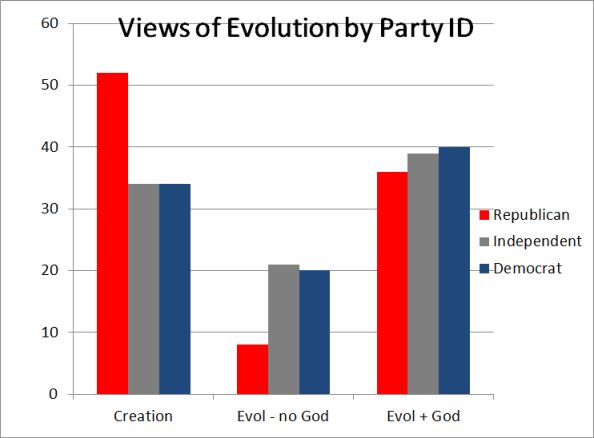
Here are the results of a recent Gallup poll that asked which position  “Comes closest to your views.”

  • God created human beings pretty much in their present form at one time within the last 10 000 years or so
  • Human beings have developed over millions of years from less advanced forms of life, but God had no part in this process
  • Human beings have developed over millions of years from less advanced forms of life, but God guided this process

Half of all Republicans think that humans have been around for only 10,000 years.

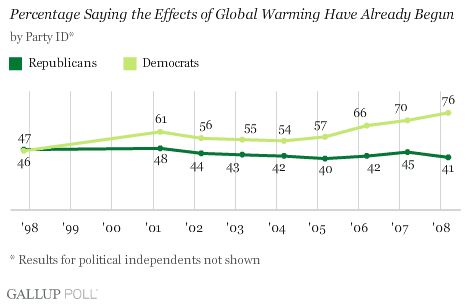
The Republican base is also much more dubious about global warming than are Democrats.

The graph goes only to 2008, and beliefs about global warming since then Americans’ have become somewhat more skeptical about the issue, but I am certain that Republicans are still well above Democrats on the chart.

As for the anti-vaccine crowd, Berezow sees them as mostly Prius-driving, organic-vegan liberals.    Maybe so.  I have a scientist friend whose son runs an organic food co-op, and she is furious at his decision not to have his kids (her grandchildren) vaccinated.  (FWIW, she drives a Prius.)  But is there more systematic evidence of this liberal/anti-vaccine connection?  Here’s Berezow’s proof.

…a public health official once noted that rates of vaccine non-compliance tend to be higher in places where Whole Foods is popular — and 89% of Whole Foods stores are located in counties that favored Barack Obama in 2008… With the exception of Alaska, the states with the highest rates of vaccine refusal for kindergarteners are Washington, Vermont and Oregon — three of the most progressive states in the country.

Areas with Whole Foods have both more vaccine skeptics and more Obama voters.  The thread of the logic is a bit thin (how big a difference is “tends to be higher”?), and it runs the risk of the ecological fallacy.  But it sounded right to me – my friend’s son lives in Vermont – and 75% (three states out of four) is pretty impressive evidence.

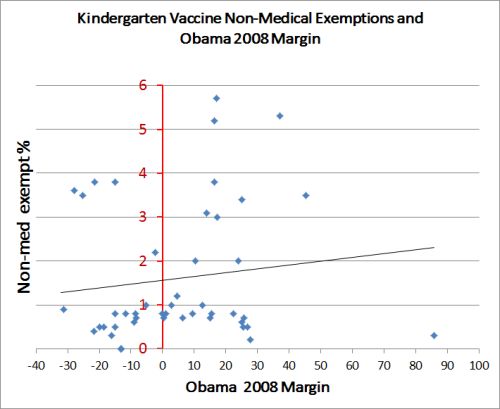
But there are 46 other states plus DC, and I wondered if they too followed the pattern.   So I looked up the CDC data on the  percentages of vaccination refusal for non-medical reasons in each state (here).  I also got data on how Democratic the state was – the margin of victory or loss for Obama in 2008.**

Sure enough, the top three — Washington, Vermont, and Oregon — are all on the Obama side of the line, though it’s worth noting that in Washington, vaccine exemption was as common in the conservative eastern part of the state (near Idaho, which also has a high exemption rate and was strongly for McCain) as it was in the more liberal western counties.   And of the states with 3% or more taking non-medical exemptions from vaccination, eight were for Obama, four for McCain. But overall, the correlation (r = 0.12) is not overwhelming.   And even in the most anti-vaccine, pro-Whole Foods states like Washington and Vermont, nearly 95% of parent s had their kindergartners vaccinated.  That’s hardly convincing evidence that Democrats are anti-science.   Compare that with the 50% of Republicans (and 75% of their presidential hopefuls) who think evolution is a hoax or at best “just a theory.”

———————

*Berezow notes that seven Democratic senators (and one Republican) wrote a letter to the FDA “threatening to halt approval of a genetically modified salmon.”  But he implies that their position had more to do with money than anti-science.  They were from the salmony Northwest, while the company seeking approval is in Massachusetts.

** The CDC had no data for Arizona, Colorado, New Hampshire, Minnesota, and Wyoming.

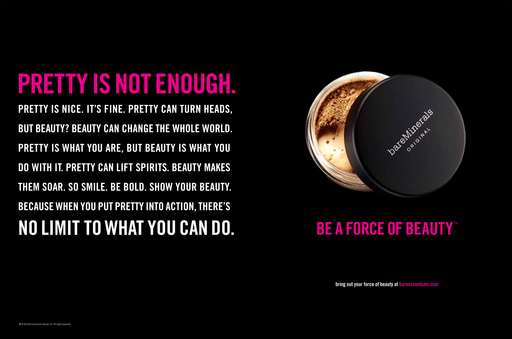
Bare Escentuals, a cosmetics company specializing in mineral makeup, has a new ad campaign that hinges upon how it found “the world’s most beautiful women…without ever seeing their faces.” Models and actresses showed up at the casting call and filled out questionnaires about themselves, which were given to Bare Escentuals. The company then cast the campaign solely on the basis of the questionnaires, choosing models not for their looks but for their “inner beauty,” posting a series of videos about the women on their website:

The campaign uses its selection process as a touchstone for all its taglines, pitting “pretty” against “beauty”: “Pretty can turn heads…beauty can change the whole world.” The commercials and print ads showcase the selected models in their daily lives: We see Lauren, a volunteer firefighter, hoisting a water hose from the ladder truck; we learn that Keri enjoys skateboarding and learned Farsi to communicate with her in-laws. This is meant to let us see the model meeting the company’s definition of beautiful by being themselves.

On its face this seems a logical, even praise-worthy, response to the constant barrage of unrealistic messages hurled at women every day about what appearance they should aspire to. But in so doing, the campaign commodifies women’s inner lives in addition to their beauty. Viewers are asked to reward the company for putting the models’ personalities on display; we’re expected to judge the models, albeit positively, for going above and beyond the model call of duty — she’s a volunteer firefigher! she has a sword collection! she blogs! By parading the inner (and formerly private) lives of the models for profit, the company appears to be showing us “real” women instead of the professional beauties that they are.

The customer takeaway is supposed to be that Bare Escentuals, more than other companies, recognizes that beauty comes from within. But the net effect is that we are shown how “being oneself” is now subject to standards of beauty. The same labor that has always gone into looking attractive — the labor that models have professionalized and monetized (smiling, appearing natural in front of the camera, speaking the company line) — is now applied to “being yourself,” which has been turned into a field of commodified emotional labor.

———-

Autumn Whitefield-Madrano writes at The Beheld, a blog exploring the role of beauty and personal appearance in our lives through essays, cultural analysis, long-form interviews, and more.

If you would like to write a post for Sociological Images, please see our Guidelines for Guest Bloggers.