Search results for The

Cross-posted at The Social Complex.

From the people who brought you greasy chicken wings, overpriced beer, and casual sexism while you wait…

Do these ads really require commentary?

The first video is able to squeeze heightism, sexism, and homophobia into one commercial spot.  And the second video is so blatantly playing off of the societal notion that short men have very little social worth (and zero sexual worth) that they even have a line in it that refers to height specifically: “why do you have to be so tall?”

These ads are especially good for those who believe that women have a monopoly on heightism.  Hooters’ target consumer base is nearly exclusively male and so their ads are designed to appeal to that base.  So here we have ads targeted at a male audience which attempt to humiliate short men through comedic effect for the purpose of highlighting their low grade frozen seafood and sophomoric titillation – and you still think shallow women are to blame for heightism?

Pay special attention to the dialogue.  Every word is designed to legitimize the widely held belief that short men are socially inferior.  In one section, an African American male diner looks over to the short man who is getting attention from the “Hooter’s Girls” and says “I don’t get it”, followed by a close up of an out-of-place female diner; her mouth agape with disbelief from what she is witnessing.

Of course, the gag is supposed to be that short men are generally “losers” but this particular short man is a “winner” at Hooters because “Shrimp Is In This Summer”.

I would have loved to be in the pitch meeting at the advertising firm that came up with these ads:

“Get it?  Shrimp = Short Men!  Because “shrimp” is a common slur used against short men.  Get it?  Funny, right?  And it’s O.K. because they had a professionally dressed, diverse group of people commenting on the strangeness of the whole scenario.  And the short guy was laughing…he was having a blast.  It’s all in good fun.”

Hilarious, right?

—————————

Geoffrey Arnold is an associate with a mid-sized corporate law firm’s Business Litigation Practice Group.  When Geoffrey isn’t chasing Billable Hours in the defense of white-collar criminals, he is most likely writing about social justice with a special emphasis on height discrimination at his blog: The Social Complex.  See also Geoffrey’s guest post introducing the concept of heightism as a gendered prejudice.

If you would like to write a post for Sociological Images, please see our Guidelines for Guest Bloggers.

Cross-posted at Racialicious and Caroline Heldman’s Blog.

Tower Heist (2011) the new movie starring Ben Stiller and Eddie Murphy, is the latest installment in blatantly racist movie-making. Stiller plays a high-end condo manager in Manhattan who bails out a local criminal (Murphy) to steal a stash of cash that one of the wealthy condo residents swindled from the condo staff. It’s been nearly thirty years since Murphy played nearly the same character in his breakout role in 48 Hours, and the fact that he is still cast as a jive-talking criminal speaks to how little has changed when it comes to the portrayal of black Americans in popular culture.

Hyperbolic racial stereotypes are still sooooo amusing for some.  As LA Times film critic Betsy Sharkey writes, “Murphy and Stiller are a good pair, with Murphy once again mainlining his ghetto-comedy crazy and Stiller suited up for another straight-man gig. These are the kinds of roles they both do best, and their face-off in the front seat of an out-of-control car is worth the price of admission.” (Now reverse the names in this quote to see how racialized and racially offensive it is.)

Perhaps more disturbing is the way in which film critics are talking about this movie as a comback for Eddie Murphy  (“Eddie Murphy’s Road to Reddemption,” “Tower Heist: Murphy is Back on Top,” “‘Tower’ Heist Features Eddie Murphy Back in ‘Classic ’80s Form“). What does it mean when playing an insultingly stereotypical black criminal is deemed “redemption” for a black actor whose movies have grossed nearly $7 billion worldwide? And where, exactly, did Eddie Murphy go? The Shrek series grossed nearly $3 billion worldwide, while his Nutty Professor and Doctor Dolittle franshises grossed $428 million and $470 million, respectively. Murphy has appeared in a steady stream of successful movies in the past decade, including Dreamgirls for which he was nominated for an Academy Award.

Closer examination of media critics’ analysis reveals a nostalgia for Eddie Murphy’s breakthrough role as a criminal in 48 HoursJon Niccum writes that inTower Heist “Murphy shows flashes of the aggressive, non-family-friendly persona that made him a superstar following 48 Hours. Aggressive?  Non-family friendly?

eddie-murphy-comeback-stern

To summarize, Eddie Murphy grossing oodles of money as a successful director, producer, writer, and actor in films featuring him as a doctor, a veterinarian, a dedicated father, and the voice of a beloved donkey in the second highest-grossing animated film of all time is considered some sort of failure, but playing a jive talking felon is redemption. Huh?

There are many ways to interpret this — that Hollywood and movie critics (and many in society) are more comfortable with black actors playing damaging, stereotypical roles involving criminality, violence, and deviance (remember back in 2002 when Denzel Washington finally won the Oscar for playing a crooked cop?); that male actors are failures if they appear in family-friendly movies, regardless of how economically successful these movies may be; that to be considered successful, male actors have to appear in movies geared towards male audiences.

Whatever the reason(s), it is embarassing for Hollywood and its “critics” to continue to be so ignorant. Eddie Murphy called out the movie industry’s racism at the 1988 Academy Awards during his presentation of the Best Picture award: “I’m going to give this award, but black people will not ride the caboose of society and we will not bring up the rear anymore. I want you to recognize that.” Two decades later, Murphy finds himself riding the caboose, furnished by the creators of Tower Heist.

Indeed, even time is a social construction.  This point is well-illustrated by our bi-yearly clock-switching ritual in the name of “daylight savings.” Writes Economist Nick Rowe at Worthwhile Canadian Initiative:

I’ve heard stories about people who set their watches 10 minutes fast, so they won’t be late for meetings. It’s hard to understand how it could work. Do they forget they set their watches 10 minutes fast? Because if they remember, they should be able to figure out they’ve got an extra 10 minutes, so there’s still plenty of time to grab a quick coffee before the meeting starts. If it works, they must be fooling themselves.

This weekend the government will tell us all to put our watches back one hour. They want us all to do everything one hour later. It’s hard to understand how it will work. Do they think we will all forget we’ve set our watches one hour slow? What’s more, they can’t even force us to change our watches.

But I know it will work. We will (almost) all set our watches one hour slow, and we will (almost) all start doing (almost) everything one hour later, by the sun, compared to what we would have done if we hadn’t changed our watches. But why?

Why?  Because, as I’m sure Rowe’s well aware, collective agreements matter.  In this case, you’ll be early!  For everything!  Doctor’s appointments, classes, meetings, dates… you’ll show up for lunch and the restaurant will still be closed… you’ll drop off your kid and the school won’t be open… you’ll arrive at happy hour and the drinks will be full price!  Tragedy!  You’ll get fired for leaving work early everyday and piss off your spouse with an alarm clock that goes off an hour before it needs to.   There are real consequences, in other words, for deviating from the norm… even when it is a total fabrication.

Lisa Wade, PhD is an Associate Professor at Tulane University. She is the author of American Hookup, a book about college sexual culture; a textbook about gender; and a forthcoming introductory text: Terrible Magnificent Sociology. You can follow her on Twitter and Instagram.

This is a re-post in response to a new submission by vmlojw.

—————————

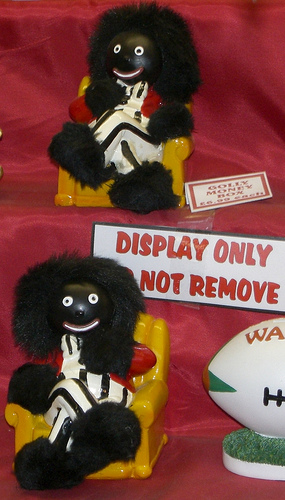
Toban B. sent us this photo he took in Cardiff, Wales, of Golliwog banks:

3793292190_e2d3d187a2

While the sign indicates these particular ones were for display only, Toban says there were others clearly for sale.

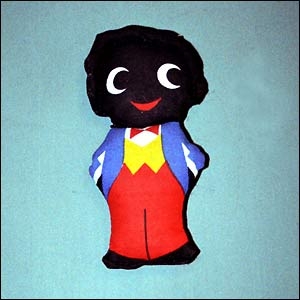
The golliwog (also spelled golliwogg) is an old racist caricature, clearly similar to blackface minstrel-type or mammy figures in the U.S. It emerged in the 1800s but was popularized when James Robertson and Sons adopted a golliwog named Golly as the logo for their jam around 1910:

untitled

Now, obviously you’ll often find these types of things for sale in antique stores, or on display at museums. They were very common in the U.S., Britain, and I’m sure many other countries, so it’s not surprising you’d come upon them.

The thing about the golliwogs Toban saw, though, is that they don’t appear to be antiques. The same ones can be found on ebay, and here’s the box they come in, which looks quite new (as do the dolls themselves):

299116571_tp

The ebay listing for that one lists it as “brand new,” though theoretically that could refer to an antique that had never been taken out of the box, I suppose. But the listing doesn’t say anything about it being an antique. And Toban says,

…the items on the table around them — at Cardiff Market — generally weren’t antiques.  Since there were newly mass produced tourist/nationalism industry products around them, people passing by generally wouldn’t view the Golliwogg dolls as antiques.  The dolls weren’t somehow distinguished from the newer products.

vmlojw, who is in Sydney, Australia, emailed in to tell us that her 1-year-old daughter received one as a gift and she later “found a local charity stall full of knitted golliwogs.”  vmlojw figured this couldn’t happen in North America; I’m not so sure.

It’s one thing to find antique racist caricatures for sale. I still don’t know why you’d want to buy one, but I can certainly see why they’d be appropriate for museum displays. But I find it both bizarre and disturbing when new versions of such things are produced and put on sale as a “cutesy” souvenir. Do people think we’re so “post-racial” now that these are completely disconnected from their origins in a racist culture that viewed non-Whites as less human, less intelligent, and less civilized? Why would someone think this is an adorable reminder of their time in Cardiff? I really don’t get it.

Also see: vintage Jezebel products, mammy souvenirs for sale in Savannah, modern reproductions of old racist images, and patterns for making mammy-type dolls.

Cross-posted at Family Inequality.

Americans about my age and older all seem to have stories about how we survived our school playgrounds without today’s cushy soft surfaces, safety-oriented climbing structures, and running water.

Here is a picture of the playground at my elementary school. I myself survived a fall off one of those seesaws onto the broken-glass-strewn asphalt, with nothing but a scrape to show for it (attended to by the school secretary — there was no “school nurse” back then either).

In the safety craze in recent decades, sadly, real seesaws were one of the first things to go.

Go back another few generations, and you’ll find stories like this — about 200 children killed in the streets of New York in 1910 (from the NYT Jan. 1, 1911):

Most of those kids weren’t in cars or wagons; they were playing in the streets, doing work for their families, or just wandering around unattended — there were no public playgrounds. In contrast, in 2009 there were about 10 pedestrian or cycling children killed by vehicles in New York City. Ah, the good old days.*

Nowadays

As things have gotten safer for America’s children, of course, parents have become ever more concerned with their safety, as well as with their learning and development. Somewhere in America on a Sunday a few weeks ago, in an affluent community, a public playground was bubbling with activity. Every child seemed to be enjoying a rollicking good time on the latest safety-designed play equipment, cushioned by a luxuriously deep bed of mulch.

Also, each child seemed to be within a few feet of a parent or other adult caretaker — coaching, encouraging, spotting, supervising.

In recent years, concern about the physical fitness of children has increased, especially among poor children. Some researchers have asked whether the proximity of safe neighborhood playgrounds is one cause of the social class disparity in obesity rates. That would make sense because obesity rates are lower among children who play outdoors. But the relationship between social class and playing outdoors is not clear at all. Rich children have more access to some kinds of facilities, but poor children have more free time — and, where there is public housing, it usually includes playgrounds, like this one photographed in the 1960s:

In Annette Lareau’s analysis of family life and social class, Unequal Childhoods, children of middle class and richer parents spend more time in organized activities, and poorer kids spend more time in unstructured time (including play and TV). But as these pictures show, there’s play and there’s play. Are middle class parents hovering more than poorer parents do, and with what effect?

Consider a recent article by Myron Floyd and colleagues (covered here), which attempted to assess the level of physical activity among children in public parks by observing 2,700 children in 20 public parks in Durham, NC:

[The] presence of parental supervision was the strongest negative correlate of children’s activity… the presence of adults appears to inadvertently suppress park-based physical activity in the current study, particularly among younger children… This result should be used to encourage park designers to create play environments conducive to feelings of safety and security that would encourage rather than discourage active park use among children. For example, blending natural landscapes, manufactured play structures, and fencing in close intimate settings can be used to create comfortable environments for children and families. Such design strategies could encourage parents to allow their children to freely explore their surroundings, providing more opportunities for physical activity.

Interestingly, park in the pictured above has a fence around it so that parents can hang around at a distance with little fear for their children.

Under social pressure

In Under Pressure, one of many books bemoaning the excesses of over-parenting, Carl Honoré wrote:

Even when we poke fun at overzealous parenting… part of us wonders, What if they’re right? What if I’m letting my children down by not parenting harder? Racked by guilt and terrified of doing the wrong thing, we end up copying the alpha parent in the playground.

The point is not just that some parents have overzealous supervisory ambitions, driven by unequal investments in children and a threateningly competitive future. I think there is a supervision ratchet that feeds on the interaction between parents. In an article called “Playground Panopticism,” Holly Blackford summarized her observations:

The mothers in the ring of park benches symbolize the suggestion of surveillance, which Foucault describes as the technology of disciplinary power under liberal ideals of governance. However, the panoptic force of the mothers around the suburban playground becomes a community that gazes at the children only to ultimately gaze at one another, seeing reflected in the children the parenting abilities of one another.

This plays out in everyday interaction, whether one wants to engage it or not. If everyone else’s kid is closely supervised while yours is running around bonkers on her own, what is a parent to do? If the other parents insist that their kids not go “up the slide” and yours just scrambles past them, you feel the pressure. (You also put the other parent in the position of violating another taboo — supervising someone else’s child.) So it’s not just fear of underparenting that drives parents to hover — it’s also the cross-parent interactions. These are the moments when contagious parenting behavior spreads.

—————————

*I started looking at this after reading about it in Viviana Zelizer’s Pricing the Priceless Child, in which she writes, “The case of children’s accidental death provides empirical evidence of the new meanings of child life in twentieth-century America.”

Reminder: This blog post does not constitute research, but rather commentary, observation and recommendations for reading and discussion. The description of my childhood playground, and of one recent afternoon at one park, are anecdotes, something that stimulates reflection on wider issues, not empirical evidence or data.

Cross-posted at Ms.

According to a BBC News story sent in by Leiana S. and Kinesiology professor Mary Louise Adams, the International Boxing Association may soon require female boxers to wear skirts.  The President of the Association, Dr. Ching-Kuo Wu, argues that it will allow viewers to tell the difference between the men and the women who currently wear the same uniforms, including headgear.  Right now the skirt is an optional variation on the official uniform but, Dr. Wu says, “After we hear about its comfort and how easy it is to compete in the uniform, it may be compulsory.”

At the European Championships in Rotterdam last week, female boxers from Poland and Romania adopted the new uniform.  A coach of the Poland team said: “By wearing skirts, in my opinion, it gives a good impression, a womanly impression.”

This might be an example of officials assuming that (1) men are the main audience for boxing and that (2) men will watch women’s boxing more if they differentiate/sexualize women.

It might also, however, be an example of an attempt to retrench difference between men and women exactly when those differences start to dissolve.  Discomfort with the lack of actual differences between men and women sometimes leads individuals to encourage or enforce artificial ones.  I would say that this is one of the main functions of clothes today. Yeah, I said it. I think exaggerating what are actually rather weak and strongly overlapping differences between men and women is one of the primary functions of clothes.

In any case, it’s probably a combination of both.

Earlier this year they tried this with Badminton, but it didn’t take.

The idea that female athletes aren’t sufficiently feminine has been around as long as sports have been around.  Today, the feminizing of athletes is ubiquitous.  See our posts on Serena Williams’s ESPN cover, Candace Parker “is pretty, which helps,” press photos of female athletes in dressesgroundbreaking female sailor is also prettysexualizing female Olympic athletesdiets of championsmedia portrayals of female athletes, and valuing dads in the WNBA.

Lisa Wade, PhD is an Associate Professor at Tulane University. She is the author of American Hookup, a book about college sexual culture; a textbook about gender; and a forthcoming introductory text: Terrible Magnificent Sociology. You can follow her on Twitter and Instagram.

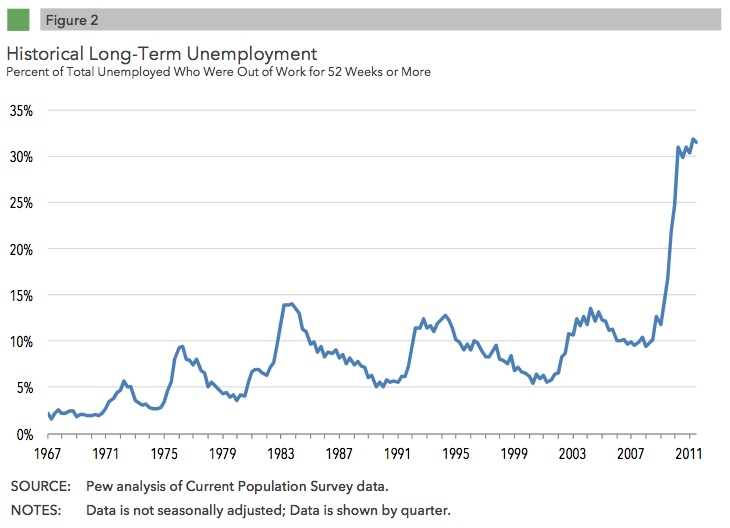
The Pew Charitable Trusts just released an update on the effects of long-term unemployment. One aspect of this economic crisis that sets it apart from others over the past several decades is how long unemployment is lasting. At this point, about a third of the unemployed have been out of a job for a full year or more:

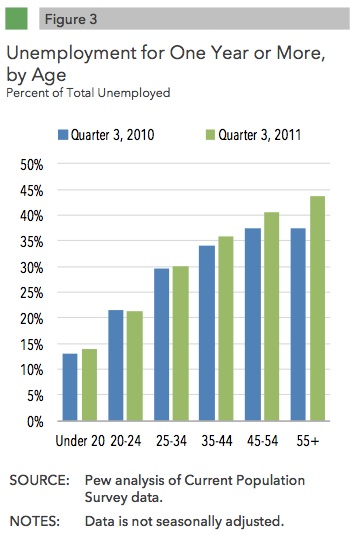
Though the likelihood of being unemployed went down with age, among those who have lost their jobs, long periods of unemployment are more common among older than younger workers:

Read the full mini-report here. Via Talking Points Memo.

Also check out Lisa’s post on the long-term consequences of unemployment.

With all the emphasis on Halloween, you may or may not have heard that this year, October 31st was noteworthy for another reason: according to the United Nations, that’s the day the global population hit 7 billion. The UN has set up a website to provide information about population trends and estimates for the future. Here’s the current world population, by region:

The map is interactive, so you can click on a region to find out its population, as well as its percentage of the total world population.

You can also estimate the population through 2100 based on various fertility scenarios. In the default medium scenario, fertility is expected to follow past trends, leveling out at a little over 10 billion by 2100:

On the other hand, if we saw no further reductions in global fertility, the 2100 population would be over 26.8 billion:

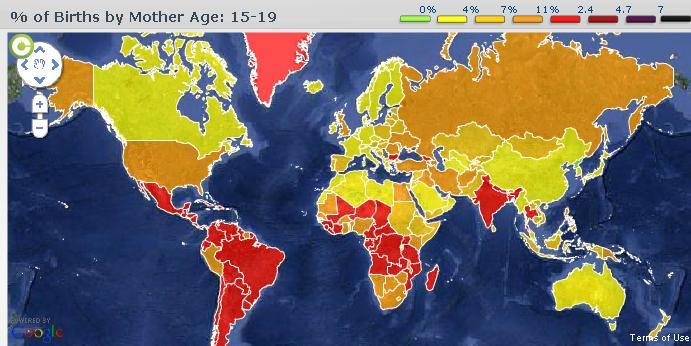
There’s an enormous amount of data available at the site. For instance, if you select the Births tab, you can click on either a region or a specific country and find out what percent of births are to women in different age groups. Here’s the % of all births to women aged 15-19, by country:

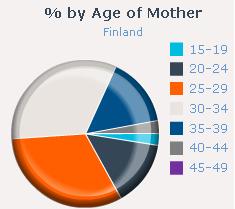
And the chart showing the total age breakdown for Finland (at the site you can hover over the graph to get the actual %):

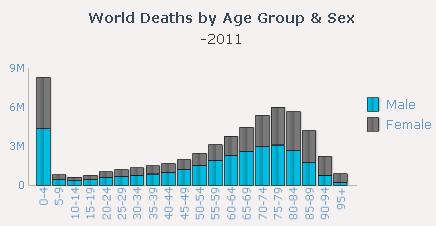
A chart of deaths by age and sex, illustrating the continued high mortality in infancy and early childhood:

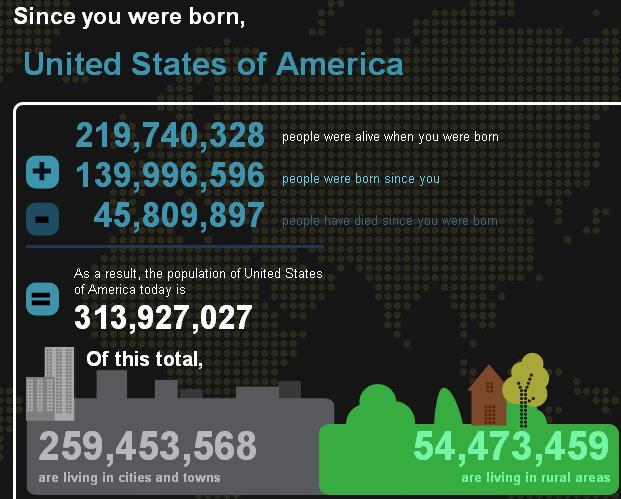
There’s also a section of the site where you can enter information about your own date and place of birth and then get a snapshot of what the global population was when you were born. Since I entered the world:

Overall, it’s a pretty great resource, and another one of those websites that can easily eat up a significant amount of your time without you realizing it.