
Search results for The
Cross-posted at Montclair SocioBlog.
Jacob and Isabella were the most popular baby names last year. Some observers, even some sociologists, see this as the influence of the Twilight series. (See here for example.)
But Jacob, Isabella, and even Bella were on the rise well before Stephanie Meyer sent her similarly-named characters out to capture the hearts, minds, and naming preferences of romantic adolescents:

The forecasters predict a bumper crop soon in Rue, Cato, and perhaps other names that are from the Hunger series. Still, since the YA (Young Adult) audience for these books and movies are more Y than A, I’m hoping for lag time of at least a few years before they start naming babies. As I blogger earlier, Splash, the film with Darryl Hannah as Madison the mermaid, came out in 1984, but it was not until nine years later that Madison surfaced in the top 100 names. And if there’s a Hogwarts effect, we’re still waiting to see it. The trend in Harry and Harold is downward on both sides of the Atlantic, and Hermione has yet to break into the top 1000.
Don’t look for any Katnisses to be showing up in your classes for quite a while.
 Dolores R. sent in a flubbed opportunity to represent Mexicans positively and reach out to the expanding Mexican market in the U.S. In “honor” of Cinco de Mayo, Mike’s Hard Lemonade hired five men — in fake mustaches and sombreros — to pretend to be a Mariachi band. They then improvised songs in response to submissions from viewers. The stunt is self-conscious, along the lines of the “ironic” “hipster racism” we now see so much of.
The fake band may have been making fun of themselves, but they did so by engaging in something that they had already decided was ridiculous, Mariachi music. Happy Cinco de Mayo, everyone.
A better approach, Latino Rebels suggests, would have been to spotlight some of the actual awesome Mariachi music out there. They wouldn’t have even had to be traditional. They could have hired a real band to improvise, or they could have drawn on the existing Mariachi cover bands, bands that do really neat stuff! Here’s, for example, is a band covering Hotel California:
Lisa Wade, PhD is an Associate Professor at Tulane University. She is the author of American Hookup, a book about college sexual culture; a textbook about gender; and a forthcoming introductory text: Terrible Magnificent Sociology. You can follow her on Twitter and Instagram.
Yesterday, in honor of May Day, Anna North at Buzzfeed Shift posted a set of photos on the history of women in the (mostly U.S.-based) labor movement. One that I found particularly interesting was this 1918 poster urging women to be both thrifty and productive industrial workers as they play their role in winning World War I:
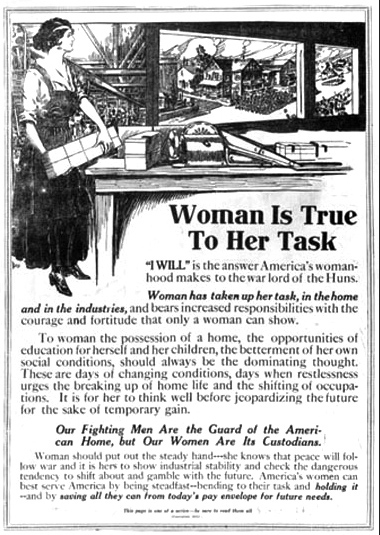
Note how patriotism is clearly connected to the idea of women having more opportunities:
To woman, the possession of a home, the opportunities of education for herself and her children, the betterment of her own social conditions, should always be the dominating thought.
But the poster simultaneously warns them against using their freedom for their own pleasure at the expense of the nation:
…restlessness urges the breaking up of home life and the shifting of occupations. It is for her to think well before jeopardizing the future for the sake of temporary gain…it is hers to show industrial stability and check the dangerous tendency to shift about and gamble with the future. America’s women can best serve American by being steadfast — bending to their task and holding it — and by saving all they can from today’s pay envelope for future needs.
So women are encouraged to think of themselves as empowered workers, with increased opportunities available to them, but only to the degree that this makes them reliable, productive workers and thrifty citizens, drawing on ideas of women’s special role in the home. Just as women are the “custodians” of their homes, they must also ensure “industrial stability” by sticking with their jobs for the good of the nation — a choice which might, of course, conflict with a woman’s efforts to improve her own or her family’s social conditions by, say, taking a job that pays more or has better working conditions. The poster encourages women to consider their opportunities, but ties those opportunities tightly to the common good of the nation and the family, ultimately warning women against too much pursuit of individual self-interest.
Yikes. In a report designed to prove the feasibility of measuring electrodermal activity on subjects going about their daily life, at least one student showed near brain-death during class.
Am I exaggerating? Yes. But, even so, brain patterns during class matched watching TV closer than any other activity on the list. Studying and homework, lab work, and socializing got more of his attention… sleep was a veritable mental work-out compared to class.
Draw whatever conclusions you will…

Joi Ito, via BoingBoing. Full text of the paper here.
Lisa Wade, PhD is an Associate Professor at Tulane University. She is the author of American Hookup, a book about college sexual culture; a textbook about gender; and a forthcoming introductory text: Terrible Magnificent Sociology. You can follow her on Twitter and Instagram.
Tenure!
Lisa Wade is celebrating the news that, come Fall, she will be a tenured professor at Occidental College! Now that she’s in the “golden handcuffs,” she can say all the stuff she’s been holding back on Twitter and Facebook. :)
New Course Guide:
- The Sociology of Sports, by J.A. Carter
New Pinterest Page:
Best of April:
Two of our posts received over 1,000 “likes” on Facebook this month:
- Lisa Wade, Fat People Can Be as Healthy as Thin People
- Wendy Christensen, Lost in Translation: Tattoos and Cultural Appropriation
Other popular posts in April include:
- Lisa Wade, Welcome to the State Home for the Manic Pixie Dream Girls
- Martin Hart-Landsberg, We Are Not All In It Together
- Jenny Davis, Trayvon Martin: The Mistake of the Progressive Left
- Gwen Sharp, The Harsh Realities of Juvenile Detention
- Lisa Wade, Manipulated Women and High Fashion
- Lisa Wade, Portraying and Pushing Female Competitiveness
- Gwen Sharp, Race, Representation, and Reactions to the Hunger Games
- Caroline Heldman, The Hunger Games, Hollywood, and Fighting Fuck Toys
- Lisa Wade, Class Privilege and Parental Leave
Social Media ‘n’ Stuff:
Finally, this is your monthly reminder that SocImages is on Twitter, Facebook, Google+, and Pinterest.
You can also follow Gwen’s great Twitter feed or find Lisa on both Twitter and Facebook (she just joined this month!).
Most of the rest of the team is on Twitter too: @familyunequal, @carolineheldman, @jaylivingston, and @wendyphd.
Links this Month:
NASA has posted a series of pairs of satellite images that show a range of changes around the world. They’re great for illustrating human-environment interactions; some of the changes are directly human-caused, while others, while others show the changing consequences of floods and fires as our settlement and agricultural patterns change.
For those of us living in Las Vegas, these images of the shrinking Lake Mead reservoir, which provides water and electricity, is not reassuring. The reservoir has gotten smaller due to multiple factors, including a long-term drought and more water being taken from the Colorado River upstream:

Deforestation in Niger, as land has increasingly been turned over to agriculture:

Here, we see increasing urban growth around Denver International Airport, which now takes up 53 square miles of what used to be farmland:

Algal blooms due to agricultural and household runoff into Lake Atitlan, Guatemala:

Changes to the Sonoran coastline in Mexico due to shrimp farming:

The dramatic shrinking of the Aral Sea, largely due to the amount of water taken out of rivers for irrigation:

The full set of 167 paired images is really striking, and if viewed in the “all images” layout, you can select among various topics, focusing on cities, water, human impacts, and so on.
Here’s a neat story that reminds us that beneath “mainstream” culture are rich, unique, and sometimes whimsical sub-cultures:
In 1946 a clown aficionado named Stan Bult began collecting the faces of clowns painted onto blown out chicken eggs. It became a U.K. tradition and, because it is considered a great breach of etiquette to steal another clown’s face, the eggs served as a sort of “registry.” The tradition crossed the pond in 1979 when Leon “Buttons” McBryde began a collection in the U.S. Linda, McBryde’s wife, paints the eggs herself (they use goose) and they’ve now collected over 700 unique clown faces.
Check out this example from the British collection.
Clown Eggs via Learn Something Every Day.
Lisa Wade, PhD is an Associate Professor at Tulane University. She is the author of American Hookup, a book about college sexual culture; a textbook about gender; and a forthcoming introductory text: Terrible Magnificent Sociology. You can follow her on Twitter and Instagram.
Cross-posted at Montclair SocioBlog.
Jacob and Isabella were the most popular baby names last year. Some observers, even some sociologists, see this as the influence of the Twilight series. (See here for example.)
But Jacob, Isabella, and even Bella were on the rise well before Stephanie Meyer sent her similarly-named characters out to capture the hearts, minds, and naming preferences of romantic adolescents:
The forecasters predict a bumper crop soon in Rue, Cato, and perhaps other names that are from the Hunger series. Still, since the YA (Young Adult) audience for these books and movies are more Y than A, I’m hoping for lag time of at least a few years before they start naming babies. As I blogger earlier, Splash, the film with Darryl Hannah as Madison the mermaid, came out in 1984, but it was not until nine years later that Madison surfaced in the top 100 names. And if there’s a Hogwarts effect, we’re still waiting to see it. The trend in Harry and Harold is downward on both sides of the Atlantic, and Hermione has yet to break into the top 1000.
Don’t look for any Katnisses to be showing up in your classes for quite a while.
Dolores R. sent in a flubbed opportunity to represent Mexicans positively and reach out to the expanding Mexican market in the U.S. In “honor” of Cinco de Mayo, Mike’s Hard Lemonade hired five men — in fake mustaches and sombreros — to pretend to be a Mariachi band. They then improvised songs in response to submissions from viewers. The stunt is self-conscious, along the lines of the “ironic” “hipster racism” we now see so much of.
The fake band may have been making fun of themselves, but they did so by engaging in something that they had already decided was ridiculous, Mariachi music. Happy Cinco de Mayo, everyone.
A better approach, Latino Rebels suggests, would have been to spotlight some of the actual awesome Mariachi music out there. They wouldn’t have even had to be traditional. They could have hired a real band to improvise, or they could have drawn on the existing Mariachi cover bands, bands that do really neat stuff! Here’s, for example, is a band covering Hotel California:
Lisa Wade, PhD is an Associate Professor at Tulane University. She is the author of American Hookup, a book about college sexual culture; a textbook about gender; and a forthcoming introductory text: Terrible Magnificent Sociology. You can follow her on Twitter and Instagram.
Yesterday, in honor of May Day, Anna North at Buzzfeed Shift posted a set of photos on the history of women in the (mostly U.S.-based) labor movement. One that I found particularly interesting was this 1918 poster urging women to be both thrifty and productive industrial workers as they play their role in winning World War I:
Note how patriotism is clearly connected to the idea of women having more opportunities:
To woman, the possession of a home, the opportunities of education for herself and her children, the betterment of her own social conditions, should always be the dominating thought.
But the poster simultaneously warns them against using their freedom for their own pleasure at the expense of the nation:
…restlessness urges the breaking up of home life and the shifting of occupations. It is for her to think well before jeopardizing the future for the sake of temporary gain…it is hers to show industrial stability and check the dangerous tendency to shift about and gamble with the future. America’s women can best serve American by being steadfast — bending to their task and holding it — and by saving all they can from today’s pay envelope for future needs.
So women are encouraged to think of themselves as empowered workers, with increased opportunities available to them, but only to the degree that this makes them reliable, productive workers and thrifty citizens, drawing on ideas of women’s special role in the home. Just as women are the “custodians” of their homes, they must also ensure “industrial stability” by sticking with their jobs for the good of the nation — a choice which might, of course, conflict with a woman’s efforts to improve her own or her family’s social conditions by, say, taking a job that pays more or has better working conditions. The poster encourages women to consider their opportunities, but ties those opportunities tightly to the common good of the nation and the family, ultimately warning women against too much pursuit of individual self-interest.
Yikes. In a report designed to prove the feasibility of measuring electrodermal activity on subjects going about their daily life, at least one student showed near brain-death during class.
Am I exaggerating? Yes. But, even so, brain patterns during class matched watching TV closer than any other activity on the list. Studying and homework, lab work, and socializing got more of his attention… sleep was a veritable mental work-out compared to class.
Draw whatever conclusions you will…
Joi Ito, via BoingBoing. Full text of the paper here.
Lisa Wade, PhD is an Associate Professor at Tulane University. She is the author of American Hookup, a book about college sexual culture; a textbook about gender; and a forthcoming introductory text: Terrible Magnificent Sociology. You can follow her on Twitter and Instagram.
Tenure!
Lisa Wade is celebrating the news that, come Fall, she will be a tenured professor at Occidental College! Now that she’s in the “golden handcuffs,” she can say all the stuff she’s been holding back on Twitter and Facebook. :)
New Course Guide:
- The Sociology of Sports, by J.A. Carter
New Pinterest Page:
Best of April:
Two of our posts received over 1,000 “likes” on Facebook this month:
- Lisa Wade, Fat People Can Be as Healthy as Thin People
- Wendy Christensen, Lost in Translation: Tattoos and Cultural Appropriation
Other popular posts in April include:
- Lisa Wade, Welcome to the State Home for the Manic Pixie Dream Girls
- Martin Hart-Landsberg, We Are Not All In It Together
- Jenny Davis, Trayvon Martin: The Mistake of the Progressive Left
- Gwen Sharp, The Harsh Realities of Juvenile Detention
- Lisa Wade, Manipulated Women and High Fashion
- Lisa Wade, Portraying and Pushing Female Competitiveness
- Gwen Sharp, Race, Representation, and Reactions to the Hunger Games
- Caroline Heldman, The Hunger Games, Hollywood, and Fighting Fuck Toys
- Lisa Wade, Class Privilege and Parental Leave
Social Media ‘n’ Stuff:
Finally, this is your monthly reminder that SocImages is on Twitter, Facebook, Google+, and Pinterest.
You can also follow Gwen’s great Twitter feed or find Lisa on both Twitter and Facebook (she just joined this month!).
Most of the rest of the team is on Twitter too: @familyunequal, @carolineheldman, @jaylivingston, and @wendyphd.
Links this Month:
NASA has posted a series of pairs of satellite images that show a range of changes around the world. They’re great for illustrating human-environment interactions; some of the changes are directly human-caused, while others, while others show the changing consequences of floods and fires as our settlement and agricultural patterns change.
For those of us living in Las Vegas, these images of the shrinking Lake Mead reservoir, which provides water and electricity, is not reassuring. The reservoir has gotten smaller due to multiple factors, including a long-term drought and more water being taken from the Colorado River upstream:

Deforestation in Niger, as land has increasingly been turned over to agriculture:

Here, we see increasing urban growth around Denver International Airport, which now takes up 53 square miles of what used to be farmland:

Algal blooms due to agricultural and household runoff into Lake Atitlan, Guatemala:

Changes to the Sonoran coastline in Mexico due to shrimp farming:

The dramatic shrinking of the Aral Sea, largely due to the amount of water taken out of rivers for irrigation:

The full set of 167 paired images is really striking, and if viewed in the “all images” layout, you can select among various topics, focusing on cities, water, human impacts, and so on.
Here’s a neat story that reminds us that beneath “mainstream” culture are rich, unique, and sometimes whimsical sub-cultures:
In 1946 a clown aficionado named Stan Bult began collecting the faces of clowns painted onto blown out chicken eggs. It became a U.K. tradition and, because it is considered a great breach of etiquette to steal another clown’s face, the eggs served as a sort of “registry.” The tradition crossed the pond in 1979 when Leon “Buttons” McBryde began a collection in the U.S. Linda, McBryde’s wife, paints the eggs herself (they use goose) and they’ve now collected over 700 unique clown faces.
Check out this example from the British collection.

Clown Eggs via Learn Something Every Day.
Lisa Wade, PhD is an Associate Professor at Tulane University. She is the author of American Hookup, a book about college sexual culture; a textbook about gender; and a forthcoming introductory text: Terrible Magnificent Sociology. You can follow her on Twitter and Instagram.