Search results for The

Americans were recently asked whether they believed that President Obama could do much to lower gas prices.  The answer was highly correlated with political party affiliation: 65% of Republicans said “yes,” while only33% of Democrats said the same.

In fact, the President has very little control over the price of gas.  According to the Washington Post:

Today’s oil prices are the product of years and decades of exploration, automobile design and ingrained consumer habits combined with political events in places such as Sudan and Libya, anxiety about possible conflict with Iran, and the energy aftershocks of last year’s earthquake in Japan.

An expert calls the idea that a President can substantially influence the oil market “preposterous.”

So, does this mean that Democrats are smarter about econo-geo-politics?

Nope. It just means a Democrat is in the White House.  The pollsters, WP/ABC News, asked the same question in 2006, during the Bush Administration.  That year 73% of Democrats gave President Bush some of the blame for gas prices; only 47% of Republicans did.

(Red = answered “yes” in 2006; Blue = answered “yes” in 2012)

Such switches, argues political scientist Brendan Nyhan, are typical.  NPRreports: “On a range of issues, partisans seem partial to their political loyalties over the facts. When those loyalties demand changing their views of the facts, he said, partisans seem willing to throw even consistency overboard.” Nyhan believes that the phenomenon might be related to “cognitive dissonance,” a sense of unease that comes from holding two incompatible beliefs at once.  If you like the President, in other words, it might be hard for you to also think that he could do something about gas prices, but isn’t.

Lisa Wade, PhD is an Associate Professor at Tulane University. She is the author of American Hookup, a book about college sexual culture; a textbook about gender; and a forthcoming introductory text: Terrible Magnificent Sociology. You can follow her on Twitter and Instagram.
The National Bureau of Economic Research recently released a paper by  Emin Dinlersoz and Jeremy Greenwood about unionization in the U.S.. They argue that economic shifts that changed the relative prevalence of different types of occupations partially explain decreasing union membership.

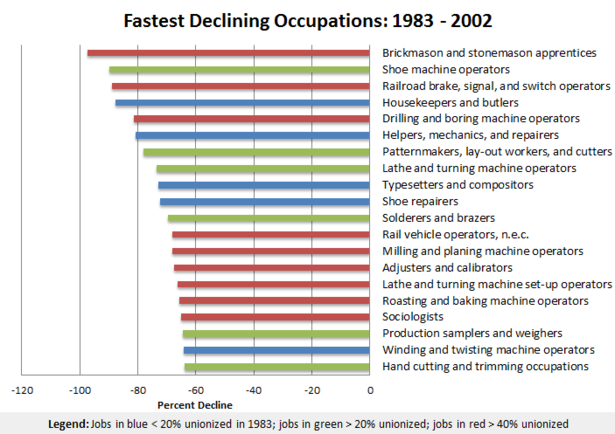
So what occupations are growing, and which are declining? Jordan Weissmann, at The Atlantic, adapted two graphs from the NBER paper that illustrate larger economic changes. Of the twenty fastest-declining occupations (in terms of % decrease), many are factory or industrial production jobs — machine operators of various types fare especially poorly (also, sorry, fellow sociologists):

The color of the graph indicates the level of unionization for each occupation; blue = less than 20%, green = 20-40%, red = over 40%. Nine of these occupations were over 40% unionized; their decline means the loss of many decently-paid jobs that provided benefits to employees without high levels of formal education.

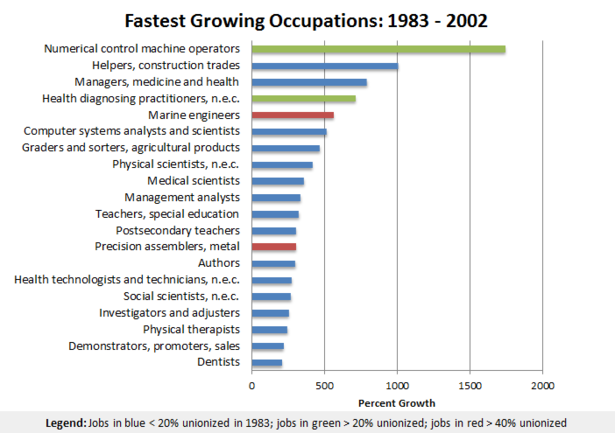
So which occupations are growing, then? Take a look (though note this reflect % change, not overall # of employees):

Notice that top category: numerical control machine operators. Those words reflect a profound shift in manufacturing in the U.S. Numerical control machine operators program and operate computerized machinery, which requires a very different type of human operation than the classic assembly line machinery did — less input of physical labor and more technical management and troubleshooting.

Many of the other fastest-growing occupations require specialized, and often lengthy, higher education or licensing: health-diagnosing practitioners, teachers, scientists, physical therapists, and dentists, for instance. And unionization is consistently low in these types of occupations, contributing to overall declines in the prominence of unions in the U.S. over time.

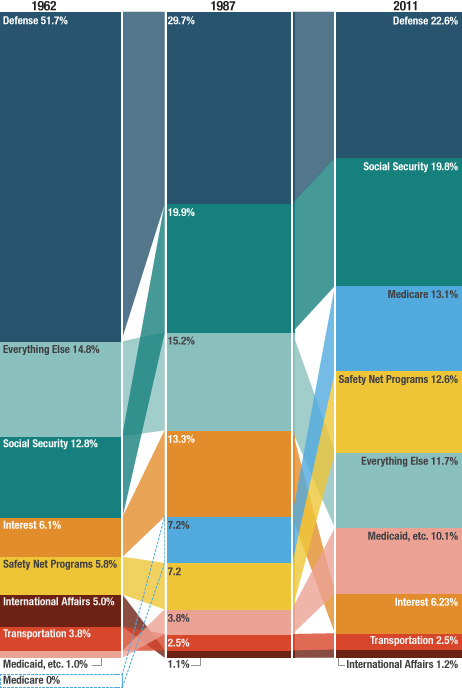
NPR’s Planet Money blog posted this image showing changes in major categories of federal spending over the past 50 years. Notably, though defense spending (which includes veteran benefits) is still the largest category of federal spending, it’s a much smaller proportion of the total budget than it was in the ’60s; spending on interest on our debt has also fallen quite a bit since the ’80s. On the other hand, spending on Social Security, Medicare and Medicaid (which didn’t even exist in 1962), and safety net programs (including food stamps and unemployment) have grown. The somewhat reduced “everything else” category includes everything from education to space exploration to agriculture and more:

Via The Sociological Cinema; data available at the Office of Management and Budget.

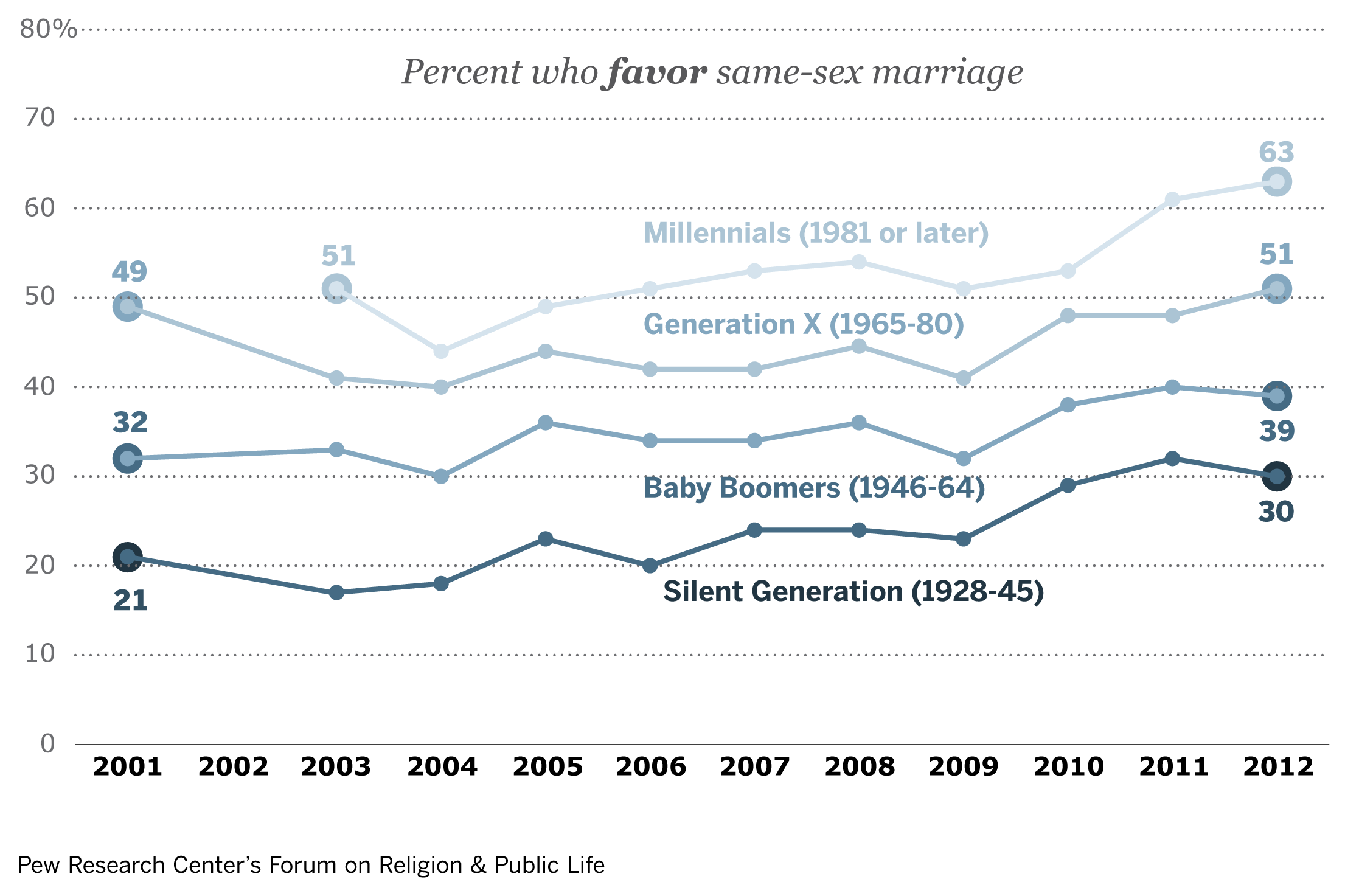
Last week, on the heels of Obama’s announcement that he supports gay marriage, NPR interviewed the President of the Pew Research Center, Andrew Kohut, about trends in American support for the issue.  Kohut explained that American opinion has changed dramatically, and unusually, in a very short time.  In 1996, for example, 27% of people supported gay marriage (65% opposed).  This “really didn’t change very much” for a while.  In 2004, when Republicans mobilized the issue to get conservatives to the polls, 60% still opposed it.  But today, in the space of less than a decade, we have more people supporting gay marriage than opposing it.  Some polls show the majority of Americans believe that we should have the right to marry someone of the same sex.

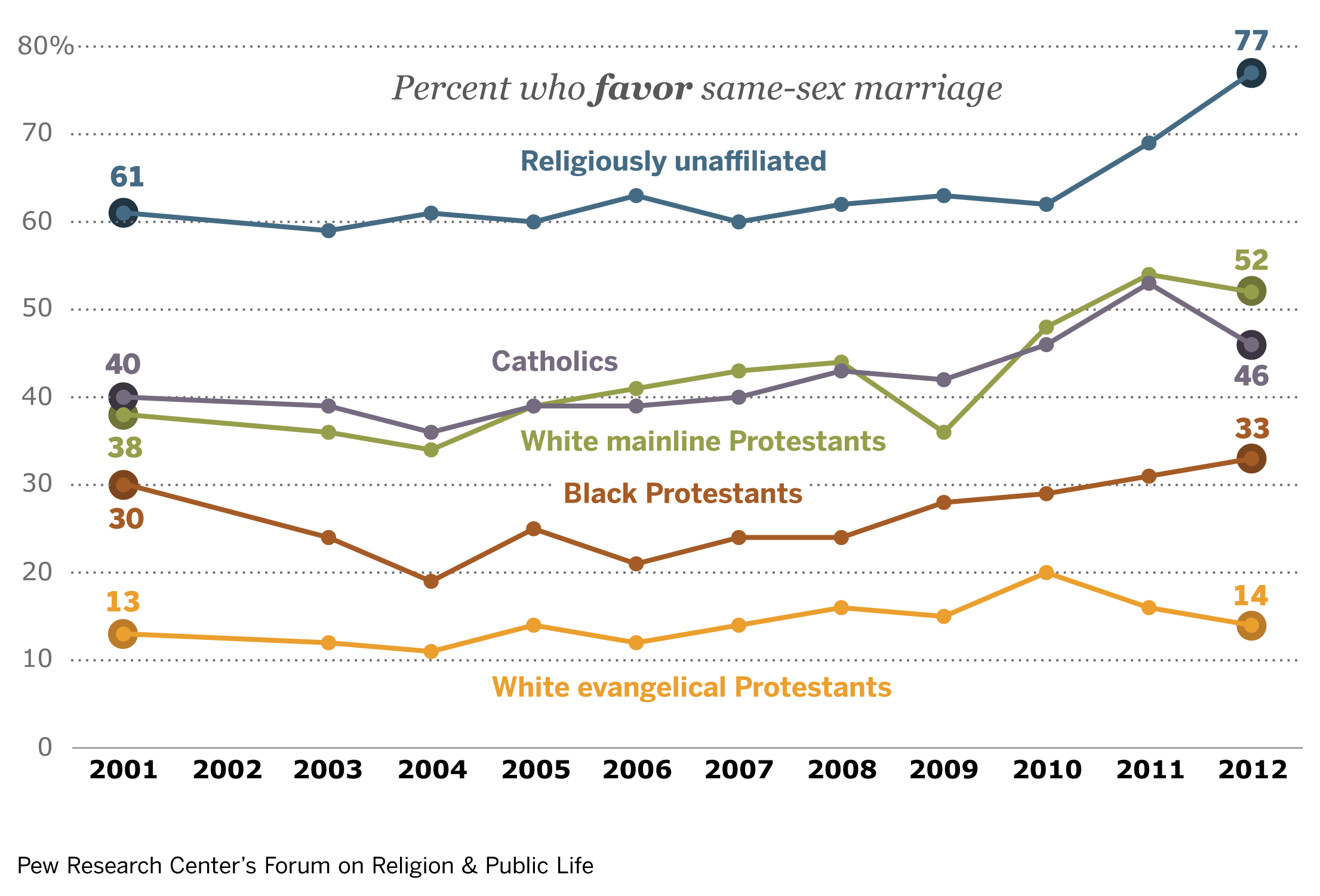
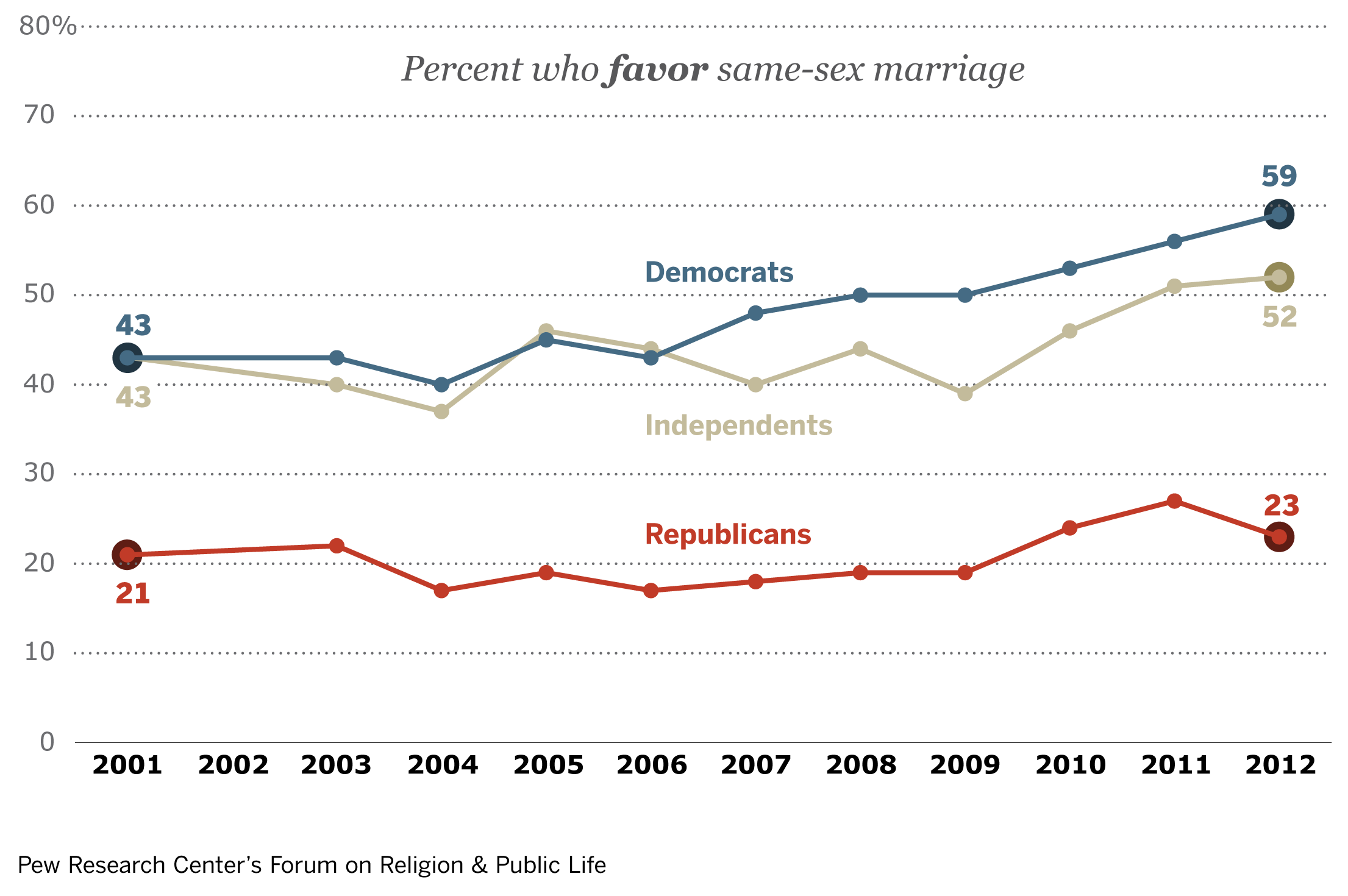
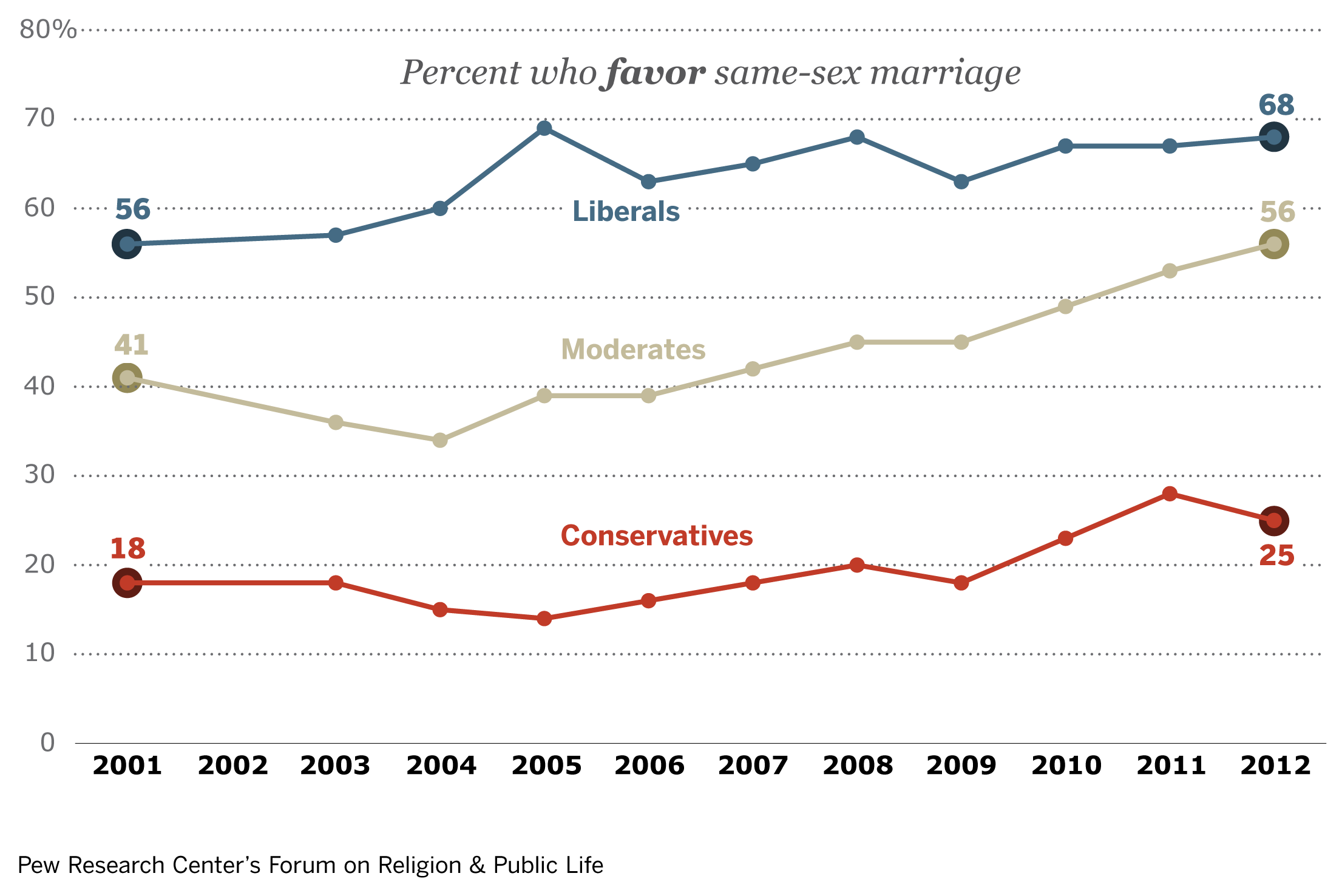
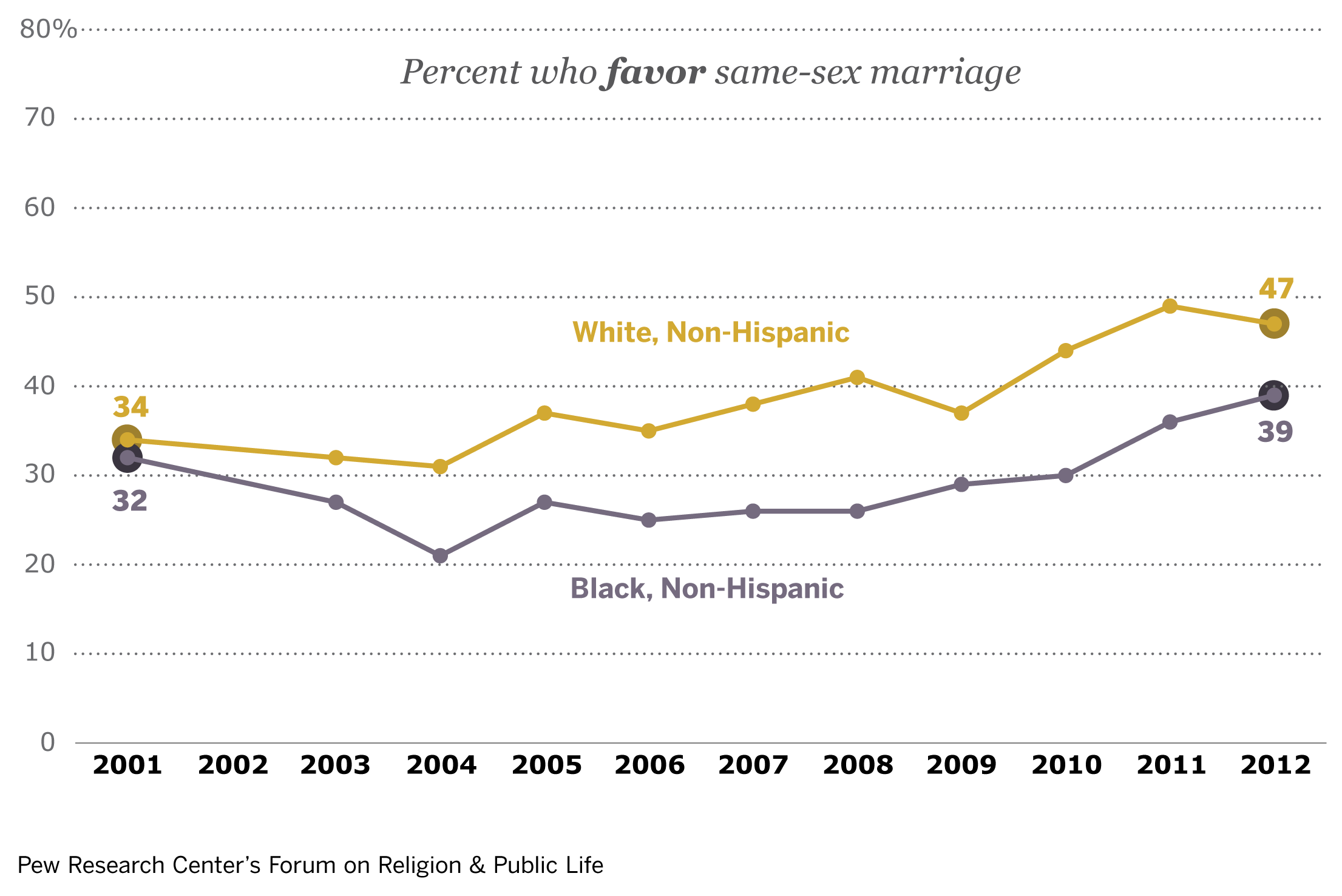
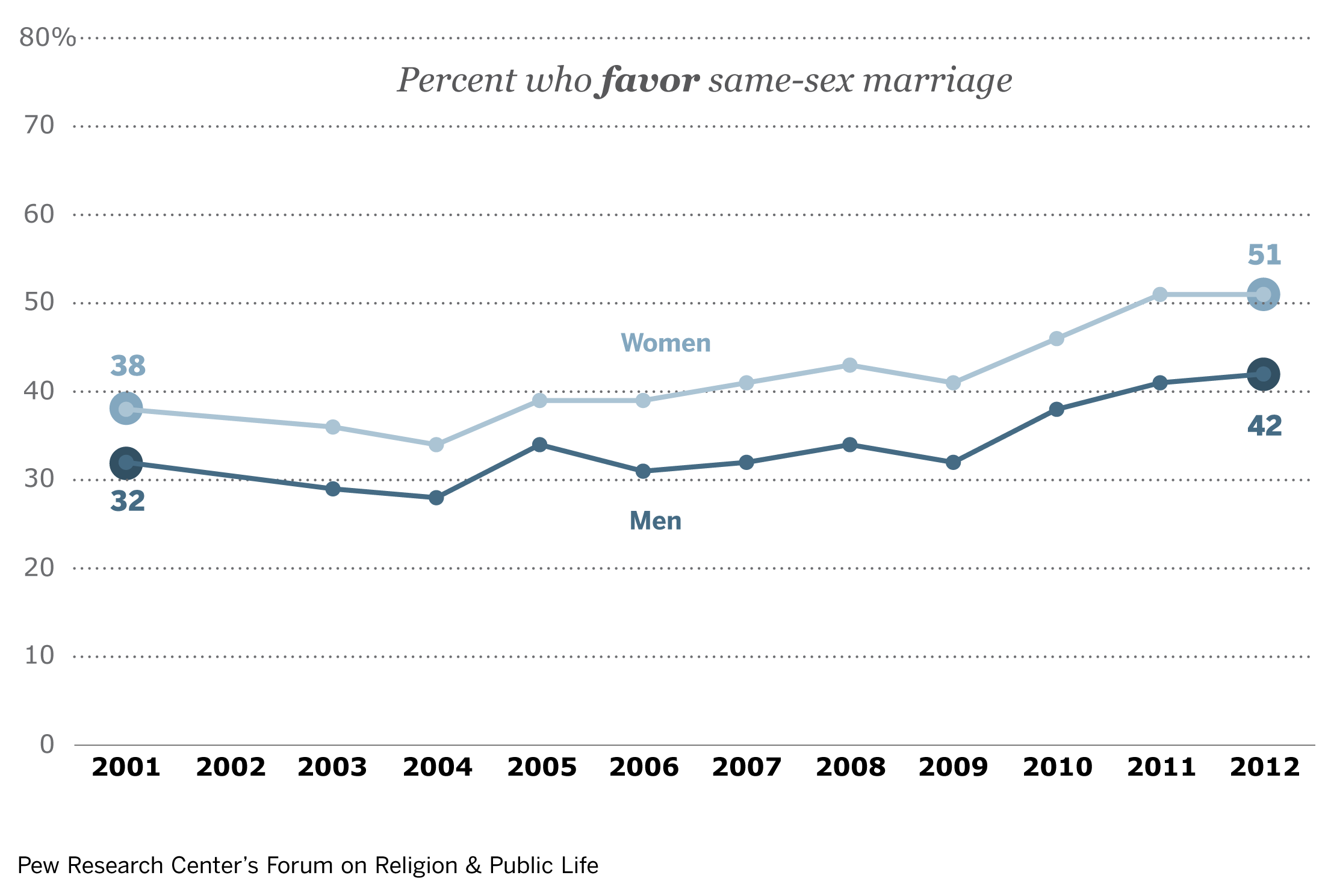
This trend is driven, in part, by young people replacing the old, but focusing on this overshadows the fact that essentially all Americans — of every stripe — show higher support for gay marriage than they did a decade ago.  Both men and women and people of all races, political affiliations, religions, and ages are showing increased support for gay marriage.  This is a real, remarkable, and rare shift in opinion:

Opinion by age:
Opinion by religion:
Opinion by political party:
Opinion by political orientation:
Opinion by race:
Opinion by gender:
Via Montclair SocioBlog.

Lisa Wade, PhD is an Associate Professor at Tulane University. She is the author of American Hookup, a book about college sexual culture; a textbook about gender; and a forthcoming introductory text: Terrible Magnificent Sociology. You can follow her on Twitter and Instagram.
Sociologists have observed that employment in the U.S. is largely structured around an assumption that the worker has no family responsibilities.  The ideas that an employee should be able to work during non-school hours, stay late when needed, take off time for their own illness but never anyone else’s, for example, all presume that the workers have either no children or someone else taking care of children for them.

Most jobs, then, are not designed to be compatible with family responsibilities.  Since most people doing primary child care are women, this hurts mothers disproportionately.  Mothers have a more difficult time being the “perfect employee” and also face discrimination from employers.  This translates into some telling numbers.  Women make about 69% of what men make (not controlling for type of occupation), but most of this disadvantage is related to parental status, not sex. Women without children make 90% of what men make, while mothers make 66%.  Ann Crittenden’s book, The Price of Motherhood, lays out these numbers starkly.

These issues are at the heart of this well-crafted Ampersand cartoon by B. Deutsch, which prompted this post in anticipation of Mother’s Day in the U.S.

Lisa Wade, PhD is an Associate Professor at Tulane University. She is the author of American Hookup, a book about college sexual culture; a textbook about gender; and a forthcoming introductory text: Terrible Magnificent Sociology. You can follow her on Twitter and Instagram.
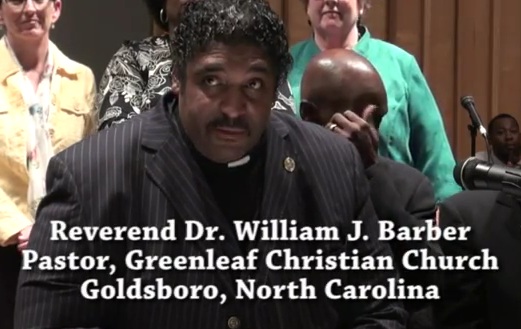
Many of you may have seen a video featuring Reverend William Barber speaking out against North Carolina’s Amendment One, which banned same-sex marriages (and which was approved by voters on Tuesday). The video is heartfelt and passionate, and is also a great example of the importance of how we frame issues in social movements.

Reverend Barber argues that media coverage of the amendment has asked the wrong questions. Whether same-sex couples should be allowed to get married isn’t the core issue here, he says; what’s really at stake is whether the majority should get to vote on which rights will be guaranteed to those in the minority, a decision he sees as a dangerous standard in a nation that has used it previously to exclude racial/ethnic minorities, women, and the poor from the full benefits and protections of citizenship. This reframes the amendment from an issue about same-sex marriages to a broader question about rights, equal protection, and the dangers of codifying inequality into our governing documents:

Hennessy Youngman kicks around the question, should art be beautiful?

If you liked, more from Youngman:

Lisa Wade, PhD is an Associate Professor at Tulane University. She is the author of American Hookup, a book about college sexual culture; a textbook about gender; and a forthcoming introductory text: Terrible Magnificent Sociology. You can follow her on Twitter and Instagram.
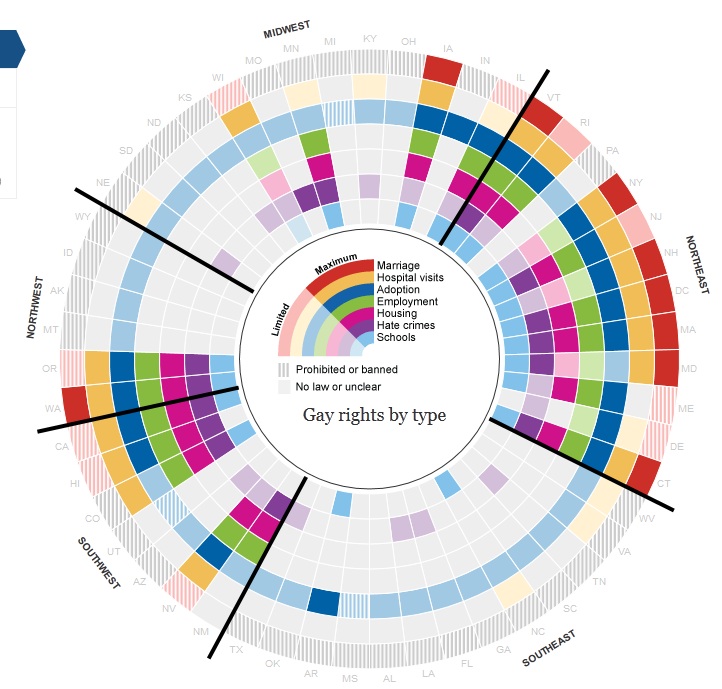
Yesterday I stumbled upon a really great interactive graphic posted by the Guardian that summarizes the degree to which a number of rights and benefits are available to gays and lesbians in the U.S., by state. Each state is represented as a segment radiating out from the center of the circle; each colored ring represents a particular right, benefit, or protection:


  • Light blue = whether state has a law addressing discrimination or bullying in the school system
  • Purple = state-level hate-crime laws
  • Pink = protection against housing discrimination
  • Green = protection against employment discrimination
  • Blue = right to adopt (lighter shade indicates individuals are allowed; darker shade means gay and lesbian couples are allowed to jointly adopt)
  • Yellow = right to visit partner in the hospital
  • Red = marriage

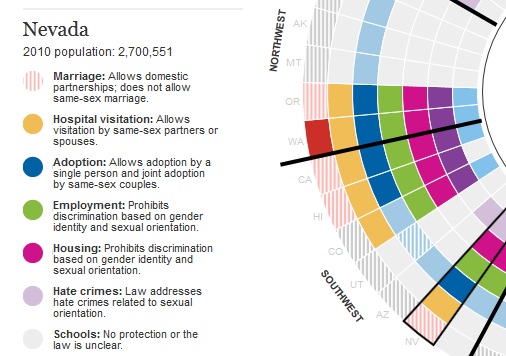
The different shades indicate differences in the scope of coverage (say, full marriage rights vs. domestic partnership — and it has been updated to reflect yesterday’s passage of the bill outlawing same-sex marriage in North Carolina — or whether a law bans discrimination based on sexual orientation but not gender identity); the Guardian website explains each issue. Their post also allows you to hover over a state and get a more detailed summary. Here’s the info for Nevada, for instance:

The graphic also lets you scale states by population if you want to get a better sense of the proportion of the U.S. population living in areas that do or do not provide these protections.