Search results for The

S. Alfonzo sent us a link to the abridged version of The Codes of Gender, in which Sut Jhally, known for a number of documentaries on pop culture, analyzes current messages about masculinity and femininity in advertising, applying the ideas of Erving Goffman regarding gender and cultural performance. Definitely worth the time to watch:

The Media Education Foundation has provided a full transcript and tips for using the film in the classroom.
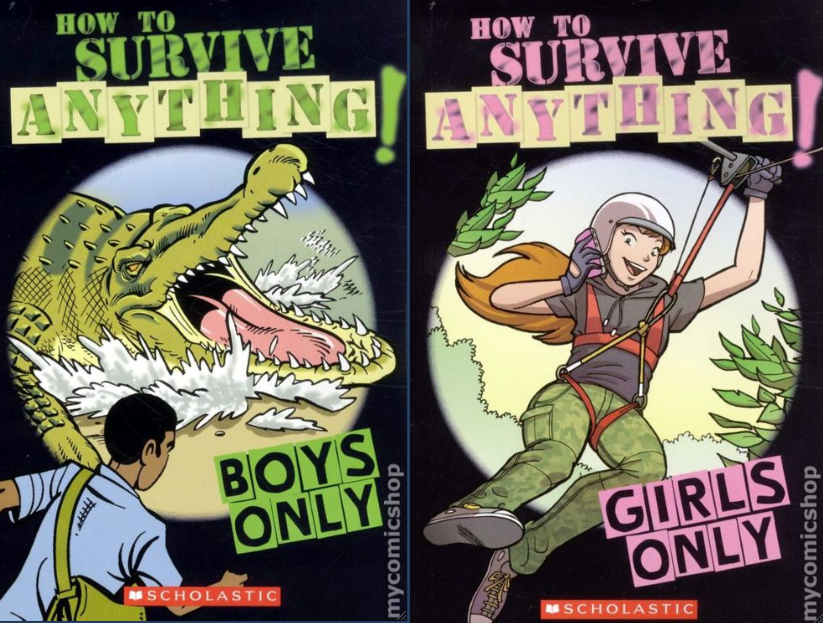

Annie C. and another reader sent us a link to a post by Ryan North at what are the haps about a set of gendered “survival guides” for kids published by Scholastic (and which the publisher now says it won’t continue printing). Boys and girls apparently need very different survival skills, which the other sex shouldn’t know anything about:

In his post, Ryan provides the table of contents for each. What do boys and girls need to be able to survive? For boys, no big surprises — forest fire, earthquake, quicksand, your average zombie or vampire attack, that type of thing, many including, according to teen librarian Jackie Parker, practical and useful tips:

How to Survive a shark attack
How to Survive in a Forest
How to Survive Frostbite
How to Survive a Plane Crash
How to Survive in the Desert
How to Survive a Polar Bear Attack
How to Survive a Flash Flood
How to Survive a Broken Leg
How to Survive an Earthquake
How to Survive a Forest Fire
How to Survive in a Whiteout
How to Survive a Zombie Invasion
How to Survive a Snakebite
How to Survive if Your Parachute Fails
How to Survive a Croc Attack
How to Survive a Lightning Strike
How to Survive a T-Rex
How to Survive Whitewater Rapids
How to Survive a Sinking Ship
How to Survive a Vampire Attack
How to Survive an Avalanche
How to Survive a Tornado
How to Survive Quicksand
How to Survive a Fall
How to Survive a Swarm of Bees
How to Survive in Space

Girls seem to require a very different set of survival skills. Like how to survive a breakout — a skill boys don’t apparently need, though they also get acne. Other handy tips are how to deal with becoming rich or a superstar, how to ensure you get the “perfect school photo,” surviving a crush, whatever turning “a no into a yes” is (persuasiveness, I suppose), picking good sunglasses, dealing with a bad fashion day, and of course “how to spot a frenemy”:

How to survive a BFF Fight
How to Survive Soccer Tryouts
How to Survive a Breakout
How to Show You’re Sorry
How to Have the Best Sleepover Ever
How to Take the Perfect School Photo
How to Survive Brothers
Scary Survival Dos and Don’ts
How to Handle Becoming Rich
How to Keep Stuff Secret
How to Survive Tests
How to Survive Shyness
How to Handle Sudden Stardom
More Stardom Survival Tips
How to Survive a Camping Trip
How to Survive a Fashion Disaster
How to Teach Your Cat to Sit
How to Turn a No Into a Yes
Top Tips for Speechmaking
How to Survive Embarrassment
How to Be a Mind Reader
How to Survive a Crush
Seaside Survival
How to Soothe Sunburn
How to Pick Perfect Sunglasses
Surviving a Zombie Attack
How to Spot a Frenemy
Brilliant Boredom Busters
How to Survive Truth or Dare
How to Beat Bullies
How to be an Amazing Babysitter

Aside from the multiple items clearly focused on appearances, Ryan points out that several others emphasize looks. Camping is “excellent for the skin,” while the seaside survival chapter provides a lot of fashion tips.

Many of the girls’ tips are about surviving social situations or dealing with emotions — embarrassment, keeping a secret, dealing with bullies. These are all probably more useful to kids than knowing how to survive quicksand, and tips for handling stardom are statistically more likely to be useful at some point than dealing with a T-Rex. So the issue here isn’t that the boys’ guide is inherently more useful or smarter or better; probably all kids should be issued a guide to surviving Truth or Dare (also, dodgeball). But the clear gendering of the guides, with only girls getting tips about dealing with social interactions, emotions, and looks, while outdoorsy injury/natural disaster survival tips are sufficient for boys, illustrates broader assumptions about gender and how we construct femininity and masculinity.

Solomon Asch was a social psychologist famous for his experiments in conformity.  In 1962 he collaborated with Candid Camera, a TV show, to show just how easy it is to reverse an innocuous social norm: the direction one stands in an elevator.

Does it still work?  Watch this University of South Florida replication:

Asch did many such experiments, including showing that people will agree with others when asked a simple question, even if they suspect everyone else is wrong.  The implications are obvious.  Social pressure is incredibly powerful and we’ll do things that seem pretty bizarre just to fit in.  How one stands in an elevator, of course, is a trivial matter and has almost no consequences short of feeling funny.  Imagine how much we’ll be willing to do when the consequences are even a little bit greater.

For more great social psychology: entering a theater full of bikers, doing nothing, change blindness, norm breaching, Milgram’s obedience experiment (plus the original flyer).

Lisa Wade, PhD is an Associate Professor at Tulane University. She is the author of American Hookup, a book about college sexual culture; a textbook about gender; and a forthcoming introductory text: Terrible Magnificent Sociology. You can follow her on Twitter and Instagram.

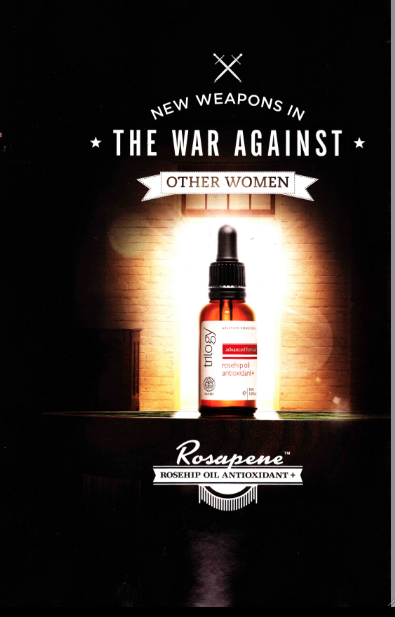
Rebecca sent in an ad she saw in an Australian women’s magazine that explicitly reinforces the idea that women are in perpetual competition with one another. The ad declares an anti-aging product a weapon to be used “in the war against other women,” reminding women that we should consider ourselves to be in a battle with one another over who is most physically attractive — and thus, presumably, most likely to win the ultimate prize of remaining sexually attractive to men:

Check out our earlier posts on the discourse of women-as-competitors, how objectification divides women, the “don’t hate me because I’m beautiful” advertising trope, and an Israeli Bacardi ad campaign that told women to get an ugly friend to make themselves look better.

The Belgian Cancer Foundation is trying to increase awareness of skin cancer and the importance of wearing sunscreen to protect against it. Unfortunately, they’ve recently decided the best way to get this across is to fall back on a familiar message: ladies, if you don’t do what we say, you’ll be hideous and your guy won’t want you any more. In this video released as part of the campaign, ostensibly aimed at men (and sent in by YetAnotherGirl and Grace W.), guys fall asleep with their young female partners. After they fall asleep, the women sneak out of bed and their moms take their places, and we get to see the startled reactions when the men wake up, with the final warning that if men don’t make their girlfriends wear sunscreen, “she’ll start looking like her mom far too soon”:

Because you know, ladies, if you don’t wear sunscreen, you’ll age, and that makes you so gross and scary that men will fall out of bed trying to get away from you. And what could be more romantic than a boyfriend lovingly reminding his girlfriend to put on some sunscreen so she doesn’t someday totally freak him out?

Via Gawker.

Cross-posted at Montclair SocioBlog.

Air pollution is what economists call an “externality.”  It is not an intrinsic part of the economic bargaining between producers and consumers.  The usual market forces — buyers and sellers pursuing their own individual interests — won’t help.  The market may bring us more goods at lower prices, for example, but it can harm the air that everyone, in or out of that market, has to breathe. To create or protect a public good, the free market has to be a little less free.  That’s where government steps in.  Or not.

Case in point: My son and his girlfriend arrived in Beijing ten days ago.  The got-here-safely e-mail ended with this:

…was blown away by the pollution! I know people talk about it all the time, but it really is crazy.

And it is.  Here’s a photo I grabbed from the Internet:

Flickr creative commons by nasus89.

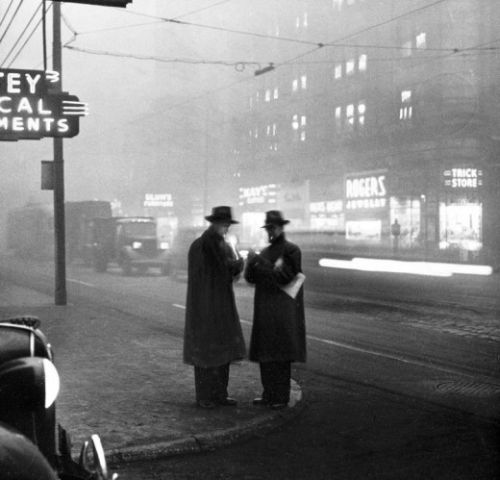
At about the same time, I came upon a this link to photos of my home town Pittsburgh in 1940.  Here are two of them:
Today in downtown Pittsburgh, the streetcars and overhead trolleys are gone.  So are the fedoras.  And so is the smoke.

The air became cleaner in the years following the end of the War.  It didn’t become clean all by itself, and it didn’t become clean because of free-market forces.  It got clean because of government — legislation and regulation, including an individual mandate.

The smoke was caused by the burning of coal, and while the steel mills accounted for some of the smoke, much of the it came from coal-burning furnaces in Pittsburghers’ houses.  If the city was to have cleaner air, the government would have to force people change the way they heated their homes.  And that is exactly what the law did. To create a public good — clean air — the law required individuals to purchase something — either non-polluting fuel (oil, gas, or smokeless coal) or smokeless equipment.*

Initially, not everyone favored smoke control, but as Pittsburgh became cleaner and lost its “Smoky City” label, approval of the regulations increased, and there was a fairly rapid transition to gas heating.  By the 1950s, nobody longed for the unregulated air of 1940.  Smoke control was a great success.**  Of course, it may have helped that Pittsburgh did not have a major opposition party railing against this government takeover of home heating or claiming that smoke control was a jobs-killing assault on freedom.

————————

* Enforcement focused not on individuals but distributors.  Truckers were forbidden from delivering the wrong kind of coal.

** For a fuller account of smoke control in Pittsburgh, see Joel A. Tarr and Bill C. Lamperes, Changing Fuel Use Behavior and Energy Transitions: The Pittsburgh Smoke Control Movement, 1940-1950: A Case Study in Historical Analogy. Journal of Social History , Vol. 14, No. 4, Special Issue on Applied History (Summer, 1981), pp. 561-588.

Jay Livingston is the chair of the Sociology Department at Montclair State University. You can follow him at Montclair SocioBlog or on Twitter.

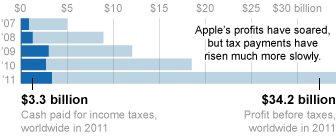
Apple’s profits more than quintupled in the last five years, but their tax burden has risen much more slowly.  Last year, just 9.8% of their profits went to taxes.   “By comparison,” writes economist Marty Hart-Landsberg, “Wal-Mart was downright patriotic — paying a tax rate of 24 percent.”

How does the company do it?  Hart-Landsberg summarizes the New York Times: “The answer is tax loopholes and a number of subsidiaries in low tax places like Ireland, the Netherlands, Luxembourg and the British Virgin Islands. ”  More details at Reports from the Economic Front.

Lisa Wade, PhD is an Associate Professor at Tulane University. She is the author of American Hookup, a book about college sexual culture; a textbook about gender; and a forthcoming introductory text: Terrible Magnificent Sociology. You can follow her on Twitter and Instagram.

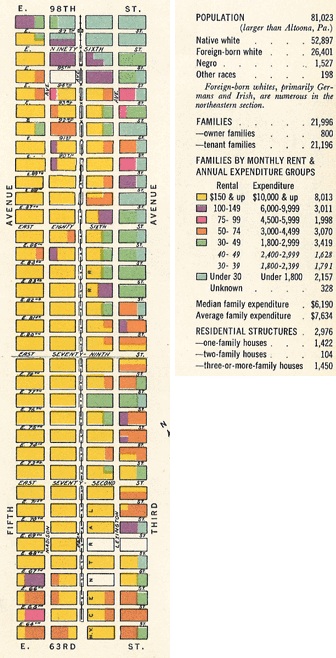
In the early 1940s, four news organizations — the New York Times, the Daily Mirror, News Syndicate Co. (now the Tribune Company), and Hearst Consolidated Publications — collaborated on a detailed market analysis of New York City, complete with statistics about racial/ethnic makeup, color-coded maps of rents, and photos and short narratives of each neighborhood. The Center for Urban Research, at the City University of New York (CUNY) Graduate Center, recently posted the resulting 1943 document, Market Analysis. The interactive archive is a treasure trove of information about New York in the 1940s.

Described as the “district of the silver spoon,” the Upper East Side, then as now, was among the most affluent neighborhoods, with many rents above the then-exorbitant $150 mark (now about $2,500):

The description points out that even in this affluent area, the rich and poor lived in close proximity, with $30/month apartments within a block of some of the most expensive real estate in the city.

The Lower East Side, on the other hand, is described as “the most populous, most crowded, most old-world district in New York City,” with so many immigrants that its atmosphere is “essentially alien”:

The narrative provides some information about urban planning policies of the time, as well. It notes that the Lower East Side had dropped by over 200,000 in 20 years, noting that “slum clearance” had led to more open public space; it also mentions the emergence of large housing developments, such as Knickerbocker Village — the type of large housing projects, often financed with government funding, that became the preferred solution to providing low-income housing, often leading to the displacement of many low-income residents when their residences were torn down to make room for the developments.

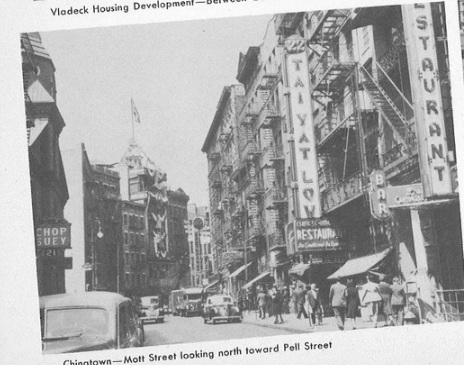
The “tiny Chinatown” that then existed on the Lower East Side at Pell and Mott Streets:

You get the idea. Clicking around for a while provides lots of interesting tidbits to illustrate major demographic, economic, and public-policy changes and how they have impacted life in the city. The Center for Urban Research has also provided a comparison of a number of characteristics between 1940 and today.