Search results for The

YetAnotherGirl sent us a link to a post at Jezebel about a sign MarketFair Mall, in New Jersey, put up (and then took down after criticism and a petition) to apologize for any inconvenience some remodeling might cause:

The sign does a couple of things. It normalizes the idea that the type of verbal harassment women often face when in public (see my post from a couple of years ago for a personal example) is, in fact, the natural outcome of how women look. Rather than feeling harassed, women should interpret such comments as the compliments they really are. Yes, yes, we can shake our heads and act annoyed, but isn’t it ultimately nice to know we look good?

The sign also reinforces a certain view of working-class masculinity, one in which working-class men are crude and lacking in basic civility, unable or unwilling to control how they express themselves, a fact that everyone else may find a bit irritating but should ultimately shrug off with a bit of a smile.

This view of working-class masculinity is reinforced in a Dutch commercial sent in by Sarah van B. The commercial is for Gamma, a chain of hardware stores in the Netherlands. In it, boys build houses out of Legos, displaying various stereotypes of rough, brutish masculinity: lack of middle-class manners (burping, nose-picking), uncontrolled bodies (belly hanging out, visible butt crack), and group harassment of women:

Sarah translates the call to the woman as “Where are those pretty little legs going?”

Such depictions normalize the harassment of women while also associating it with a general lack of sophistication, something that only the lower classes would engage in. They encourage the audience to laugh at the men who do so, finding humor in their brutish antics, but also reinforce the idea that women should just expect this type of behavior from the type of men who do manual labor.
In a previous post I discussed how the U.S. became more religious in the 1950s, in part in response to its the Cold War enemies (atheist communists).  In fact, the U.S. is among the most religious countries in the world.  Using data from the International Social Survey Programme, Sociologist Tom Smith paints wildly different religious portraits of 28 nations (full text).

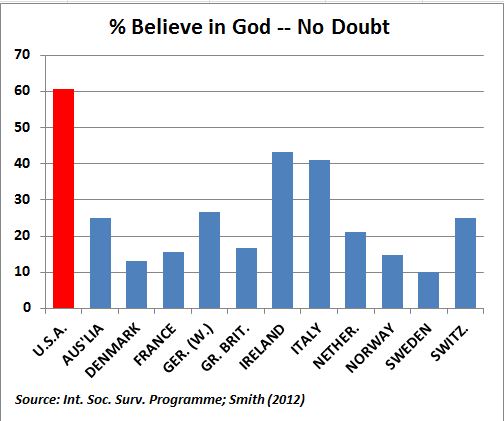
When asked whether they “know that God really exists and… have no doubt about it,” 61% of Americans say “yes.”  Of the 28 nations studied, only four were more likely to say “yes” to this question: Poland, Israel, Chile, and the Philippines. Here’s how we look compared to similar countries:

Here’s all 28 in rank order (borrowed from LiveScience).  Notice how wide the divergence is.  In Japan, the least religious country according to this measure, only 4% say they have no doubt God exists.  In The Philippines, 84% have no doubt.

% Have No Doubt God Exists:

  • Japan: 4.3 percent
  • East Germany: 7.8 percent
  • Sweden: 10.2
  • Czech Republic: 11.1
  • Denmark: 13.0
  • Norway: 14.8
  • France: 15.5
  • Great Britain: 16.8
  • The Netherlands: 21.2
  • Austria: 21.4
  • Latvia: 21.7
  • Hungary: 23.5
  • Slovenia: 23.6
  • Australia: 24.9
  • Switzerland: 25.0
  • New Zealand: 26.4
  • West Germany: 26.7
  • Russia: 30.5
  • Spain: 38.4
  • Slovakia: 39.2
  • Italy: 41.0
  • Ireland: 43.2
  • Northern Ireland: 45.6
  • Portugal: 50.9
  • Cyprus: 59.0
  • United States: 60.6
  • Poland: 62.0
  • Israel: 65.5
  • Chile: 79.4
  • The Philippines: 83.6

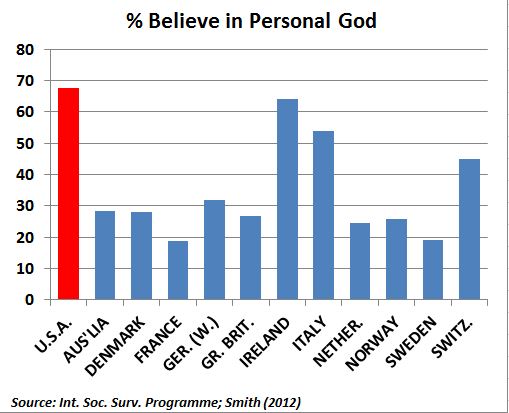
Americans are also particularly likely to believe in a “personal God,” one who is closely attentive to the lives of each and every person.

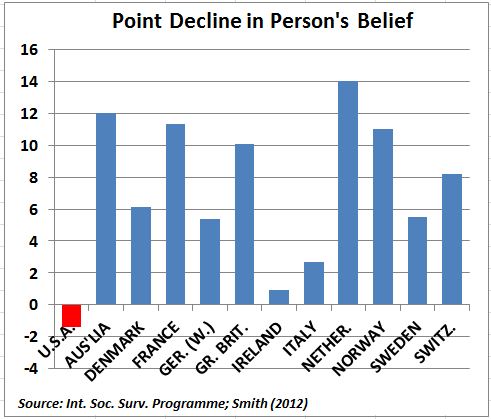
Quite interestingly, the U.S. is in the minority in that Americans tend to become increasingly religious as they age.  In most countries, people become less religious over time.  This graph (confusingly labeled), shows changes in DISbelief over the life course.  The U.S. is the only country among these in which disbelief declines:

Lifetime Change in Religiosity (from increase in disbelief to increase in belief):

  • The Netherlands: -14.0
  • Spain: -12.4
  • Australia: -12.0
  • France: -11.3
  • Norway: -11.0
  • Great Britain: -10.1
  • Switzerland: -8.2
  • Germany (East): -6.9
  • Denmark: -6.1
  • Czech Republic: -5.5
  • Sweden: -5.5
  • Germany (West): -5.4
  • New Zealand: -4.0
  • Italy: -2.7
  • Poland: -1.8
  • Japan: -1.5
  • Ireland: -0.9
  • Chile: +0.1
  • Cyprus: +0.2
  • Portugal: +0.6
  • The Philippines: +0.8
  • Hungary: +1.0
  • Northern Ireland: +1.0
  • United States: +1.4
  • Israel: +2.6
  • Slovakia: +5.6
  • Slovenia: +8.5
  • Latvia: +11.9
  • Russia: +16.0

Rates of atheism — a strong disbelief in God — also vary tremendously.  East Germany is the most atheist, with more than half of citizens claiming disbelief.  The country is a stark contrast to the atheist among them, Poland and the U.S. (only 3% atheist), Chile and Cyprus (2%), and The Phillipines (1%).

% Atheist:

  • East Germany: 52.1
  • Czech Republic: 39.9
  • France: 23.3
  • The Netherlands: 19.7
  • Sweden: 19.3
  • Latvia: 18.3
  • Great Britain: 18.0
  • Denmark: 17.9
  • Norway: 17.4
  • Australia: 15.9
  • Hungary: 15.2
  • Slovenia: 13.2
  • New Zealand: 12.6
  • Slovakia: 11.7
  • West Germany: 10.3
  • Spain: 9.7
  • Switzerland: 9.3
  • Austria: 9.2
  • Japan: 8.7
  • Russia: 6.8
  • Northern Ireland: 6.6
  • Israel: 6.0
  • Italy: 5.9
  • Portugal: 5.1
  • Ireland: 5.0
  • Poland: 3.3
  • United States: 3.0
  • Chile: 1.9
  • Cyprus: 1.9
  • The Philippines: 0.7

As a post-9/11 American watching another election cycle, I can’t help but notice how so much of our rhetoric revolves — sometimes overtly and sometimes not — around people who are the wrong religion.  Notably, Muslims.  And yet, the U.S. and many Muslim countries are alike in being strongly religious, at least in comparison to the many strongly secular countries.

This is odd because stands in contrast to recent data on American attitudes.  Within the U.S., people express much less tolerance for atheists than they do Muslims (homosexuals, African Americans, and immigrants). Weirdly, we think we have more in common with more secular nations like Great Britain than we do with countries like Pakistan or Saudi Arabia. In certain ways, the opposite might be true.

Thanks to Claude Fischer for the graphs.  Fischer, a sociologist at UC Berkeley, is the author of Made in America: A Social History of American Culture and Character.

Lisa Wade, PhD is an Associate Professor at Tulane University. She is the author of American Hookup, a book about college sexual culture; a textbook about gender; and a forthcoming introductory text: Terrible Magnificent Sociology. You can follow her on Twitter and Instagram.

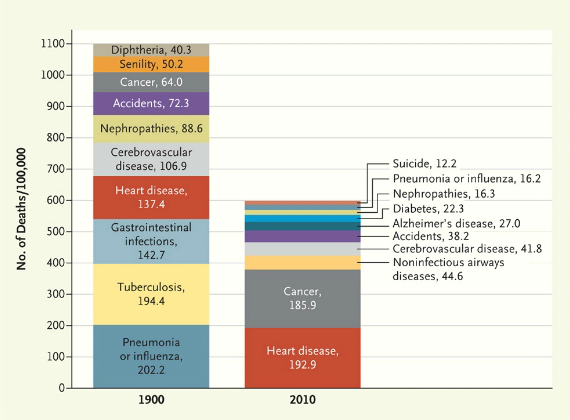
The Washington Post has provided an image from the New England Journal of Medicine that illustrates changing causes of death. Comparing the top 10 causes of death in 1900 and 2010 (using data from the Centers for Disease Control and Prevention), we see first that mortality rates have dropped significantly, with deaths from the top 10 causes combined dropping from about 1100/100,000 to about 600/100,000:

And not surprisingly, what we die from has changed, with infectious diseases decreasing and being replaced by so-called lifestyle diseases. Tuberculosis, a scourge in 1900, is no longer a major concern for most people in the U.S. Pneumonia and the flu are still around, but much less deadly than they used to be. On the other hand, heart disease has increased quite a bit, though not nearly as much as cancer.

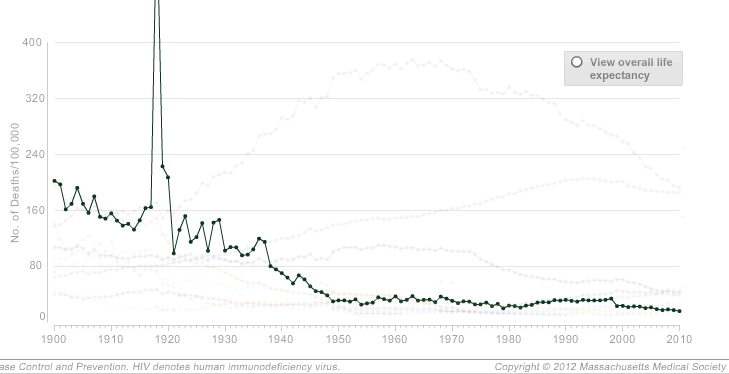
The NEJM has an interactive graph that lets you look at overall death rates for every decade since 1900, as well as isolate one or more causes. For instance, here’s a graph of mortality rates fro pneumonia and influenza, showing the general decline over time but also the major spike in deaths caused by the 1918 influenza epidemic:

The graphs accompany an article looking at the causes of death described in the pages of NEJM since its founding in 1812; the overview highlights the social context of the medical profession. In 1812, doctors had to consider the implications of a near-miss by a cannonball, teething could apparently kill you, and doctors were concerned with a range of fevers, from bilious to putrid. By 1912, the medical community was explaining disease in terms of microbes, the population had gotten healthier, and an editorial looked forward to a glorious future:

Perhaps in 1993, when all the preventable diseases have been eradicated, when the nature and cure of cancer have been discovered, and when eugenics has superseded evolution in the elimination of the unfit, our successors will look back at these pages with an even greater measure of superiority.

As the article explains, the field of medicine is inextricably connected to larger social processes, which both influence medical practice and can be reinforced by definitions of health and disease:

Disease definitions structure the practice of health care, its reimbursement systems, and our debates about health policies and priorities. These political and economic stakes explain the fierce debates that erupt over the definition of such conditions as chronic fatigue syndrome and Gulf War syndrome. Disease is a deeply social process. Its distribution lays bare society’s structures of wealth and power, and the responses it elicits illuminate strongly held values.

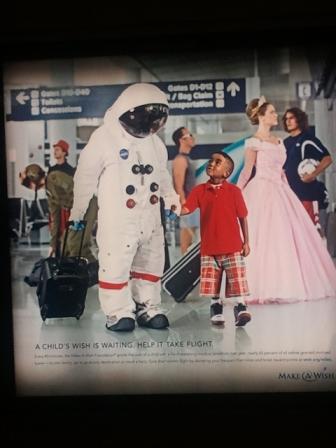
I snapped this photograph of a Make a Wish Foundation advertisement at the Los Angeles International Airport.  The organization aims to grant wishes to children with life-threatening medical conditions.

Unfortunately, in this advertisement, they pigeonhole girls into the princess role.  There are five adult males in the ad with the little boy: a soccer player, a surfer, a soldier, a man in a red hat (?), and an astronaut (I’m assuming people imagine there is a man in that space suit). There is one female, and she looks to be a princess.  (Or maybe that’s supposed to be an option for the little boy in the ad? Somehow I don’t think so.)

Meanwhile, Aisha C. sent in this March of Dimes promotion, called “I’m Born To…”  It portrays children, each given a supposedly natural talent (hence, “I’m born to…”).  Each child, though, is attributed a gender stereotypical talent and future:

Lisa Wade, PhD is an Associate Professor at Tulane University. She is the author of American Hookup, a book about college sexual culture; a textbook about gender; and a forthcoming introductory text: Terrible Magnificent Sociology. You can follow her on Twitter and Instagram.

Cross-posted at Ms.

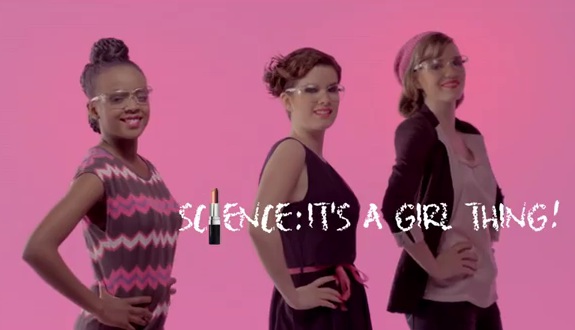
Paul (an Irish grad student), Carys G., Zeynep A., Marjan vdW., and one other reader all sent in a link to a new video released by the European Commission. The video, “Science: It’s a Girl Thing!”, is meant to encourage girls to consider careers in the natural and physical sciences, presenting science, as the title suggests, as an area compatible with femininity and other “girl things” — make-up, high heels, and fashion:

The video has been roundly criticized (check out the Twitter feed for #sciencegirlthing), both for presenting a stereotyped image of girls and for misrepresenting the scientific workplace (one female scientist Tweeted wondering what will happen to any girls possibly drawn in by this campaign when they learn that in many labs, open-toed heels violate safety codes).

I suspect the makers of the video believe they are doing that first thing — trying to push back against the idea that science is unfeminine. Indeed, the video is part of the larger Science: It’s a Girl Thing! campaign, and the website also contains 12 profiles of female European scientists, which provide more realistic depictions of women working in a range of scientific fields. But many viewers, including a lot of scientists (both women and men), see it as the second thing — another example of what I described in my original post of the cartoon as “superficial attempts to overcome the often structural constraints that keep women out of masculinized arenas of social life.”

Indeed, girls don’t just need to be told “you can do science and look cute too!” In fact, a post at New Scientist discusses the results of a recently-published article by Diana Betz and Denise Sekaquaptewa, “My Fair Physicist? Feminine Math and Science Role Models Demotivate Young Girls”. Betz and Sekaquaptewa found that images of conventionally feminine women in science fields actually demotivated female middle school students and decreased their perceptions of their likelihood of success in science and math. Girls appeared to see these images and, instead of thinking “Oh, I can like makeup and clothes but still do science!”, they thought, not unreasonably, “Oh, great, so I have to be smart and still meet all the demands of conventional femininity, too?” Instead of inspiring girls, the images were threatening, making them feel less likely to succeed in science and math. This effect was most pronounced for those girls who weren’t already interested in such fields — presumably the exact group campaigns such as Science: It’s a Girl Thing! are meant to attract. As the authors conclude (p. 7), “Submitting STEM role models to Pygmalian-style makeovers…may do more harm than good.”

Gwen Sharp is an associate professor of sociology at Nevada State College. You can follow her on Twitter at @gwensharpnv.

Earlier this month NPR profiled Alex Hernandez, a member of a Mexican third gender.  This prompted me to re-post our discussion of muxes from 2008.  Images of Hernandez, taken by photographer Neil Rivas, are added at the end.

A New York Times article this week briefly profiles muxes, a third “gender” widely accepted in Oaxaca, Mexico.  According to the article, this part of Mexico has retained many of the pre-colonial traditions.  One of these included flexibility around gender and sexual orientation.  From the article:

There, in the indigenous communities around the town of Juchitán, the world is not divided simply into gay and straight. The local Zapotec people have made room for a third category, which they call “muxes” (pronounced MOO-shays) — men who consider themselves women and live in a socially sanctioned netherworld between the two genders.

“Muxe” is a Zapotec word derived from the Spanish “mujer,” or woman; it is reserved for males who, from boyhood, have felt themselves drawn to living as a woman, anticipating roles set out for them by the community.

Not all muxes express their identities the same way. Some dress as women and take hormones to change their bodies. Others favor male clothes. What they share is that the community accepts them; many in it believe that muxes have special intellectual and artistic gifts.

Robin B. pointed us to a slide show at NPR.

Lisa Wade, PhD is an Associate Professor at Tulane University. She is the author of American Hookup, a book about college sexual culture; a textbook about gender; and a forthcoming introductory text: Terrible Magnificent Sociology. You can follow her on Twitter and Instagram.

Earlier this month, Louisiana’s legislature voted to expand its school voucher program to cover the entire state, allowing parents whose children attend low-rated schools to use government-funded vouchers to help pay the cost of tuition at one of about 125 schools on an approved list (assuming, of course, their child is accepted). Another law recently passed in the state will provide tax credits for private donations to voucher programs, a policy already implemented in some states, including Pennsylvania.

Critics have expressed concern about some of the schools approved for the program, including a lack of site visits in the approval process and the inclusion of schools that do not appear to have the facilities or staff for the large increases in enrollment that would result if all of their available vouchers were used.

The expansion of the voucher program has also brought renewed attention to the curricula used at schools receiving state funds through voucher systems. Some of the schools approved for the voucher program in Louisiana, as well as other states, use textbooks produced by several evangelical organizations, including A Beka Book and Bob Jones University. In the documentary School Choice: Taxpayer-Funded Creationism, Bigotry, and Bias, Rachel Tabachnick and Bruce Wilson discuss Pennsylvania’s voucher program. Here’s an 8-minute clip focusing on the contents of some textbooks published by A Beka Book and BJU:

Examples from A Beka Book and Bob Jones University Press Curricula from Bruce Wilson on Vimeo.

Highlights:

  • Humans and dinosaurs co-existed.
  • God designed “checks and balances” to prevent environmental crises, so chill! After all, “Roses are red, violets are blue; they both grow better with more CO2.”
  • “Rumors” of foreclosures, high unemployment, homelessness, and general misery during the Great Depression are just socialist propaganda.
  • Unions just want to destroy the accomplishments of “hardworking Americans.”
  • Mormons, Unitarians, and Catholics = bad.
  • And then there’s the history of racial/ethnic relations: “God used the ‘Trail of Tears’ to bring many Indians to Christ” and “Through the Negro spiritual, slaves developed patience to wait on the Lord and discovered that the truest freedom is freedom from the bondage of sin.” No, seriously — I didn’t make those up.

You can read some additional examples in a recent post at Salon, including the following:

Are dinosaurs alive today? Scientists are becoming more convinced of their existence. Have you heard of the `Loch Ness Monster’ in Scotland? `Nessie,’ for short has been recorded on sonar from a small submarine, described by eyewitnesses, and photographed by others. Nessie appears to be a plesiosaur.

Schools using these texts have been approved to receive government funds for education. It highlights one of critics’ concerns about voucher programs: that it is, in effect, often a way to provide taxpayer-funded education that is explicitly religious and may or may not conform to accepted standards of scientific inquiry.

Here’s the full-length documentary:

School Choice: Taxpayer-Funded Creationism, Bigotry, and Bias from Rachel Tabachnick on Vimeo.

Also see our earlier post on a Texas textbook standards advisor explaining that books should emphasize the positive, such as how minorities ought to be really grateful to Whites for giving them rights.

One of our readers sent in an example of our cultural tendency to conflate “ethnic” with “non-white,” a conflation that renders whiteness invisible in discussions of race/ethnicity and its social impacts. You Beauty posted a slideshow about choosing an appropriate sunscreen, and the first slide highlights two that are “best for ethnic skin.” The accompanying text refers to “deeper skin tones” and includes a link to a story on “dark skin decoded”:

It’s a small example of the way that race and ethnicity are perceived more broadly in our culture, with whiteness taken as the neutral, as the absence of noticeable race/ethnicity, while “ethnic” is the marked, non-neutral state of all those who aren’t white.