Search results for The

A student pointed me to bharatmatrimony.com, a matchmaking website targeting the general Indian sub-continent:

You can choose to search a variety of more specific groups (Hindi, Punjabi, Tamil, etc.). Among other search criteria, you can specify caste and sub-caste.

I did a quick search (I put in “any” for caste) and found that the profiles are publicly available (presumably you only have to pay if you actually want to contact them), and include such information as complexion (one profile said “wheatish”), blood type (??), eating habits (vegetarian or not), horoscope and whether or not the person requires a good horoscope match, the person’s caste and sub-caste, annual income, and their preferences in a partner (they can state a caste and first-language preference but not a complexion preference, from what I can tell).

The website might be useful for any number of discussions–about technology and the increasing global reach of the internet, of modern methods of dating, about what type of information we might think is important at first glance about a person (although in the U.S. I bet many people would say asking about someone’s complexion is inappropriate or racist, I presume we have things on our dating sites that would seem rude in India; also, I’d argue American users of dating website don’t openly ask about complexion but can get that information from photos and so may be judging potential partners on it anyway). This could also bring up an interesting discussion of language–I suspect many students would be horrified at the idea of a “matchmaker,” which implies arranged marriages to some degree, but a “dating service” seems different (even though eharmony and other sites call potential partners “matches”).

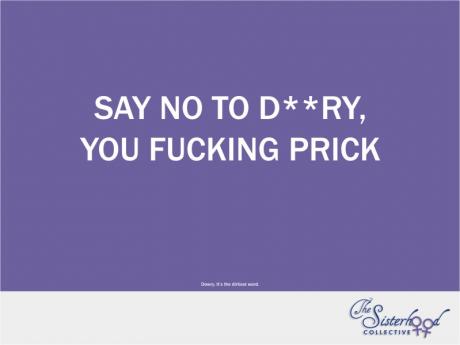
The same student also uncovered these anti-dowry posters:

They can be found here. I have tried to find a website for The Sisterhood Collective or the ad agency that supposedly made these posters but have not be able to, so I do not have definitive proof they are real (I have no reason to say they aren’t, only that I’m usually cautious of things that supposedly were displayed in other countries that seem a little too funny/horrific to be true, so I always try to do a little digging if I can. Snopes.com didn’t have anything on it.

One thing that I thought was interesting about the anti-dowry posters was that when I first saw them, the language (“you fucking prick”) made me assume they were directed at men, although when I looked at them again I realized there was no reason they couldn’t be directed at women. If they were meant to target a male audience, it could lead to an interesting discussion of the implication that only men are engaged in patriarchal oppression, ignoring the role that older women (particularly potential mothers-in-law) play in reinforcing dowry and the devaluation of women.

Finally, here’s the cover (found here) of the very first issue of Vogue India, from October, 2007:
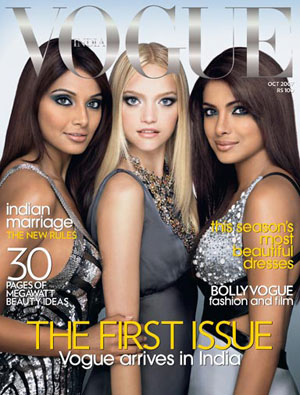
Here we see that the image of beauty provided by the magazine to the millions of women in India includes a narrow set of features: light skin, straight hair, stereotypically “European” facial features–and, of course, very, very thin bodies. Compare to this Indian ad for skin-lightening cream for a discussion of standards of beauty and how a generalized “White” ideal of beauty has been increasingly globalized.

Thanks, Kellie G.!

The University of Michigan Sexual Assault Prevention and Awareness Center gives a thumbs up to these ads for Pyrex kitchen cookware for using androgynous figures instead of women.  Doing so suggests that people use kitchens, not just women.  Contrast it to, well, as far as I can remember, just about every other ad for every other kitchen product that I’ve ever seen (for examples, see here, here, here, here, and here).


Thanks to Laura L. for the tip!


Found here, here, and here thanks to Erin H.  Thanks!

Erin writes:

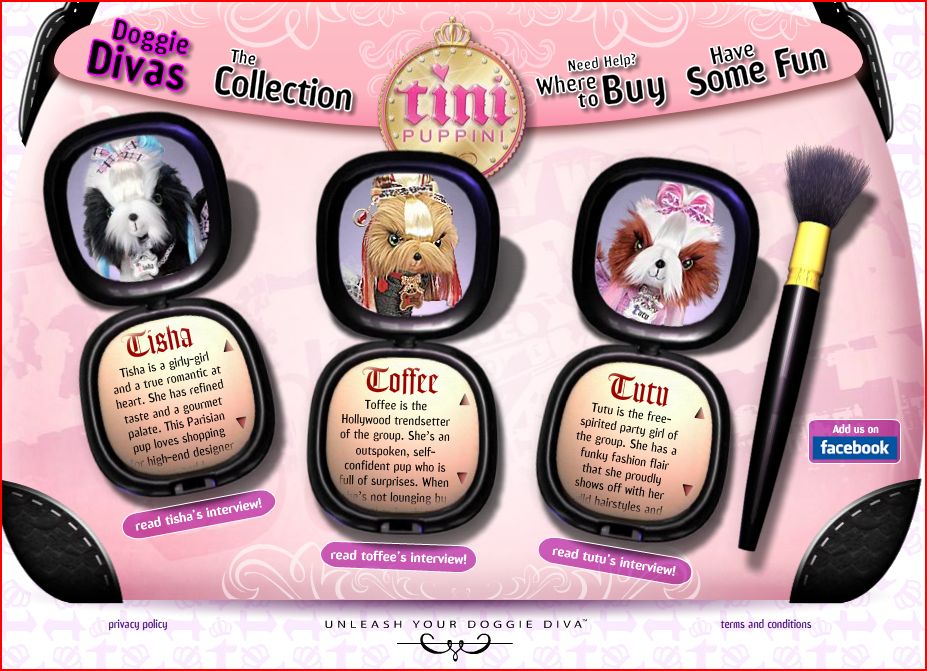
This brings together the awful hypersexualisation of toys for young girls (recommended: ages 4 – 8 ) with the often bizarre and sometimes disturbing anthropomorphisation of animals. In this case, Bratz dolls (complete with impossible footwear and freakishly large eyes) meet My Little Ponies in an unholy combination of hinted-at cleavage, age-inappropriate costuming / accessories and come-hither glances! So many shades of ick. What would the equivalent for young boys be, I wonder?

Speaking of, is anyone else nostalgic for my little ponies and carebears?  Sigh.

NEW!  In a similar phenomenon, I present you the Tini Puppini (found here via Jezebel):

Larry brought my attention to Save the Ta-Tas, a breast-cancer awareness company. I can’t quite decide what to make of them–the website says a “portion of gross sales” is contributed to fighting breast cancer, but not how big of a portion. So presumably you are fighting breast cancer by paying $24.95 for t-shirts like this one:

bigtatas.jpg

I assume it’s a for-profit company. And the t-shirts are kind of funny, and they’re bringing attention to a worthy cause. And yet it’s another example of consumption as activism (see here, here, and here; there are other examples if you search under the “activism” tag). I mean, you could just donate $25 straight to a breast cancer awareness organization and know all $25 went there, as opposed to knowing some unspecified “portion” of it did. I guess if you’re going to buy a t-shirt anyway, you might as well buy one that will provide some money to an organization you care about, but if your interest is in actually funding breast cancer research, there seem to be more efficient ways to go about it.

On the other hand, I am fascinated by this product:

booblubebathroom.jpg

Despite what your dirty little mind might be thinking, the website informed me that Boob Lube is to be used for breast self-exams. Why you would need lube for that, I cannot say.

Thanks, Larry!

NEW: 73man pointed out the Irish Women’s Health Care “Two Tits and a Vote” campaign to get people to demand that politicians help provide more access to breast cancer screening. Here’s a photo from the campaign:


Note that the Mona Lisa stamp in the background has huge boobs.

This campaign is unlike the first one because it’s not attached to a corporation, as far as I can tell. But it seems like there would be a way to bring attention to this issue without using the body of a model-thin women with big boobs.

Then again, I guess maybe those are the type of boobs politicians would be most worried about being damaged.

Thanks, 73man!

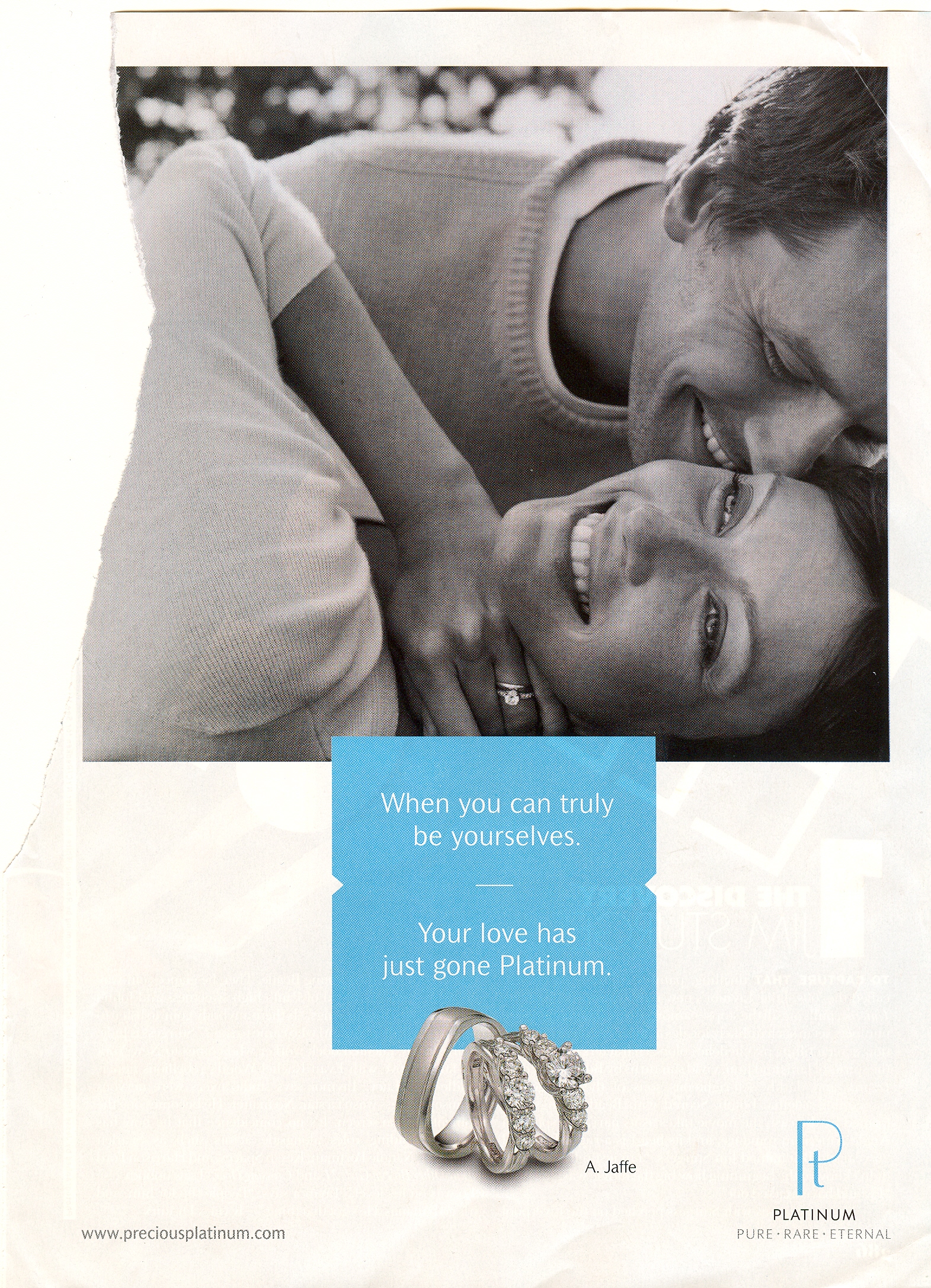
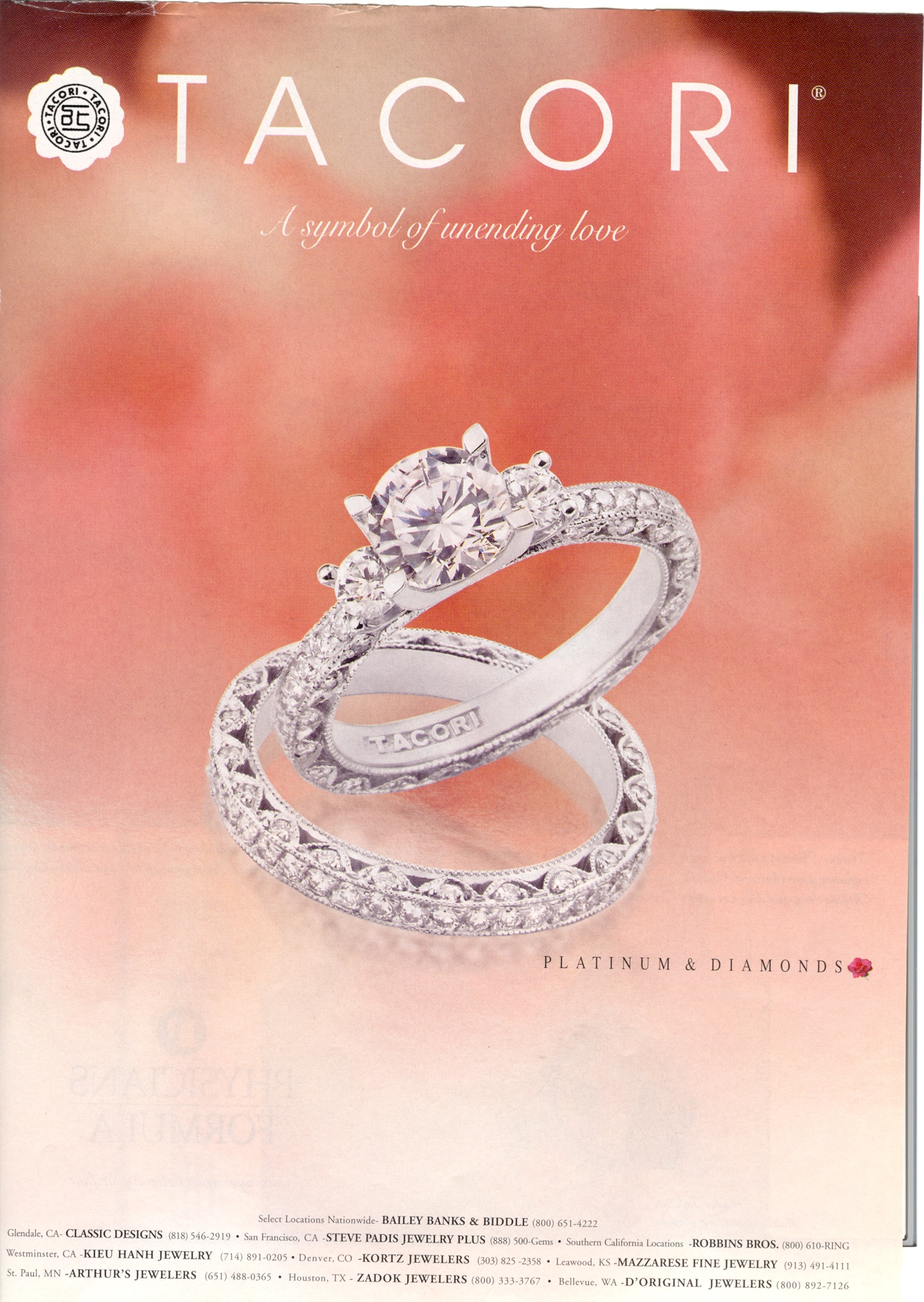
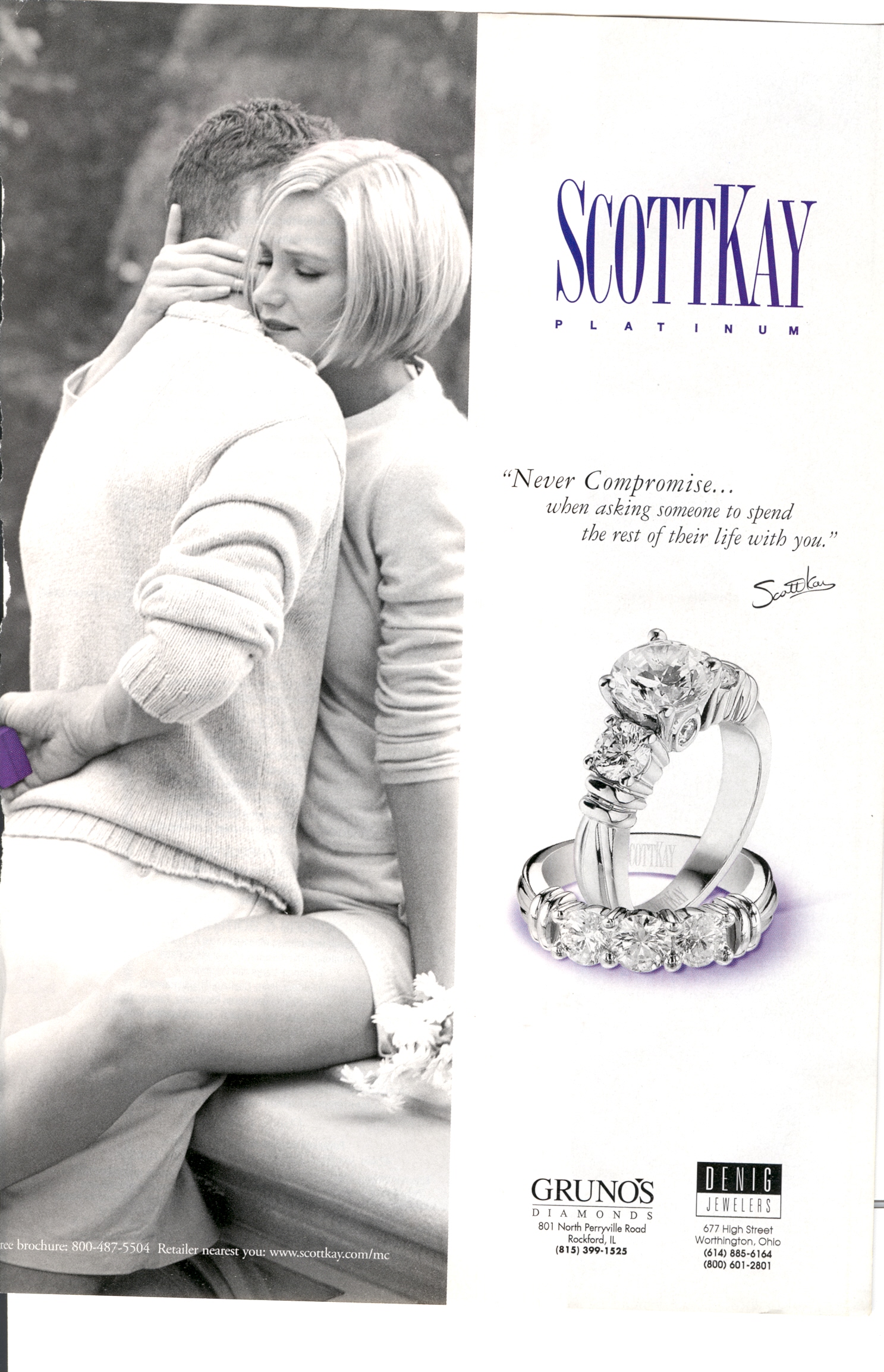
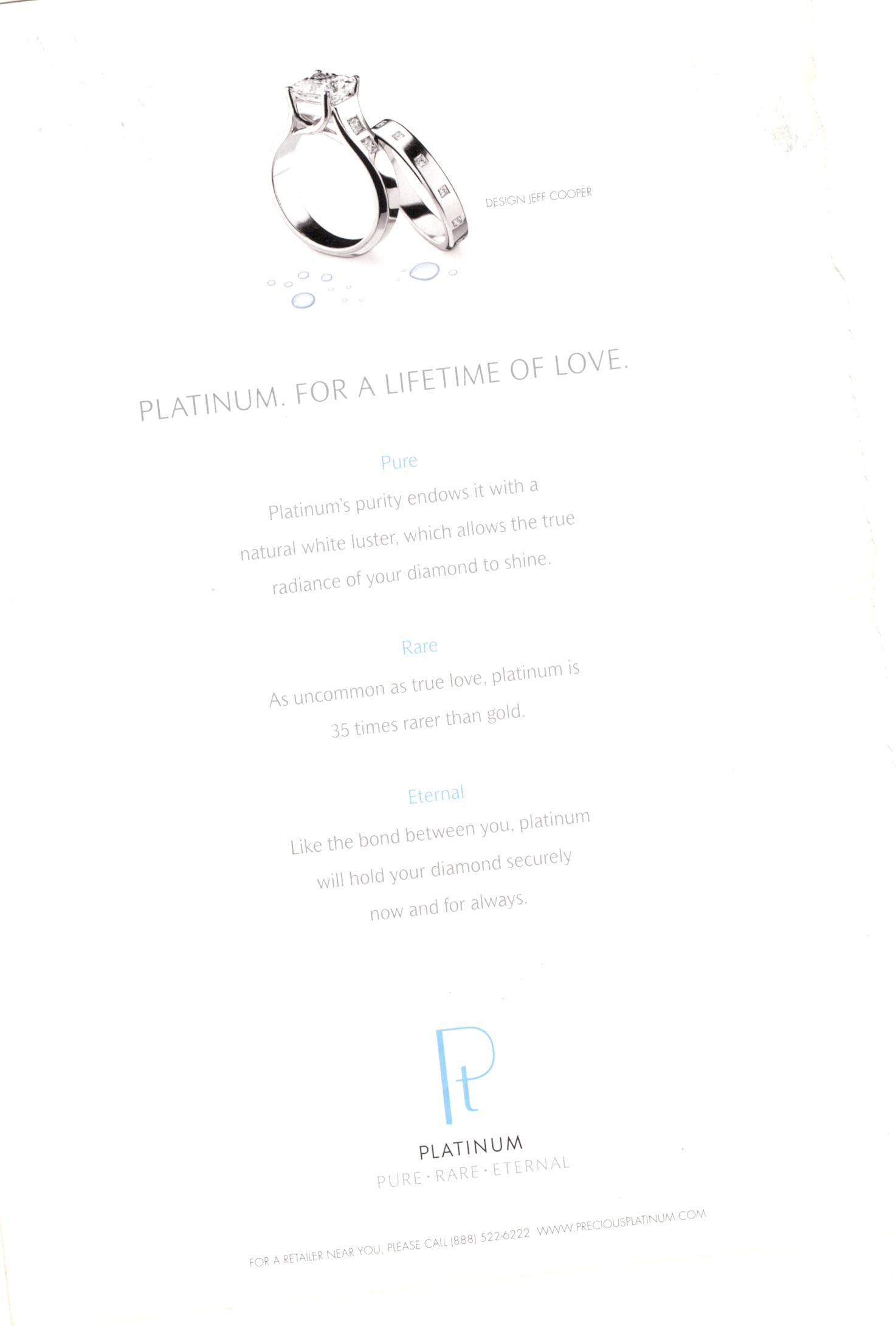
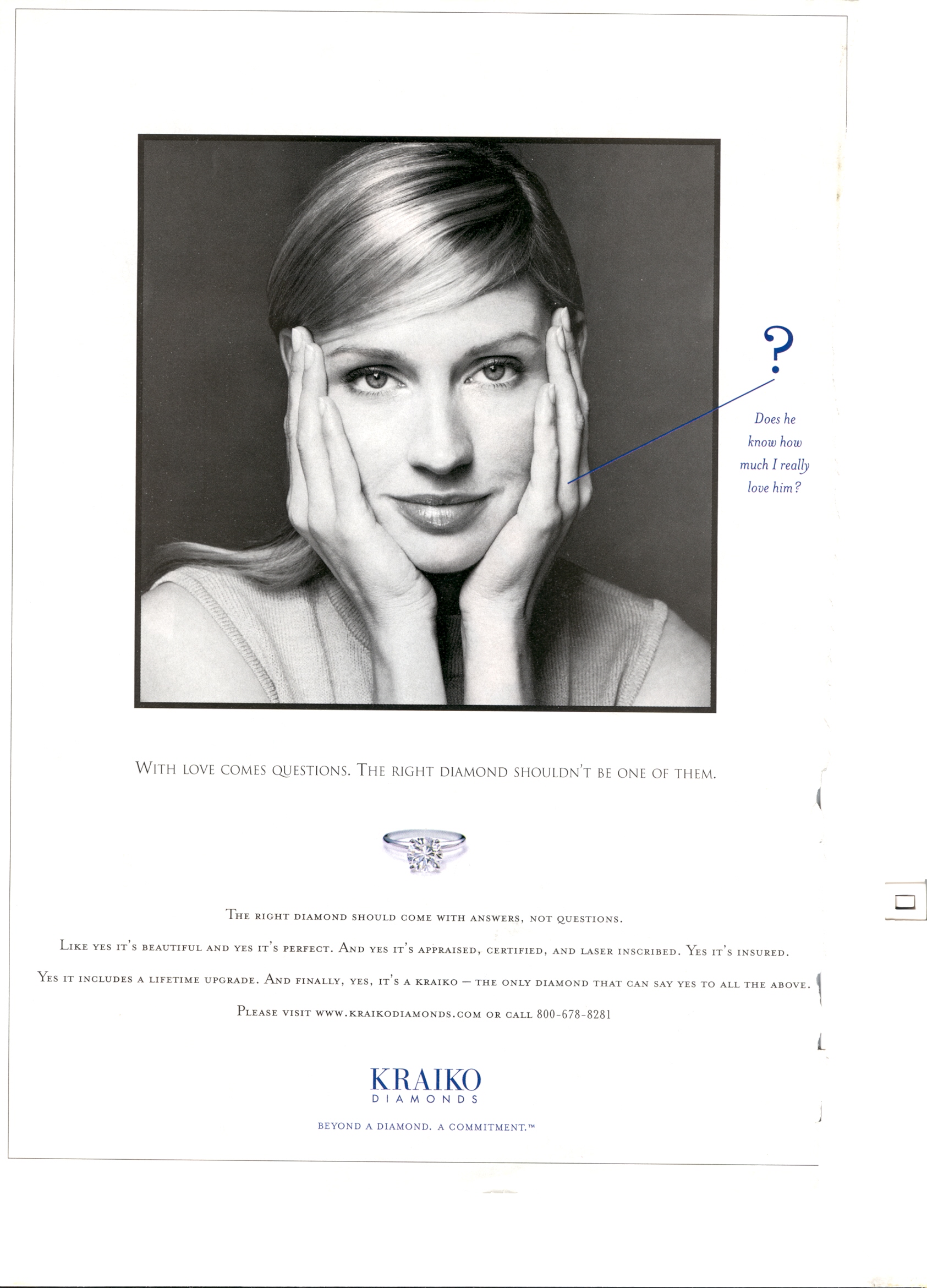
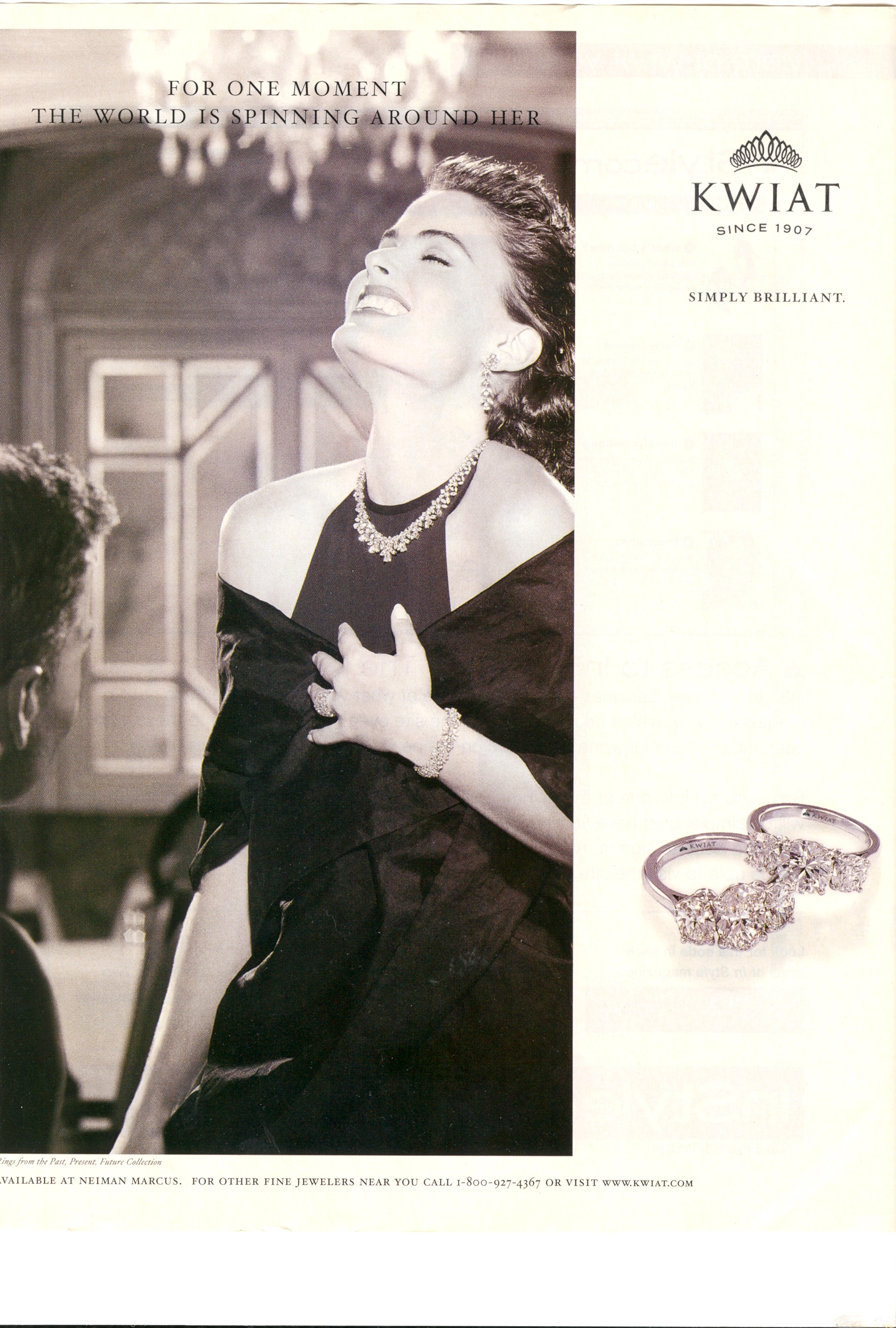
I use this set of engagement ring ads, though any set would do, to illustrate the way in which ads have to sell much more than just the product. To sell an engagement ring, these ads also are selling: monogamy and the pair bond; marriage as the proper way to cement that bond; love, and love as a basis for marriage; the need for a symbol of commitment and a ring (a diamond ring specifically, apparently platinum preferably) as that symbol; men’s role as financial provider and decider (in that he buys the ring and proposes); the importance of the proposal (it needs to be a surprise and an event in itself); the importance of an expensive ring (i.e., “Does he know how much I really love him?”); and… what else?

scan0018.jpg

Text: “When you can truly be yourselves. Your love has just gone Platinum.”

media-engagement-rings-6.jpg

Text: “Tacori: A symbol of unending love”

media-engagement-rings-5.jpg

Text: “Never compromise… when asking someone to spend the rest of their life with you.”

media-engagement-rings-4.jpg

Text: “Platinum. For a lifetime of love. Platinum’s purity endows it with a natural white luster which allows the true radiance of your diamond to shine. As uncommon as true love, platinum is 35 times rarer than gold. Like the bond between you, platinum will hold your diamond securely now and for always.”

media-engagement-rings-3.jpg

She asks: “Does he know how much I really love him?”

Under the image: “With love comes questions. The right diamond shouldn’t be one of them.”

media-engagement-rings-1.jpg

Text: “For one moment the world is spinning around her.”

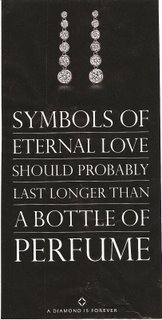
Here’s an ad for earrings that has the same message about love:

earrings.jpg

This video, produced by Mother Jones, shows Pastor Rod Parsley arguing that America was founded to destroy Islam and has a divine mandate to do so.  It is interesting on at least two levels:

First, as a response to the Reverend Wright story, it reminds us that Wright is not the only preacher who says outrageous things, and Obama is not the only politician to get “spiritual guidance” from a controversial figure.  In which case, the question might be: Which outrageous preachers are most likely to be targeted as problematic?  And by who?

Second, the video could be used to demonstrate how a person can be made to appear frightening or evil through editing.  In this case, the move to slow motion, the use of black-and-white, the strategic stills.

In many ways, this video, produced by the left, uses many of the same tactics as the anti-Reverend Wright clips on Fox News and elsewhere. For comparison, The Daily Show put together a montage of coverage that appears in the clip below (at about 6 minutes, 51 seconds) that uses choice words (“fiery”), tone of voice, and fast motion:

Thanks to Joe DeM. for tipping us off to the Mother Jones video!

Lisa Wade, PhD is an Associate Professor at Tulane University. She is the author of American Hookup, a book about college sexual culture; a textbook about gender; and a forthcoming introductory text: Terrible Magnificent Sociology. You can follow her on Twitter and Instagram.

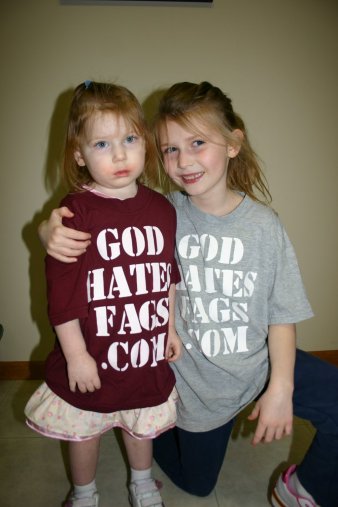
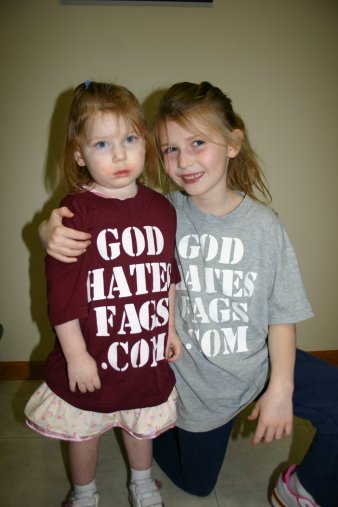
god_hates_fags.jpg

In case you weren’t aware, godhatesfags.com is a website run by Fred Phelps, leader of Westboro Baptist Church in Topeka, Kansas. They’re the ones who have anti-gay protests around the U.S., including at some points showing up at the funerals of gay men, and have moved on to a general “God hates America” theme, due to all our depravity. He makes Jeremiah Wright (Obama’s pastor) look like a teddy bear–at least he was just saying God ought to damn America.

These t-shirts depress me more than anything I have seen in a really long time.

A completely unrelated Kansas story: When I was living there, in a small town, I discovered that my vet was the head of the Board of Education and was leading the anti-evolution efforts at the time (this was before voters elected a new Board and got rid of a lot of the anti-evolution people).

Anyway, thanks to Larry H. from The Daily Mirror for this photo (found here). I guess.

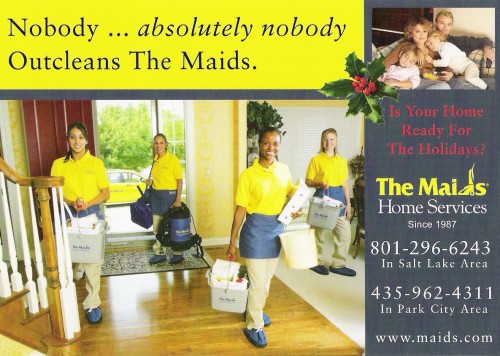
From the website of The Maid Brigade, a housecleaning service offering “green” cleaning services.

Who hires house cleaners (or as they put it, “who needs a maid?”)?

c2.jpg

c1.jpg

Who cleans houses?


w1.jpg

w2.jpg

w3.jpg

When I went through the whole site I was able to find one picture of a white, non-Hispanic-appearing woman cleaning and one picture of a somewhat dark-skinned homeowner, but the overwhelming pattern is what you see here.

And no, there were no male maids. Do you really even have to ask?

Anyway, it’s an interesting example of class, the commodification of housework, and the ways that class and race separate women, such that upper-middle-class white women often free themselves from the second shift of housework by hiring other poorer, often non-white women to do it.

NEW! (Jan. ’10): Sara L. sent us another example: