Content Note: This posts discusses various forms of transmisogyny and TERFs

2Photo taken at the Napoli Pride Parade in 2010

On Tuesday, Lisa Wade posted a piece, asking some important questions about drag- Is it misogynistic? Should it be allowed in LGBT safe spaces? How can pride organizers enforce drag-free pride events, if such an idea is useful? The good news is that many of these questions are already being asked in some circles. The bad news, is that outside of these circles –where specifics are unknown and the cis experience takes centre stage– such questions can lead to some harmful conclusions.

First some basics. Wade contends that a recent Glasgow Free Pride event “’banned’ drag queens from the event, citing concerns that men dressing up like women is offensive to trans women.” The event didn’t ban drag queens, but rather decided not to have any drag acts perform on their stage, but even this decision has now been reversed. In any case, the initial decision to go without drag performances was not made because of offence caused, as Wade says, but rather because the Trans/Nonbinary Caucus of the event felt that it would “make some of those who were transgender or questioning their gender uncomfortable”. Wade’s misunderstandings seem to come from having used the Daily Beast article on the matter as a source rather than the actual press release from free pride.

The title of Wade’s essay, and the repeated references to “girlface” in the essay itself, not only misunderstood the critiques levelled at drag, but also conflated blackface and drag. This misconception is appropriative of black struggle- it stems from conflation of the two separate histories, one of which was a major tool in the subjugation of black people across America and another which grew as part of queer (then, gay) liberation in a diverse, working class environment, led by women of colour. Comparing the two of them is highly disingenuous.

It is an argument that is about as novel as it is accepting of trans people’s existence. Sheila Jeffries, among many other TERFs, is infamous for using this line of argument to capitalize on the widespread condemnation of blackface in her efforts to attack trans women. Wade is, whether she intends to or not, using this dog whistle in her essay.

Getting a few facts wrong (Which is understandable if you are not part of these conversations. The Daily Beast got it wrong too and this is why allies are usually asked to take a seat in these debates.) and using terminology that is usually reserved for deeply transphobic arguments are somewhat superficial problems that lay on the surface of a much bigger problem: the centering of cis feelings on trans issues. Wade seems to think that the biggest problem, with the Glasgow Free Pride decision is that drag parodies femininity and womanhood.

While this is true in the general sense, drag is understood in the trans community to be oppressive because of the central conceit of the parody: that the performer, while affecting womanhood, is “actually a man.”

It’s about the bulge in the dress, the errant chest hair and the deep voice from the sculpted body. The fact that they’re “always PMSing” is a joke about how they don’t have uteruses. Their stage names, often punning on genitals (“Conchita Wurst”), act to center not their femininity, but the “failure” to produce a cis femininity. This was the drag that the gay media was insisting be reinstated, and that Glasgow Free Pride allowed on their stage again when they reversed their decision.

Drag is not monolithic –both historically and sociologically, different drags have and do exist– which is why Glasgow Free Pride specifically critiques “cis drag” (drag performed by cis people) as making people uncomfortable.

Many of the drag queens of color who led S.T.A.R. and Stonewall were not people who played a woman on stage or in a bar for a few hours a week, but people who lived their lives as women, and their drag is fundamentally different from that of people who perform in televised competition today.

Maybe these drags belong on a pride. Maybe there are decolonised drags which would be welcome. But contemporary western cis drag isn’t about femininity, it’s about the drag queen’s failures to produce an impression of cis womanhood, the upshot of which, also produces a caricature of trans womanhood, seen by society as a flawed womanhood.

Given this, it is possible to see drag as an attack on transwomanhood first and foremost, and cis women more as collateral damage in a long controversy within LGBTQIA+ communities. Glasgow Free Pride understood this, and this is why the call came from their trans caucus, not their women’s caucus.

Writing a post which centers the debate on cis women while spending a minimal time on trans women derails a conversation that should be about the transmisogyny of contemporary drag. It is an issue which is actively causing damage by perpetuating stereotypes and, yes, making pride parades unwelcoming for trans women and other maab trans people.

Wade should rest assured that the “conversation” she calls for is, actually, happening. It happens in trans communities all the time. It bubbled over into the mainstream for a few days, and trans people lost a safe space in a radical pride alternative in the process. What she’s actually asking is that the conversation become permanently legible to cis women by focusing on the minor issues that effect them, rather than the transmisogyny of drag.

T.Walpole is on twitter. More info at drcabl.es/awesome/. She originally wrote this post for Cyborgology.

I saw “Trainwreck” last night. The 7:00 p.m. showing at the 68th Street AMC was full. Maybe people had come just to get out of the apartment and yet avoid the beastly heat, but they enjoyed the movie.  Sometimes the laughter lasted long enough to cover up the next joke.

The “Trainwreck” story is standard rom-com: Amy Schumer plays a young woman who rejects the idea of commitment and love. Circumstances put her together with a man she seems to have nothing in common with. You can guess the rest.

But this is Amy Schumer’s movie, so there’s an important twist – the conventional sex roles are reversed. It’s the man who is sweet and naive and who wants a real relationship; the woman has a lot of sex with a lot of different guys, drinks a lot, smokes weed, and resists love until at the end, she decides to become the woman he wants her to be.

Here is the R-rated version of the trailer:

What interested me was not the movie itself, but the reaction in some conservative quarters. For Armond White at the National Review, the movie triggered something like what Jonathan Haidt calls “disgust” – a reaction to the violation of strong taboos that surround things like food, sex, blood and other bodily matters, and death. These taboos are often arbitrary, not rational. Pork is an “abomination,” for example, because… well, because it is, and because pigs are “unclean.”

“Trainwreck” has no pork, but it does have what some find unclean.

Schumer’s tampon jokes and gay jokes, female versions of locker-room humor, literally drag pop culture to the toilet. A girl-talk scene set in adjoining restroom stalls — one revealing dropped panties, the other panty-less (obviously Amy) — is just Apatow using women to show off his indecency.

As a comedian and now as a filmmaker, Schumer talks about women-things: body functions and body parts. These jokes seem to elicit two different kinds of laughter. Back when researchers studying small group interaction were trying to code and categorize behavior, laughter posed a problem (see this earlier post). It could be coded as “Shows Tension,” but it might also be “Shows Tension Release.”

With Amy Schumer jokes, the male laughter is mostly a nervous, full of tension about a taboo subject. But the female laughter seems much less inhibited – tension release, maybe even a relief, as if to say, “Someone is finally talking publicly and frankly about things we could only whisper about,” since most of the time they have had to pretend to share the male taboo.

Indecency indeed. But something is indecent only to members of groups that deem it indecent. Some groups are not at all disgusted by pork.  And for some audiences, tampon jokes and toilet-stall conversations about Johnny Depp movies are not indecent; they’re just funny. What audiences might those be? Women.

Take the tampon joke that the National Reviewer finds indecent. It would seem obvious that used tampons look different depending on where you are in your period – less bloody on the final day, more so a few days earlier. But at the mere mention of this fact in “Trainwreck,” hilarity ensues, especially among women in the audience.

The thing about taboos – ideas about what is indecent or disgusting – is that entire social structures get built around them. To violate the taboo is to threaten the entire edifice. Powerful taboos on women-things often go with male domination. So for the National Review, the “Trainwreck”reversal of rom-com gender roles makes the movie dangerous and subversive.

Here are some excerpts from the review just to give the flavor of this Purity-and-Danger-like conflating of taboo, female sexuality, and social/political threat to the established order (emphasis mine):

Schumer turns female sexual prerogative into shamelessness

the degradation of sex — and women

uses sex to promote feminist permissiveness.

She enjoys a sexual license

Amy brazenly practices the same sexual habits as men

Lacking
. . . old-fashioned sense of shame,

It’s merely brazen, like Lena Dunham’s HBO series, Girls (also about a promiscuous female writer

Schumer’s film can be seen to distort human relations into smut.

This is not just disrespectful, it confirms Schumer’s project of cultural takeover,

she aims to acquire cultural power

Schumer disguises a noxious cultural agenda as personal fiat. She’s a comedy demagogue who okays modern misbehavior yet blatantly revels in PC notions about feminism, abortion, and other hot-button topics

Wow.

I should add that not all conservative publications felt so threatened. Joe Morganstern at the Wall Street Journal gave the movie a warm review. Breitbart saw the movie’s essential conservatism (“The anti-slut message is a healthy one”) and praised Schumer as a comic actor.  Still, the National Review piece seems emblematic of something broader in the cultural conservative camp: a taboo-like reaction to female sexuality.

Originally posted at Montclair SocioBlog.

Jay Livingston is the chair of the Sociology Department at Montclair State University. You can follow him at Montclair SocioBlog or on Twitter.

SocImages News:

  • A huge thanks to Jon Smadja for freshening up the site and made it mobile friendly!

You like!  Here are our most appreciated posts this month:

Thanks everybody!

Editor’s pick:

Top comic:

Top post on Tumblr this month:

Social Media ‘n’ Stuff:

This is your monthly reminder that SocImages is on TwitterFacebookTumblr, and Pinterest.  I’m on Facebook and most of the team is on Twitter: @lisawade@gwensharpnv@familyunequal, and @jaylivingston.

Finally…

It’s been a hard summer so far, but let’s not let July 2015 go without one more time reveling in the joy of discovery:

2

Lisa Wade, PhD is an Associate Professor at Tulane University. She is the author of American Hookup, a book about college sexual culture; a textbook about gender; and a forthcoming introductory text: Terrible Magnificent Sociology. You can follow her on Twitter and Instagram.

All attributed motivations are approximate. All races are unconfirmed. All crimes are alleged. All oppression is interconnected.


June 17, 2015:

White American male with a weapon who believes in his own superiority kills in order to feel powerful. He kills nine black parishioners because black people are all the same to him and he needs to do what he needs to do to remind the world that he is dominant.


June 17, 2015:

White American male with a weapon who believes in his own superiority tries to kill in order to feel powerful. He crashes in the midst of trying to run someone over with his car because “go back to the country you came from” and don’t tell him not to use the business’ phone because he is dominant.


June 21, 2015:

White American male with a weapon who believes in his own superiority stabs in order to feel powerful. He stabs three musicians because ew gay and “skinny jeans” and he will show them what happens to fags because he is dominant.


June 26, 2015:

White American male with a weapon who believes in his own superiority kills in order to feel powerful. He shoots a Muslim man in the head at a four-way stop because “go back to Islam” – or maybe a traffic dispute – because it was his turn to go, damn it, because he is dominant.


July 1, 2015:

White American male with a weapon who believes in his own superiority kills in order to feel powerful. He kills a lion because it’s one of the most majestic creatures he can think of and being able to kill and behead it affirms that he is dominant.


July 10, 2015:

White American male with a weapon who believes in his own superiority threatens murder in order to feel powerful. He retaliates against a black woman because she refuses to perform subservience and “I will light you up” if that’s what it takes to show you people that I am dominant.


July 11, 2015:

White American male with a weapon who believes in his own superiority kills in order to feel powerful. He opens fire on two Native American men he believes are homeless because he’s “tired of watching them” and it is not acceptable that he is uncomfortable or inconvenienced because he is dominant.


July 18, 2015:

White American male with a weapon who believes in his own superiority attempts murder in order to feel powerful. He shoots a person in the face because he believes he is an undocumented immigrant – “a fucking Mexican” – because this is his country and, therefore, he is dominant.


July 18, 2015:

White American male with a weapon who believes in his own superiority kills serially in order to feel powerful. He pulls a gun and strangles a woman with the intent to torture because he assumes she is nothing to anybody and murdering prostitutes makes him feel dominant.


July 19, 2015:

White American male with a weapon who believes in his own superiority kills in order to feel powerful. He, a police officer, shoots a man in the face because he might be getting away after a traffic violation; black lives don’t matter because he is dominant.


July 22, 2015:

White American male with a weapon who believes in his own superiority kills in order to feel powerful. He murders his wife and her two children because she is giving him “relationship problems” and she doesn’t have the right to do that because he is dominant.


July 23, 2015:

White American male with a weapon who believes in his own superiority kills in order to feel powerful. He kills women because they keep doing and saying things that he does not approve of and he doesn’t have to take it anymore because he is dominant.


August 3, 2015:

White American males with weapons who believe in their own superiority stockpile weapons in order to feel powerful. They amass guns and ammunition and make homemade bombs because the the government insists on existing and they refuse to respect any entity above themselves because they are dominant.


August 6, 2015:

White American male with weapons who believes in his own superiority makes bombs in order to feel powerful. He builds explosive devices filled with BBs and nails because he sympathizes with the KKK, the Nazis, and what the Confederate Army was really defending but luckily he only blows off his own leg and I wonder now how he feels about being dominant.


August 7, 2015:

White American male with a weapon who believes in his own superiority kills in order to feel powerful. He shoots a man four times within seconds of apprehending him because I am a cop and you are not allowed to do that and his only consequence is to get fired for “bad judgement” because he is dominant.


August 16, 2015.

White American male with a weapon who believes in his own superiority kills in order to feel powerful. He kills a man because he got in the way of his desire to kill his fiancee, who deserved it, because she argued with him and it was necessary to remind her that he is dominant.


Summer, 2015.

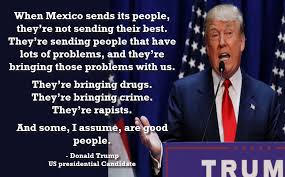
2Killing at the hands of an illegal alien spurs furious debate about closing borders and deporting the undocumented. It is the year before a presidential election and candidates denounce undocumented immigrants as the conveyors of Mexican violence into our country.

When Robert J. Sampson, Harvard sociologist and criminologist, wrote about this news, he was not writing about the death of young Kate Steinle in San Francisco in 2015, but about murders in New Jersey in 2007. And he wrote to say that his research and that of others showed that immigrants are less likely than the native-born to commit murder and “that immigration — even if illegal — is associated with lower crime rates….” He had previously made similar claims in The New York Times and had gotten vituperation in response.

Popular skepticism toward Sampson might be expected given the media coverage of sensational crimes like the one on Pier 14 and of Mexico’s drug wars. But behind the headlines, the daily reality on the streets of the U.S. seems to be that immigrants bring less crime. Indeed, scholars like Sampson have suggested that the surge of Latino immigration, documented and not, may partly explain the great drop in violent crime in American cities since the 1980s.

Now, two presidential cycles since the Sampson article, we have new studies and more technically sophisticated ones on the topic. What do they say about the effects of immigration on crime and violence?

Immigration does not increase crime

The research I reviewed – several recent articles (see bibliography here) – is pretty consistent: Immigrants and concentrations of immigrants are associated with lower rates of crime and homicide. To be more cautious: at minimum, there is no connection between immigration and higher rates of crime.

Studies of individuals show that, as two experts summarize, “immigrants are less, not more, crime prone than their native-born counterparts.” Second- and third-generation immigrants start to look more like many-generation Americans in criminality (much as they do in other ways, such as diet and health behaviors). One study suggests that for adolescents the “protective” effect against criminality of being an immigrant may wear off after four years. But newcomers are notably less likely to commit crime than otherwise similar American-born youth.

Neighborhoods with many immigrants are not higher in crime

Many new studies compare neighborhoods, cities, or counties to assess the relationship between local concentrations of immigrants (or of Latinos) and rates of crime or violence. The general conclusion is that the higher these concentrations in a community, the lower the rates. A couple of studies find that the connection depends on the local context. In more impoverished neighborhoods or in cities with historically larger numbers of immigrants or with immigrant political power, additional immigration seems to push crime down yet more.

Complex statistical work suggests that this correlation reflects a causal connection: more immigrants arrive and violent crime fades. Why would that be so?

Sampson and others suggest that Latino immigrants have stronger families and community institutions, such as churches, than do the native-born. These provide more social control over youth. Researchers also propose that immigration has helped economically revitalize many U.S. cities and driven down crime that way, too.

Whatever the explanation, the general pattern is the reverse of the heated rhetoric: Overall, immigration goes with less criminal violence.

Claude Fischer is a sociologist at UC Berkeley and is the author of Made in America: A Social History of American Culture and Character. This post originally appeared at his blog, Made in America, and was re-posted on the Berkeley Blog.

Hoooo-ray! This (newly described by science) spider has 8 legs and it’s doing cartwheels to celebrate SocImages’ 8th birthday!

1

This is our 5,530th post and still going strong. Thanks to all of you who discovered SocImages this year and those of you who’ve been hanging on since the beginning!

Here are some highlights from the last year. Quite a trip down memory lane!

  • Sociological Images was awarded this year’s American Sociological Association’s Distinguished Contributions to Teaching Award. We would love to think that the blog eases class prep a little and helps people get the best out of their students. If that’s what this award means, we’re over the moon.
  • I was honored to be invited to talk about SocImages in a plenary speech at the Midwest Sociological Society. Of course, there were lots of pictures. You’re welcome to view the slideshow here.
  • Rush Limbaugh covered a post about the relationship between studying economics and being antisocial and it sheds a scary light into the inner workings of his mind. (And I got called a “professorette” so… like I said, all high kicks all the time.)
  • We got tumbld by Wil Wheaton!
  • Two new Pinterest pages: pinkwashing and sexy what!?, a collection of totally random stuff being advertised as weirdly and unnecessarily sexual.
  • Our social media accounts continue to grow like weeds: thanks to the 74,000 of you on facebook,  23,000 on tumblr, 22,000 on twitter, and 14,000 on pinterest.  We do have fun and learn stuff, too!

Here’s to another year! (Sorry about the spider.)

Lisa Wade, PhD is an Associate Professor at Tulane University. She is the author of American Hookup, a book about college sexual culture; a textbook about gender; and a forthcoming introductory text: Terrible Magnificent Sociology. You can follow her on Twitter and Instagram.

Recently there’s been heightened attention to calling out microaggressions and giving trigger warnings. I recently speculated that the loudest voices making these demands come from people in categories that have gained in power but are still not dominant, notably women at elite universities.  What they’re saying in part is, “We don’t have to take this shit anymore.” Or as Bradley Campbell and Jason Manning put it in a recently in The Chronicle:

…offenses against historically disadvantaged social groups have become more taboo precisely because different groups are now more equal than in the past.

It’s nice to have one’s hunches seconded by scholars who have given the issue much more thought.

Campbell and Manning make the context even broader. The new “plague of hypersensitivity” (as sociologist Todd Gitlin called it) isn’t just about a shift in power, but a wider cultural transformation from a “culture of dignity” to a “culture of victimhood.” More specifically, the aspect of culture they are talking about is social control. How do you get other people to stop doing things you don’t want them to do – or not do them in the first place?

In a “culture of honor,” you take direct action against the offender.  Where you stand in society – the rights and privileges that others accord you – is all about personal reputation (at least for men). “One must respond aggressively to insults, aggressions, and challenges or lose honor.” The culture of honor arises where the state is weak or is concerned with justice only for some (the elite). So the person whose reputation and honor are at stake must rely on his own devices (devices like duelling pistols).  Or in his pursuit of personal justice, he may enlist the aid of kin or a personalized state-substitute like Don Corleone.

In more evolved societies with a more extensive state, honor gives way to “dignity.”

The prevailing culture in the modern West is one whose moral code is nearly the exact opposite of that of an honor culture. Rather than honor, a status based primarily on public opinion, people are said to have dignity, a kind of inherent worth that cannot be alienated by others. Dignity exists independently of what others think, so a culture of dignity is one in which public reputation is less important. Insults might provoke offense, but they no longer have the same importance as a way of establishing or destroying a reputation for bravery. It is even commendable to have “thick skin” that allows one to shrug off slights and even serious insults, and in a dignity-based society parents might teach children some version of “sticks and stones may break my bones, but words will never hurt me” – an idea that would be alien in a culture of honor.

The new “culture of victimhood” has a different goal – cultural change. Culture is, after all, a set of ideas that is shared, usually so widely shared as to be taken for granted. The microaggression debate is about insult, and one of the crucial cultural ideas at stake is how the insulted person should react. In the culture of honor, he must seek personal retribution. In doing so, of course, he is admitting that the insult did in fact sting. The culture of dignity also focuses on the character of offended people, but here they must pretend that the insult had no personal impact. They must maintain a Jackie-Robinson-like stoicism even in the face of gross insults and hope that others will rise to their defense. For smaller insults, say Campbell and Manning, the dignity culture “would likely counsel either confronting the offender directly to discuss the issue,” which still keeps things at a personal level, “or better yet, ignoring the remarks altogether.”

In the culture of victimhood, the victim’s goal is to make the personal political.  “It’s not just about me…”  Victims and their supporters are moral entrepreneurs. They want to change the norms so that insults and injustices once deemed minor are now seen as deviant. They want to define deviance up.  That, for example, is the primary point of efforts like the Microaggressions Project, which describes microaggressions in exactly these terms, saying that microaggression “reminds us of the ways in which we and people like us continue to be excluded and oppressed” (my emphasis).

5

So, what we are seeing may be a conflict between two cultures of social control: dignity and victimhood. It’s not clear how it will develop. I would expect that those who enjoy the benefits of the status quo and none of its drawbacks will be most likely to resist the change demanded by a culture of victimhood. It may depend on whether shifts in the distribution of social power continue to give previously more marginalized groups a louder and louder voice.

Cross-posted at Montclair SocioBlog.

Jay Livingston is the chair of the Sociology Department at Montclair State University. You can follow him at Montclair SocioBlog or on Twitter.

Reddit’s co-founder Steve Huffman, who is currently taking over CEO responsibilities in the wake of Ellen Pao’s resignation, has started doing these Fireside AMAs where he makes some sort of edict and all of the reddit users react and ask clarifying questions. Just today he made an interesting statement about the future of “free speech” in general and certain controversial subreddits in particular. The full statement is here but I want to focus on this specific line where he describes how people were banned in the beginning of Reddit versus the later years when the site became popular:

Occasionally, someone would start spewing hate, and I would ban them. The community rarely questioned me. When they did, they accepted my reasoning: “because I don’t want that content on our site.”

As we grew, I became increasingly uncomfortable projecting my worldview on others. More practically, I didn’t have time to pass judgement on everything, so I decided to judge nothing.

This all comes at the heels of some interesting revelations by former, former Reddit CEO Yishan Wong saying that Ellen Pao was actually the person in the board room championing free speech and it was Huffman, fellow co-founder Alexis Ohanian, and others that really wanted to clamp down on the hate speech. So that’s just a big side dish of delicious schadenfreude that’s fun to nibble on

But those quotes bring up some questions that are absolutely crucial to something Britney Summit-Gil posted here a few days ago, namely that Reddit finds itself in a paradox where revolting against the administration forces users to recognize that “Reddit is less like a community and more like a factory,” and that the free speech they rally around is an anathema to their other great love: the free market.

What structures this contradiction, what sets everyone up at cross-purposes, also has a lot to do with Huffman’s reticence to ban people as the site grew. After all, why would Huffman feel “increasingly uncomfortable” making unilateral banning decisions as the site grew, and why was his default position then be “to judge nothing”? Why does it, all of a sudden, become unfair or inappropriate to craft a community or even a product with the kind of decisiveness that comes with “I just don’t like it”?

The answer to all of this comes out of two philosophic ideas: One is the Enlightenment model of reason that we still use to undergird our concepts of legitimacy and rhetorical persuasiveness. That big decisions that effect lots of people should be argued out and have practical and utilitarian reasons and not be based on the whims of an individual. That’s what kings did and that sort of authority is arbitrary even if the results seem desirable.

The second is relatively more recent but still fundamental to the point of vanishing: the idea of the modern society as being governed by bureaucracies that have written rules that are followed by everyone. The rule of law, not of individuals. Bureaucracies are nice when they work because if you look at the written down rules, you have a fairly good idea of how to behave and what to expect from others. It’s a very enticing prospect that is rarely fully experienced.

Huffman doesn’t say as much but this is essentially how we went from fairly common-sense decisions about good governance to free speech fanaticism: not choosing to ban is the absence of arbitrary authority. When you have a site that lets you vote on things it feels like a decision to stop imposing order from the top is making room for democratic order from below.

But this is closer to the kind of majoritarian tyranny that even the architects of the American constitution were worried about. Voting in the 1700s was something that only aristocrats were qualified to do. Leave it to rabble and you would have chaos. That’s why they built a bicameral legislature that originally featured a senate with members appointed by state governments.

It should also be said that one of the oldest laws in the United States is that Congress can’t make laws that specifically target a single individual or organization. That’s why those efforts to defund Planned Parenthood in 2011 were immediately dismissed as unconstitutional. Laws have to apply to everyone equally.

And so what Huffman is presently faced with is a problem of liberal (lowercase L) and modern state governance. How do you write broad laws that classify r/coontown without just saying “I ban r/coontown”?  Unfortunately, this is also the biggest fuel line to the flames of fear that banning even detestable subreddits are a threat to free speech in general. This is, fundamentally, why it even makes sense to argue that banning an outwardly and explicitly racist subreddit can threaten the integrity of other subreddits either in the present or sometime in the future. Laws apply to everyone equally.

So if Reddit wants to get itself out of this paradox, I say dispense with liberalism all-together. At the very least come up with some sort of aspirational progressive vision of what kind of community you want to have and persuade others that they should work to achieve it. This sort of move is the biggest departure that anarchist political theory takes from mainstream liberalism: that communities can agree on the features of a future utopia and govern in the present as if you are already free to live that future utopia. Organizing humans with blanket laws forces you to explain the obvious, namely that hateful people suck and should be persuaded to act otherwise if they wish to remain part of a community that is meaningful to them.

Right now Huffman and the rest of the Reddit administration have come up with some strange and inelegant ways of dealing with the present problem. They make all these dubious distinctions between action and speech; between inciting harm and just abstracting wishing it on people; and lots of blanket “I know it when I see it” sorts of decency rules. Under liberalism redditors would be right to demand very specific descriptions of the “I know it when I see it” kinds of moments.

But if prominent members were to just be upfront in stating what sort of community they would like to see and then acting as if it already existed, discontents would have to persuade admins that they were acting against their own interests and propose a more compelling way to achieve the stated utopia. If they don’t like the utopia at all, then those people can leave for Voat and new users who like that utopia might come to replace them. At the very least, if Reddit were to take this approach, users might actually start answering the question that is at the heart of the matter but is rarely stated in explicit terms: who gets to be a part of the community?

Cross-posted at Cyborgology.

David Banks is a PhD candidate in Rensselaer Polytechnic Institute’s Science and Technology Studies Department. You can follow him on Twitter and Tumblr.