NEWS

Find us on facebook and twitter, if you like.

Germany! I’ll be in Munich for the month of September!  If there are any Sociological Images fans in the area, I’d love to have a cocktail hour!  Email me at socimages@thesocietypages.org and we’ll set it up.

Our New Look:  We’d like to thank Jon Smajda, our IT and all-around tech fix-it guy, for the great redesign of the site. As you may have noticed, it’s now easier to search for posts, comments are threaded, and the page looks less cluttered overall. Jon, your work is greatly appreciated!

Better Searchage! We updated some of our tags to make it easier to search for posts. There were two major changes:

(1) While we still have a generic “race/ethnicity” tag, we also created tags for the major racial/ethnic groups recognized in the U.S.  You can now search for “race/ethnicity: Asians/Pacific Islanders” and so on. In some cases we struggled with how to define groups or which labels to use. We settled on terms that are generally recognizable and that were short enough to fit in our tags box.  Most posts that are labeled with the “race/ethnicity” tag are now also assigned to at least one specific racial/ethnic tag.

(2) Previously we had individual countries listed alphabetically in the tags list. We decided it would be better to have them all listed as “nation: [specific country]” so they show up together as a group rather than scattered throughout the tags list. So, for instance, Egypt is now listed as “nation: Egypt.”

Changes to Comment Moderation Policy: We have always taken a hands-off approach to reader comments so as to not stifle discussion.  First, while we try to read every comment, we prefer to focus on putting up new content and we found that readers did a pretty good job of responding to each other.  Second, we often found even hateful and mean-spirited comments useful for illustrating some of the points we were trying to make, particularly how groups who fear loss of privilege will lash out and attempt to invalidate any critiques of their social position.  Finally, we have pretty thick skins and don’t really get too worked up about people insulting us.

However, as we posted about earlier in the month, we had an incident in which readers of an anti-feminist website left extremely hateful and threatening comments targeting a specific reader, including posting personal information (such as location) and encouraging physical violence against her and her dog. As a result we rethought our attitude toward comments. We’re not adopting a formal policy, but we decided some moderation is necessary. In general, comments that are hateful or threatening toward other commenters, or that are mean-spirited toward particular social groups (i.e., “I hate Black people”) and do not in any way contribute to a discussion of the issue will be deleted. We will undoubtedly miss some comments or not notice them immediately. We certainly won’t delete comments just because they disagree with us or are rather snarky, and we of course can’t protect readers from any comment they might find unpleasant or offensive–the comments section would have to be shut down completely. Basically, our policy toward comments is: Don’t be an ass, and if you are, we’ll delete your comments when we have time.

We also decided not to provide direct links to racist or misogynistic sites. We’ll provide the web address in posts about such sites so readers know where images came from but won’t have a link; this prevents their administrators from tracking back to our site and posting a barrage of threatening or overtly offensive comments.

We know these changes in how we handle comments won’t please everyone, or maybe anyone–some will want us to moderate more and others would prefer that we don’t moderate at all. But it seemed like the best compromise for preserving the ability for readers to discuss–and criticize–posts while not allowing some commenters to intimidate other readers to the point that they fear commenting.

FROM THE ARCHIVES: AUGUSTS

In light of the recent scandal over Caster Semenya’s sex, we thought we’d resurrect a post from August 2008 about the sexualization of female Olympic athletes.

And, to mark the anniversary of Hurricane Katrina, we’d love for you to visit our post from August 2007 about racist interpretations of survival strategies in the aftermath of the storm.

NEWLY ENRICHED POSTS (Look for what’s NEW!)

You might have noticed that when we revamped the website (thanks Jon!), our names appeared in the right-hand column alongside neutral avatars which, as we’ve discussed many times, are actually male avatars (there is some delicious irony here).  It turns out that WordPress not only has the male as default, but there is no female option at all.  You can, however, choose to be a monster.  We eventually went with no avatar at all.  We documented the saga, including all of the options offered by WordPress, in our post on default avatars. Scroll down. [Gwen notes: I kinda want to be the monster.]

Sex

Sea Monkeys!  We added new ads for sea monkeys to our post on heteronormativity and a new collection we’re starting on ads that use sex to sell the most unlikely things.

Speaking of, remember our post full of ads that place the product or tagline in front of a woman’s crotch?  We thought so.  We added an ad for London Fog, sent in by Dmitriy T. M.

Oh geez. We added more examples to our ejaculation imagery ad. We’re sorry, but there was no getting around it. The new material includes images from a campaign for The IceCreamists and an ad for a water gun called the Oozinator (you’ve got to see it).

We also added another image to our recent post on using women’s bodies to symbolize HIV infection.

Race

We found a rodent control ad comparing the Chinese to rats and added it to our long list of anti-Chinese propaganda circa 1900.  We also added an image of lemon ice cream marketed with a caricatured Asian image to a prior post about Italian candies in a blackface-reminiscent wrapper.

Jason K. sent us another example of Obama depicted as a pre-modern and/or savage African, this time a poster showing Obama as a “witch doctor,” so we added it to our post of him presented as a Barbarian and a cannibal.

To our post discussing how people of color are often included in ads as symbols of flavor, color, or spice, we added a comparison of two McDonald’s french fry containers sent in by Joshua B.

Kids

Emily M. sent us another laxative ad in which a small child finally gets the loving mother she deserves because of the wonderful powers of laxatives, which we added to our earlier post on the topic.

You can also check out the vintage ad for Lane Bryant girls’ clothing that we added to our post on fashion for “chubby” girls.

Gender

We added more gendered products–masculinized ear plugs, ahem, “ear screws,” feminized tape “Just for girls!” and boys’ and girls’ sandwich bags–to our post on pointlessly gendered products.

Relatedly, both Danielle F. and Sara S.-P. sent us a link to the new Playstation Portable for omg! girlz!  We added it to our post on girlified games (like the Ouija Board).

Moving on to creepily gendered products, we added a photo of the storefront of Sweet Taters Cafe, sent in by Dmitiry T.M., featuring a “hot” potato, if you get my drift, to our post on sexualized food.

Evony has released more cleavage-fixated ads so we updated our post on the evolution, and increasing boob-centricness, of their recent ad campaign.

Kyle M. alerted us to the advertising campaign for the sci-fi show Surrogates. We added it to our post looking at how gender intersects with (real and fictional) robotics.

Ronni S. found a “Thank God you’re a man commercial” in which a woman becomes hysterical and men drink beer.  We added it to our post featuring ads that suggest that being a woman sucks.

And also in overtly sexist, we found another commercial that portrays women as batshit insane, this time for shoes.  It’s delightful.

Thanks for reading everyone!

I saw this footage of flatworm reproduction years ago on PBS and I was so excited when Robin H. sent it in!

Flatworms are hermaphroditic.  All flatworms can inseminate and be inseminated.  These flatworms also have two penises each. Flatworms are sexual.  That is, they reproduce sexually by finding a partner with which to trade genetic material.  (Asexual creatures do not trade genetic material, they reproduce by making copies of themselves.)

A flatworm reveals its two penises (in white):

4

What is interesting about this clip sociologically (in case you’re not already intrigued enough) is how the narrator describes what the flatworms are doing.

Let’s first suppose that it makes little sense to attribute human emotions and motivations to flatworms.  Let’s also suppose that narrations of animal behavior are often going to tell us a lot about how we think and only a little, if anything, about what’s going on with the  social lives of invertebrates.

As you watch the clip below, notice that they explain the behavior not descriptively, but metaphorically.  Flatworm mating behavior is like war and wars have winners and losers:

[youtube]http://www.youtube.com/watch?v=5fx-YgcP8Gg[/youtube]

So the narrator explains that flatworm “sex is more like war than love.”  Worms are “swordsmen” who are “penis fencing.” (Mix metaphors much?)  They carry “double daggers” (penises).  And “the first one to make a successful jab, delivers its sperm.”

Notice how the narrator genders the hermaphroditic flatworms.  Because they have penises they are “swordsmen.”  Apparently their equally functional capacity to be inseminated is eclipsed by their dangerous daggers!

And notice, too, how they describe the flatworm who becomes inseminated as the “loser.”  The “losing flatworm,” the narrator explains, “bears the burden of motherhood, committing valuable resources to having offspring.”

Wow.

Sperm on the “loser”:

3

Now it may be true that being the “mother” involves the use of resources. [Note: And this is a nod to the evolutionary logic involved.]  But even so, we would never call the females of non-hermaphroditic sexual species “losers” would we?  I mean, they both get to pass on their genetic material, and doesn’t that make them both winners from an evolutionary perspective?

No doubt it seems reasonable to call the functional female of the pair a loser in a sexist world in which childbearing is defined as a disability (according to the Americans with Disabilities Act) and childraising is defined as non-productive (it garners no wages or benefits and cannot be put on a resume).  Gosh, being non-hermaphroditic, human females are losers by default.  They don’t even get to play the game.

So sexism is one way to explain the wildly offensive characterization of the inseminated flatworm as a “loser.”  But it also may just be that, in choosing a war/sports metaphor to describe flatworm behavior, they inevitably had to characterize one or the other as a loser.  This is a great example of the folly of metaphor.  Metaphors can be used to make something unfamiliar make sense by comparing it to something familiar, but it also runs the risk of forcing the thing being explained to mirror the thing you use to explain it with.

It’s simply sloppy.  And, all too often, it results in projecting ugly realities with which we are all too familiar onto those things we don’t really understand.

For another example of the projection of socially constructed human relations onto the body, see our post on sperm, eggs, and fertilization.

Lisa Wade, PhD is an Associate Professor at Tulane University. She is the author of American Hookup, a book about college sexual culture; a textbook about gender; and a forthcoming introductory text: Terrible Magnificent Sociology. You can follow her on Twitter and Instagram.

Depending on who you ask, the cash-for-clunkers program was a huge success or a huge failure, given that the demand was so enormous that it ran out of vouchers almost immediately.  It’s almost as if fuel efficiency is finally starting to matter to the U.S. consumer after a decade or so of SUV-worship.  However, this vintage ad for Volkswagen bus reveals that this is not the first time that U.S. car buyers have been concerned about efficiency:

VWvan

Text:

The special paint job is to make it perfectly clear that our Station Wagon is only 9 inches longer than our Sedan.

Yet it carries almost 1 ton of anything you like. (Almost twice as much as you can get into wagons that are 4 feet longer.)

Or eight solid citizens, with luggage.

Or countless kids, with kid stuff.

The things you never think about are worth thinking about, too.

You never worry about freezing or boiling, the rear engine is air-cooled.

You can expect about 24 miles per gallon and about 30,000 miles on your tires.

And you can forget about going out of style next year, next year’s model will look the same.

The most expensive VW Station Wagon costs $2,655. It comes in red and white or gray and white or green and white.

And you won’t ever have to go around painting sedans on it to show how small it is.

Just Park.

Via Copyranter.

See also this ad for Volvo from 1974.

—————————

Lisa Wade is a professor of sociology at Occidental College. You can follow her on Twitter and Facebook.

Nate Silver at FiveThirtyEight discusses the “Cash for Clunkers” program. There has been a fair amount of criticism of the fact that the program, which is supposed to stimulate the economy partly by providing a boost to the auto industry, has been used by consumers to buy a large number of non-U.S.-made cars (which, of course, is a slippy definition–there are Toyota and Honda plants in the U.S. and Ford plants in Mexico, but by “U.S.-made,” people generally refer to Ford, GM, and I guess Chrysler).

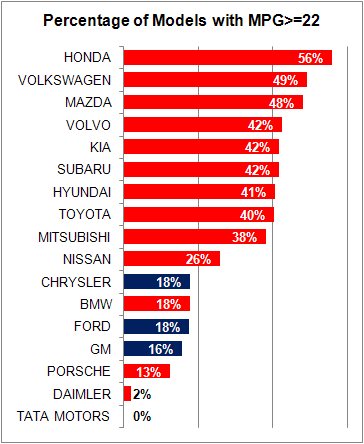
But the other point of the Cash for Clunkers program was to increase the gas mileage of the U.S. auto fleet overall.  The new car you can apply the federal aid to has to get at least 22 mpg. And because of choices the U.S. auto companies have made in the past about what kinds of cars and trucks to emphasize, a smaller proportion of the models Ford, GM, and Chrysler offer qualify for the program:

clunk

Of course, this graph doesn’t tell us how popular each of the models are–if GM only had one model that got more than 22 mpg, but that one model was incredibly popular, the company might have an average fleet fuel efficiency that was relatively good. And if Chrysler had a lot more models available than Honda, it might have more 22+ mpg models total even though they’re a lower percentage of all Chrysler cars.

Still, I found the graph shocking; 22 mpg seems like such a low benchmark, I never would have guess than less than 1 in 5 U.S. models manages to meet it. Hopefully the Cash for Clunkers will have a longer-term effect of encouraging the U.S. automakers to emphasize fuel efficiency to a much greater degree than they’ve been doing (and U.S. consumers to buy their fuel efficient models).

This ad from 2000 (found here) is an opportunity to differentiate between types of objectification, in its most literal sense.  Instead of making a product into the shape of a woman (see here and here), the woman is made into the product.

Picture1

See also this post on where there’s a similar example in which a woman’s curves are meant to reflect the curves of a kitchen counter, this one in which a woman is made into a glass of beer, and, to a slightly lesser extent, this ad in which a white and black woman are used to represent a boring and tasty beverage respectively.

—————————

Lisa Wade is a professor of sociology at Occidental College. You can follow her on Twitter and Facebook.

Ever since it occurred to me a few years ago, I’ve been deeply disturbed the two meanings that the word “fuck” has in U.S. culture.  We use the word when we want to hurt someone really, really bad; and we use it to describe what may be the most physically intimate thing two people can do together.  The fact that the word has that double meaning, I think, speaks volumes about our fucked up relationship with sex.

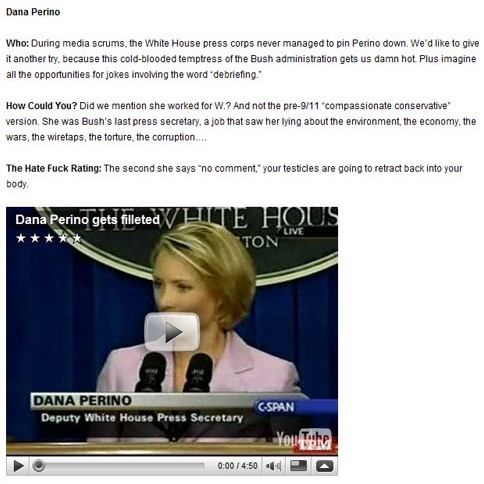
Illustrating this, Caroline H. pointed me to a June 2009 Playboy slideshow of politically conservative women that readers want to “hate fuck.”  After protests, Playboy took the slideshow down, but RedState captured screen shots. You can see them all here. I post a selection below.

The first slide:

playboy-1


Megyn Kelly:

playboy-3-500

Amanda Carpenter:

playboy-5-500

Elisabeth Hasselbeck:

playboy-6

Dana Perino:

playboy-7-500

—————————

Lisa Wade is a professor of sociology at Occidental College. You can follow her on Twitter and Facebook.

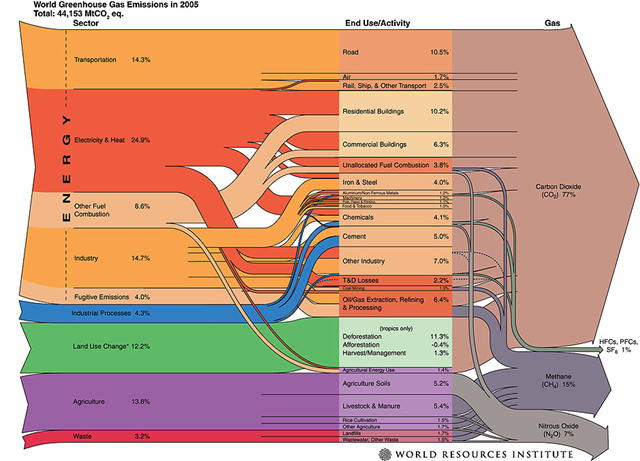
The graphic below is interesting to me in light of the discourse about greenhouse gas emissions.  We often hear about emissions from cars and sometimes about emissions from industry.  I was surprised, then, to see that electricity and heat was such a large contributor to carbon dioxide emissions.  And I feel like land use change and agriculture hardly get discussed at all.

Picture2

Graphic borrowed from ChartPorn, which also has an interactive graphic that breaks down emissions by country (via Simoleon Sense).

—————————

Lisa Wade is a professor of sociology at Occidental College. You can follow her on Twitter and Facebook.

Jerry F. sent us a link to a neat interactive website where you can look at global GDP per capita by country, region, predominance of Buddhism/Islam/Christianity, language spoken, and so on. The data come from the 2008 CIA World Factbook.

The country with the highest GDP per capita? That would be itsy-bitsy Liechtenstein:

Picture 1

Much of Liechtenstein’s economy is linked to its popularity as a place to register holding companies because of low business taxes, so the exceedingly high GDP is probably a result of that. With a GDP of $103,500, Qatar is the second wealthiest nation.

Compare that snapshot of part of the Europe graph to this one for countries in the Horn of Africa:

Picture 2

From what I could tell, the lowest per capita GDP is in Zimbabwe: $200. Only one country on the entire African continent (Equatorial Guinea) breaks $20,000. The shockingly low GDPs in Africa, which indicate a continued lack of industrial (or any other) development, is the most striking pattern. Poor countries in Asia and South America seem downright wealthy by comparison.

As with any international database, I’m sure there are weaknesses with the Factbook–if nothing else, the difficulty of collecting meaningful, comparable data for all countries. I’d pay attention to the overall pattern rather than the specific dollar amount for any one country. If any of you have specific knowledge of the strengths and weaknesses of the CIA Factbook, let us know in the comments.

And also, of course, these numbers tell us nothing about how national wealth is distributed within each country. The average standard of living might be better in a country with a lower GDP where wealth is more evenly distributed across the population than in a “richer” country where a small group controls a highly disproportionate amount of wealth.

Related posts: military spending as a % of GDP, map of global use of electric lights after dark, carbon dioxide emissions per country, questioning the developed/undeveloped binary, international disproportions, and inequality in affluent nations.