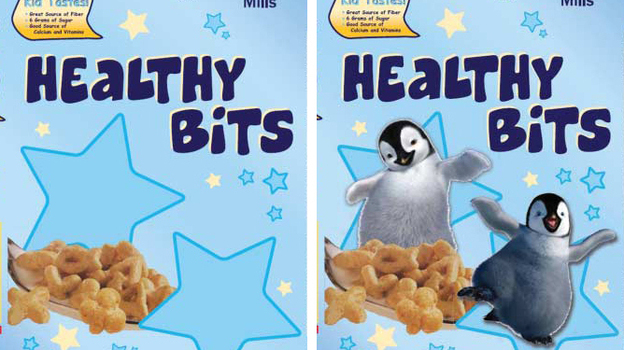
Bryan L. sent us a link to an NPR story about the effects of using cartoon characters to market food to kids. The study, conducted by researchers at Yale University’s Rudd Center for Food Policy and Obesity, had 80 children between the ages of 4 and 6 eat what they were told was a “new” cereal. The cereal was either called Sugar Bits or Healthy Bits, and in each case, half of the boxes included cartoon penguins and half didn’t. Here’s are the two options for Healthy Bits:

Kids were  then asked to rate the taste of the cereal, using a 5-point smiley face scale. Interestingly, kids rated the taste of Healthy Bits more highly than that of Sugar Bits (overall mean rating of 4.65 vs. 4.22). Less surprisingly, the presence of a cartoon character on the box led kids to think the cereal taste better (overall mean rating of 4.70 with a character, vs. 4.16 without).

You can read an overview of the article, “Influence of Licensed Spokescharacters and Health Cues on Children’s Ratings of Cereal Taste, which was published in the Archives of Pediatrics & Adolescent Medicine.

So it appears that kids are getting some of the message about nutrition and healthy eating, and that describing something as having lots of sugar leads them to evaluate it more negatively than they might have otherwise. (I couldn’t help but wonder if there might be a contrast effect, also. Maybe kids expect something  called Healthy Bits to be really gross and, if it doesn’t, evaluate it more positively than they would have, while they expect Sugar Bits to be super awesome and rate it particularly harshly if it doesn’t live up to their hopes. I know that type of comparative priming effect occurs with adults, where our initial expectations influence our later subjective assessment, but I have no idea to what degree that occurs with kids. Anybody know enough about childhood development to comment?)

However, cartoon characters have a strong influence on how kids evaluate the taste of cereal, enough to override their nutritional concerns. Put a cute penguin on Sugar Bits, and it suddenly tastes as good as a box of Healthy Bits without the penguin. Another study from researchers at the Rudd Center found that kids preferred to eat graham crackers, gummy snacks, and even carrots more if they were in a package with a popular cartoon character.

So the good news here is that kids may be willing to make better eating choices than we often give them credit for, and describing something as “healthy” isn’t the kiss of death we might expect. But the use of cartoon characters, such as tie-ins from TV shows and movies, is a powerful form of marketing. If such characters — especially, I assume, highly recognizable and popular ones — appear more often on less healthy options, they undermine efforts to guide children to develop healthy eating habits.

UPDATE: Reader qwirkle was able to get a copy of the entire article, which does make clear that the kids rating Sugar Bits lower than Healthy Bits wasn’t just an “expectations effect”:

Another explanation for the difference in children’s assessments of the cereal involves their expectations of the cereal taste based on the name. Specifically, the cereal used for this study had only a moderately sweet taste. Consequently, children may have been disappointed by the lack of sugary flavor in the cereal named Sugar Bits and pleasantly surprised by the sugary flavor in the cereal named Healthy Bits. At 6 g of sugar per serving, however, the sugar content was comparable to that of other commonly available sweet cereals (eg, 6 g in Honey Kix and 9 g in Honey Nut Cheerios). Nevertheless, whether the children were reacting to their expectations of the cereal’s taste or expressing their skepticism of the merits of sugary products, when the character was present on the box, children reported a more favorable subjective experience with the product.”

This month’s celebrity gossip included a scandal over a photo Serena Williams tweeted of herself that was quickly taken down.  The photo was of Williams in a bra and panties behind what appears to be a curtain; you can see her silhouette and some fuzzy details of what she is wearing.  It was timed to correlate with the release of the World Tennis Association’s Strong is Beautiful campaign, featuring Williams of course.

Williams took the photo down because of criticism.  A man had recently been arrested on charges of stalking her and the image, critics claimed, was exactly the kind of thing that triggered men to stalk her.  She shouldn’t encourage the creeps, said the blogosphere.  Sports columnist Greg Couch, for example, called her a hypocrite for daring to release such a photo and still wishing to avoid being stalked, and then went on to discuss her appearance and clothing choices at length.

Of course, selling one’s own sex appeal is more or less required for any female athlete who wants to reach the pinnacle of her career without being called a “dog” and a “dyke” at every turn.  So Williams isn’t breaking the rules, she’s playing the game.  And, yet, when she plays the game she gets, in return, not only stalkers, but criticism that suggests that, were she to be stalked again, she was asking for it.  This is an excellent example of the ugly truth about the patriarchal bargain.

A patriarchal bargain is a decision to accept gender rules that disadvantage women in exchange for whatever power one can wrest from the system. It is an individual strategy designed to manipulate the system to one’s best advantage, but one that leaves the system itself intact.  Williams is making a patriarchal bargain, exchanging her sex appeal for the heightened degree of fame and greater earning power we give to women who play by these rules (e.g., Kim Kardashian).  Don’t be too quick to judge; nearly 100% of women do this to some degree.

But once women appear to have acquiesced to the idea that their bodies are public property, their bodies are treated as public property.  Others, then, feel that they have the right to comment on, evaluate, and even control their bodies.  Williams made her body public, the logic goes, therefore anything that happens to it is her fault.  This is why the bargain is patriarchal.  Williams will be excoriated for her unwillingness to defer to the male gaze if she refuses to trade on her sex appeal. But if she does make this trade, she’ll be the first against the wall if anything bad happens to her.

Lisa Wade, PhD is an Associate Professor at Tulane University. She is the author of American Hookup, a book about college sexual culture; a textbook about gender; and a forthcoming introductory text: Terrible Magnificent Sociology. You can follow her on Twitter and Instagram.

M.H. thought we might like to get to post about the sexualization of food again, so she sent us a link to a post at Redbook that is one of the more bizarre and blatant examples I’ve seen in a while. The article, titled “Blow Him Away in Bed: Oral Sex Tips” (an excerpt from Redbook’s 500 Sex Tips), is illustrated with various foods.

Here’s an example of one of their helpful hints:

Other tips are illustrated with images of a pickle, popsicle, mushroom, banana, a baguette, and a butternut squash, among others.

I cannot help but feel that if you write something that requires you to type “keywords: squash, tomato, vegetable, phallic, fellatio, oral sex, blow job, penis,” you may want to reconsider the topic, but that’s just me.

UPDATE: Readers are correctly pointing out that this example differs significantly from most of our other examples of sexualization of food by not being degrading in the way many of the others were. I think this is more just a curious example of the wide array of foods we sexualize, as well as how silly a lot of sex tips in women’s magazines are.

Gwen Sharp is an associate professor of sociology at Nevada State College. You can follow her on Twitter at @gwensharpnv.

I’ve argued that the visual aids used in computer programs designed to help us learn new languages are ethnocentric, generic, and uninformative.  Since then, I have been working on an alternative to these images, compiling a database of culturally organized images called the Culturally Authentic Pictorial Lexicon (CAPL).

What strikes me as both a student and a professor of language and culture is that the visual world differs so greatly across cultures and even minor differences are telling in how we organize and perceive our world. Color is one of the easiest ways to find differences in cultures. I have previously discussed the linguistic and cognitive differences of color, but now I want to show some simple examples of color in culture through analysis of various postal systems.

In China, the postal system uses a deep hunter green:

(source)

 In Japan, it is a bright red, much like England.

England:

(source)

Japan:

(source)

 In Germany, it is a bright yellow (think DHL):

(source)

In Russia, it is a lighter but similar shade of the deep postal blue in the U.S.

Russia:

(source)

 The U.S.:

(source)

This example of postal systems is an easy way to illustrate how color becomes one of the central ways to communicate and, although the same message is shared across cultures, the path to that message varies through color.

Michael Shaughnessy is an Associate Professor of German and Chair of Modern Languages at Washington & Jefferson College.  In addition to German language, literature, and culture, he has a professional interest in educational technology, especially the authenticity of multimedia imagery.  His book German Pittsburgh (Arcadia Publishing) highlights the contributions of German speaking immigrants to our area.

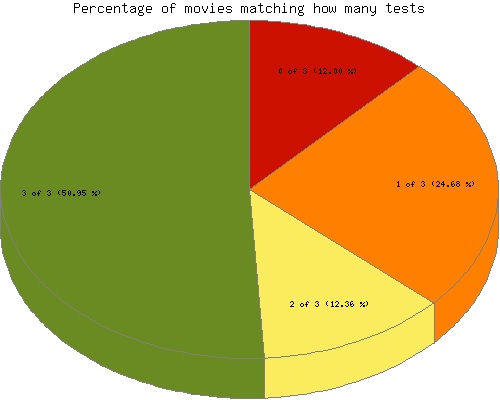
I suspect most Soc Images readers will, by now, be familiar with the Bechdel Test — the set of criteria for evaluating whether female characters are included in movies in even minimally non-male-centered ways, made popular by Alison Bechdel of Dykes to Watch Out For. To pass, a movie has to have at least two female characters who have at least one conversation with one another about something other than a man. For a quick overview, see our repost of Anita Sarkeesian discussing the Bechdel Test.

Leah B. let us know that there’s a website, Bechdel Test Movie List, entirely devoted to rating movies based on the criteria (with the stipulation that female characters have to actually be named to count). It consists of a list of movies that have been added and rated by readers; there are currently over 2,000 movies produced between 1900 and 2011 rated on the website. This is, obviously, nowhere near a random sample; as you’d expect, it’s highly weighted toward more recent movies, and of course not everyone agrees on the ratings (you can add a symbol to show you disagree and leave a comment on a movie’s rating page).

That said, the site includes a stats page that is interesting to look through just for a snapshot of the inclusion of women in these movies. Here’s a breakdown of the entire list; green indicates movies that passed all three tests, yellow passed 2, orange passed 1, and red didn’t pass any of the three:

It’s fun to browse through, for entertainment value and a starting place for thinking about the Bechdel Test and pop culture.

Feminist Frequency’s Anita Sarkeesian is back with another trope. In this one she covers the “evil demon seductress.” Sarkeesian argues that the trope reproduces the stereotype that women use their sexuality to manipulate men. This encourages us to always view their sexual expression with suspicion such that we deny women authentic sexualities.

Thanks to Anita for linking to our post about the femme fatal praying mantis.

Lisa Wade, PhD is an Associate Professor at Tulane University. She is the author of American Hookup, a book about college sexual culture; a textbook about gender; and a forthcoming introductory text: Terrible Magnificent Sociology. You can follow her on Twitter and Instagram.

We have posted in the past about the controversy surrounding the casting of the movie The Last Airbender. Many fans of the original series were upset that Asian characters were recast as White, with the main cast initially containing no non-White characters at all. This fits in with a more general lack of Asian main characters in Hollywood.

More recently, a different controversy about race and casting emerged when African American British actor Idris Elba was cast as the Norse god Heimdall in Thor, though this character was always White in the comic book series.

Anthony N. sent in a video by MovieBob at The Escapist that discusses concerns over race in casting Thor and why recasting a White character with a non-White actor doesn’t have the same implications as recasting a non-White character with a White actor does:

,/p>


Discussing media attention to Donald Trump, Jay Smooth (Ill Doctrine) describes what sociologists call agenda setting.  The phrase refers to the media’s ability to shape what we think about (and what we don’t think about), if not what to think about it.  That is, the media can’t necessarily tell us what to think, but it can certainly keep some issues on-the-agenda while leaving others invisible to us.

In this case, Smooth points out, the media’s coverage of Trump led to public interest in him; that public interest waned as soon as Trump was out of the news.

See also Agenda Setting and Obama’s Socialist Leanings and Media Reaction to Janet Jackson’s “Wardrobe Malfunction.”

Lisa Wade, PhD is an Associate Professor at Tulane University. She is the author of American Hookup, a book about college sexual culture; a textbook about gender; and a forthcoming introductory text: Terrible Magnificent Sociology. You can follow her on Twitter and Instagram.