Cross-posted at Montclair SocioBlog.

In case you wondered about what we in the U.S. pay for health care compared with those unfree unfortunates who suffer under various forms of socialized medicine, here are some graphs from 2009 showing the advantages of what is sometimes called “the best health care system in the world.”

The graphs are from the International Federation of Health Plans. I’ve selected only four — to show the relative costs* of

  • an office visit
  • a day in the hospital
  • a common procedure (childbirth without complications)
  • a widely used drug (Lipitor)

You can download all the charts here, but be warned: it gets boring. We’re number one in every chart, at least in this one category of how much we shell out.

Since we have the best health care in the world, this must mean that you get what you pay for. Our Lipitor must be four to ten times as good as the Lipitor that Canadians take.

Hat tip: Ezra Klein.

———————–

*These amounts are what providers are paid by governments or other insurers, not what the patient pays, which in many Eurpean countries is essentially nothing. See the footnotes for the tables in the original document. Or look at the comments on this at Boing Boing, a discussion which is remarkably civil (do they monitor comments?).

Tenure!

Lisa Wade is celebrating the news that, come Fall, she will be a tenured professor at Occidental College!  Now that she’s in the “golden handcuffs,” she can say all the stuff she’s been holding back on Twitter and Facebook. :)

New Course Guide:

New Pinterest Page: 

Best of April:

Two of our posts received over 1,000 “likes” on Facebook this month:

Other popular posts in April include:

Social Media ‘n’ Stuff:

Finally, this is your monthly reminder that SocImages is on TwitterFacebookGoogle+, and Pinterest.

You can also follow Gwen’s great Twitter feed or find Lisa on both Twitter and Facebook (she just joined this month!).

Most of the rest of the team is on Twitter too: @familyunequal@carolineheldman@jaylivingston, and @wendyphd.

Links this Month: 

NASA has posted a series of pairs of satellite images that show a range of changes around the world. They’re great for illustrating human-environment interactions; some of the changes are directly human-caused, while others, while others show the changing consequences of floods and fires as our settlement and agricultural patterns change.

For those of us living in Las Vegas, these images of the shrinking Lake Mead reservoir, which provides water and electricity, is not reassuring. The reservoir has gotten smaller due to multiple factors, including a long-term drought and more water being taken from the Colorado River upstream:

Deforestation in Niger, as land has increasingly been turned over to agriculture:

Here, we see increasing urban growth around Denver International Airport, which now takes up 53 square miles of what used to be farmland:

Algal blooms due to agricultural and household runoff into Lake Atitlan, Guatemala:

Changes to the Sonoran coastline in Mexico due to shrimp farming:

The dramatic shrinking of the Aral Sea, largely due to the amount of water taken out of rivers for irrigation:

The full set of 167 paired images is really striking, and if viewed in the “all images” layout, you can select among various topics, focusing on cities, water, human impacts, and so on.


Here’s a neat story that reminds us that beneath “mainstream” culture are rich, unique, and sometimes whimsical sub-cultures:

In 1946 a clown aficionado named Stan Bult began collecting the faces of clowns painted onto blown out chicken eggs.  It became a U.K. tradition and, because it is considered a great breach of etiquette to steal another clown’s face, the eggs served as  a sort of “registry.”  The tradition crossed the pond in 1979 when Leon “Buttons” McBryde began a collection in the U.S.   Linda, McBryde’s wife, paints the eggs herself (they use goose) and they’ve now collected over 700 unique clown faces.

Check out this example from the British collection.

Clown Eggs via Learn Something Every Day.

Lisa Wade, PhD is an Associate Professor at Tulane University. She is the author of American Hookup, a book about college sexual culture; a textbook about gender; and a forthcoming introductory text: Terrible Magnificent Sociology. You can follow her on Twitter and Instagram.

U.S. Senator Susan Collins (R, Maine) and Representative Carolyn Maloney (D, New York) have both gone on record claiming that having more women employed in the Secret Service would prevent scandals like the one involving Colombian prostitutes.

In classic Daily Show form, Jon Stewart and his “correspondents” respond (thanks to Dmitriy T.M. for the link!):

Lisa Wade, PhD is an Associate Professor at Tulane University. She is the author of American Hookup, a book about college sexual culture; a textbook about gender; and a forthcoming introductory text: Terrible Magnificent Sociology. You can follow her on Twitter and Instagram.

Cross-posted at Brad’s Blog.

Here are a few commercials for the new MilkBite™ from Kraft. They play on stereotypes about mixed-race individuals.

[youtube]https://youtu.be/ffkDRynWAMw[/youtube]

Here is a transcription:

You didn’t think, did you? You, uh, didn’t think what life was going to be like for me — mom, dad — for your son.

In another commercial, the characters have the following conversation:

I just have a question. Your profile said you were milk.
Uh huh, yep, I am.
You just look like granola.
Granola, yeah, I know. I get that a lot. This was a mistake.
No, wait. Please don’t go. I’m kinda into it.

There are other spots on Kraft’s YouTube page, most playing on these same themes. The problem with a marketing campaign like this is that it trivializes the experience of people with multiple racial/ethnic identities who are still often met with derision and confusion. The first ad above perpetuates the self-fulfilling prophecy about “confused” identities. As a child, I remember family members telling me that they didn’t have a problem with interracial couples but worried about how others might react to their children.

In my classroom earlier this year, a young white woman expressed overt anger when I told the class that the 2010 2000 Census, for the first time, allowed individuals to check more than one racial category. “How can they do that?!!” she demanded to know. Living in a country with a president who had a black father and an white mother complicates all of this. Beyond the standard “post-racial America” narrative, Pres. Obama’s racial identity — even though he identifies only as black — means that people feel entitled to be dismissive of the problems that come with our increasingly complex constructions of race.

Anita Sarkeesian at Feminist Frequency points out that the marketers are likely fully aware of the inappropriate nature of these types of campaigns, and in fact, that is precisely why they launch them. They are seen as ironic, over-the-top, cynical, and tongue-in-cheek. It’s “they know that I know that they know” that it’s racist. It’s a virtual “wink and a nod.” Lisa Wade at SocImages points out that it’s a “no-one-will-ever-believe-we’re-serious” mindset. Sadly, not all people are in on the joke and will find their bigotry and ignorance reinforced, but the rest of us should know better than to perpetuate racism, even under the guise of humor.

————————

Bradley Koch is a sociologist at Georgia College. He is currently the co-director of the study abroad program based in Athens, Greece.  His research interests include religion, sexuality, higher education, and teaching and learning. In his free time, Brad enjoys making music and riding his road bike around rural Georgia.

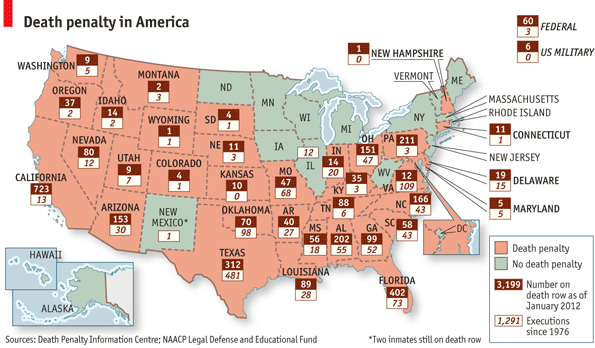
Capital punishment in the U.S. has gotten renewed attention recently, with Connecticut’s governor signing a bill repealing the death penalty this week and Californians set to vote on a ballot initiative in November that would get rid of capital punishment in the state.

Think Progress recently reposted a map showing the legality of the death penalty across the U.S. (now out of date since the change in Connecticut), as well as data on the number of people on death row per state (dark red boxes) and the number executed since 1976 (white boxes):

Talking about capital punishment in the U.S. hides a significant amount of variation. While the death penalty is technically available in most states, its use is very uneven. In many states where the death penalty is legal, prosecutors rarely push for it, and the vast majority of death penalty sentences are never actually carried out (for instance, notice that while over 700 people are currently on death row in California, the state has a much lower number of executions since 1976 than many other states). The exception is the South, which accounts for a disproportionate number of death penalty sentences and carries out such sentences at a much higher rate than other states.

In a podcast just posted at Office Hours, David Garland, author of Peculiar Institution: America’s Death Penalty in an Age of Abolition, discusses why capital punishment persists in the U.S. and also highlights the unevenness in its application. It’s a really great summary of the various factors that lead to the patterns we see in the map.

A resolution to the matter described below was announced yesterday.  In order to preserve the religious memorial without violating the separation of church and state, the Park Service has agree to give the land it sits on to two private citizens who take care of the monument.  Problem solved?

———————

The Supreme Court is in the process of deciding whether a cross erected 75 years ago as a memorial to war veterans violates the constitutional separation between church and state. The cross sits on the Mojave National Preserve and, therefore, is on public land. After lower court rulings, the cross was covered in plywood.

In deliberations, Justice Scalia tried to argue that the cross is a neutral and universal symbol. He said:

It’s erected as a war memorial. I assume it is erected in honor of all of the war dead… What would you have them erect?… Some conglomerate of a cross, a Star of David, and you know, a Muslim half moon and star?

Faced with an argument that the cross is distinctly Christian, he said:

I don’t think you can leap from that to the conclusion that the only war dead that that cross honors are the Christian war dead. I think that’s an outrageous conclusion.

Scalia’s comments reveal a common phenonemon that we’ve discussed in terms of race and gender, but not yet religion.  As Jay Livingston pointed out at MontClair SocioBlog, one can only think of Christian symbols as non-specific if one thinks of Christianity as somehow normal, neutral, and for everyone.  In the U.S., because Christianity is the dominant religion, many people simply see it as default.  You’re Christian unless you’re something else.  Something else that marks you as different and specific, Christianity does not.

This is one way that dominance works.  It makes itself invisible.

UPDATE! Dmitriy T.M. pointed out that Steven Colbert addressed this issue on The Colbert Report back in 2009:

See our other posts on how whiteness and maleness are the characteristics we attribute to “person,” unless there are reasons to do otherwise, herehere, here, and here.

Lisa Wade, PhD is an Associate Professor at Tulane University. She is the author of American Hookup, a book about college sexual culture; a textbook about gender; and a forthcoming introductory text: Terrible Magnificent Sociology. You can follow her on Twitter and Instagram.