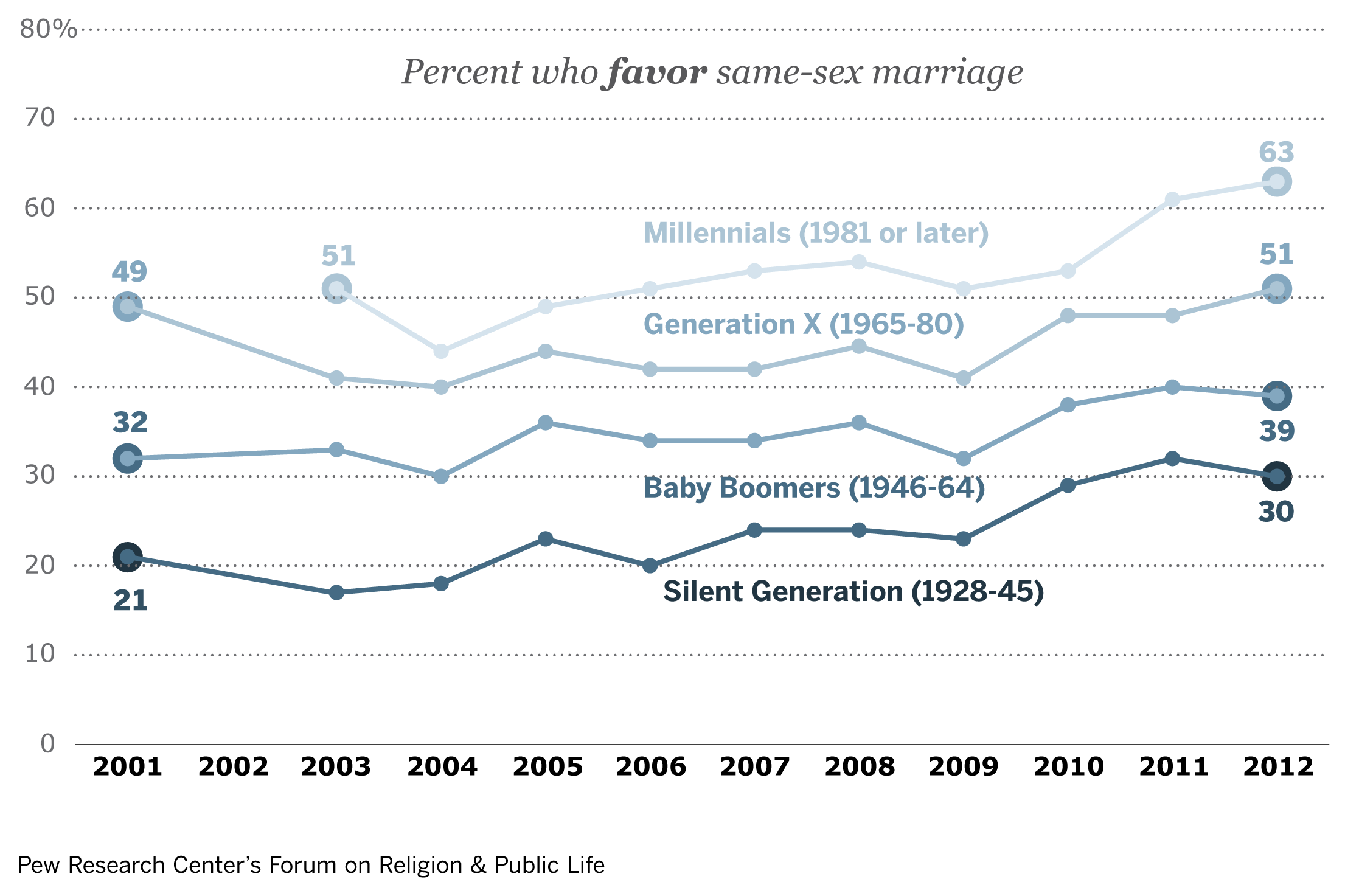
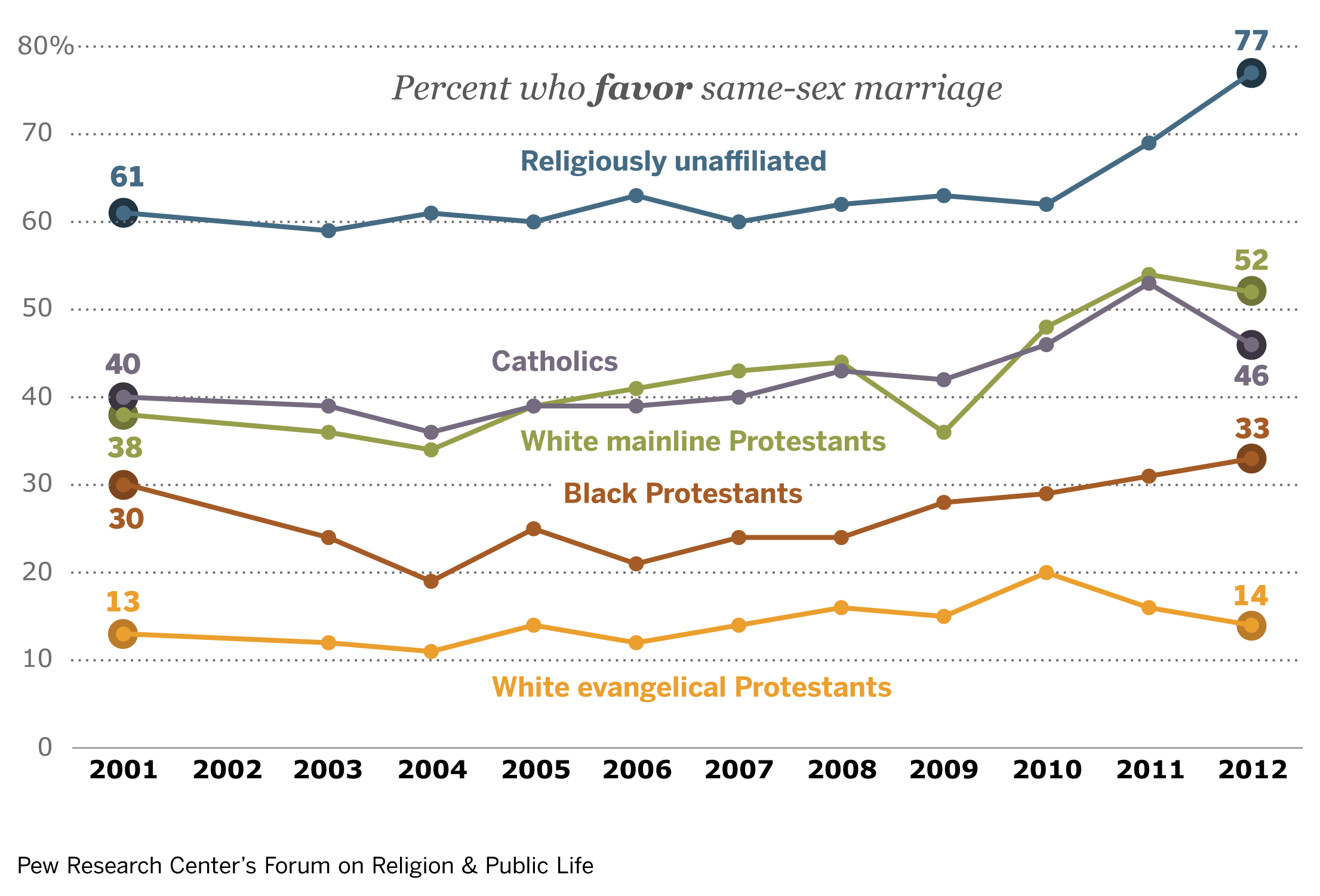
Last week, on the heels of Obama’s announcement that he supports gay marriage, NPR interviewed the President of the Pew Research Center, Andrew Kohut, about trends in American support for the issue.  Kohut explained that American opinion has changed dramatically, and unusually, in a very short time.  In 1996, for example, 27% of people supported gay marriage (65% opposed).  This “really didn’t change very much” for a while.  In 2004, when Republicans mobilized the issue to get conservatives to the polls, 60% still opposed it.  But today, in the space of less than a decade, we have more people supporting gay marriage than opposing it.  Some polls show the majority of Americans believe that we should have the right to marry someone of the same sex.

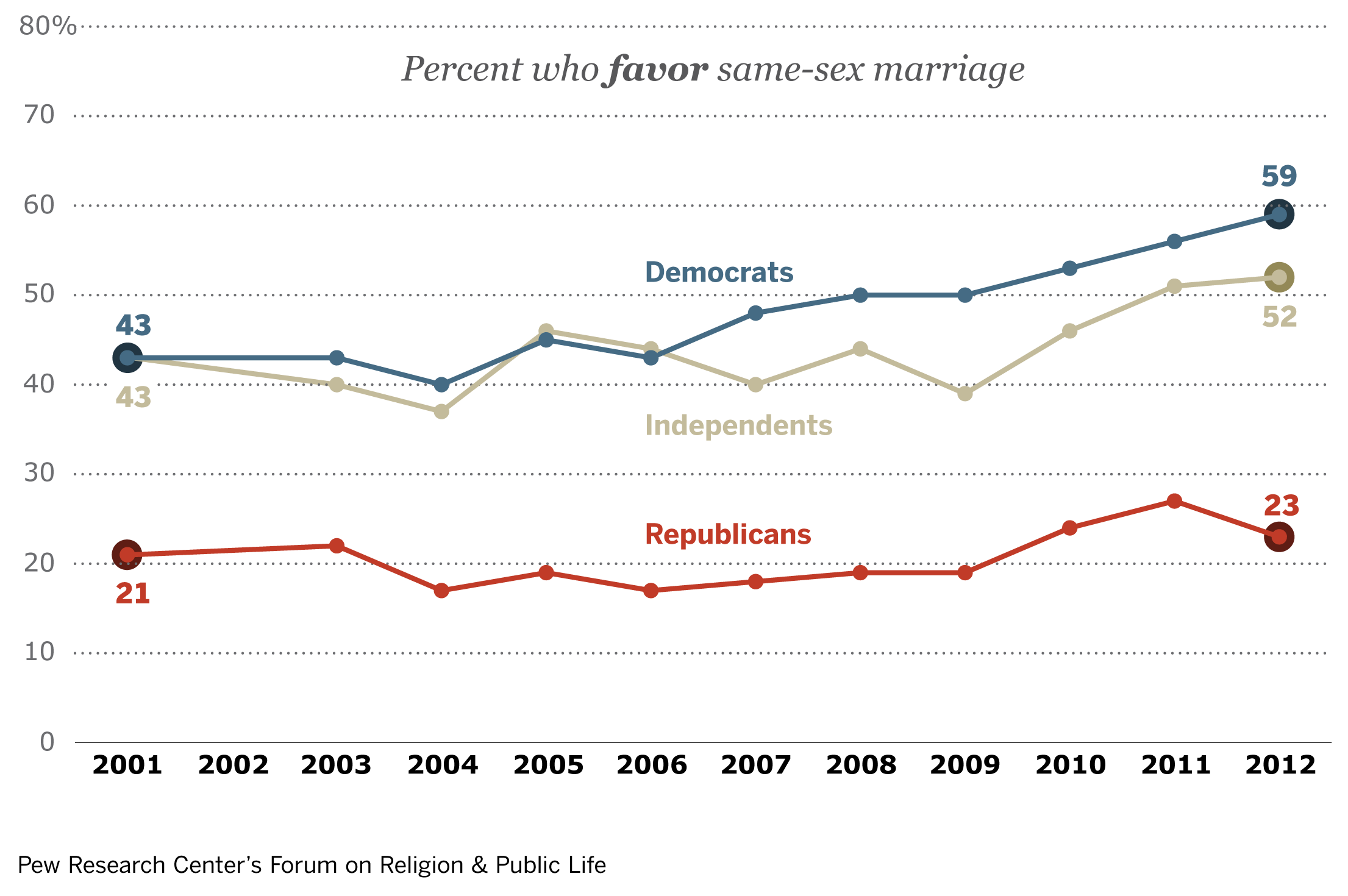
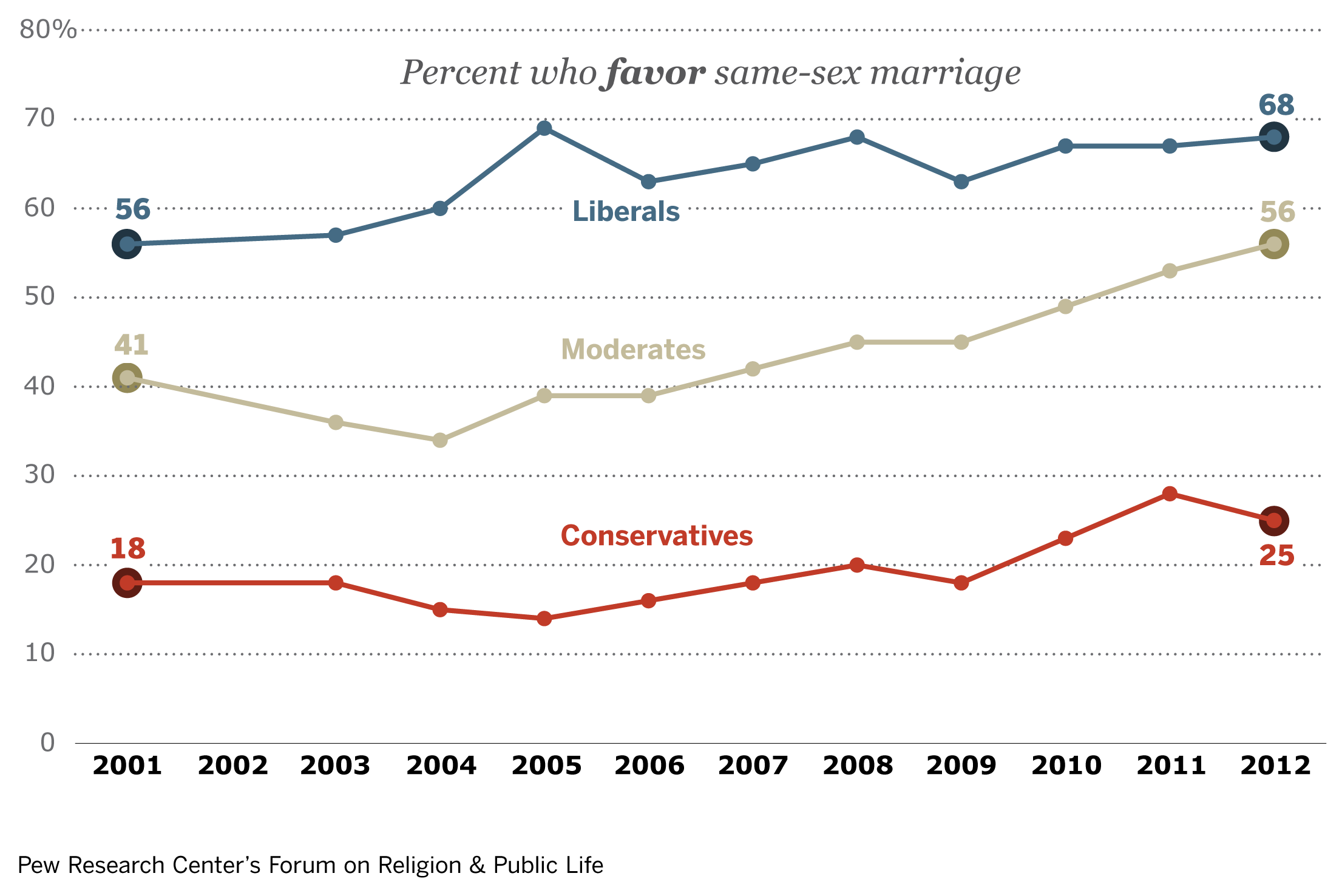
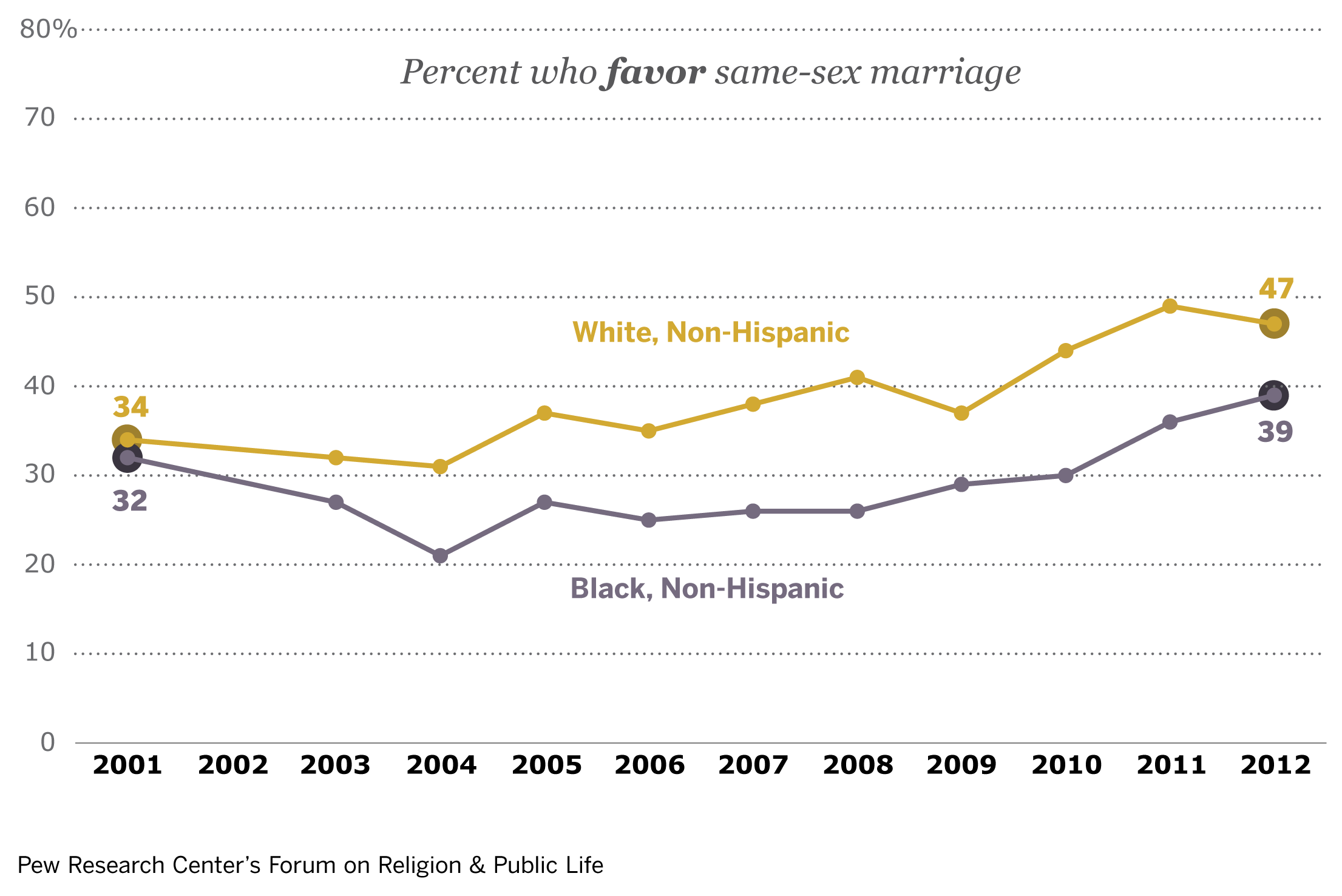
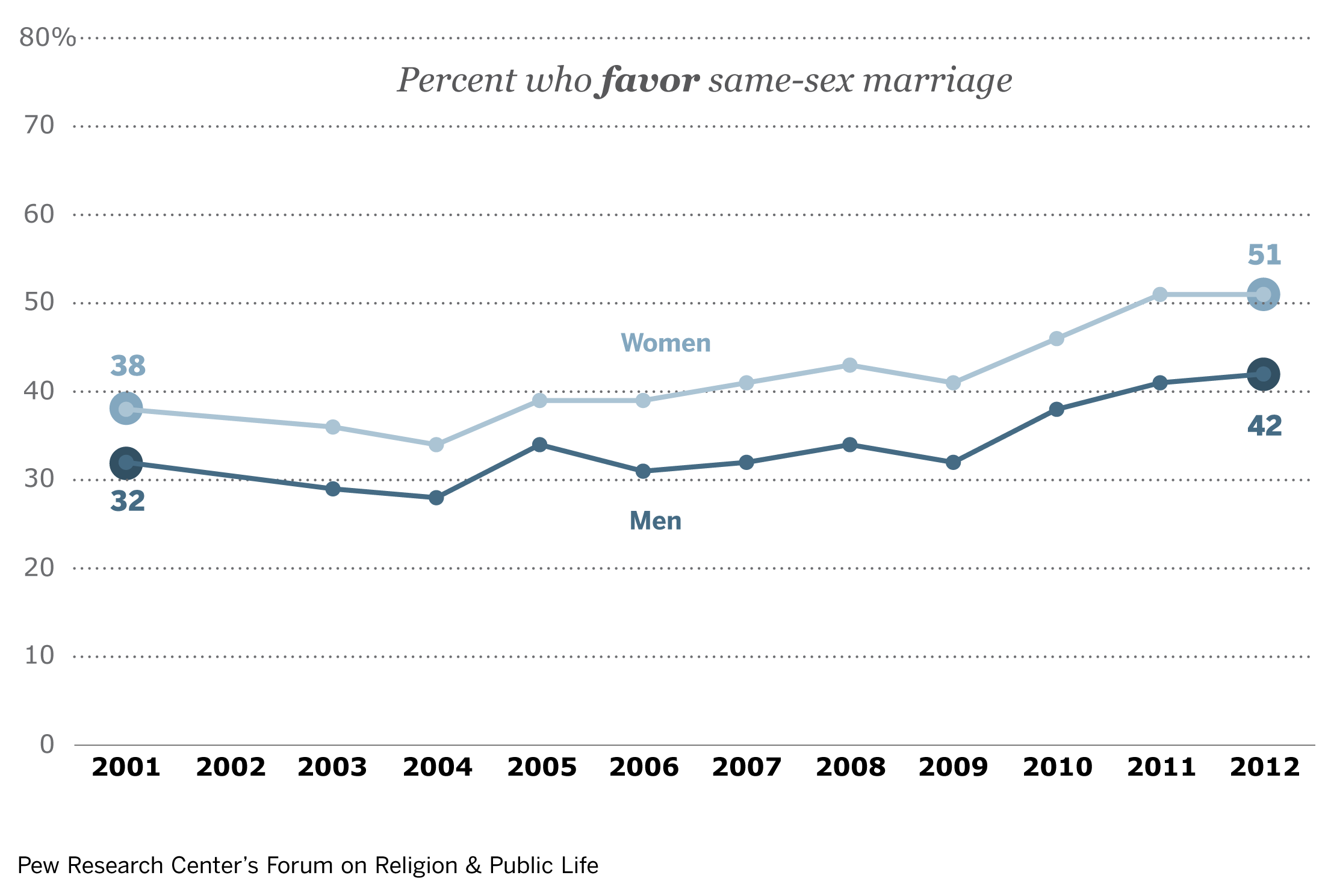
This trend is driven, in part, by young people replacing the old, but focusing on this overshadows the fact that essentially all Americans — of every stripe — show higher support for gay marriage than they did a decade ago.  Both men and women and people of all races, political affiliations, religions, and ages are showing increased support for gay marriage.  This is a real, remarkable, and rare shift in opinion:

Opinion by age:
Opinion by religion:
Opinion by political party:
Opinion by political orientation:
Opinion by race:
Opinion by gender:
Via Montclair SocioBlog.

Lisa Wade, PhD is an Associate Professor at Tulane University. She is the author of American Hookup, a book about college sexual culture; a textbook about gender; and a forthcoming introductory text: Terrible Magnificent Sociology. You can follow her on Twitter and Instagram.

Florence Colgate recently won the title of Britain’s Most Beautiful Face.  The competition, which attracted more than 8,000 contestants, was sponsored by Lorraine Cosmetics.  The company compared each face to a mathematical algorithm representing beauty.  Florence, who is blonde and blue-eyes, came out on top:

[youtube]https://www.youtube.com/watch?v=YQjFFTezh5I[/youtube]

An example of the formula from the Daily Mail:

A woman’s face is said to be most attractive when the space between her pupils is just under half the width of her face from ear to ear. Florence scores a 44 per cent ratio. Experts also believe the relative distance between eyes and mouth should be just over a third of the measurement from hairline to chin. Florence’s ratio is 32.8 per cent.

So, it’s science, right?  Well, that plus (at least) a little bit of racism.  Carmen Lefèvre, a psychologist, was quoted explaining why Florence was so “classically” beautiful:

Florence has all the classic signs of beauty. She has large eyes, high cheekbones, full lips and a fair complexion. Symmetry appears to be a very important cue to attractiveness.

How did “fair complexion” get mixed up in there?

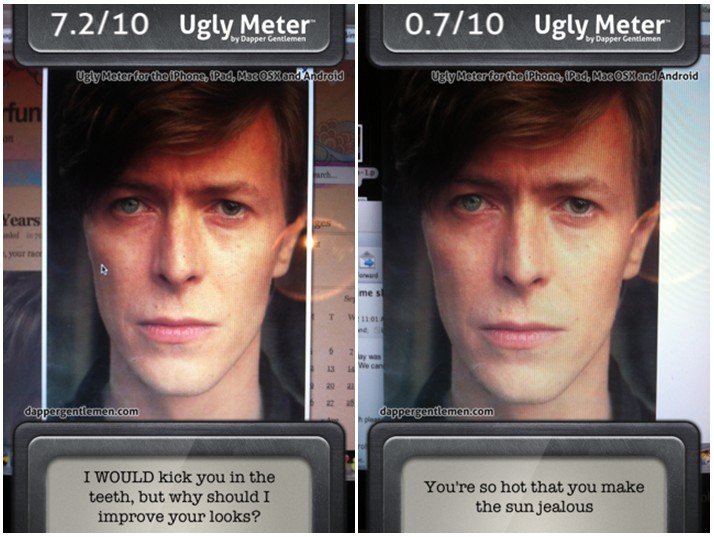
Not an isolated incident either.  Tom Megginson, of Work That Matters, reported on Britain’s Most Beautiful Face and added in another example of “objective” measures of beauty conflating light with pretty and dark with ugly.  This time it’s an app called Ugly Meter. You take a picture of your face and it tells you if you’re hot or not.  What Megginson noted was the overt colorism.  One attractiveness finding read:

For what it’s worth, he also scanned in some famous faces and found it to be, let’s just say, inexplicable and inconsistent:
Okay, well it might be right about Barbie. (Ha! I beat you to it, commentors!)

Ugly Meter, by the way, is offering a cash prize for the ugliest face.  So… the world is keepin’ it balanced, I guess.

Lisa Wade, PhD is an Associate Professor at Tulane University. She is the author of American Hookup, a book about college sexual culture; a textbook about gender; and a forthcoming introductory text: Terrible Magnificent Sociology. You can follow her on Twitter and Instagram.
Sociologists have observed that employment in the U.S. is largely structured around an assumption that the worker has no family responsibilities.  The ideas that an employee should be able to work during non-school hours, stay late when needed, take off time for their own illness but never anyone else’s, for example, all presume that the workers have either no children or someone else taking care of children for them.

Most jobs, then, are not designed to be compatible with family responsibilities.  Since most people doing primary child care are women, this hurts mothers disproportionately.  Mothers have a more difficult time being the “perfect employee” and also face discrimination from employers.  This translates into some telling numbers.  Women make about 69% of what men make (not controlling for type of occupation), but most of this disadvantage is related to parental status, not sex. Women without children make 90% of what men make, while mothers make 66%.  Ann Crittenden’s book, The Price of Motherhood, lays out these numbers starkly.

These issues are at the heart of this well-crafted Ampersand cartoon by B. Deutsch, which prompted this post in anticipation of Mother’s Day in the U.S.

Lisa Wade, PhD is an Associate Professor at Tulane University. She is the author of American Hookup, a book about college sexual culture; a textbook about gender; and a forthcoming introductory text: Terrible Magnificent Sociology. You can follow her on Twitter and Instagram.

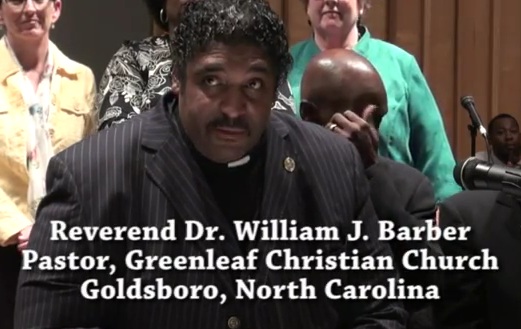
Many of you may have seen a video featuring Reverend William Barber speaking out against North Carolina’s Amendment One, which banned same-sex marriages (and which was approved by voters on Tuesday). The video is heartfelt and passionate, and is also a great example of the importance of how we frame issues in social movements.

Reverend Barber argues that media coverage of the amendment has asked the wrong questions. Whether same-sex couples should be allowed to get married isn’t the core issue here, he says; what’s really at stake is whether the majority should get to vote on which rights will be guaranteed to those in the minority, a decision he sees as a dangerous standard in a nation that has used it previously to exclude racial/ethnic minorities, women, and the poor from the full benefits and protections of citizenship. This reframes the amendment from an issue about same-sex marriages to a broader question about rights, equal protection, and the dangers of codifying inequality into our governing documents:

In this three-minute clip, sociologist Shelley Correll discusses her research on the “motherhood penalty.”  The phrase refers to the finding that being a mom specifically, not just being female or being a parent, leads to lower income. Scholars have begun to realize just how significant this is. As Correll explains, the pay gap between women with and without children is larger than that between women and men:

For more, see the full text of Correll’s paper titled “Getting a Job: Is There a Motherhood Penalty.”

Lisa Wade, PhD is an Associate Professor at Tulane University. She is the author of American Hookup, a book about college sexual culture; a textbook about gender; and a forthcoming introductory text: Terrible Magnificent Sociology. You can follow her on Twitter and Instagram.
Hennessy Youngman kicks around the question, should art be beautiful?

If you liked, more from Youngman:

Lisa Wade, PhD is an Associate Professor at Tulane University. She is the author of American Hookup, a book about college sexual culture; a textbook about gender; and a forthcoming introductory text: Terrible Magnificent Sociology. You can follow her on Twitter and Instagram.

Yesterday Native Appropriations featured a presentation about Urban Outfitters, cultural appropriation in fashion, and the struggle to get the clothing chain to stop labeling clothing as “Navajo.” The presentation is great both for explaining this particular case — which included the Navajo nation sending a cease-and-desist letter demanding that Urban Outfitters stop using the term Navajo in its marketing — and also because it shows how one particular story spread through social media, which increasingly have the ability to bring mainstream media attention to stories that otherwise might have gone unnoticed.

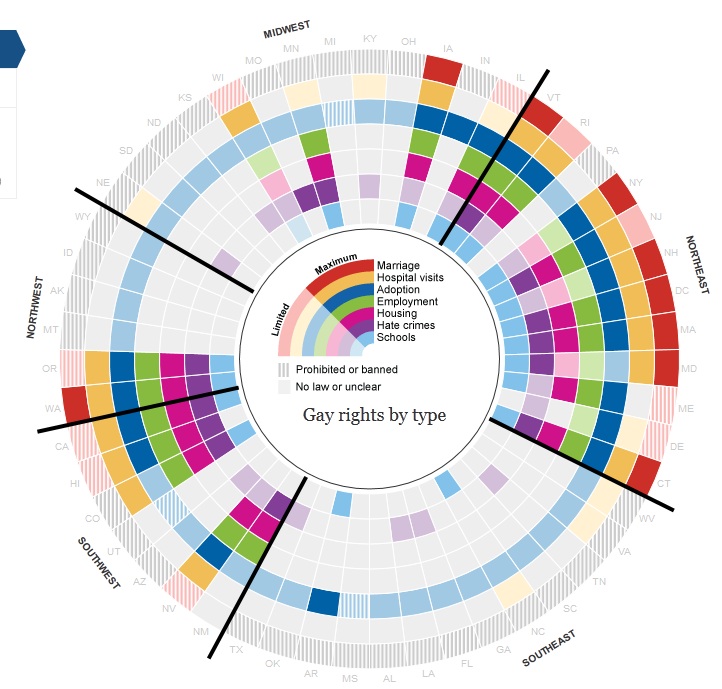
Yesterday I stumbled upon a really great interactive graphic posted by the Guardian that summarizes the degree to which a number of rights and benefits are available to gays and lesbians in the U.S., by state. Each state is represented as a segment radiating out from the center of the circle; each colored ring represents a particular right, benefit, or protection:


  • Light blue = whether state has a law addressing discrimination or bullying in the school system
  • Purple = state-level hate-crime laws
  • Pink = protection against housing discrimination
  • Green = protection against employment discrimination
  • Blue = right to adopt (lighter shade indicates individuals are allowed; darker shade means gay and lesbian couples are allowed to jointly adopt)
  • Yellow = right to visit partner in the hospital
  • Red = marriage

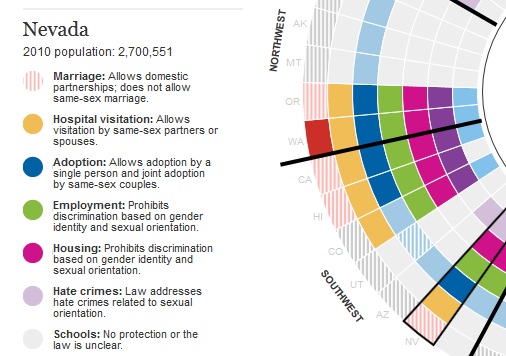
The different shades indicate differences in the scope of coverage (say, full marriage rights vs. domestic partnership — and it has been updated to reflect yesterday’s passage of the bill outlawing same-sex marriage in North Carolina — or whether a law bans discrimination based on sexual orientation but not gender identity); the Guardian website explains each issue. Their post also allows you to hover over a state and get a more detailed summary. Here’s the info for Nevada, for instance:

The graphic also lets you scale states by population if you want to get a better sense of the proportion of the U.S. population living in areas that do or do not provide these protections.