Cross-posted at Montclair SocioBlog.

By now, you have heard about the killing of Trayvon Martin.  But when did you first hear about it?  If you’re a news junkie and were watching the national news channels,  the answer to that question might well depend on which one you watch.  ThinkProgress counted the number of stories about this killing on three cable news outlets in the week following the event.

Megan McCardle interprets the data as an example of “the Availability Heuristic, a rule of thumb that says the frequency of an event should correspond to how quickly you can think of examples of it.”  The Availability Heuristic makes us overestimate the risk of shark attacks.  The Availability Heuristic is probably behind my students’ writing confidently that teenage pregnancy has been steadily rising (thank you, MTV).

McCardle looks at the graph and sees a reason for different perceptions of racism as a problem:

…the disparity here may have something to do with whether one thinks institutional racism remains a serious problem in the United States. Conservatives often seem to think it isn’t, and that if anything, the real problem is how often spurious charges of white racism are deployed by their political opponents, while liberals more often tend toward the opposite view. Maybe both groups are drawing justified inferences from the data they’re seeing.

Do Fox viewers discount racism because of what they see?  Or is the network disparity more an example of another cognitive wiring problem – Confirmation Bias?  Confirmation bias is our tendency to seek out and to remember information that fits with our existing ideas.  Faced with information that clashes with that world view, we ignore, forget, distort, or misinterpret.

In Foxland — the world of both those who create Fox news and those who consume it — racism is not a real problem.  A story of a white Hispanic man armed with a 9mm chasing down and shooting a black teenager armed only with Skittles has no place in that world.  The Fox news producers don’t want to tell that story, and the viewers don’t want to hear it.  In the days since this graph appeared, the story has become too big for even Fox to ignore. I would imagine that Fox will instead interpret the events so as to fit with the view that McCardle suggests — that whites are the victims.  If you watch Fox, get ready to hear a lot about self-defense.

Last month the Centers for Disease Control (CDC) released a series of graphic anti-smoking ads intended to “raise awareness of the human suffering caused by smoking and to encourage smokers to quit.”   The campaign, titled “Tips From Former Smokers,” depicts individuals who have experienced some of the potential effects of tobacco use, including stomas, stroke, lung removal, heart attack, limb amputations, and asthma.  For example, this ad features several former smokers who offer “tips” on how to live with a throat stoma (hole), such as “Crouch, don’t bend over—you don’t want to lose the food in your stomach”:

This ad shows Terrie, a throat cancer survivor, completing the morning routine she performs in order to maintain her appearance after losing her hair and teeth and having a tracheotomy:

Finally, this ad depicts several people who suffered a vascular disease brought on by smoking who had to have limbs amputated:

In addition to the whether these ads will be effective in persuading smokers to quit, we might ask whether fear and stigma are appropriate health promotion strategies.  Is it possible or ethical to scare people into changing their behaviors?  What are the implications of using stigmatized people to serve as a warning label to others?

What’s most striking about these ads is how they use and portray the human body.  Medical sociologist Deborah Lupton suggests that health promotion campaigns such as this one do not simply depict bodies but also produce them; that is, the ways we talk about and create images of certain bodies says something about who or what that body is and what it does. She argues that when the body is seen as uncontrolled, say, with holes or missing limbs, then the self is understood as undisciplined.  For these former smokers, their undisciplined selves resulted in their uncontrolled bodies. Lupton suggests that by producing the body as a site of contamination or catastrophe the rest of us can be kept in line by fear.

In these ads, a group of disabled people and cancer survivors are used as a warning for current smokers to quit.  The ads invite us to feel disgust at their bodies and fear at what could happen to our own.  In particular, Terrie’s ad invokes gendered beauty norms and prompts viewers to imagine themselves without traditional markers of attractiveness such a full head of hair.

Paying attention to how health promotion images use the body is one way to think more critically about bodies, well-being, and how to effectively promote healthy behaviors.

 —————

Christie Barcelos is a doctoral candidate in Public Health/Community Health Education at the University of Massachusetts Amherst.

This 48-second ad is a fantastic example of framing, as well as a super-ridiculous blast-from-the-past.  Paid for by the movie theater industry, the ad attacks the idea of cable.  Cable, of course, was going to deliver more content to television sets and potentially compete for the business movie theaters enjoyed. So they frame cable as “pay tv” and counterpose it to “free tv.”  They don’t, you might notice, frame cable as “pay tv” and the movie theaters as “pay movies” because that comparison is not as useful for them.  Instead, without drawing attention to the fact that they charge for entertainment, they try to delegitimate the idea of paying for on-screen entertainment at home.

They also try to argue that cable tv will bring scary monsters into your living room.  So cute.  In an era where millions of instances of pornifed violence are just a click away, it is almost incomprehensible to imagine wanting to make sure that scary movies stayed at the theater.

Via BoingBoing.

Lisa Wade, PhD is an Associate Professor at Tulane University. She is the author of American Hookup, a book about college sexual culture; a textbook about gender; and a forthcoming introductory text: Terrible Magnificent Sociology. You can follow her on Twitter and Instagram.

In our post devoted to vintage douche ads, we present a number of examples of such ads that warn women that if they do not take steps to control their smelly, disturbing girly parts, they risk permanently alienating their male partners. Such ads encourage women to feel shame and anxiety about their bodies, which require constant vigilance or they become offensive to men.

Jeff S., Saed A., and Yvette send in a Indian commercial for Clean and Dry Intimate Wash that includes the same theme. The commercial starts out with a despondent-looking woman who cannot get her male companion’s attention. But a quick shower is just the trick; Clean and Dry apparently lightens as it deodorizes, with the word “fairness” appearing as the darkish smudge on the cartoon image magically disappears. According to the product description,

To be used while showering, its special pH-balanced formula cleans and protects the affected area, and even makes the skin fairer. Life for women will now be fresher, cleaner, fairer!

And presto! She’s confident, sassy, and suddenly has her boyfriend’s full attention; all is right with the world:

[youtube]https://www.youtube.com/watch?v=8phEyKrxBZM[/youtube]

Via Jezebel.

Gwen Sharp is an associate professor of sociology at Nevada State College. You can follow her on Twitter at @gwensharpnv.

Technically yesterday was tax day, but since it fell on a weekend and today is a holiday in Washington, D.C. (Emancipation Day), Americans actually got two extra days to file. Whether you’re already done or are wildly rushing to finish up, you might enjoy this short video by political economist Robert Reich, explaining how the concentration of wealth, and the ability of the very wealthy to redesign the tax code to their advantage have affected the overall economy:

Via The Sociology Cinema.

The Numbers

Types of Taxes as a Percent of GDP (1937-2014)
Historical Comparison of Top Tax Brackets (1945-2010)
Tax Receipt for 2009

The Winners and the Losers

Recent Trends in US Income Inequality and the Tax Rate (1990-2010) (pictured)
Social Class and the Tax Burden
Donation and Welfare States
Corporate Tricks of the Trade
Who Benefited from the Bush Tax Cuts

Tax Cultures

Collecting Taxes in Pakistan
Danish vs. American Attitudes Towards Taxes
TurboTax Maps Out a (Conventional) Future

Lisa Wade, PhD is an Associate Professor at Tulane University. She is the author of American Hookup, a book about college sexual culture; a textbook about gender; and a forthcoming introductory text: Terrible Magnificent Sociology. You can follow her on Twitter and Instagram.

Mother Jones magazine offers some comparisons. Highlights:

  • Its net sales is greater than the GDP of Norway.
  • Its entertainment sales is triple that of Hollywood.
  • It emits more CO2 than the 50 lowest-emitting countries together.
  • It employs a workforce the size of the population of the 50 smallest countries in the world.
  • Its square-footage exceeds that of the island of Manhattan.

The data:


Via SocProf.

Lisa Wade, PhD is an Associate Professor at Tulane University. She is the author of American Hookup, a book about college sexual culture; a textbook about gender; and a forthcoming introductory text: Terrible Magnificent Sociology. You can follow her on Twitter and Instagram.

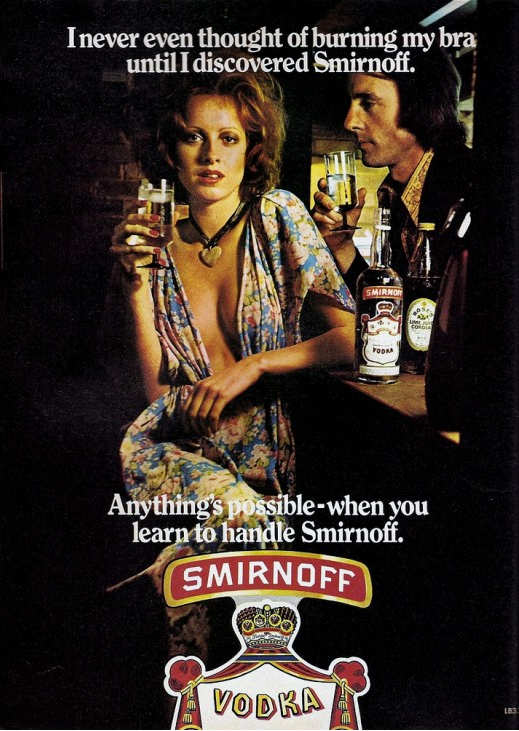
In a collection of alcohol ads from the 1960s and ’70s, Retronaut included an ad that is a nice example of how marketers sometimes co-opt social movements.  In this case, the co-optation works against the movement, sending the opposite message that it intended.

“I never even thought of burning my bra until I discovered Smirnoff,” says a woman with bedroom eyes.   The message, of course, is not that a woman who drinks the vodka will become politicized; instead, it is that Smirnoff will “loosen her up” and facilitate seduction.

We’ve posted other examples of this phenomenon, including a series of Playboy illustrations that co-opted the feminist movement (“Male supremacy is all right — but I favor a different position”) as well as the Civil Rights and Anti-War movements.  We’ve also collected instances of feminist rhetoric being used to market a wide range of products and, of course, there’s always the remarkable “torches of freedom” pro-smoking campaigns.

The bra-burning story, incidentally, is a myth.  In 1968 feminists protested outside of the Miss America pageant; they threw many items deemed oppressive into a trash can: bras, yes, as well as cosmetics, high heels, etc.  They didn’t light the trash can on fire.  The idea that they burned bras was added later, in an effort to link the Women’s Movement to the Anti-War Movement (remember that draftees were burning their draft cards).  The Anti-War Movement was, at the time, being taken more seriously, so the link was meant to give feminism more credibility.  Instead, the idea of feminists burning bras became a humorous cultural trope, hence the ad above.

Lisa Wade, PhD is an Associate Professor at Tulane University. She is the author of American Hookup, a book about college sexual culture; a textbook about gender; and a forthcoming introductory text: Terrible Magnificent Sociology. You can follow her on Twitter and Instagram.