Cross-posted at Reports from the Economic Front.

“Too big to fail” — that was the common explanation voiced at the start of the Great Recession for why the Federal Reserve had no choice but to channel trillions of dollars into the coffers of our leading banks. But, the government also pledged that once the crisis was over it would take steps to make sure we would never face such a situation again.  

The chart below shows the growing concentration of bank assets in the hands of the top 3 U.S. banks. The process really took off starting in the late 1990s and never slowed down right up to the crisis.  It was the reality of the top three banks controlling over 40 percent of total bank assets that gave meaning to the “too big to fail” fears.    

nature09659-f52.jpg

But what has happened since the crisis?  According to Bloomberg Businessweek, the largest banks have only gotten bigger:

Five banks — JPMorgan Chase, Bank of America, Citigroup, Wells Fargo, and Goldman Sachs — held more than $8.5 trillion in assets at the end of 2011, equal to 56 percent of the U.S. economy, according to the Federal Reserve. That’s up from 43 percent five years earlier.

The Big Five today are about twice as large as they were a decade ago relative to the economy, meaning trouble at a major bank would leave the government with the same Hobson’s choice it faced in 2008: let a big bank collapse and perhaps wreck the entire economy or inflame public ire with a costly bailout. “Market participants believe that nothing has changed, that too-big-to-fail is fully intact,” says Gary Stern, former president of the Federal Reserve Bank of Minneapolis.

pol_banks17_inline4051.jpg

Not surprisingly, this kind of economic dominance translates into political power.  For example, the U.S. financial sector is leading the charge for new free trade agreements that promote the deregulation and liberalization of financial sectors throughout the world.  Such agreements will increase their profits but at the cost of economic stability; a trade-off that they apparently find acceptable.

The recently concluded U.S.-Korea Free Trade Agreement is a case in point.  Leading financial firms helped shape the negotiating process.  As a consequence, Citigroup’s Laura Lane, corporate co-chair of the U.S.-Korea FTA Business Coalition, was able to declare that the agreement had “the best financial services chapter negotiated in a free trade agreement to date.”  Among other things, the chapter restricts the ability of governments to limit the size of foreign financial service firms or covered financial activities.  This means that governments would be unable to ensure that financial institutions do not grow “too big to fail” or place limits on speculative activities such as derivative trading.  The chapter also outlaws the use of capital controls.

These same firms are now hard at work shaping the Transpacific Partnership FTA, a new agreement with a similar financial service chapter that includes eight other countries.  Significantly, although the U.S. Trade Representative has refused to share any details on the various chapters being negotiated with either the public or members of Congress, over 600 representatives from U.S. multinational corporations do have access to the texts, allowing them to steer the negotiations in their favor.

The economy may be failing to create jobs but leading financial firms certainly don’t seem to have any reason to complain.

We’ve posted in the past about stereotypes about Africa. For instance, Binyavanga Wainaina’s video describes common tropes used when non-Africans write about Africa, while Chimamanda Adichie discusses the problem with the limited narratives we hear about African people and nations.

In another great example of challenging such stereotypes, Dolores sent us a video in which four young men highlight common portrayals of Africans — and specifically, African men — in movies. It’s really great:

Via Colorlines.

Erin Hatton sent in a 1937 redlining map of Philadelphia, so I decided to update our earlier post on segregation and redlining in the city.

—————

One historical cause of residential segregation was redlining. Lenders would color-code different neighborhoods on residential maps; red was generally the color used to designate a neighborhood as “dangerous,” meaning mortgages would not be approved in those areas, since they were considered to be high-risk areas for mortgage defaults. This was generally a blanket rule: people found themselves unable to get mortgages to buy property in redlined areas, regardless of their income or the value of the particular house they wanted to buy. And a high proportion of Black (and sometimes White immigrant) residents generally meant that a neighborhood would be automatically tagged as a high-risk area.

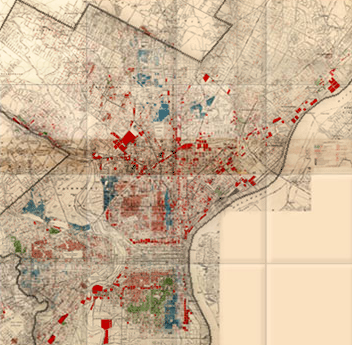
The University of Pennsylvania Redlining in Philadelphia project provides an example of a map created to guide lending in Philadelphia. The map was created in 1934 by J.M. Brewer, who owned a real estate consulting company and later was chief appraiser for Metropolitan Life Insurance.

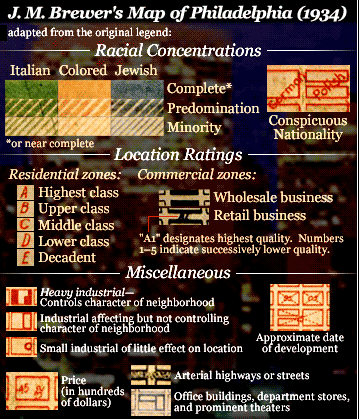
This legend was adapted from the original for the U. of Pennsylvania website:

The legend looks like the “colored” areas are coded yellow, but it’s actually red on the map. Brewer created another map in 1935 and helped draw the federal Home Owners’ Loan Corporation (HOLC) map of Philadelphia in 1937.

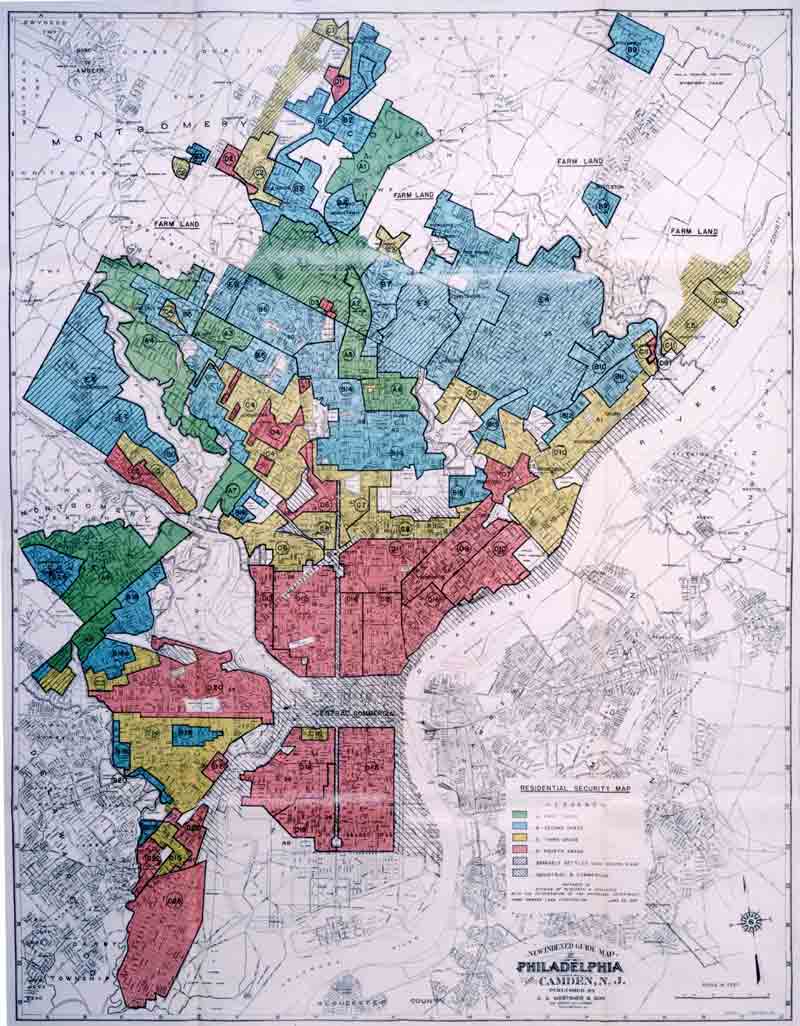
Erin Hatton sent a link to that 1937 HOLC map, which reflects the governmental institutionalization of racism, marking some groups as inherently undesirable:

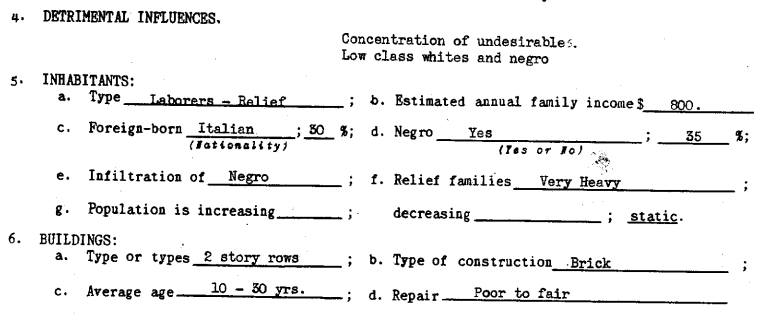
If you go to Redlining Philadelphia and click on areas of the map, it links to the survey sheets used to rate each neighborhood. All include a section on detrimental elements and a demographics breakdown, with areas to note the presence of immigrants, African Americans, poor families, and so on, such as this section of a survey sheet for area 22, giving a security grade of D:

African Americans were not the only group targeted by redlining. For instance, the survey sheet for area 5 mentions the “danger of Jewish encroachment”:

Redlining made it difficult for Blacks (and some White ethnics) to buy homes. Racial discrimination meant Blacks often couldn’t buy homes outside Black neighborhoods, but Black neighborhoods were often redlined by lenders, meaning Blacks couldn’t get mortgages to buy houses inside them, either. As a result, African Americans were disproportionately barred from one of the major avenues to acquiring wealth (building equity through home ownership), leading to increasing racial disparities in wealth and home ownership over time.

Also check out our post on segregated Durham.

Today is Administrative Assistant’s Day!  Enjoy our really fabulous post from last year in which we recount Ann Swidler’s observations about “Secretary’s Day” and Social Control.

Abortion is highly politicized in the U.S. (more so than in many other countries) and the fight between those who are in favor of and against available abortion occurs on two fronts.  One is familiar to just about everyone: the effort to overturn Roe v. Wade, the legislation Supreme Court decision that established the legality of abortion in 1973.

The second front, though, is less familiar.  It involves reducing the ease of access to legal abortion. Efforts to increase barriers to accessing legal abortion include passing laws that require minors to notify their parents of an abortion or get their consent, requiring mandatory counseling for abortion-seekers, instituting waiting periods, and discouraging medical schools from teaching abortion procedures.  Some of the issues of diminishing access are non-movement related; others are the direct result of pro-life activism.

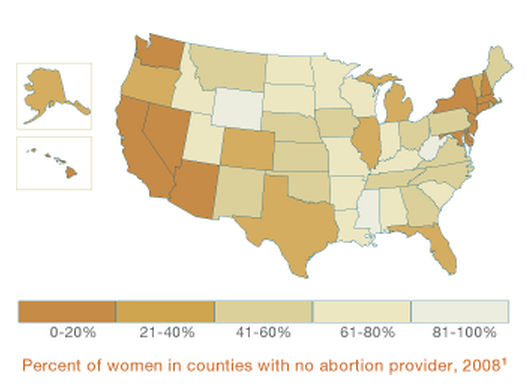
I bring this up in order to focus on an additional barrier to access: a reduction in the number of clinics and hospitals that provide abortions.  The map below, based on data from the Guttmacher Institute and compiled by ANSIRH, shows how availability varies by state.  In the darkest states, up to 20% of women live in a county with no abortion provider; in the lightest states, between 81 and 100% percent do.
Living far from the nearest abortion provider is a problem especially for low-income women.  Such women are less likely to have an employer who will give her a day off to travel to the clinic, less likely to get a paid sick day, and less likely to be able to afford to lose even a single day’s wages.  She is also less likely to have a car, making it more difficult to get to a distant location, and less likely to have reliable day care for any existing children.  If the state requires in-person counseling and has a waiting period, it means that the woman must take two days off, travel to and from the clinic twice, and arrange for child care on multiple days.

Reduction in the availability of abortion does not necessarily reduce the number of abortions.  We recently posted global data showing that less liberal abortion laws actually correlate with higher rates of abortion.  The data below, also from Guttmacher, show that were abortion laws are less liberal (largely in developing countries), the rate of abortion is 34/1,000 women oer year, compared to 39/1,000 in developed countries (the difference may look significant here, but imagine how trivial it would look if the horizontal axis went all the way to it’s true maximum of 1,000):
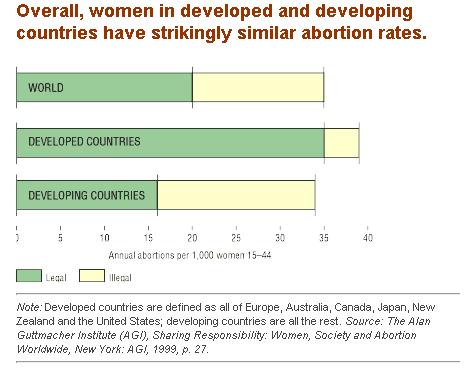
Guttmacher explains that the relevant variable isn’t availability of abortion, but the unintended pregnancy rate (which is surprisingly high in the U.S.).

Barriers to accessing abortion, then, don’t lower the abortion rate.  They do, however, increase the likelihood that an abortion procedure will occur later in pregnancy and guarantee a greater logistic burden on the pregnant woman.

Lisa Wade, PhD is an Associate Professor at Tulane University. She is the author of American Hookup, a book about college sexual culture; a textbook about gender; and a forthcoming introductory text: Terrible Magnificent Sociology. You can follow her on Twitter and Instagram.

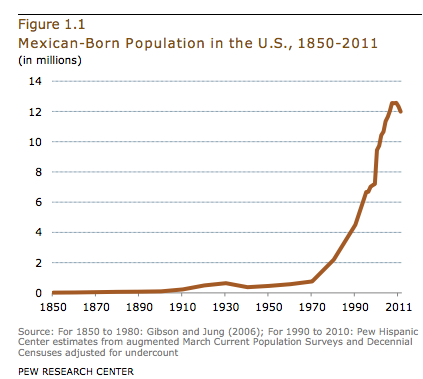
The Pew Hispanic Center has released a new report on trends in migration from Mexico. For the first time in 40 years, immigration from Mexico has slowed:

This is a notable change, as Mexican immigration has been the single largest immigrant flow to the U.S. form a single country, in overall numbers (though in the late 1800s, German and Irish immigrants made up a larger percent of all immigrants annually than Mexicans make up today). The report attributes this change to a range of factors, from changing economic conditions in Mexico, the recession’s effects on the U.S. economy, border enforcement, and the dangers of border crossings.

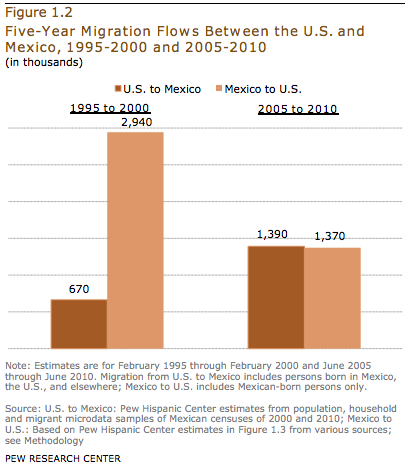
Indeed, we may now be seeing more people moving from the U.S. to Mexico than vice versa:

The change is due primarily to a drop in undocumented immigration, which peaked around 2007 and has dropped off significantly since:

There’s a lot more information available on changes in border enforcement and socio-economic changes in Mexico, so check out the full report.

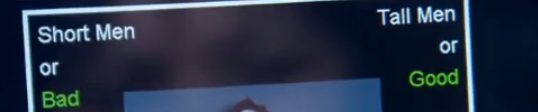
This four-minute video reports research showing that, even if we’re not aware of it, most of us have unconscious biases against short men.  (It’s also a great description of Implicit Association Tests.)

[youtube]https://www.youtube.com/watch?v=SRlWvzUznlw[/youtube]

You, too, can take any multitude of implicit association tests.  Simply go to Harvard’s Project Implicit.

Borrowed from The Social Complex, a heightism blog. See also guest posts from The Social Complex introducing the concept of heightism as a gendered prejudice and discussing heightism (and other icky stuff) at Hooters.

Lisa Wade, PhD is an Associate Professor at Tulane University. She is the author of American Hookup, a book about college sexual culture; a textbook about gender; and a forthcoming introductory text: Terrible Magnificent Sociology. You can follow her on Twitter and Instagram.

Over the last couple of years, we’ve collected a number of awesome examples of kids illustrating socialization into particular types of interaction or performance. We had the toddlers expertly mimicking the cadences of a conversation; we had a 2-year-old rapping; there was the baby worshipper; and finally, the baby preacher, who has the gestures and rhythms of a certain type of preaching down pat.

Thanks to Stephanie V., now we’ve got another example. This 4-year-old has not only figured out how to rap using different cadences and tones, he accompanies himself on a keyboard and drum machine, and has a pretty excellent grasp of song construction. Enjoy!

[youtube]https://www.youtube.com/watch?v=nDtgyGwvUus[/youtube]

Gwen Sharp is an associate professor of sociology at Nevada State College. You can follow her on Twitter at @gwensharpnv.