This is the first part in a series about how girls and women can navigate a culture that treats them like sex objects. Cross-posted at Ms.,  BroadBlogs, and Caroline Heldman’s Blog.

Around since the 1970s and associated with curmudgeonly second-wave feminists, the phrase “sexual objectification” can inspire eye-rolling. The phenomenon, however, is more rampant than ever in popular culture.  Today women’s sexual objectification is celebrated as a form of female empowerment.  This has enabled a new era of sexual objectification, characterized by greater exposure to advertising in general, and increased sexual explicitness in advertisingmagazinestelevision showsmoviesvideo gamesmusic videostelevision news, and “reality” television.

What is sexual objectification?  If objectification is the process of representing or treating a person like an object (a non-thinking thing that can be used however one likes), then sexual objectification is the process of representing or treating a person like a sex object, one that serves another’s sexual pleasure.

How do we know sexual objectification when we see it?  Building on the work of Nussbaum and Langton, I’ve devised the Sex Object Test (SOT) to measure the presence of sexual objectification in images.  I proprose that sexual objectification is present if the answer to any of the following seven questions is “yes.”

1) Does the image show only part(s) of a sexualized person’s body?
Headless women, for example, make it easy to see her as only a body by erasing the individuality communicated through faces, eyes, and eye contact:
We get the same effect when we show women from behind, with an added layer of sexual violability. American Apparel seems to be a particular fan of this approach:

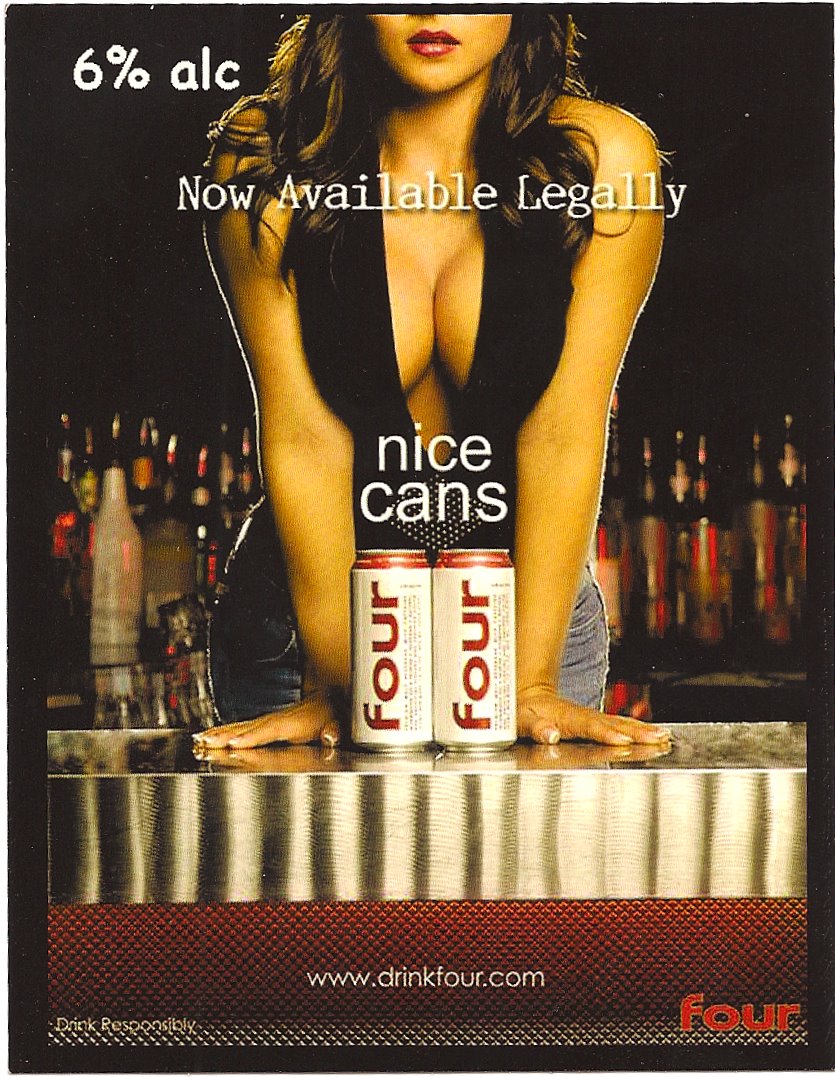
2) Does the image present a sexualized person as a stand-in for an object?

The breasts of the woman in this beer ad, for example, are conflated with the cans:

Likewise, the woman in this fashion spread in Details in which a woman becomes a table upon which things are perched. She is reduced to an inanimate object, a useful tool for the assumed heterosexual male viewer:
Or sometimes objects themselves are made to look like women, like this series of sinks and urinals shaped like women’s bodies and mouths and these everyday items, like pencil sharpeners.

3) Does the image show a sexualized person as interchangeable? 
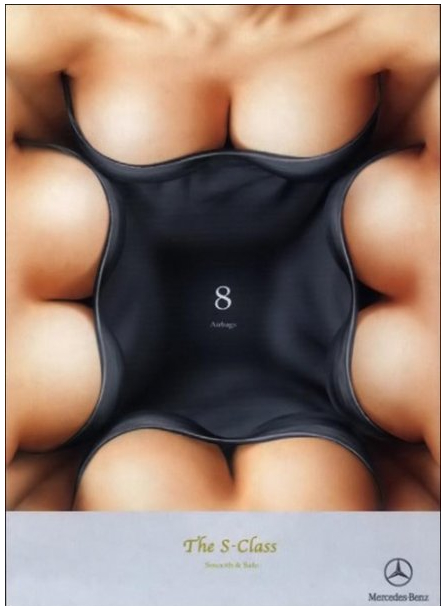
Interchangeability is a common advertising theme that reinforces the idea that women, like objects, are fungible. And like objects, “more is better,” a market sentiment that erases the worth of individual women. The image below advertising Mercedes-Benz presents just part of a woman’s body (breasts) as interchangeable and additive:

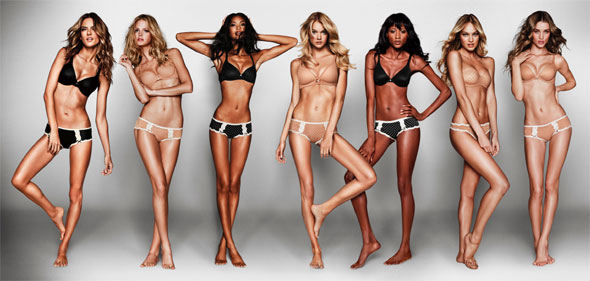
This image of a set of Victoria’s Secret models, borrowed from a previous SocImages post, has a similar effect. Their hair and skin color varies slightly, but they are also presented as all of a kind:

4) Does the image affirm the idea of violating the bodily integrity of a sexualized person that can’t consent?

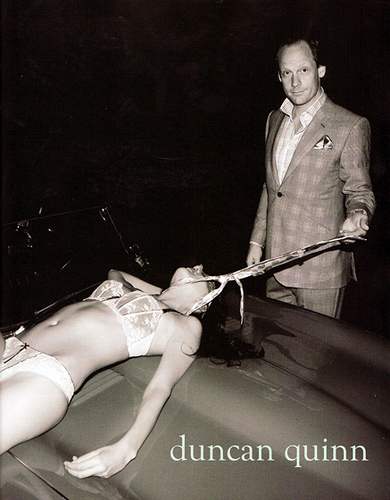
This ad, for example, shows an incapacitated woman in a sexualized positionwith a male protagonist holding her on a leash. It glamorizes the possibility that he has attacked and subdued her:

5) Does the image suggest that sexual availability is the defining characteristic of the person? 

This ad, with the copy “now open,” sends the message that this woman is for sex.  If she is open for business, then she presumably can be had by anyone.

6) Does the image show a sexualized person as a commodity (something that can be bought and sold)?

By definition, objects can be bought and sold, but some images portray women as everyday commodities.  Conflating women with food is a common sub-category.  As an example, Meredith Bean, Ph.D., sent in this photo of a Massive Melons “energy” drink sold in New Zealand:
In the ad below for Red Tape shoes, women are literally for sale:

7) Does the image treat a sexualized person’s body as a canvas?

In the two images below, women’s bodies are presented as a particular type of object: a canvas that is marked up or drawn upon.

——————

The damage caused by widespread female objectification in popular culture is not just theoretical.  We now have over ten years of research showing that living in an objectifying society is highly toxic for girls and women, as is described in Part 2 of this series.

Caroline Heldman is a professor of politics at Occidental College. You can follow her at her blog and on Twitter and Facebook.

SocImages News:

Lisa appeared on the pop culture podcast Sounds Familiar to talk about the role of women in horror flicks.  Are slasher flicks feminist?  Well, kinda they are!

She also served as the guest expert on KPCC’s AirTalk for a conversation on the grandfather who was kicked out of a Barnes & Noble children’s book section for being a single male.  She called it  “gender profiling” (listen).

The folks from Office Hours, one of our sibling blogs at The Society Pages, posted a podcast with Lisa and Gwen discussing Sociological Images and public sociology more generally.

The Guardian reposted part of Matt Cornell’s SocImages post on his “man boobs” and Playboy Radio had him on for an “awkward” Q&A.

Quotes and Links:

We were quoted or linked at The Atlantic, the Kansas City Star, TV Tropes, the Huffington Post, and Jezebel.

New Resources:

Gwen added a section on politics to her Intro to Sociology Course Guide and Lisa put together a new Pinterest page, this one collecting all the images from our posts on Disney.

Social Media ‘n’ Stuff:

Finally, this is your monthly reminder that SocImages is on TwitterFacebookGoogle+, and Pinterest.  Lisa is on Facebook and most of the team is on Twitter: @lisadwade@gwensharpnv@familyunequal@carolineheldman@jaylivingston, and @wendyphd.

In Other News…

We wanted to give a shout out to the anonymous fan who added this sticky note to the paperwork for a book Lisa ordered on interlibrary loan.   You made our day!  :)

A while back, in a post about Kim Kardashian’s fame, Lisa summarized the concept of a patriarchal bargain as “a decision to accept gender rules that disadvantage women in exchange for whatever power one can wrest from the system. It is an individual strategy designed to manipulate the system to one’s best advantage, but one that leaves the system itself intact.”

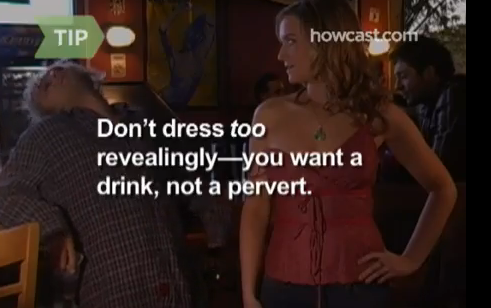
Christine B. sent in an excellent example of an individual-level attempt at empowerment with the confines of gender inequality. The video, part of the Howcast series of how-to videos, explains to women how to get men to buy them drinks at a bar:

In case you didn’t feel like watching the video, I can sum it up for you:

  • Dress sexy, but not slutty, or you’re asking for it. How do you know if you’ve crossed the line? Well, if any men act inappropriately toward you, you must have shown too much boob. Better luck next time!
  • Instead of planning a fun night out with your female friends, select only one — the bubbliest one, obviously — and go find a male-dominated environment.
  • Buy yourself one drink right off the bat, so it looks like you’re an independent-minded woman who isn’t trying to get free shit in return for being pretty. I mean, you are doing that, but you don’t want to make it obvious. Men might be turned off if the gendered exchange were made explicit.
  • Assume all men are stupid.
  • Don’t ever stop to question a system that tells women that trading on our appearance, faking interest in people, excluding friends from social outings because they might be annoying to random men you’ve never met, and being manipulative are all totally empowering and socially-acceptable ways to behave as long as ladies get a fairly low-cost item for free in return for our efforts.

Transcript after the jump.

more...

The Stonewall Riots, widely described as the birth of the modern gay and transgender rights movement, occurred on this day in 1969.


Lisa Wade, PhD is an Associate Professor at Tulane University. She is the author of American Hookup, a book about college sexual culture; a textbook about gender; and a forthcoming introductory text: Terrible Magnificent Sociology. You can follow her on Twitter and Instagram.

When asked to contribute to an exhibition about chocolate, photographer James Mollison decided to “explore the disparity between the producer and consumer.”  Chocolate is always a luxury, of course (and is often deliberately marketed this way), and the product, at its finest, can be exceptionally delicious and exceptionally expensive.

Mollison went to Côte d’Ivoire, the country responsible for producing the largest proportion of cacao, to bring the contrast between the product and its producers to life.  The men he photographed, he reports, earned less than $1 a day.

You can see them at his website.

Lisa Wade, PhD is an Associate Professor at Tulane University. She is the author of American Hookup, a book about college sexual culture; a textbook about gender; and a forthcoming introductory text: Terrible Magnificent Sociology. You can follow her on Twitter and Instagram.

For those readers who teach statistics, or methods, or cover the representation of data in their classes, or, like me, are just geeky and unfortunately easily amused, I present to you The World’s Most Accurate Pie Chart.

Gwen Sharp is an associate professor of sociology at Nevada State College. You can follow her on Twitter at @gwensharpnv.

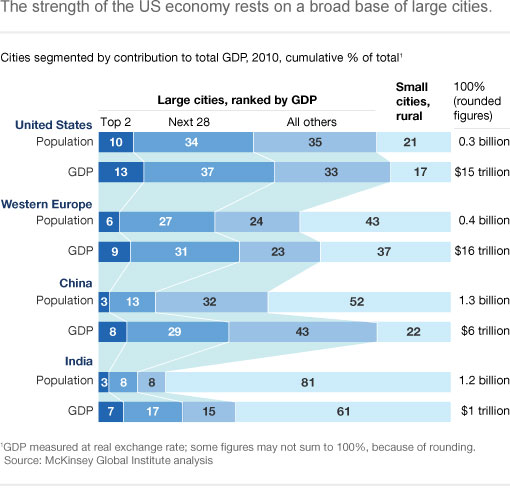
Peter Nardi, from Pitzer College, let us know that the McKinsey Global Institute recently released a report on U.S. cities and the economy. Large cities (those with 150,000+ residents), are more dominant in the U.S. than in Western Europe, China, and India. More of both the national population and economic productivity (measured by GDP) is concentrated in cities in the U.S. than in those other areas, with the exception of the concentration of GDP in large cities in China:

So overall, the vast majority of the U.S. population lives in cities, and they drive economic development and change here. But of course, the fortunes of cities within the U.S. have varied greatly. If we look at the top 30 cities (by GDP) in 1978 and 2010 (in constant 2010 dollars), we can see the decline of many older manufacturing and transportation centers in the northeast and Great Lakes areas. Milwaukee, Indianapolis, Columbus, and Buffalo fell out of the top 30 altogether, while Philly, Detroit, Pittsburgh, Cleveland, and Cincinnati experienced decreases in their contributions to the overall economy, as did three river port cities — New Orleans, Kansas City, and St. Louis. On the other hand, the Sun Belt has become much more prominent, with cities in the South and Southwest entering the top 30 or rising in the rankings (and 6 of the top 30 from California alone):

Most of the economic growth, the study finds, is due to expanding populations. Large cities aren’t becoming much more productive — cities with high overall GDP growth didn’t have higher per capita growth rates than other cities, so it isn’t that their economies are transforming in ways that make workers tremendously more productive individually. They’re growing much faster in terms of population, and that expansion pushes economic growth.

The report also found there’s no single path to successful economic growth for cities. Some with diversified local economies did very well, but others were below average; similarly, some cities that were largely dependent on just one or two economic sectors have suffered, but others did quite well. Check out the full report for a much more detailed analysis on the factors that influence the rise or decline of the economies of U.S. cities, as well as future challenges.

(Via The Atlantic.)

Raised by a racist father, Johnny Lee Clary joined the Klan in 1963 at the age of 14. By 30, he had risen through the ranks and was named the Imperial Wizard, the leader of the entire organization.  He was an outspoken advocate of white supremacy and violence against non-whites, even appearing on the Oprah Winfrey show.

In this four-minute video, he discusses his association with Reverend Wade Watts, a Black civil rights activist and member of the NAACP.  Watts expressed kindness and love towards Clary, even in the face of escalating violence (Clary ultimately set fire to his church).  Deeply affected by Watts, Clary would eventually recant his association with the KKK and join Watts in the fight against racism.

Lisa Wade, PhD is an Associate Professor at Tulane University. She is the author of American Hookup, a book about college sexual culture; a textbook about gender; and a forthcoming introductory text: Terrible Magnificent Sociology. You can follow her on Twitter and Instagram.