
Earlier this month, Louisiana’s legislature voted to expand its school voucher program to cover the entire state, allowing parents whose children attend low-rated schools to use government-funded vouchers to help pay the cost of tuition at one of about 125 schools on an approved list (assuming, of course, their child is accepted). Another law recently passed in the state will provide tax credits for private donations to voucher programs, a policy already implemented in some states, including Pennsylvania.

Critics have expressed concern about some of the schools approved for the program, including a lack of site visits in the approval process and the inclusion of schools that do not appear to have the facilities or staff for the large increases in enrollment that would result if all of their available vouchers were used.

The expansion of the voucher program has also brought renewed attention to the curricula used at schools receiving state funds through voucher systems. Some of the schools approved for the voucher program in Louisiana, as well as other states, use textbooks produced by several evangelical organizations, including A Beka Book and Bob Jones University. In the documentary School Choice: Taxpayer-Funded Creationism, Bigotry, and Bias, Rachel Tabachnick and Bruce Wilson discuss Pennsylvania’s voucher program. Here’s an 8-minute clip focusing on the contents of some textbooks published by A Beka Book and BJU:

Examples from A Beka Book and Bob Jones University Press Curricula from Bruce Wilson on Vimeo.

Highlights:

  • Humans and dinosaurs co-existed.
  • God designed “checks and balances” to prevent environmental crises, so chill! After all, “Roses are red, violets are blue; they both grow better with more CO2.”
  • “Rumors” of foreclosures, high unemployment, homelessness, and general misery during the Great Depression are just socialist propaganda.
  • Unions just want to destroy the accomplishments of “hardworking Americans.”
  • Mormons, Unitarians, and Catholics = bad.
  • And then there’s the history of racial/ethnic relations: “God used the ‘Trail of Tears’ to bring many Indians to Christ” and “Through the Negro spiritual, slaves developed patience to wait on the Lord and discovered that the truest freedom is freedom from the bondage of sin.” No, seriously — I didn’t make those up.

You can read some additional examples in a recent post at Salon, including the following:

Are dinosaurs alive today? Scientists are becoming more convinced of their existence. Have you heard of the `Loch Ness Monster’ in Scotland? `Nessie,’ for short has been recorded on sonar from a small submarine, described by eyewitnesses, and photographed by others. Nessie appears to be a plesiosaur.

Schools using these texts have been approved to receive government funds for education. It highlights one of critics’ concerns about voucher programs: that it is, in effect, often a way to provide taxpayer-funded education that is explicitly religious and may or may not conform to accepted standards of scientific inquiry.

Here’s the full-length documentary:

School Choice: Taxpayer-Funded Creationism, Bigotry, and Bias from Rachel Tabachnick on Vimeo.

Also see our earlier post on a Texas textbook standards advisor explaining that books should emphasize the positive, such as how minorities ought to be really grateful to Whites for giving them rights.

In Privileged, sociologist Shamus Khan discusses what he learned by studying one of the most elite boarding schools in the country, St. Paul’s School.  The school molds some of the most privileged members of our society, sending them off into some of its most powerful positions.  So, how do these high school students think of themselves?

Khan argues that new social mandates to diversify elite education may have some pernicious negative effects.  A generation ago, when most students who attended the high school came from rich backgrounds, St. Paul’s students knew that they were there because they were members of the privileged class.  Today about 1/3rd of students do not pay full tuition.  Students, then — both those on scholarships and those who aren’t — learn to think of themselves as individuals who have worked hard to get where they are.

The problem, as Khan articulates it, is that identifying as a member of a class acknowledges that privileged individuals are lucky and may owe some gratitude to a society that has boosted them up.  Thinking of oneself as a uniquely talented individual, in contrast, encourages a person to attribute all of their privilege to their own merits, so they not only feel no gratitude to society, but also fail to notice that our social institutions play a part in disadvantaging the disadvantaged.

And, in the end, students at St. Paul’s School may very be talented individuals who have worked hard, but they’re also members of a class.  Two-thirds of St. Paul’s students pay full tuition — $45,000 per year — so 2/3rds of the students still come from the top 1% of society.  Now, more than ever, they fail to recognize their privilege.

Lisa Wade, PhD is an Associate Professor at Tulane University. She is the author of American Hookup, a book about college sexual culture; a textbook about gender; and a forthcoming introductory text: Terrible Magnificent Sociology. You can follow her on Twitter and Instagram.

One of our readers sent in an example of our cultural tendency to conflate “ethnic” with “non-white,” a conflation that renders whiteness invisible in discussions of race/ethnicity and its social impacts. You Beauty posted a slideshow about choosing an appropriate sunscreen, and the first slide highlights two that are “best for ethnic skin.” The accompanying text refers to “deeper skin tones” and includes a link to a story on “dark skin decoded”:

It’s a small example of the way that race and ethnicity are perceived more broadly in our culture, with whiteness taken as the neutral, as the absence of noticeable race/ethnicity, while “ethnic” is the marked, non-neutral state of all those who aren’t white.

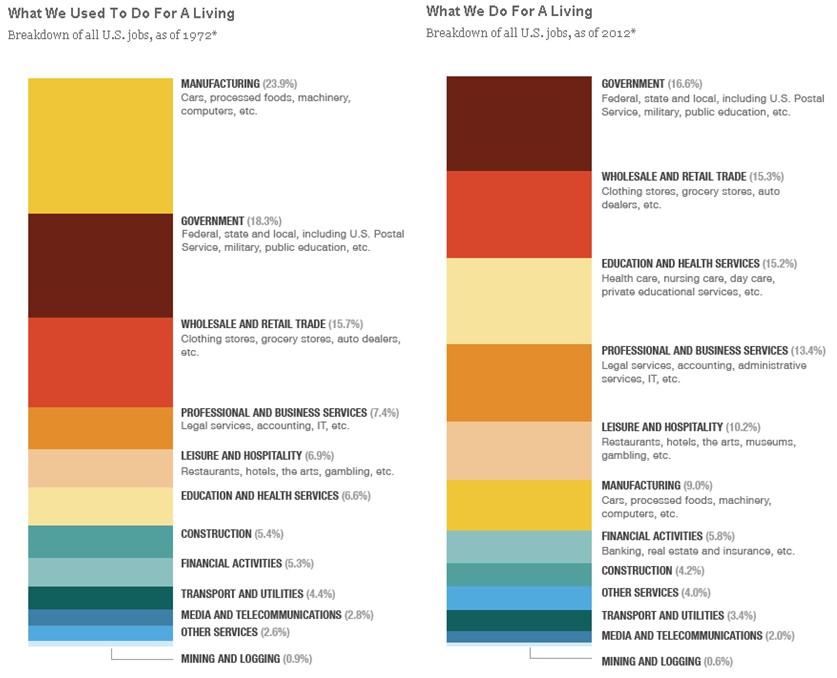
The phrase “service economy” — commonly used to describe the U.S. economic profile these days — refers to a decrease in manufacturing (where we make things for people) and an increase in the service sector (where we do stuff for people).

Planet Money put together stacked bar graphs to illustrate the increasing importance of service in our economy (1972 on the left, 2012 on the right).  Manufacturing (making things) is in yellow, so you can clearly see its decline in prominence.  Service sectors include “professional and business services,” “leisure and hospitality,” and “education and health services.”

So, when people talk about the move to a service economy, these are the changes they’re talking about.  We also see the “servitization of products” (don’t you love academics?), or a tendency for products to come with more and more service.  A restaurant, for example, offers a product (made by the chef), but also a degree of service (offered by the wait staff).  Both the quality of the food and the service vary as you move from fast food restaurants to high end eateries. When we see a servitization of products, we see a ratcheting up of the level of expected service that attends any given product.

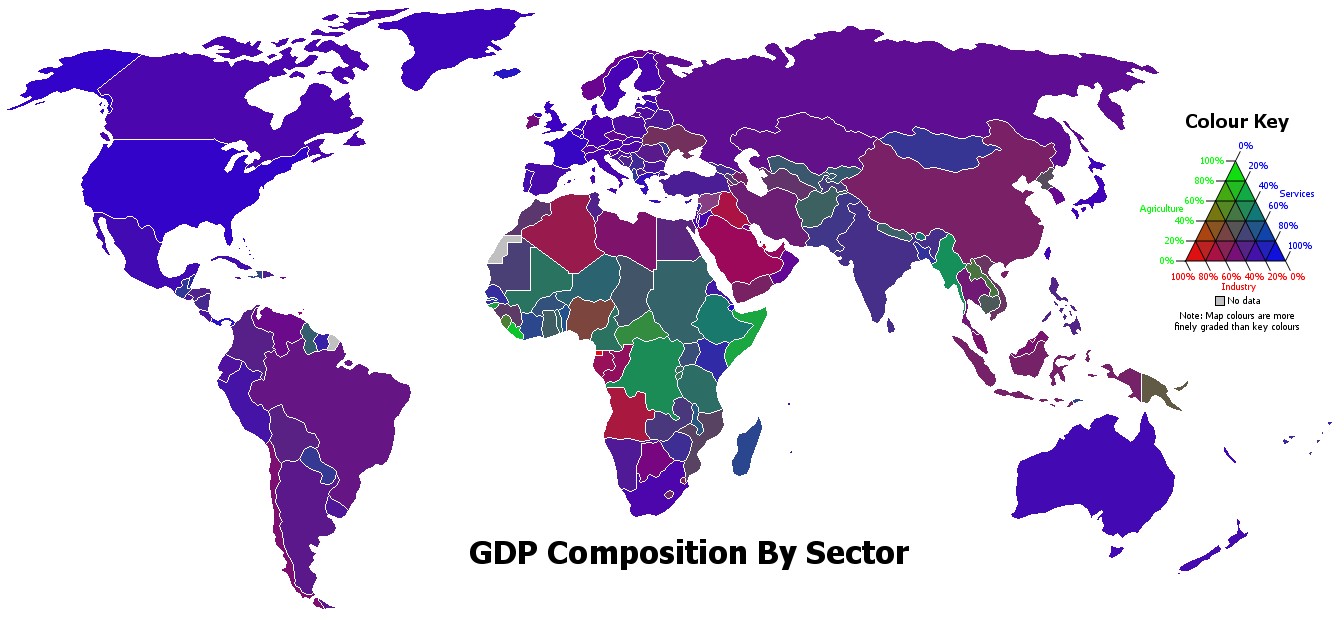
The U.S. economy, by the way, is more heavily characterized by service than most of the world.  The map below is colored to indicate the relative balance between service (blue), manufacturing (red), and agricultural (green) industries in each state.  You can see that the U.S. is among the bluest country on the map:

One of the concerns with the move to a service economy is that service jobs on the low end of the occupational hierarchy tend to be “bad” jobs, while manufacturing jobs, even when they’re on the low end, tend to be “good.”  Service jobs are “bad” in the sense that they tend to have low wages, underemployment, little chance for advancement, and poor or no benefits.  We’re talking, here, about jobs in sales, cashiering, food preparation, and the like.  Because of this tendency, the move to a service economy is taking some of the blame for the shrinking of the middle class.

Lisa Wade, PhD is an Associate Professor at Tulane University. She is the author of American Hookup, a book about college sexual culture; a textbook about gender; and a forthcoming introductory text: Terrible Magnificent Sociology. You can follow her on Twitter and Instagram.

This spring the Chronicle of Higher Education offered an in-depth look at the number of highly educated people receiving federal aid.  Though, on average, they are still doing better than people without college degrees, these populations have not been immune to the recession.

While I sensed an undercurrent of classism in the article (e.g., “how could someone like me be on aid”), it offered an interesting profile of the post-graduate degree job outlook, especially for people with a PhD.  Notably, it reminds us just how risky pursuing graduate work can be; 70% of all faculty are now off the tenure-track.  That often means that they teach part-time, have no benefits, and face semester-to-semester job insecurity.

These faculty could probably do something else, but many of them are trying to realize a dream that they’ve spent 10 to 15 years of their lives working towards.  So, they continue to teach part-time for relatively low pay and participate in a job market that, for the most part, opens up only once a year.

For more on the economics and politics of academic labor, read Keith Hoeller’s The Future of the Contingent Faculty Movement.

Lisa Wade, PhD is an Associate Professor at Tulane University. She is the author of American Hookup, a book about college sexual culture; a textbook about gender; and a forthcoming introductory text: Terrible Magnificent Sociology. You can follow her on Twitter and Instagram.
This weekend I read an article in Bitch magazine about Project Unbreakable. Last fall, then 19-year-old Grace Brown began photographing survivors of sexual assault holding posters with quotes from their attackers (or, in some cases, the police or others they told about the attack). It’s a powerful art project that highlights the emotional manipulation (“I love you,” or “If you tell your mom she’ll hate you for causing us to break up”) that often accompanies rape and sexual abuse. Collectively they illustrate many of the justifications perpetrators give. The quotes chosen by the survivors also make clear that the demands to keep the incident secret and the efforts of abusers to justify their behavior are as much a part of the attack as the physical element.

Gwen Sharp is an associate professor of sociology at Nevada State College. You can follow her on Twitter at @gwensharpnv.

In the Sociology of Gender textbook, I spend a chapter discussing the idea of institutions.  I define the term as “persistent patterns of social interaction aimed at meeting the needs of a society that can’t easily be met by individuals alone.”  These needs  include educating the next generation, providing health care, ensuring safety, and enabling efficient transportation.  These things are done better and more efficiently if we all chip in and put together a system.

What is interesting about institutions from a sociological perspective is that, once they’re in place, it is essentially impossible to opt out.  You can choose not to buy a car, for example, but the government is still going to spend your tax dollars on highway infrastructure.  You can amass as much medical knowledge and experience as you like, but you’ll still be a criminal if you practice medicine without a licence.  You can believe the government is corrupt and stay home on voting day, but Congress is still going to pass legislation to which you will be held accountable.

You get the picture.

In any case, I thought of this when I came across the striking photography of Eric Valli.  Valli seems to specialize in capturing the lives of people living very close to the earth.  In one series, he follows a group of individuals who have decided to live “off the grid.”  That is, they’ve “unplugged” from the social institutions that sustain us.

The photographs reveal people who are committed to being off the grid. It’s no joke.  And, yet, as I scrolled through them, I couldn’t help to notice how many trappings of the rest of the world were part and parcel of their lives (canoes, coats, oil lamps, cooking and eating utensils, halters, firearms, hot sauce, etc).

I’m not questioning, at all, whether or not these people are off the grid. They certainly appear to be.  But it is interesting to notice how much of the grid is still a part of their lives.

Lisa Wade, PhD is an Associate Professor at Tulane University. She is the author of American Hookup, a book about college sexual culture; a textbook about gender; and a forthcoming introductory text: Terrible Magnificent Sociology. You can follow her on Twitter and Instagram.
S. Alfonzo sent us a link to the abridged version of The Codes of Gender, in which Sut Jhally, known for a number of documentaries on pop culture, analyzes current messages about masculinity and femininity in advertising, applying the ideas of Erving Goffman regarding gender and cultural performance. Definitely worth the time to watch:

The Media Education Foundation has provided a full transcript and tips for using the film in the classroom.