For the last week of December, we’re re-posting some of our favorite posts from 2012.

In Counted Out: Same-Sex Relations and Americans’ Definitions of Family, released last month, authors Brian Powell, Catherine Bolzendahl, Claudia Geist, and Lala Carr Steelman look at how Americans conceptualize “the family” — that is, not what they think about their own families, but what they think counts as a family. Which groups or living arrangements do they include in the definition of “family,” and who is excluded?

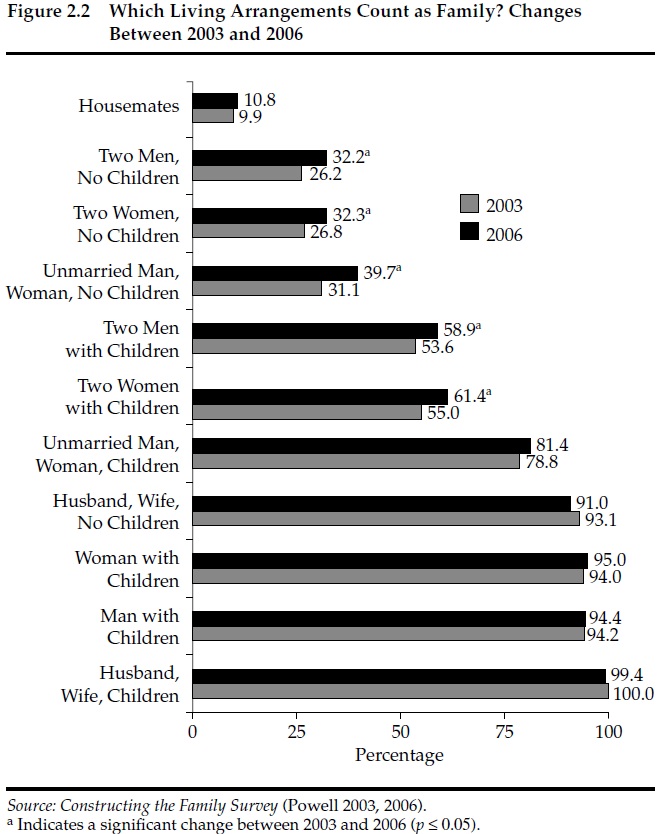
Based on surveys conducted in 2003 and 2006, Americans still hold the stereotypical nuclear family (husband, wife, kids) as the gold standard — virtually everyone agrees that such a group counts as a family. Being legally married, or the presence of children, generally leads to acceptance of a grouping as a family — the overwhelming majority believed single parents and their children count as families, as do married heterosexual couples without kids, and even unmarried heterosexual couples who have children. But when couples are same-sex, or don’t have kids, Americans are much less certain that they can qualify as a family. In 2006, the percent of respondents believing gay or lesbian couples with kids are families was notably smaller than for those agreeing that single parents or straight couples count, though it had increased since 2003:

And notice the importance of children to definitions of family — only a minority of respondents thought that gay, lesbian, or straight couples without kids are a family.

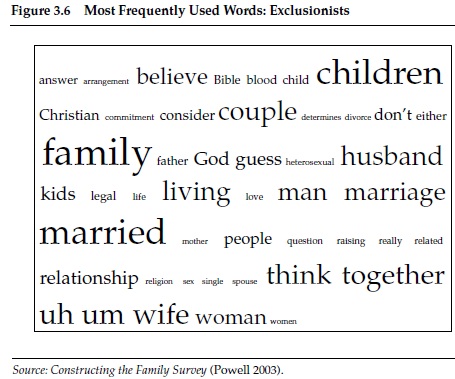
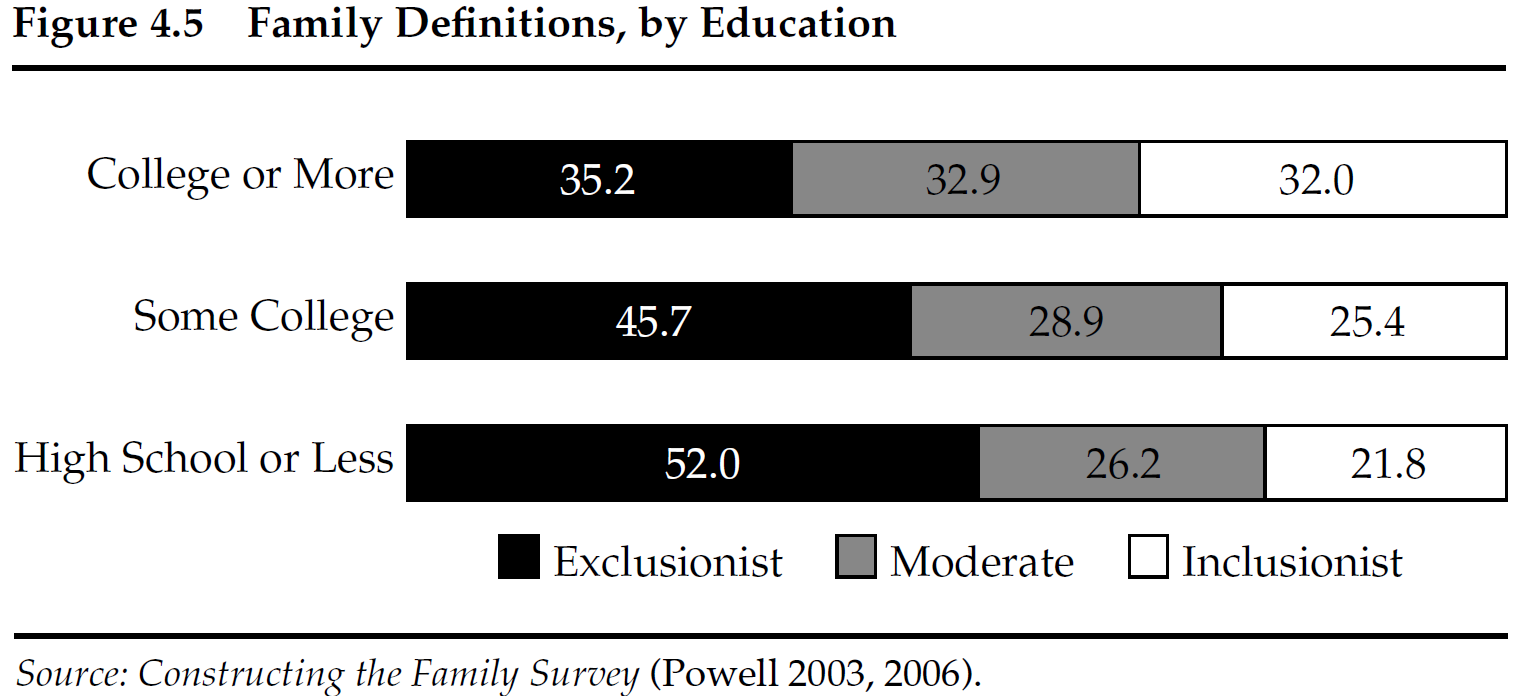
The authors divided respondents into three groups, based on their answers: exclusionists (those with the most restrictive definitions of family), moderates, and inclusionists (those with the most expansive definitions). Looking at the words these groups used as the talked about their characterizations of family, we see clear differences. The words used most frequently by exclusionists highlight the centrality of marriage, as well as an emphasis on what type of people constitute a family (husband, wife, woman, man), and the explicit inclusion of religious-based elements in their ideas of what makes a family:

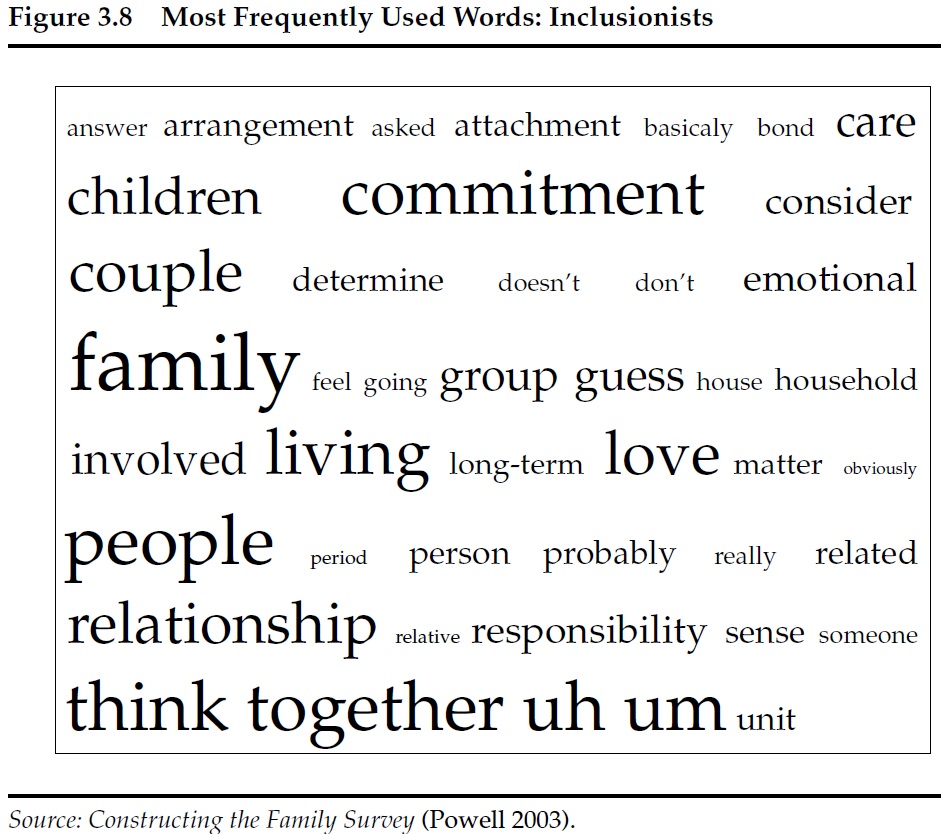
The language used by inclusionists emphasized emotional attachments rather than the legal institution of marriage as the basis for determining what counts as a family:

Women were more inclusive than men, in general:

The more educated respondents were, the more inclusive their definitions of family tended to be:

The Russell Sage Foundation released these and many other charts and tables from the book, so it’s definitely worth a look if you’re interested in how Americans think about the family. Overall, the authors found that definitions of the family were becoming more inclusive. Presumably this trend has continued and even accelerated since the 2006 survey, given how attitudes have shifted on a number of issues involving gay and lesbian rights in the past few years.

Gwen Sharp is an associate professor of sociology at Nevada State College. You can follow her on Twitter at @gwensharpnv.

Christmas Across Cultures

The Economics of Christmas

Racializing Christmas

Christmas and Gender

Gift Guides and the Social Construction of Gender

Sexifiying Christmas

Christmas Marketing

Lisa Wade, PhD is an Associate Professor at Tulane University. She is the author of American Hookup, a book about college sexual culture; a textbook about gender; and a forthcoming introductory text: Terrible Magnificent Sociology. You can follow her on Twitter and Instagram.
‘Tis the season where women’s workloads expand because they are held disproportionately responsible for the cleaning, decorating, cooking, card sending, gift buying, and gift wrapping involved with the holidays (e.g., you need 12 mums and 6 arms to make it all happen).

In light of that, this “survival tip” from Ace Hardware encouraging men to buy things for themselves is especially obnoxious.  Thanks to Martha J. for sending it to us!

—————————

Lisa Wade is a professor of sociology at Occidental College. You can follow her on Twitter and Facebook.

This is one of our favorite Christmas-themed posts from the archive.  We hope you don’t mind the re-post!

Stressing remarkable differences between the two, Rachel and Lucy sent in the music videos for the original Mariah Carey version of “All I Want for Christmas is You” (1994) and the re-make (2011).  They suggested that the comparison reveals two trends: the rising emphasis placed on consumption and the new hyper-sexualization.  I figured, “yeah, I’ll bet they’re onto something there.”  And boy were they.

The first video involves Mariah mostly bounding around in the snow in a snow suit. Often acting pretty darn goofy, with dogs and Santa.

She spends part of the video inside with kids, a Christmas tree, presents, and more animals.  She’s usually wearing a sweater.

She spends less than (I’m guessing) 10 seconds of the video in a sexy Mrs. Claus outfit and, when she’s wearing it, it looks like she’s got long johns on her legs.

The new video, featuring Justin Bieber, is wildly different. Instead of a snowy field or an intimate home, the video takes place in a shopping mall.  It centrally features a Nintendo product.

Likewise, instead of bounding around in the snow like a goof, she spends the entire video up against a wall in super high heels and the sexy Mrs. Claus outfit (except this one doesn’t have sleeves or a midriff).

At one point she runs her hand down her body, touching her breast and moving down to her crotch; at another she just leans against the wall with her back to us and swings her butt back and forth.

So there’s one data point, for what it’s worth, but in line with emerging research on and plenty of anecdotal evidence of the “pornification” of American culture.

“All I Want for Christmas is You” (1994):

“All I Want for Christmas is You” (2011):

Lisa Wade, PhD is an Associate Professor at Tulane University. She is the author of American Hookup, a book about college sexual culture; a textbook about gender; and a forthcoming introductory text: Terrible Magnificent Sociology. You can follow her on Twitter and Instagram.
A set of photos, taken by Ian Mansfield, are a neat illustration of how culture can coordinate human action.  They capture London on Christmas morning.  Said Mansfield:

Apart from the emptiness of the city, it is the silence that makes the experience such an addictive one for me.

London is never silent, not even at 3am, but on Xmas morning, it is almost silent. The background drone of aircraft approaching Heathrow has gone, and away from main roads, the streets lack the sound of car tyres rolling over tarmac.

Heading home, also a sound you never really hear now – the pealing of church bells. Not just coming from a single church you are nearby, but from all over the city as the sound carries far further than usual and surrounds you from all sides. Magical.

More at Ian Mansfield’s website (via BoingBoing).

Lisa Wade, PhD is an Associate Professor at Tulane University. She is the author of American Hookup, a book about college sexual culture; a textbook about gender; and a forthcoming introductory text: Terrible Magnificent Sociology. You can follow her on Twitter and Instagram.
This is one of our favorite Christmas-themed posts from the archive.  We hope you don’t mind the re-post!

White privilege refers to the many, many benefits of being white in a society dominated, both culturally and materially, by other white people. The notion was popularized by Peggy McIntosh in a 1989 an essay titled White Privilege: Unpacking the Invisible Knapsack.  One benefit is that most fictional characters, unless otherwise specified (and sometimes even so), are assumed to be white.  Growing up non-white in a white-dominated world, then, means that  most of the mythological figures of your childhood do not look like you in one important way.

Santa, of course, is a fictional figure whose appearance is invented.  Theoretically anyone could be Santa.  Yet, while we may see the occasional non-white Santa at the mall or in novelty holiday stories, he is unbearably and overwhelmingly white in our (google-able) imagination:  The first three pages of a google image search for “Santa”:

For more examples, see all of our posts about white privilege.  Thanks for Martha Pitts as Ms. for this post idea.

Lisa Wade, PhD is an Associate Professor at Tulane University. She is the author of American Hookup, a book about college sexual culture; a textbook about gender; and a forthcoming introductory text: Terrible Magnificent Sociology. You can follow her on Twitter and Instagram.

We’ve posted before about how women are held disproportionately responsible for making holidays happen.  In our imaginations, and all-too-often in real life, the majority of the cleaning, the decorating, the cooking, the gift buying, and the card sending is done by women.

Last year Jeremiah J. sent in a twist on this theme: a CBS report on the First Ladies’ intimate involvement in the decorating of the White House for the holidays. Accordingly to the guest, they are the “commander of chief of Christmas, and they all really care.” Embedding is disabled (watch the video here).

The segment is also a really great example of how women get associated with trivial things. In addition to that stunning line, “commander of chief of Christmas,” the guest explains: “they all have their signature style… it’s really a lot of fun.” Fun, yes, but not by any means important. At the end of the video, the guest is asked if she wrote the book on First Lady involvement with decorating because she wanted ideas for how to decorate her own home. A good sport, the woman replies yes.

This year the White House highlighted Michelle Obama’s role in managing the decorating of the 54 Christmas trees that currently dot the residence.  The story specifies that Ms. Obama had help — 85 volunteers — but also that they were there to help her, specifically, with her job: “…none of this would be possible if not for the volunteers… and Mrs. Obama thanked them in her remarks this afternoon.”

See also: 12 Mums Make the Workload Light, Christmas is Women’s Work, and Holding Women Responsible for the Holidays.

Lisa Wade, PhD is an Associate Professor at Tulane University. She is the author of American Hookup, a book about college sexual culture; a textbook about gender; and a forthcoming introductory text: Terrible Magnificent Sociology. You can follow her on Twitter and Instagram.
Cross-posted at Chris Uggen’s Blog.

I’ve been reluctant to write about the terrible events at Sandy Hook Elementary School because the wounds are still too fresh for any kind of dispassionate analysis. As a social scientist, however, I’m disappointed by the fear-mongering and selective presentations of the research evidence I’ve read in reports and op-eds about Friday’s awful killing.

Such events could help move us toward constructive actions that will result in a safer and more just world — or they could push us toward counter-productive and costly actions that simply respond to the particulars of the last horrific event. I will make the case that a narrow focus on stopping mass shootings is less likely to produce beneficial changes than a broader-based effort to reduce homicide and other violence. We can and should take steps to prevent mass shootings, of course, but these rare and terrible crimes are like rare and terrible diseases — and a strategy to address them is best considered within the context of more common and deadlier threats to population health. Five points:

1. The focus on mass shootings obscures over 99 percent of homicide victims and offenders in the United States.

The numbers should not matter to parents who must bury their children, but they are important if policy makers are truly committed to reducing violent deaths. There are typically about 25 mass shootings and 100 victims each year in the United States (and, despite headlines to the contrary, mass shootings have not increased over the past twenty years). These are high numbers by international standards, but they pale relative to the total number of killings – about 14,612 victims and 14,548 offenders in 2011. In recent years, the mass shooters have represented less than two-tenths of 1 percent of the total offenders, while the victims have represented less than one percent of the total homicide victims in any given year. We are understandably moved by the innocence of the Sandy Hook children, but we should also be moved by scores of other victims who are no less innocent. There were 646 murder victims aged 12 or younger  in the United States in 2011 alone — far more than all the adults and children that died as a result of mass shootings.

2. The focus on mass shootings leads to unproductive arguments about whether imposing sensible gun controls would have deterred the undeterrable. 

As gun advocates are quick to point out, many of the perpetrators in mass shootings had no “disqualifying” history of crime or mental disorder that would have prevented them from obtaining weapons. And, the most highly motivated offenders are often able to secure weapons illegally. Even if such actions do little to stop mass shootings, however, implementing common-sense controls such as “turning off the faucet” on high capacity assault weapons, tightening up background checks, and closely monitoring sales at gun shows are prudent public policy. But the vast majority of firearms used in murders are simple handguns. I would expect the no-brainer controls mentioned above to have a modest but meaningful effect, but we will need to go farther to have anything more than an incremental effect on mass shootings and gun violence more generally.

3. The focus on mass shootings obscures the real progress made in reducing the high rates of violence in the United States. 

I heard one commentator suggest that America had finally “hit bottom” regarding violence. Well, this is true in a sense — we actually hit bottom twenty years ago. The United States remains a violent nation, but we are far less violent today than we were in the early 1990s. Homicide rates have dropped by 60 percent and the percentage of children annually exposed to violence in their households has fallen by 69 percent since 1993:

We can and should do better, of course, but these are not the worst of times.

4. The focus on mass shootings exaggerates the relatively modest correlation between mental illness and violence. 

Those who plan and execute mass shootings may indeed have severe mental health problems, though it is difficult to say much more with certainty or specificity because of the small number of cases in which a shooter survives to be examined. We do know, however, that the correlation between severe mental illness and more common forms of violence is much lower — and that many types of mental health problems are not associated with violence at all.

5. The focus on mass shootings leads to high-security solutions of questionable efficacy. 

Any parent who has attempted to drop off a kid’s backpack knows that security measures are well in place in many schools. Rates of school crime continue to fall, such that schools are today among the safest places for children to spend so many of their waking hours. In 2008-2009, for example, only 17 of the 1,579 homicides of youth ages 5-18 occurred when students were at school, on the way to school, or at school-associated events. Of course we want to eliminate any possibility of children being hurt or killed at school, but even a 2 percent reduction in child homicide victimization outside of schools would save more lives than a 90 percent reduction in school-associated child homicide victimization. While every school must plan for terrible disasters in hopes that such plans will never be implemented, outsized investments in security personnel and technology are unlikely to serve our schools or our kids.

In the aftermath of so many deaths I am neither so cynical as to suggest that nothing will change nor so idealistic as to suggest that radical reform is imminent. I’m just hoping that the policy moves we make will address our all-too-common horrors as well as the rare and terrible events of the past week.

—————————

Chris Uggen is a professor of sociology at the University of Minnesota and the author of  Locked Out: Felon Disenfranchisement and American Democracy, with Jeff Manza. You can follow him at his blog and on twitter.