Archive: Apr 2014

You approve!  Here are our most appreciated posts this month:

Editor’s pick:

Thanks everybody!

Lisa Wade, PhD is an Associate Professor at Tulane University. She is the author of American Hookup, a book about college sexual culture; a textbook about gender; and a forthcoming introductory text: Terrible Magnificent Sociology. You can follow her on Twitter and Instagram.
This February, president Obama sat down for dinner with his visiting French colleague, François Hollande. In the company of the first lady, other government officials, and some celebrities, the men enjoyed an appetizer of Illinois caviar, Pennsylvania quail eggs, and 12 US varieties of potatoes. The main dish was a Colorado beef steak with mushrooms, Vermont cheese, and salad, followed by a dessert of Hawaiian chocolate cake, Florida tangerines, and Pennsylvania vanilla ice-cream. Three types of wine accompanied the meal. Not just any types of wine: they were American wines made by French-born winemakers.

Like the food, nothing in this meal was left to chance. But why was the encounter so carefully planned? Would it make a difference if, to celebrate the French-American friendship, the presidents raised a glass of Italian wine instead?

Food provides us with much more than physical sustenance: it is a symbol of relationships among individuals and groups. What was at stake at the February state dinner was not just pleasing the presidents’ palates, but nurturing ties within and between entire nations.

Imagine, first, that the diners were served tortillas or spaghetti as a main course instead of the dry-aged, family-owned-farm-raised rib eye beef steak they had. The former quickly evoke images of Mexico and Italy, while the latter tells a distinctly American story.

Serving dishes associated with particular countries is one way of fostering an imagined community – a nation state – which Benedict Anderson describes as being too great to be maintained by personal relationships, and one that must be continuously symbolized in order to persist. Especially on celebratory occasions, food takes part in producing and communicating national identities.

State dinners aren’t the only such example: another is the festive food used in New Year’s meals. The Vietnamese will eat a tet cake, the Belgians will have smoutebollen, and Slovenians will always have potica. In a melting pot nation, sending a message of a coherent community is even more important. France used banquets in it post-revolutionary times to bring together citizens in defiance of regionally specific gastronomies, writes Julia Csergo. Similarly, during the state dinner, a steak symbolizing quintessential America amidst its diversity was the star of the presidents’ meal.

And imagine, second, what would happen if president Hollande refused any part of the meal. If he skipped the cheese, we might think he is suspicious of the way the U.S. regulates its dairy industry. If he only finished half his potatoes, does that mean American produce does not taste good enough for the French? And if he rejected the dinner invitation to begin with, does this indicate the French dislike the US altogether?

Such presidential gestures would transcend his individual palate. Two political representatives sharing a meal are not only communicating their own food preferences, they are shaping a relationship between two communities. Using commensality as a political instrument is as old as the feasts of ancient Greeks and Romans, writes Richard Ascough: the banquets that took place on special occasions served to maintain connections with gods as much as to foster connections between citizens and forming a political identity. Those who partook in the meal were considered part of a tight group, while those who were not invited, or worse yet, refused the invitation, cast themselves as outsiders. The American and the French presidents enjoying a meal together, then, symbolizes the nations’ peaceful coexistence and firm diplomatic ties.

Offering a bottle of Italian wine instead of a French-American one during the state dinner would not be a disaster, but it would certainly convey a different message, one perhaps of a somewhat colder relationship. But if we are to believe Mary Douglas’ classical 1972 text, Deciphering a Meal, just the fact the presidents were sharing more than drinks is promising: we are almost never reluctant to share a drink with strangers, while sharing meals tends to be reserved for those to whom we wish to signal intimacy. The state dinner, conveniently held right before Valentine’s day, was a political sign of affection.

Teja Pristavec is a graduate student in the sociology department, and an IHHCPAR Excellence Fellow,  at Rutgers University. She blogs at A Serving of Sociology.

Cross-posted at A Serving of Sociology and Everyday Sociology

Check out the comic at A Whole Lot of Something.

Lisa Wade, PhD is an Associate Professor at Tulane University. She is the author of American Hookup, a book about college sexual culture; a textbook about gender; and a forthcoming introductory text: Terrible Magnificent Sociology. You can follow her on Twitter and Instagram.
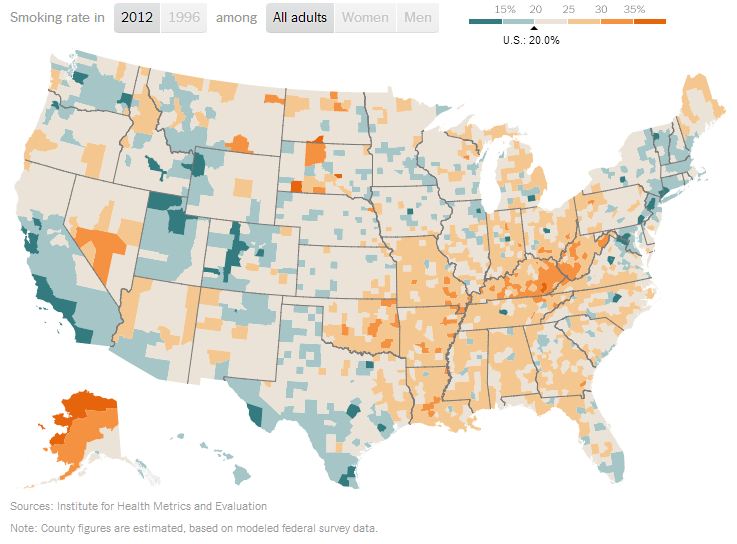
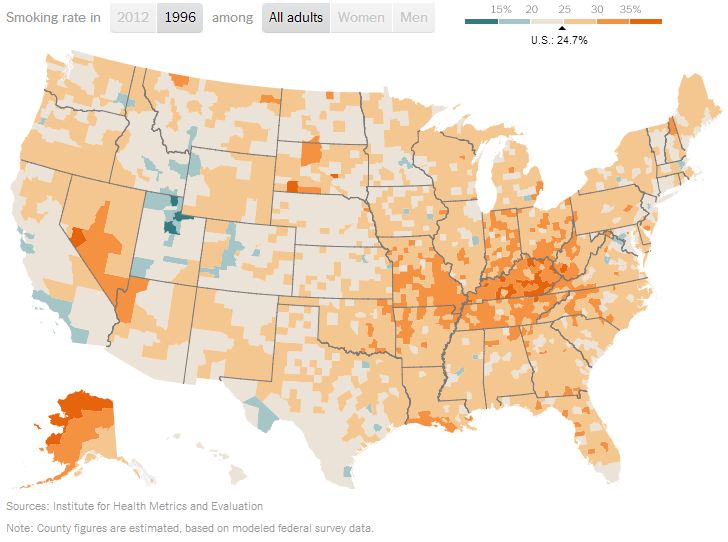
At the New York Times, Sabrina Tavernise and Robert Gebeloff discuss the tenaciousness of tobacco in low-income areas.  Smoking rates are declining, but much more slowly in some counties than others.  Local residents suggest that smoking is the least of their worries:

“Just sit and watch the parking lot for a day,” Mrs. Bowling said. “If smoking is the worst thing that’s happening, praise the Lord.”

Smoking rates, 1996:1a

Smoking rates, 2013:1

Lisa Wade, PhD is an Associate Professor at Tulane University. She is the author of American Hookup, a book about college sexual culture; a textbook about gender; and a forthcoming introductory text: Terrible Magnificent Sociology. You can follow her on Twitter and Instagram.
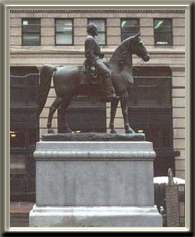
Flashback Friday.

This is a picture of a statue in Lexington, KY, in honor of Civil War general John H. Morgan. It depicts him on his favorite horse, Black Bess. The inscription is “Gen. John H. Morgan and His Bess.”

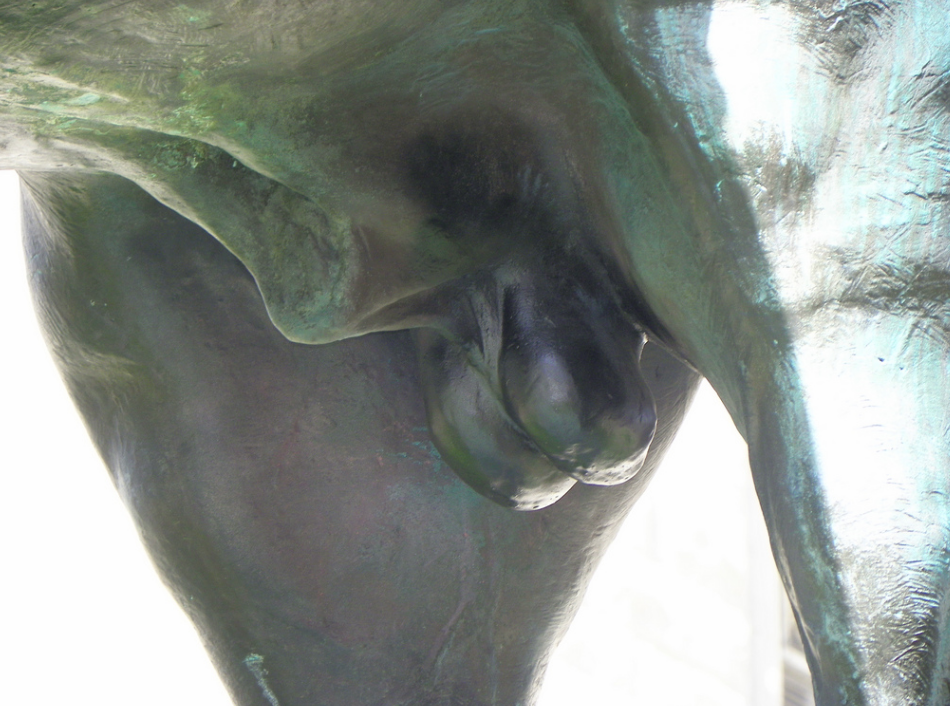
Here’s what’s interesting about this: Bess, as you might guess, was a mare — a female horse.  The statue, however, has testicles. You can see them in the picture below. The sculptor gave Bess testicles because he considered a mare an unworthy mount for a general — despite the fact that Morgan himself seemed to think she was just fine.

Flickr Creative Commons License, J Stephen Conn

I found out about this in Lies Across America: What Our Historical Sites Get Wrong by James W. Loewen. Top image borrowed from here. This post originally appeared in 2007.

Gwen Sharp is an associate professor of sociology at Nevada State College. You can follow her on Twitter at @gwensharpnv.

We all know that, on some basic level, money is purely symbolic.  It only works because everyone collectively agrees to participate in the fantasy that a dollar bill is worth a dollar, whatever that is.  Moreover, most of our money these days is purely electronic, represented by ones and zeros and real only in the most abstract sense possible.

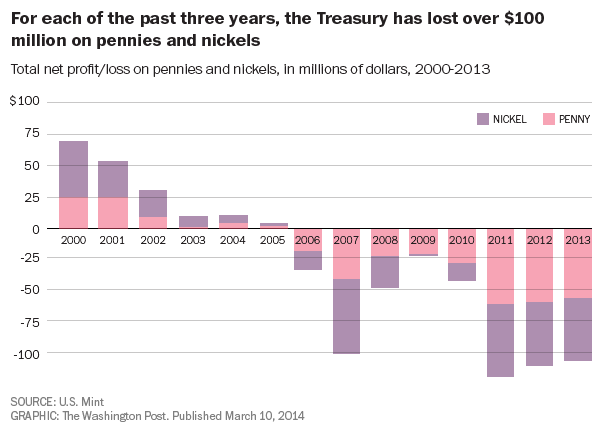
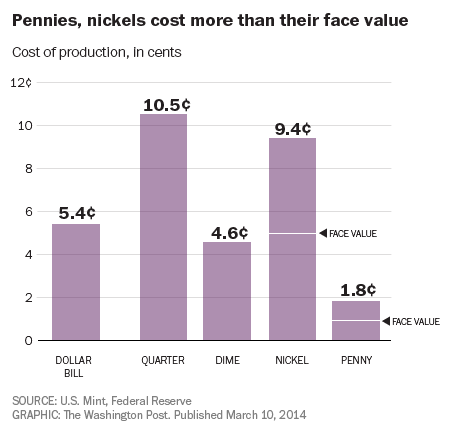
Christopher Ingraham at the Washington Post offered another way of thinking about money as a social construction: how much it costs to make it.  None of our coins are actually worth what they cost, and pennies and nickels are worth quite a bit less.

1.jpg

The excess cost of producing pennies and nickels means a budget deficit for the Treasury. In 2013, producing the coins cost the government $105 million dollars above and beyond the coins’ value.

1

Interestingly, moves to eliminate pennies have been successfully opposed by the zinc industry for years, illustrating another sociological phenomenon: the power of corporations to shape government decisions.

Lisa Wade, PhD is an Associate Professor at Tulane University. She is the author of American Hookup, a book about college sexual culture; a textbook about gender; and a forthcoming introductory text: Terrible Magnificent Sociology. You can follow her on Twitter and Instagram.
The Pink Lady is 15 oz. gin, 4 dashes of grenadine, and an egg white.

According to Shanna Farrell,  the Pink Lady was popularized in the ’50s.  Women were believed to have “dainty palates,” and so cocktails for women were designed to disguise any taste of alcohol.  In the ’70s, the Pink Lady was surpassed by the Lemon Drop and, in the ’80s, the Cosmopolitan.

Farrell asks “What does it mean to drink like a woman” today? Anecdotally, she finds that bartenders consistently expect her to order something “juicy or sweet” — “It’s pink; you’ll like it” — and respond with a favorable nod when she orders something “spirit forward.”

This is typical for America today: women are expected to perform femininity, but when they perform masculinity, they are admired and rewarded. This is because we still put greater value on men and the things we associate with them.

This phenomenon of valuing masculinity over femininity — what we call “androcentrism” — may be changing how women drink, since everyone likes that nod of approval.  Farrell reports that “women account for the fastest-growing segment of worldwide whiskey consumers.”  Well hello, Hilary.

I wonder how men will respond to women’s incursion into the whiskey market. Traditionally we’ve seen male flight.  As an activity, occupation, or product is increasingly associated with women, men leave.  In a society where women keep infiltrating more and more of men’s domains, this is a bad long-term strategy for maintaining dominance (see, for example, the feminization of education). As I ask in my forthcoming sociology of gender textbook: “What will happen when women are sipping from all the bottles?”

Thanks to the super-cool bartender Naomi Schimek for the tip!

Cross-posted at Jezebel and Pacific Standard.

Lisa Wade, PhD is an Associate Professor at Tulane University. She is the author of American Hookup, a book about college sexual culture; a textbook about gender; and a forthcoming introductory text: Terrible Magnificent Sociology. You can follow her on Twitter and Instagram.
“For many of us, quicksand was once a real fear,” write the producers at Radio Lab:

It held a vise-grip on our imaginations, from childish sandbox games to grown-up anxieties about venturing into unknown lands. But these days, quicksand can’t even scare an 8-year-old.

Interviewing a class of fourth graders, writer Dan Engber discovered that most understood the concept, but didn’t find it particularly worrisome.  “I usually don’t think about it,” said one.  They were more afraid of things like aliens, zombies, ghosts, and dinosaurs.  But they understood that it was something that people used to be afraid of: “My dad told me that when he was little his friends always said ‘look out that could be quicksand!'”

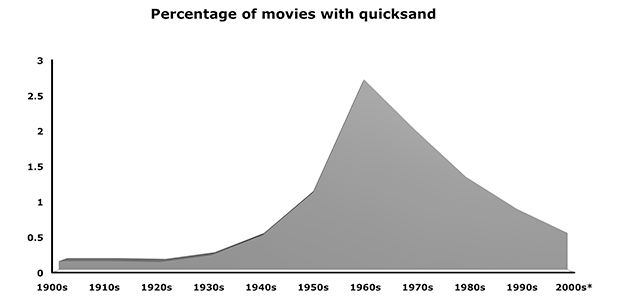
Engber became fascinated with what happened to quicksand.  He found a source of data — compiled by, of all things, quicksand sexual fetishists — that included every movie scene that involved quicksand from the 1900s to the 2000s.  Comparing this number to the total number of movies produced allowed him to show that quicksand had a lifecourse.  It rose in the ’40s, skyrocketed in the ’60s, and then fell out of favor.

1.jpg

Why?

Engber found a pattern in the data.  In quicksand’s early years, the movie scenes featured quicksand as a very serious threat.  But, after quicksand peaked, it became a  joke.  In the ’80s, quicksand even made it into My Little Pony and Perfect Strangers.  Later, in discussions about plot lines for Lost, the idea of quicksand was dismissed as ridiculous.

I guess it’s fair to say that quicksand “jumped the shark.”

In sociology, we call this the social construction of social problems: the fact that our fears don’t perfectly correlate with the hazards we face.  In this case, media is implicated. What is it making us fear today?

Lisa Wade, PhD is an Associate Professor at Tulane University. She is the author of American Hookup, a book about college sexual culture; a textbook about gender; and a forthcoming introductory text: Terrible Magnificent Sociology. You can follow her on Twitter and Instagram.