Archive: Apr 2014

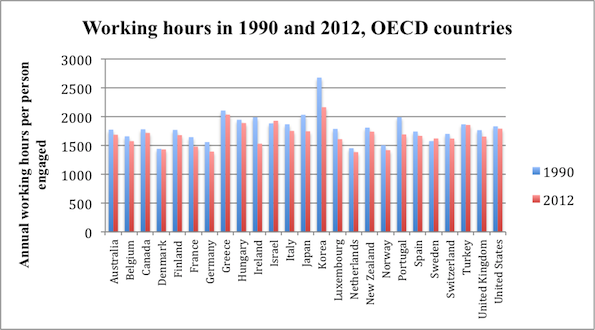
On average, U.S. workers with jobs put in more hours per year  than workers in most OECD countries. In 2012, only Greece, Hungary, Israel, Korea, and Turkey recorded a longer work year per employed person.
2

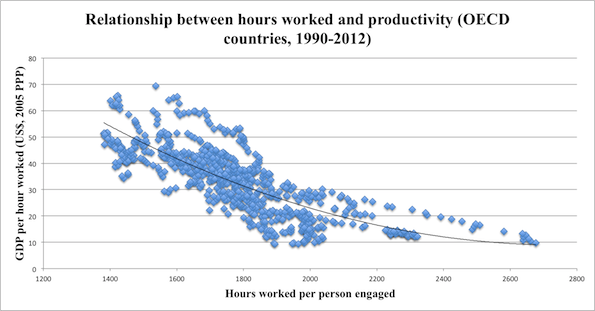
A long work year is nothing to celebrate. The following chart, from the same Economist article, shows there is a strong negative correlation between yearly hours worked and hourly productivity.
3.5

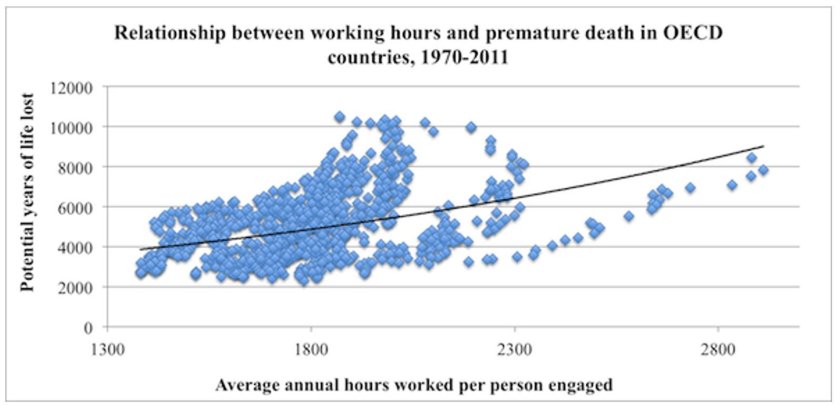
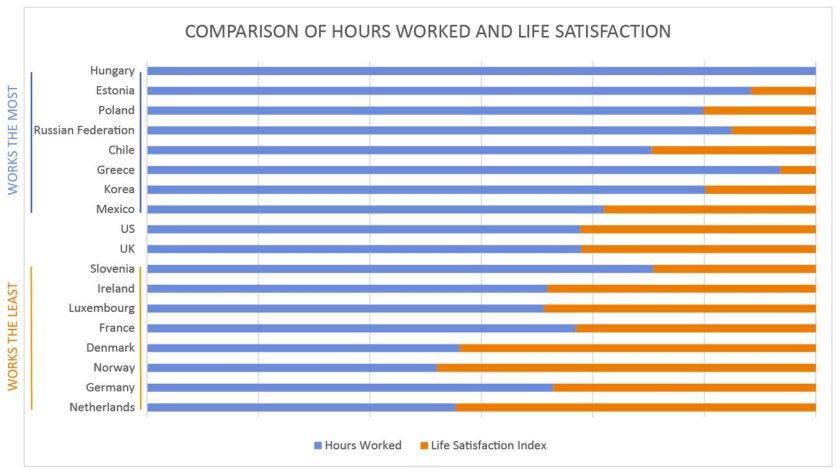
More importantly, the greater the number of hours worked per year, the greater the likelihood of premature death and poor quality of life.  This reality is highlighted in the following two charts taken from an article by Angus Chen titled “8 Charts to Show Your Boss to Prove That You Can Do More By Working Less.”
1 (2) - Copy

1 (2)

In sum, we need to pay far more attention to the organization and distribution of work, not to mention its remuneration and purpose, than we currently do.

Martin Hart-Landsberg is a professor of economics at Lewis and Clark College. You can follow him at Reports from the Economic Front.
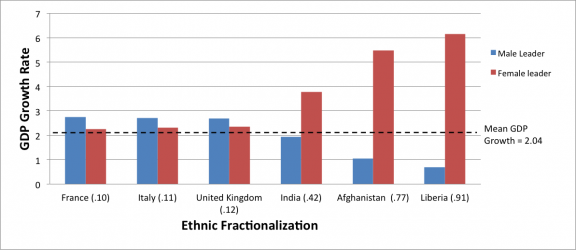
Countries with a lot of ethnic diversity generally show weaker economic growth than homogeneous countries.  A new study, however, discovered a variable that strongly reverses the trend: women leaders.

Management professor Susan Perkins and her colleagues compared the economic growth rate of 139 countries over 55 years.  They found that diverse countries did significantly better when a woman was at the helm.  The more diverse the country, the stronger the effect.

1

Perkins and her co-authors cautiously attempt to explain their data (here), but think that it may have something to do with leadership style.  Female leaders have been shown to be more collaborative and non-authoritarian than men. Co-author Nicholas Pearce speculates:

In countries with a lot of internal conflict, oftentimes people are looking for signals that the person in charge is going to be collaborative and not dictatorial or self-interested. Women’s gender role is symbolic of collaboration, that they’re going to empower marginalized voices.

Because of gender stereotypes, then, women may seem more trustworthy. Meanwhile, real differences in leadership style may affirm those expectations and be more effective in practice.

Lisa Wade, PhD is an Associate Professor at Tulane University. She is the author of American Hookup, a book about college sexual culture; a textbook about gender; and a forthcoming introductory text: Terrible Magnificent Sociology. You can follow her on Twitter and Instagram.

1Sgt. Jasmine Jacobs of the National Guard in Georgia has always plaited her hair into two twists around her head. She has been in the military for six years and has worn her hair natural (meaning no chemical treatments [perms] or hair extensions [weaves]) for four of those years. But according to the new hair-grooming requirements the U.S. Army recently released, her hair is now out of regulation.

And so are the Afro-centric hairstyles of many black women in the Army, who make up 31 percent of Army women.

Jacobs, who said she is “kind of at a loss now with what to do with my hair,” has started a White House petition asking the Army to rethink its new hair guidelines. The petition has collected more than 7,000 signatures from soldiers and civilians, but needs to reach 100,000 signatures by April 19th in order for the White House to address it.

The petition states:

Females with natural hair take strides to style their natural hair in a professional manner when necessary; however, changes to AR 670-1 offer little to no options for females with natural hair… These new changes are racially biased and the lack of regard for ethnic hair is apparent.

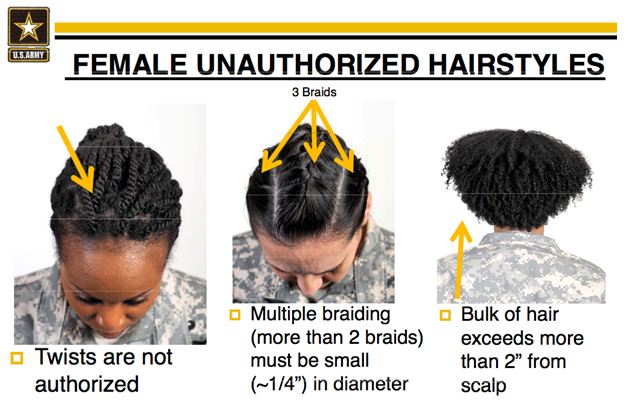
The new Army Regulation 670-1  was published Tuesday and illustrates with photos the types of hairstyles that are unauthorized for women. Those include dreadlocks, twists or any type of matted or coiled hair. A particularly cumbersome requirement disallows the bulk of a woman’s hair to “exceed more than 2″ from her scalp.” That rules out Afros and most types of non-chemically altered black hair.

Basically, almost every natural hair option that black women in the Army could wear is now off limits. One of the few traditionally natural hairstyles that was listed as appropriate is cornrows, but a slew of specifications and rules surrounded even that. The diameter of each cornrow can’t be more than one-fourth of an inch, and no more than one-eighth of an inch of scalp may be shown between cornrows.

The only way to realistically meet the new standards would be to shave one’s head, perm one’s hair or wear weaves or wigs.

Jacobs said twists like the one she wears are very popular among black women soldiers because the style requires little maintenance when in the field. Her hair’s thickness and curliness makes pulling her hair back into a bun (a style popular among white women soldiers) impossible.

A spokesperson for the Army said the grooming changes are “necessary to maintain uniformity within a military population.” When that need for “uniformity” erases the ethnic differences of a group of women and forces them to constrain themselves to European standards of hair, it presents a serious problem.

“I think, at the end of the day, a lot of people don’t understand the complexities of natural hair… I’m disappointed to see the Army, rather than inform themselves on how black people wear their hair, they’ve white-washed it all,” said Jacobs.

Screenshots taken from Army Regulation 670-1.

Anita Little is the associate editor at Ms. magazine, where this post originally appeared. You can follow her on Twitter.

Here’s Matt Holliday. It’s strike three and it was three bad calls.

2

Holliday’s body language speaks clearly, and his reaction is understandable. The pitch was wide, even wider than the first two pitches, both of which the umpire miscalled as strikes.   Here’s the data:

1.jpg

The PITCHf/x technology that makes this graphic possible, whatever its value or threat to umpires, has been a boon for sabremetricians  and social scientists.  The big data provided can tell us not just the number of bad calls but the factors that make a bad call more or less likely.

In the New York Times, Brayden King and Jerry Kim report on their study of roughly 780,000 pitches in the 2008-09 season. Umpires erred on about 1 in every 7 pitches – 47,000 pitches over the plate that were called balls, and nearly 69,000 like those three to Matt Holliday.

Here are some of the other findings that King and Kim  report in today’s article.

  •  Umpires gave a slight edge to the home team pitchers, calling 13.3% of their pitches outside the zone as strikes.  Visitors got 12.6%.
  • The count mattered: At 0-0, the error rate was 14.7%, at 3-0, 18.6% of pitches outside the zone were called as strikes, and at 0-2, only 7.3% of pitches outside the zone were called as strikes.
  • All-star pitchers were more likely than others to get favorable calls…
  • …especially if the pitcher had a reputation as a location pitcher.
  • The importance of the situation (tie game, bottom of the ninth) made no difference in bad calls.

It seems that expectation accounts for a lot of these findings. It’s not that what you see is what you get. It’s that what you expect is what you see. We expect good All-star pitchers to throw more accurately.  We also expect that a pitcher who is way ahead in the count will throw a waste pitch and that on the 3-0, he’ll put it over the plate.  My guess is that umpires share these expectations. The difference is that the umps can turn their expectations into self-fulfilling prophecies.

Cross-posted at Business Insider.

Jay Livingston is the chair of the Sociology Department at Montclair State University. You can follow him at Montclair SocioBlog or on Twitter.

Advertisements echo with many reverberations and overtones. Different people hear different things, and with all the multiple meanings, it’s not always clear which is most important.

This week Lisa Wade posted this Snickers ad from Australia. Its intended message of course is “Buy Snickers.” But its other message is more controversial, and Lisa and many of the commenters (more than 100 at last count) were understandably upset.

[youtube]https://www.youtube.com/watch?v=MqgjTZQiySw[/youtube]

The construction workers (played by actors) shout at the women in the street (not actors). “Hey,” yells a builder, and the woman looks up defensively. But then instead of the usual sexist catcalls, the men shout things like,

I appreciate your appearance is just one aspect of who you are.

And

You know what I’d like to see? A society in which the objectification of women makes way for gender neutral interaction free from assumptions and expectations.

The women’s defensiveness softens.  They look back at the men. One woman, the surprise and delight evident in her smile, mouths, “Thank you.”

But, as the ad warned us at the very beginning, these men are “not themselves.”

1 (2) - Copy

Hunger has transformed them. The ad repeats the same idea at the end.

1 (2) - Copy

Here’s Lisa’s conclusion:

The twist ending is a genuine “fuck you” to the actual women who happened to walk by and become a part of the commercial… I bet seeing the commercial would feel like a betrayal. These women were (likely) given the impression that it was about respecting women, but instead it was about making fun of the idea that women deserve respect.

I suspect that Lisa too feels betrayed.  She has bought her last Snickers bar.

My take is more optimistic.

In an earlier generation, this ad would have been impossible. The catcalls of construction workers were something taken for granted and not questioned, almost as though they were an unchangeable part of nature.* They might be unpleasant, but so is what a bear does in the woods.

This ad recognizes that those attitudes and behaviors are a conscious choice and that all men, including builders, can choose a more evolved way of thinking and acting.  The ad further shows, that when they do make that choice, women are genuinely appreciative. “C’mon mates,” the ad is saying, “do you want a woman to turn away and quickly walk on, telling you in effect to fuck off? Or would you rather say something that makes her smile back at you?”  The choice is yours.

The surface meaning of the ad’s ending is , “April Fools. We’re just kidding about not being sexists.” But that’s a small matter. Not so far beneath that surface progressive ideas are having the last laugh, for more important than what the end of the ad says is what the rest of the ad shows — that ignorant and offensive sexism is a choice, and that real women respond positively to men who choose its opposite.

* Several of the comments at Sociological Images complained that the ad was “classist” for its reliance on this old working-class stereotype.

Cross-posted at Montclair SocioBlog.

Jay Livingston is the chair of the Sociology Department at Montclair State University. You can follow him at Montclair SocioBlog or on Twitter.

Flashback Friday.

Behold, one of my favorite things on SocImages.  This pair of Italian commercials are for a do-it-yourself fabric dye.  First, commercial #1 (no Italian needed):

Message: “Coloured is better” or black men are physically and sexually superior to white men.

Screenshot (45)

BUT WAIT!  Wait till you see the twist in commercial #2!

When the man tries to use the dye to transform his wife, it becomes clear that the dye only works one way.  Clearly, it is designed for women to produce the (heteronormative, racialized) object of desire that they supposedly want.  Message: Coloreria is “What women want” or the laundry room is for ladies.

Originally posted April 2008, thanks to  Elizabeth A. and Feministing.  Also in women-are-responsible-for-cooking-and-cleaning: women love to cleanhomes of the futurewhat’s for dinner, honey?liberation through quick meals, and my husband’s an ass.

Lisa Wade, PhD is an Associate Professor at Tulane University. She is the author of American Hookup, a book about college sexual culture; a textbook about gender; and a forthcoming introductory text: Terrible Magnificent Sociology. You can follow her on Twitter and Instagram.

By now most readers are likely familiar with the idea that the American middle class is shrinking.  Most income and wealth gains over the past 40 or so years have gone to the richest Americans, while poverty is spreading and getting deeper.  As a result, the percent of Americans who can reasonably claim to be middle class is shrinking.

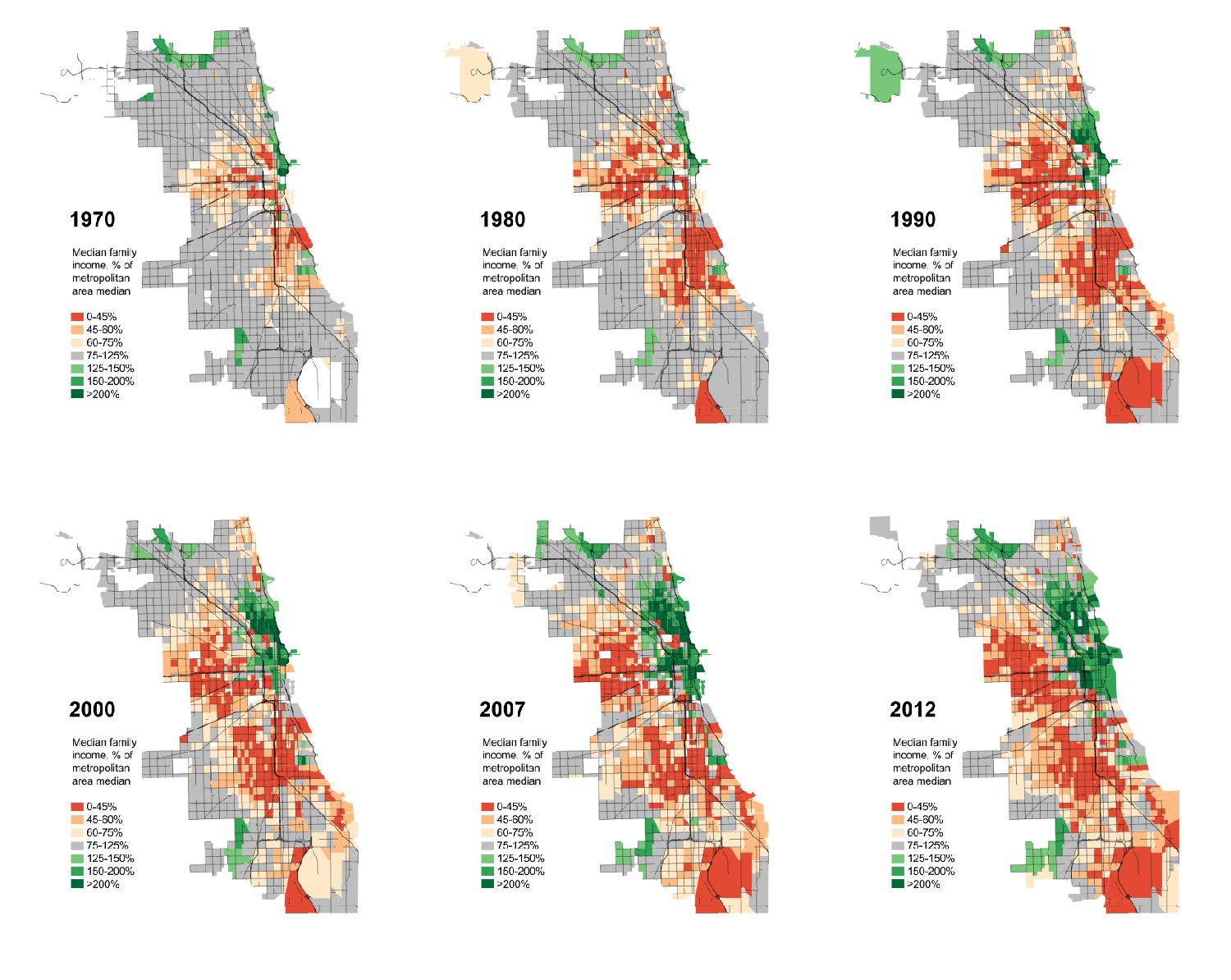
I found a fantastic animation illustrating this process in the neighborhoods of the city of Chicago.  Borrowing data from education scholar Sean Reardon and sociologist Kendra Bischoff, Daniel Hertz calculated where the  median family income of each Census tract fell relative to the entire metropolitan area.  Orange tracts are ones where the median family income is 0-45% of the median for Chicago as a whole (struggling families), dark green tracts are ones where the median is 200% or more (resource rich families).  Grey is, literally, middle class.

For simplicity’s sake, here is 1970 and 2012 right next to one another.  Notice that the 1970 map involves a lot more grey (middle class) and the 2012 map involves a lot more green (rich) and especially orange (poor).

1


Here’s the animation:

1For another interesting measure of the shrinking middle class, see our post showing increases in high paying and low paying jobs, but decreases in jobs that pay middle income wages.

Lisa Wade, PhD is an Associate Professor at Tulane University. She is the author of American Hookup, a book about college sexual culture; a textbook about gender; and a forthcoming introductory text: Terrible Magnificent Sociology. You can follow her on Twitter and Instagram.

Last week NPR reported that scientists now trace some of the rise of American obesity to the fear of fat.  Beginning in the 1970s, nutritionists began warning Americans to consume less fat.  This initiated the “low fat” and “fat free” crazes that still linger.

Yet, it now seems that people who followed the advice of nutritionists at the time — to eat less cheese, milk, and meat and more pasta, potatoes, and rice — were likely to get fatter, not skinnier.  The closer a person stuck to the dietary guidelines, the more weight they would gain and, the more weight they gained, the more others would pressure them to stick to the dietary guidelines.  The phrase “cruel irony” only begins to capture it.

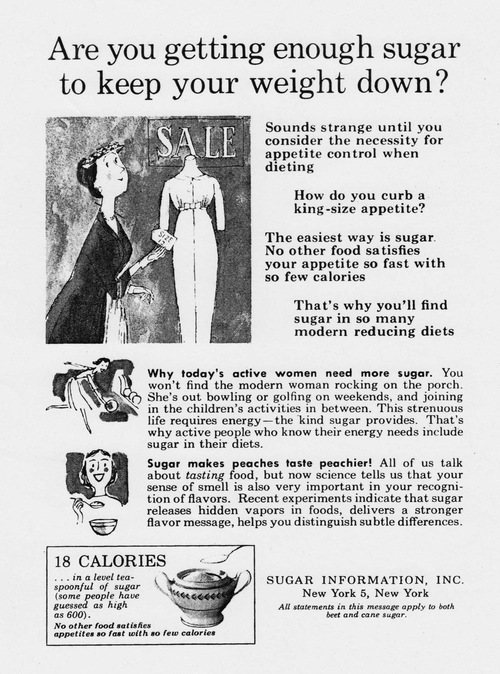
The ad below, from 1959, is a peek into another era.  Just a few years before the fear of fat began, the sugar industry was plausibly suggesting that eating more sugar was the best way to stay slim.  This was industry association propaganda, but no doubt the potato and pasta industries contributed to the story in the ’70s just as the meat and dairy industries are in on it today.

1

The revision of our nutritional guidelines reminds us to be skeptical of the conventional wisdom.  Moreover, it should inspire us all to check our tendency to judge others.  We don’t have perfect knowledge that allows us perfect control over our bodies.  Scientists are doing the best they can — and hopefully not taking too much funding from for-profit food industries — and individuals are restricted by whatever knowledge and resources they have.

Lisa Wade, PhD is an Associate Professor at Tulane University. She is the author of American Hookup, a book about college sexual culture; a textbook about gender; and a forthcoming introductory text: Terrible Magnificent Sociology. You can follow her on Twitter and Instagram.