

Archive: Apr 2014

1Posts from Easters past:

Lisa Wade, PhD is an Associate Professor at Tulane University. She is the author of American Hookup, a book about college sexual culture; a textbook about gender; and a forthcoming introductory text: Terrible Magnificent Sociology. You can follow her on Twitter and Instagram.

This chart comes from Chuck Marr at the Center on Budget and Policy Priorities.  As Marr explains:

The United States is a relatively low-tax country, as the chart shows.  When measured as a share of the economy, total government receipts (a broad measure of revenue) are lower in the United States than in any other member of the Organization for Economic Co-operation and Development (OECD), even after accounting for the modest revenue increases in the 2012 “fiscal cliff” deal and the taxes that fund health reform.

1 (2) - Copy

Martin Hart-Landsberg is a professor of economics at Lewis and Clark College. You can follow him at Reports from the Economic Front.

Flashback Friday.

The word commodification refers to the process by which something that is not bought and sold becomes something that is.  As capitalism has progressed, more and more parts of our lives have become commodified.  Restaurants are the commodification of preparing and cleaning up meals; day care and nannying is the commodification of child raising; nursing homes is the commodification of caring for elders.

We sometimes post instances of commodification that tickle us.  Previously I posted about a company that will now put together and deliver a care package to your child at camp.  A parent just goes to the site, chooses the items they want included, and charge their credit card.  As I wrote in that post: “The ‘care’ in ‘care package’ has been, well, outsourced.”

I was equally tickled by a photograph, taken by sociologist Tristan Bridges, of pre-dyed Easter eggs:

This is a delicious example of commodification.  If you don’t have the time or inclination to dye eggs as part of your Easter celebration, the market will do it for you.  No matter that this is one of those things (e.g., a supposedly enjoyable holiday activity that promotes family togetherness) that is supposed to be immune to capitalist imperatives.

While we might raise our eyebrows at this example, newly commodified goods and services often elicit this reaction.  We usually get used to the idea and, later, have a hard time imagining life any other way.

For more on commodification, peruse our tag by that name. This post originally appeared in 2012.

Lisa Wade, PhD is an Associate Professor at Tulane University. She is the author of American Hookup, a book about college sexual culture; a textbook about gender; and a forthcoming introductory text: Terrible Magnificent Sociology. You can follow her on Twitter and Instagram.

1

Writer and director Elena Rossini has released the first four minutes of The Illusionists.  I’m really excited to see the rest.  The documentary is a critique of a high standard of beauty but, unlike some that focus exclusively on the impacts of Western women, Rossini’s film looks as though it will do a great job of illustrating how Western capitalist impulses are increasingly bringing men, children, and the entire world into their destructive fold.

The first few minutes address globalization and Western white supremacy, specifically.  As one interviewee says, the message that many members of non-Western societies receive is that you “join Western culture… by taking a Western body.”  The body becomes a gendered, raced, national project — something that separates modern individuals from traditional ones — and corporations are all too ready to exploit these ideas.

Watch for yourself (subtitles available here):

Lisa Wade, PhD is an Associate Professor at Tulane University. She is the author of American Hookup, a book about college sexual culture; a textbook about gender; and a forthcoming introductory text: Terrible Magnificent Sociology. You can follow her on Twitter and Instagram.

1 (2) - CopyThe Numbers

Some History

The Winners and the Losers

Tax Cultures

Lisa Wade, PhD is an Associate Professor at Tulane University. She is the author of American Hookup, a book about college sexual culture; a textbook about gender; and a forthcoming introductory text: Terrible Magnificent Sociology. You can follow her on Twitter and Instagram.

Each  year the National Priorities Project releases a visual illustrating how our tax dollars are spent.  This is the one for 2013, sans medicare and social security taxes.

1At the end of Sociology 101, I like to ask my students: “What is the state for?”  This often takes them aback, as most of them have never considered the question before.  Is it for defense?  It is to maximize happiness or reduce misery?  Is it for maximizing GDP?  Protecting private property?  Do we want to use it to influence other countries?  How?

There are many questions to ask and they are not purely theoretical.  I like how the spending of our tax dollars helps make the conversation more concrete.

Cross-posted at Business Insider.

Lisa Wade, PhD is an Associate Professor at Tulane University. She is the author of American Hookup, a book about college sexual culture; a textbook about gender; and a forthcoming introductory text: Terrible Magnificent Sociology. You can follow her on Twitter and Instagram.

No pockets, no justice. Visit Dumbing of Age.

Lisa Wade, PhD is an Associate Professor at Tulane University. She is the author of American Hookup, a book about college sexual culture; a textbook about gender; and a forthcoming introductory text: Terrible Magnificent Sociology. You can follow her on Twitter and Instagram.
Flashback Friday.

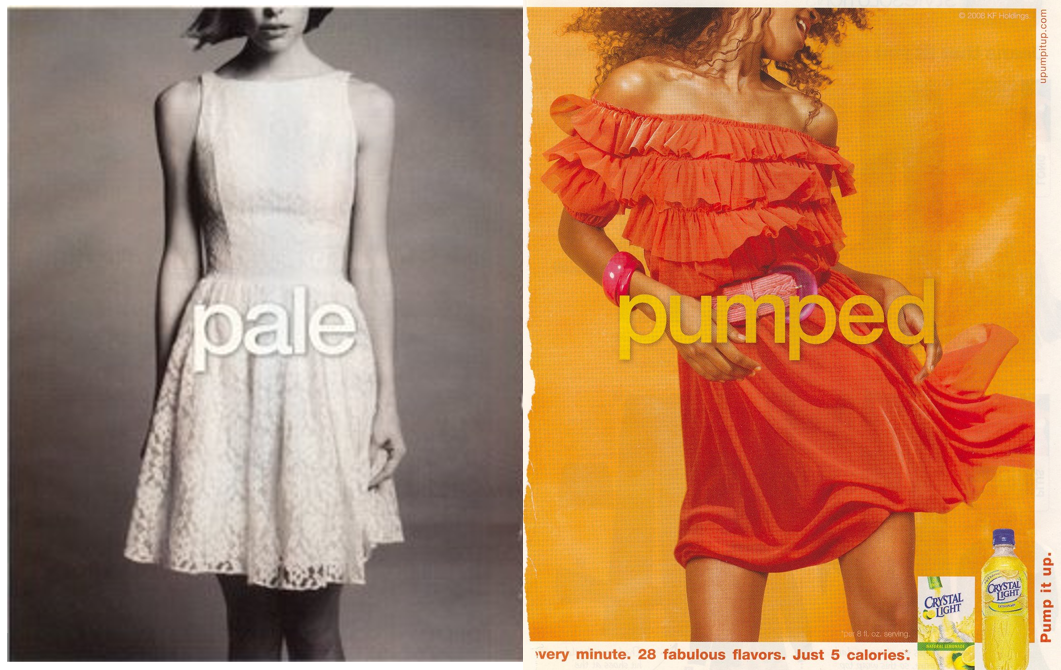
If whiteness is the neutral category — meaning that people of color are commonly understood to be raced while white people are not — then to be non-white is to be different in some way. The “bad” difference is the deviant (for example, the “welfare queen,” the “thug”), while the “good” difference is the exotic, the interesting, the hip, the cool… the hot or spicy.  Whiteness, in contrast, is boring, bland, or “vanilla.”

This two-page advertisement for Crystal Light beautifully illustrates these cultural ideas.  Notice the way the ad goes from black-and-white to color, from a white model to a model of color (but not too dark-skinned), from straight to curly (but not too curly) hair, from a rather plain dress to one that looks vaguely ethnic, and from awkward standing to dancing (of course).  In the ad, whiteness is, quite literally, bland and being of color is framed as more flavorful.

1 (2) - Copy

Lisa Wade, PhD is an Associate Professor at Tulane University. She is the author of American Hookup, a book about college sexual culture; a textbook about gender; and a forthcoming introductory text: Terrible Magnificent Sociology. You can follow her on Twitter and Instagram.