
Archive: Mar 2014

13A few times on SocImages we’ve been tickled to highlight instances of very young children performing adult behavior.  In each (adorable) case, they were great examples of how children learn how to a culturally intelligible adult and particular kinds of ones at that.

Our favorites include the baby worshipper, baby preacher, baby Beyonce, baby rapper, and babies learn how to have a conversation. Seriously. Click on every single one of those links. You won’t be disappointed.

This one is of a little girl in a Baptist church in Bishkek, Kyrgyzstan mimicking a choir conductor.  It’s fantastic.

I’m sure you’ll have your own favorite thing about it, but mine is her intensity. Maybe it’s an indication of just how seriously she takes learning.  At one time, and in a different way in the modern world, learning to copy adults was a matter of life or death. This must be part of what it means to be a human child even today.

But it may also be part of the mimicry.  Conducting tends to be a pretty serious business. Maybe she’s just performing seriousness as part of the game, like her heartfelt facial expressions.

Either way, it’s a pretty impressive performance and a wonderful example of children’s active involvement in their own socialization.

Lisa Wade, PhD is an Associate Professor at Tulane University. She is the author of American Hookup, a book about college sexual culture; a textbook about gender; and a forthcoming introductory text: Terrible Magnificent Sociology. You can follow her on Twitter and Instagram.

12In just 6 1/2 minutes, CGP Gray offers a humorous and info-packed account of Daylight Savings.  He tackles the historical rationale, the role of the equator, the contemporary debate, and the wildly wacky situations it causes today, including health problems and loss of productivity.  It’s all even wackier than you probably already imagine. Enjoy:

Also from CGP Gray:

Lisa Wade, PhD is an Associate Professor at Tulane University. She is the author of American Hookup, a book about college sexual culture; a textbook about gender; and a forthcoming introductory text: Terrible Magnificent Sociology. You can follow her on Twitter and Instagram.
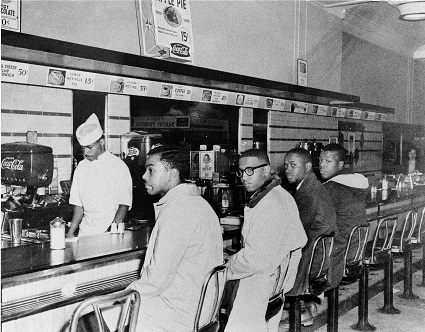
Ed, at Gin & Tacos, made a fantastic observation about this photo of a 1960 lunch counter sit-in at a Woolworth’s in Greensboro, NC, protesting the exclusion of black customers.

1

“The most interesting thing about it,” he writes:

…is that the employee behind the Whites Only lunch counter is also black. That’s curious, since on the scale of intimate social contact one would think that having someone handle your food ranks above sitting next to a fully clothed stranger on adjacent stools.

This, he observes, tells us something important about prejudice.

When I first saw this picture and learned about this period in our history… I thought that racism was about believing that another race is inferior. Like most people I got (slightly) wiser with age and eventually figured out that racism is about keeping someone else beneath you on the social ladder… If you actually thought black people were dirty savages you wouldn’t eat anything they handed you. But of course it has nothing to do with that. You’re fine being served food because servility implies social inferiority. And you don’t want to sit next to them simply because it implies equality.

When we observe efforts to uphold unequal social conditions, it’s smart to think past notions of hatred and fear (like the term homophobia unfortunately implies) and instead about how the privileged are benefiting and what they would lose along with their superordinate status.  Hate may be useful for justifying inequality, but at its root it’s about power and resources, not emotions.

Lisa Wade, PhD is an Associate Professor at Tulane University. She is the author of American Hookup, a book about college sexual culture; a textbook about gender; and a forthcoming introductory text: Terrible Magnificent Sociology. You can follow her on Twitter and Instagram.

11The paradox: masculinity is strength, power, and dominance… but femininity is terrifying. Gender rules insist that men must avoid association with the feminine at all costs because, if they do not, they are weak.  They are pussies, bitches, women, girls. Femininity is weakness and yet, oddly, it has the power to strip men of their manliness.  It is as if, as sociologist Gwen Sharp once put it, “masculinity is so fragile that apparently even the slightest brush with the feminine destroys it.”

Behold the best example of this phenomenon ever:

Let’s be clear.  The reason he’s afraid of femininity is because it’s reviled.  It makes you a woman, which makes you worthless.  Which is fine for the ladies, but dudes are advised to avoid personal denigration if at all possible.

Thanks Summer’s Eve, you make my job easy.

Lisa Wade, PhD is an Associate Professor at Tulane University. She is the author of American Hookup, a book about college sexual culture; a textbook about gender; and a forthcoming introductory text: Terrible Magnificent Sociology. You can follow her on Twitter and Instagram.
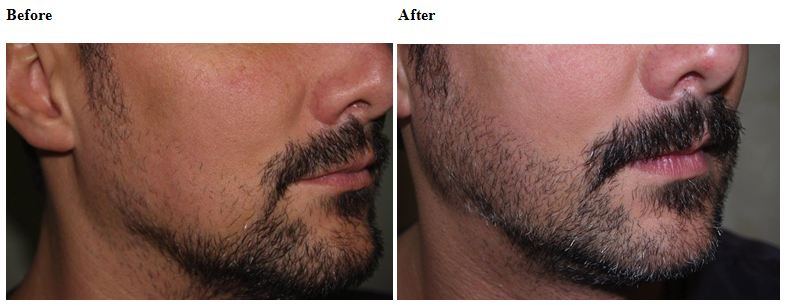
Last month I wrote about how the revival in the popularity of beards was hurting razor sales, causing companies like Proctor & Gamble to ramp up advertising encouraging “manscaping” below the neck.  Here’s another response to the trend: hair plugs for your face.

Capture

According to a facial plastic surgeon interviewed for an article at DNAinfo New York, the rate at which he is asked to do facial hair transplants has skyrocketed from ” just a handful of beard transplants each year a decade ago” to about three a week.  The surgeons mention the hipster beard trend as one cause of the rise in interest, but also cite a wide array of people who might be interested in fuller facial hair:

…clients include men who have struggled since adolescence to grow a beard, those undergoing a gender transition from female to male, men with with facial scarring and Hasidic Jews who hope to achieve denser payot, or sidelocks.

Expense for the procedure ranges from $3,o00 for partial transplants to $7,000 for a full beard.

What a fascinating example of the intersection of race, gender, religion, technology, and capitalism.  Which men’s faces have more power to determine appearance norms for men?  Or, what does masculinity look like?  Men with Asian, American Indian, and African backgrounds are less likely to be able to grow full beards, but a society centered on whiteness can make their faces seem inadequate.  If the situation were reversed, would we see white men, disproportionately, going in for laser hair removal?  Would transmen feel less pressure to be able to grow a beard to feel fully masculine?  Would they feel more if they were part of a Hasidic Jewish community?

Also, is this really about hipsters?  How much power does a young, monied demographic have to set fashion trends?  To send a wide range of people to surgeons — for goodness sake — in the hopes of living up to a more or less fleeting trend?  How do such trends gain purchase across such a wide range of people?  What other forces are at work here?

What can we learn from this about other plastic surgeries that we are more likely to take for granted as the result of natural or universal beauty?  Breast implants for women, breast reductions for men, liposuction, facelifts, labiaplasty, or eyelid surgery?

Lots of interesting conversations to be had.

Lisa Wade, PhD is an Associate Professor at Tulane University. She is the author of American Hookup, a book about college sexual culture; a textbook about gender; and a forthcoming introductory text: Terrible Magnificent Sociology. You can follow her on Twitter and Instagram.
The narrative of the American Dream is one of upward mobility, but there are some stories of mobility we prize above others.  Who is more successful: a Mexican-American whose parents immigrated to the U.S. with less than an elementary school education, and who now works as a dental hygienist? Or a Chinese-American whose parents immigrated to the U.S. and earned Ph.D. degrees, and who now works as a doctor?

Amy Chua (AKA “Tiger Mom”) and her husband Jed Rubenfeld, author of the new book The Triple Package, claim it’s the latter. They argue that certain American groups (including Chinese, Jews, Cubans, and Nigerians) are more successful and have risen further than others because they share certain cultural traits. Chua and Rubenfeld bolster their argument by comparing these groups’ median household income, test scores, educational attainment, and occupational status to those of the rest of the country.

But what happens if you measure success not just by where people end up — the cars in their garages, the degrees on their walls — but by taking into account where they started? In a study of Chinese-, Vietnamese-, and Mexican-Americans in Los Angeles whose parents immigrated here, sociologist Min Zhou and I came to a conclusion that flies in the face of Chua and Rubenfeld, and might even surprise the rest of us: Mexicans are L.A.’s most successful immigrant group.

Like Chua and Rubenfeld, we found that the children of Chinese immigrants exhibit exceptional educational outcomes that exceed those of other groups, including native-born Anglos. In Los Angeles, 64 percent of Chinese immigrants’ children graduated from college, and of this group 22 percent also attained a graduate degree. By contrast, 46 percent of native-born Anglos in L.A. graduated from college, and of this group, just 14 percent attained graduate degrees. Moreover, none of the Chinese-Americans in the study dropped out of high school.

These figures are impressive but not surprising. Chinese immigrant parents are the most highly educated in our study. In Los Angeles, over 60 percent of Chinese immigrant fathers and over 40 percent of Chinese immigrant mothers have a bachelor’s degree or higher.

At what seems to be the other end of the spectrum, the children of Mexican immigrants had the lowest levels of educational attainment of any of the groups in our study. Only 86 percent graduated from high school — compared to 100 percent of Chinese-Americans and 96 percent of native-born Anglos — and only 17 percent of graduated from college. But their high school graduation rate was more than double that of their parents, only 40 percent of whom earned diplomas. And, the college graduation rate of Mexican immigrants’ children more than doubles that of their fathers (7 percent) and triples that of their mothers (5 percent).

There is no question that, when we measure success as progress from generation to generation, Mexican-Americans come out ahead.

A colleague of mine illustrated this point with a baseball analogy: Most Americans would be more impressed by someone who made it to second base starting from home plate than someone who ended up on third base, when their parents started on third base. But because we tend to focus strictly on outcomes when we talk about success and mobility, we fail to acknowledge that the third base runner didn’t have to run far at all.

This narrow view fuels existing stereotypes that Chua and Rubenfeld play into — that some groups strive harder, have higher expectations of success, and possess a unique set of cultural traits that propels them forward.

For at least a generation, Americans have been measuring the American Dream by the make of your car, the cost of your home, and the prestige of the college degree on your wall. But there’s a more elemental calculation: Whether you achieved more than the generation that came before you. Anyone who thinks the American Dream is about the end rewards is missing the point. It’s always been about the striving.

Jennifer Lee, PhD, is a sociologist at the University of California, Irvine. Her book, The Diversity Paradox, examines patterns of intermarriage and multiracial identification among Asians, Latinos, and African Americans.  

Cross-posted at Time and Zocalo Public Square.

Let’s imagine that a woman — we’ll call her “you,” like they do in relationship advice land — is trying to calculate the odds that a man will call back after sex. Everyone tells you that if you sleep with a guy on the first date he is less likely to call back. The theory is that giving sex away at a such a low “price” lowers the man’s opinion of you, because everyone thinks sluts are disgusting.* Also, shame on you.

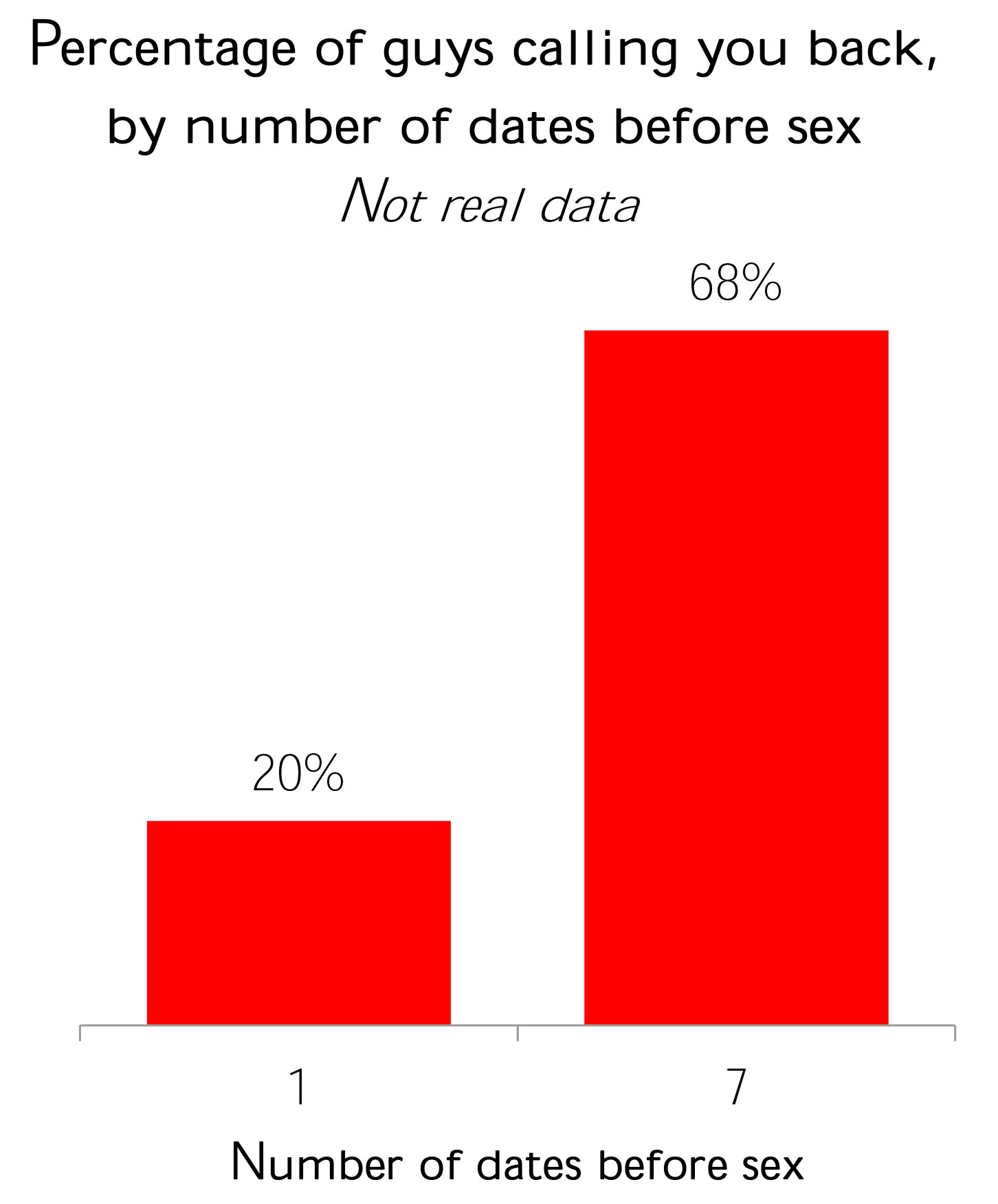
So, you ask, does the chance he will call back improve if you wait till more dates before having sex with him? You ask around and find that this is actually true: The times you or your friends waited till the seventh date, two-thirds of the guys called back, but when you slept with him on the first date, only one-in-five called back. From the data, it sure looks like sleeping with a guy on the first date reduces the odds he’ll call back.

1 (2)

So, does this mean that women make men disrespect them by having sex right away? If that’s true, then the historical trend toward sex earlier in relationships could be really bad for women, and maybe feminism really is ruining society.

Like all theories, this one assumes a lot. It assumes you (women) decide when couples will have sex, because it assumes men always want to, and it assumes men’s opinion of you is based on your sexual behavior. With these assumptions in place, the data appear to confirm the theory.

But what if that those assumptions aren’t true? What if couples just have more dates when they enjoy each other’s company, and men actually just call back when they like you? If this is the case, then what really determines whether the guy calls back is how well-matched the couple is, and how the relationship is going, which also determines how many dates you have.

What was missing in the study design was relationship survival odds. Here is a closer look at the same data (not real data), with couple survival added:

5
(Graph corrected from an earlier version.)

.

By this interpretation, the decision about when to have sex is arbitrary and doesn’t affect anything. All that matters is how much the couple like and are attracted to each other, which determines how many dates they have, and whether the guy calls back. Every couple has a first date, but only a few make it to the seventh date. It appears that the first-date-sex couples usually don’t last because people don’t know each other very well on first dates and they have a high rate of failure regardless of sex. The seventh-date-sex couples, on the other hand, usually like each other more and they’re very likely to have more dates. And: there are many more first-date couples than seventh-date couples.

So the original study design was wrong. It should have compared call-back rates after first dates, not after first sex. But when you assume sex runs everything, you don’t design the study that way. And by “design the study” I mean “decide how to judge people.”

I have no idea why men call women back after dates. It is possible that when you have sex affects the curves in the figure, of course. (And I know even talking about relationships this way isn’t helping.) But even if sex doesn’t affect the curves, I would expect higher callback rates after more dates.

Anyway, if you want to go on blaming everything bad on women’s sexual behavior, you have a lot of company. I just thought I’d mention the possibility of a more benign explanation for the observed pattern that men are less likely to call back after sex if the sex takes place on the first date.

* This is not my theory.

Cross-posted at Family Inequality and Pacific Standard.

Philip N. Cohen is a professor of sociology at the University of Maryland, College Park, and writes the blog Family Inequality. You can follow him on Twitter or Facebook.

Screenshot_18Happy Fat Tuesday to all our friends in New Orleans! Don’t do anything we wouldn’t do!

If you’re not in the middle of the revelry, enjoy these Mardi Gras posts from previous years:

Lisa Wade, PhD is an Associate Professor at Tulane University. She is the author of American Hookup, a book about college sexual culture; a textbook about gender; and a forthcoming introductory text: Terrible Magnificent Sociology. You can follow her on Twitter and Instagram.