Archive: Mar 2014

Devoted SocImages readers know that I will make any excuse to put up a video involving animals.  I’m going to do it right now.

The video is a dolphin petting a cat. In the first part of the video, you’ll see the dolphin come out of the water and try to put his chin on the top of the cat’s head.  In the second part of the video, you’ll see how the dolphin learned to do that. The cat very clearly wants to rub the top of his head, specifically, on the dolphin and the dolphin is paying attention and learning.

This isn’t just adorable interspecies communication, it’s proto-culture.  It’s the transmission of an idea. I don’t know if all the dolphins in this video pet the cat this way, or if it’s just one dolphin, but I can certainly imagine one dolphin teaching the next, just as the cat taught the first dolphin.

Or, to put it more simply, humans aren’t special because we’re humans, were special because we’re animals.

Lisa Wade, PhD is an Associate Professor at Tulane University. She is the author of American Hookup, a book about college sexual culture; a textbook about gender; and a forthcoming introductory text: Terrible Magnificent Sociology. You can follow her on Twitter and Instagram.

1 (2) - CopyAmelia Earhart, aviator. Wilma Rudolph, athlete. Sally Ride, astronaut. Elizabeth Cady Stanton, activist. Josephine Baker, performer. Virginia Woolf, novelist. Rosie the Riveter, archetype. Alice Paul, suffragist. Frida Kahlo, artist. Hillary Clinton, Secretary of State.

1 (2)

What do these women have in common? They are the 10 iconic women featured this year by womenshistorymonth.gov, the official website of Women’s History Month in the United States. A rotating banner across the top of the page shows a photo of each woman, her name, and a one word description, presumably the reason she is worthy of celebration.

Unfortunately, the women singled out for recognition at the site appear to be considered notable mainly because they excelled at what are generally thought to be “masculine” pursuits. This is androcentric, meaning that it values masculinity over femininity. Traits that have been traditionally conceptualized as masculine (such as being a leader and good at sports and math) are now seen as valuable for girls to develop, while boys are often still discouraged from do things traditionally conceptualized as feminine (such as nurturing, cooking, and cleaning).

I am all for questioning the idea that certain jobs are “men’s jobs,” but we also need to challenge the idea that only women can do “women’s jobs.” If we do not, the belief that women should do “women’s work” and, more importantly, that women’s work is not worth celebrating, is left unquestioned.

1 (3)

Women’s History Month tends to follow this trend. None of the women we typically recognize at this time of year, for example, are noted for being good cooks, care givers, or educators of children, nor are they lauded for their nurturing of others, emotional openness, kindness, or compassion — all traditionally “feminine” traits. Caring for others and teaching youth are wonderful things that everyone should be encouraged to do. Our history books should be filled with people of all genders who were exceptional in these areas. But, these traditionally feminine pursuits are not what earns one accolades during Women’s History Month, or any other time. As a consequence, people are not taught to value such jobs or the people who do them. This one-sided celebration is unlikely to solve the very problem that Women’s History Month is ostensibly designed to combat: gender inequality.

“To all the women who quietly made history” (source):

1 (4)

Laurel Westbrook is an Assistant Professor of Sociology at Grand Valley State University. Her research focuses on gendered violence, social movements, and the inner workings of the sex/gender/sexuality system.

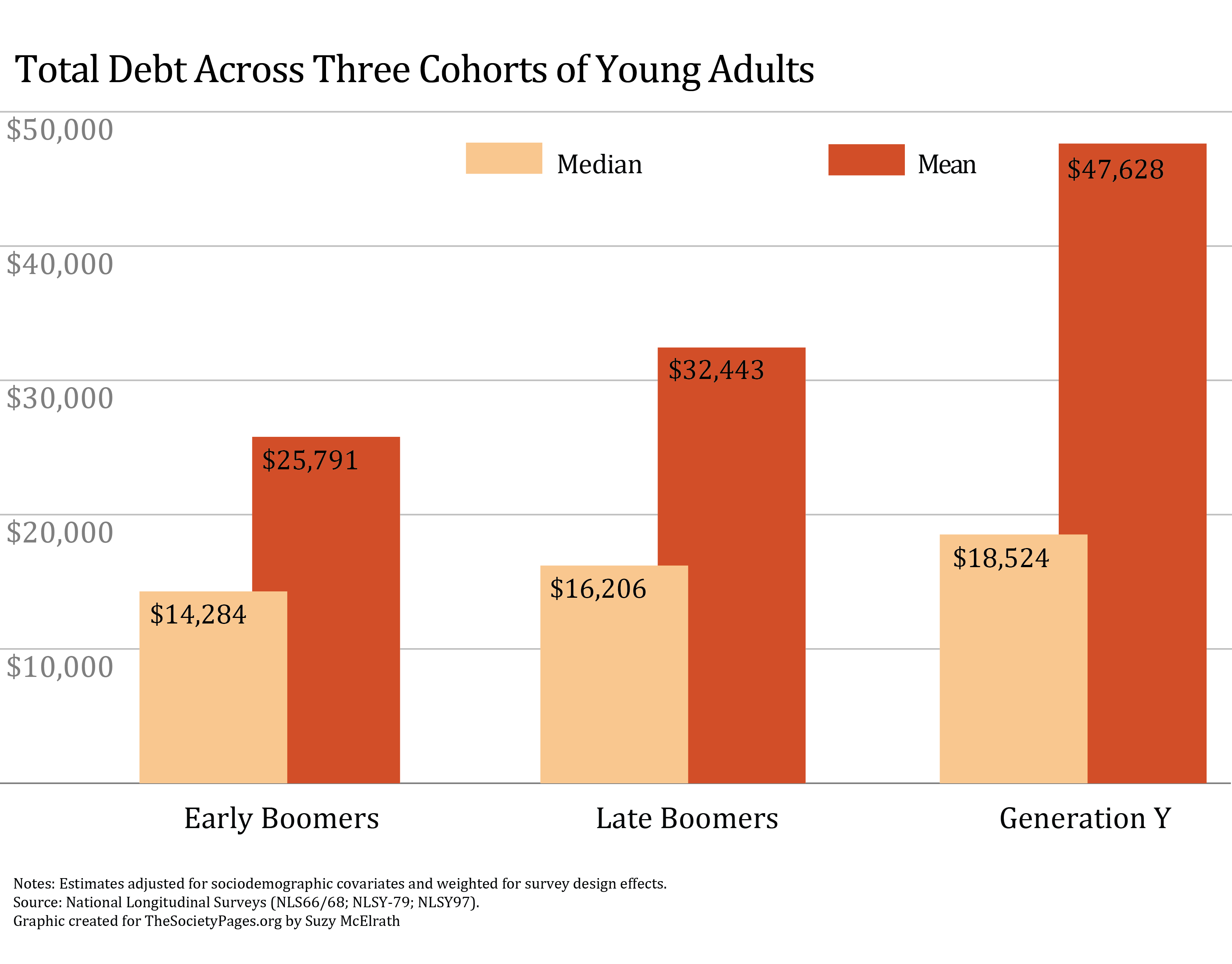
Do Millennials really carry more debt than their parents and grandparents did at their age? Yes, according to a new study by sociologist Jason Houle.  “In order to participate in society and gain economic independence,” he writes, “many young adults today must take a massive financial risk.”  Or, as he puts it, “out of the nest and into the red.”

The graph below compares the amount of debt held by three generations in young adulthood (adjusted for inflation and controlled for other variables). Notice that the median debt load has grown, but the average debt load has grown much faster. This means that, while debt has grown over all, averages are also pulled up by a small number of young people that have really high levels.

1 (2) - Copy

Some evidence suggests that high debt individuals may be coming from lower income families. They take on debt as young people because the adults in their lives have already maxed out. They can’t count on their parents, for example, to take out a second mortgage on the house in order to pay for their college education. So, if they want to go to college, they have to take on the debt themselves.

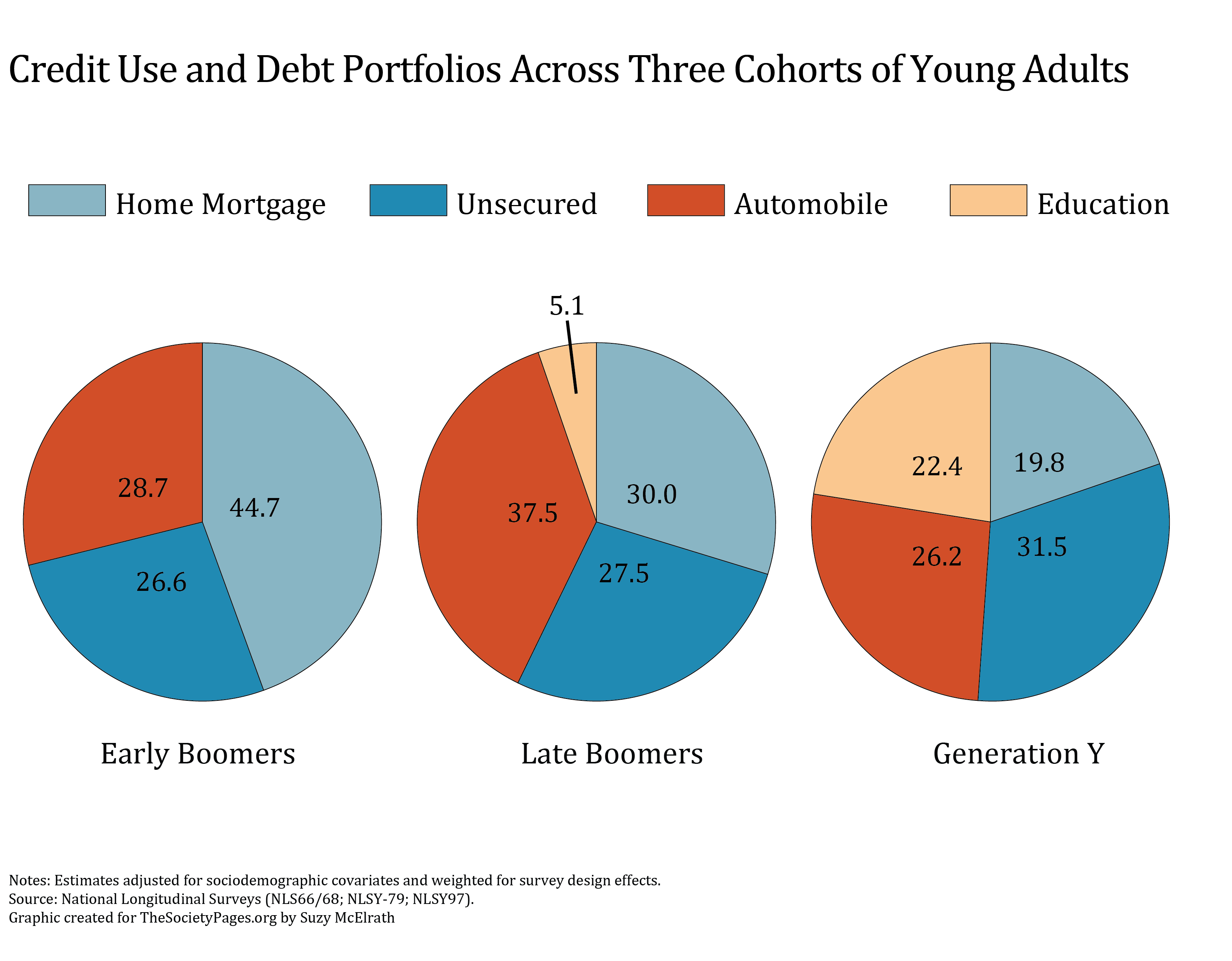
Houle’s analysis, however, also shows that the kind of debt has changed across the three generations. The pie charts below reveal that the proportion of debt accounted for by home or car loans has shrunk, while the proportion accounted for by education loans and unsecured debt, like credit cards, has risen.

1 (2)

Moreover, Houle argues that this profile of generation Y’s debt is class specific:

The more advantaged are able to take on debt that helps them pursue a middle class lifestyle and build their wealth, while the less advantaged must take on debt to pay their bills and keep their heads above water.

So, is massive financial risk the new recipe for success?

For some, the answer may be yes. But for many, the gamble does not pay off. Students that take out college loans, for example, are more likely to drop out of college than those who have a parent that can pay. The combination of school loans and minimum-wage jobs can add up to a lifetime of economic insecurity. But, without other resources, not risking at all almost guarantees failure in this economy.  For this reason, Houle argues, the availability of credit and acquisition of debt may be just another driver of income and wealth inequality.  It’s a disturbing story that you can read in more depth here.

Lisa Wade, PhD is an Associate Professor at Tulane University. She is the author of American Hookup, a book about college sexual culture; a textbook about gender; and a forthcoming introductory text: Terrible Magnificent Sociology. You can follow her on Twitter and Instagram.

A touching BBC story describes a new documentary, Menstrual Man, that chronicles the trials and tribulations of a humble man in India who sought to offer his wife a sanitary napkin.  After marrying, he discovered that his wife kept from him a secret: the rags she used and re-used to collect menstrual blood.

Only 12% of women in India used pads; they were simply too expensive for most to buy. Nearly three-quarters of all reproductive diseases were caused by poor menstrual hygiene.  A combination of high cost and embarrassment kept women from developing a safe method of managing menstruation.  Nearly a quarter of girls dropped out of school when they started their periods.

Arunachalam Muruganantham was driven to offer women a solution.  He was going to design a machine that would produce low cost menstrual pads.  He asked his wife to serve as an experimental subject, but one woman menstruating once a month wasn’t enough of a sample.  He asked medical students to participate, but the responses were slim.  He fashioned a fake uterus and collected goat blood, trying to experiment himself.

“Everyone thought he’d gone mad.”

His wife left, his mother left, his friends avoided him; it was suspected he was some kind of diseased or possessed sexual pervert, collecting menstrual blood to do god-knows-what.

Figuring out how to make highly absorptive cotton was a significant challenge.  He finally tricked a  multinational company into sending him samples of the raw material: cellulose from the bark of the tree.  Now he just had to design a cheap machine that would turn the raw material into pads.

Four-and-a-half years later, he was producing affordable menstrual pads for Indian women on a cheaply made machine.  He won an award.  His wife came back.

He built 250 machines, which he then took to the poorest areas of Northern India.  He gave them to women, at no profit, who could then produce the pads and sell them to local women.  Each woman now runs her own business.  “Over time the machines spread to 1,300 villages in 23 states.” He is now looking to expand to 106 more countries.

About his success, Muruganantham said:

Anyone with an MBA would immediately accumulate the maximum money. But I did not want to. Why? Because from childhood I know no human being died because of poverty — everything happens because of ignorance…. I have accumulated no money but I accumulate a lot of happiness.

Watch the trailer here.

Cross-posted at Pacific Standard.

Lisa Wade, PhD is an Associate Professor at Tulane University. She is the author of American Hookup, a book about college sexual culture; a textbook about gender; and a forthcoming introductory text: Terrible Magnificent Sociology. You can follow her on Twitter and Instagram.

It’s been a while since we treated our audience to a post featuring a collection of pointlessly gendered products.  Time to correct our lapse in diligence!  Here are some favorite examples we’ve added to our Pinterest board lately.

THE FOOD CATEGORY.

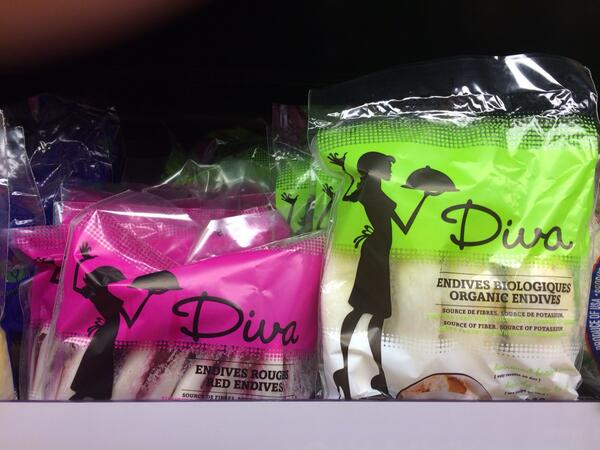
Pointlessly gendered endives:

1 (2)

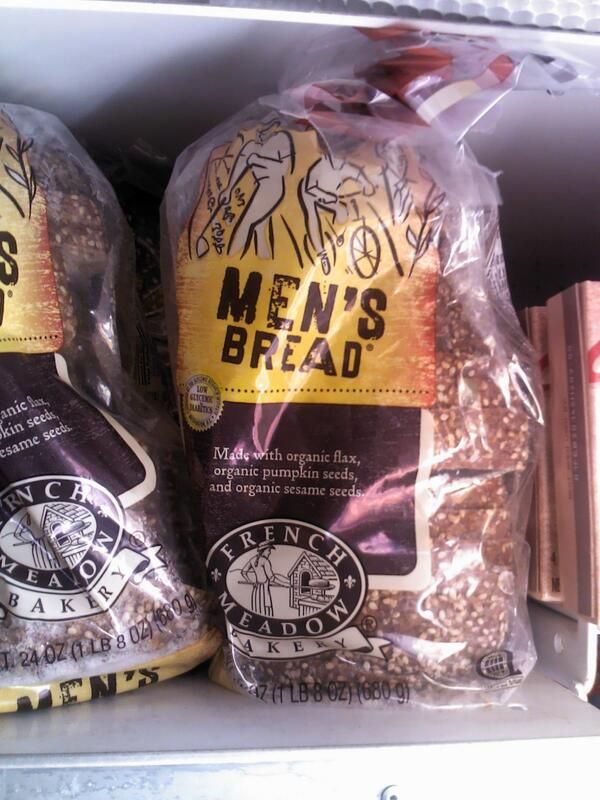
Pointlessly gendered bread:

1 (3)

Pointlessly gendered eggs:

1 (4)

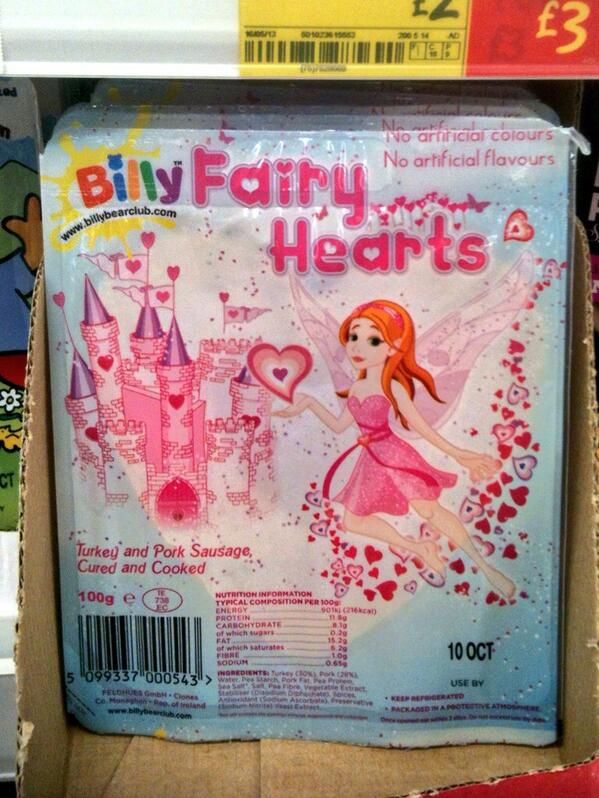
Pointlessly gendered sausages: 1 (5)

Thanks @appledaughter,  Lars F., @mamatastic, @day_jess, @jongudmundand, and @blessedharlot!

KID STUFF.

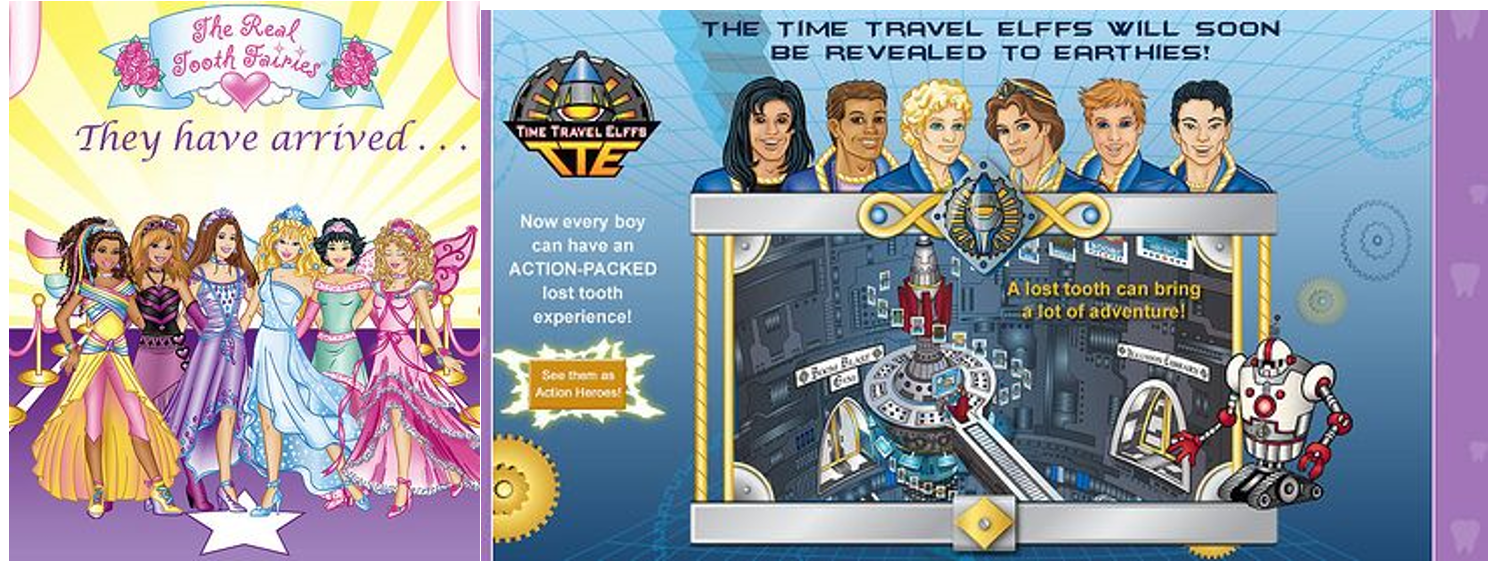
Pointlessly gendered tooth fairies:

Screenshot (38)

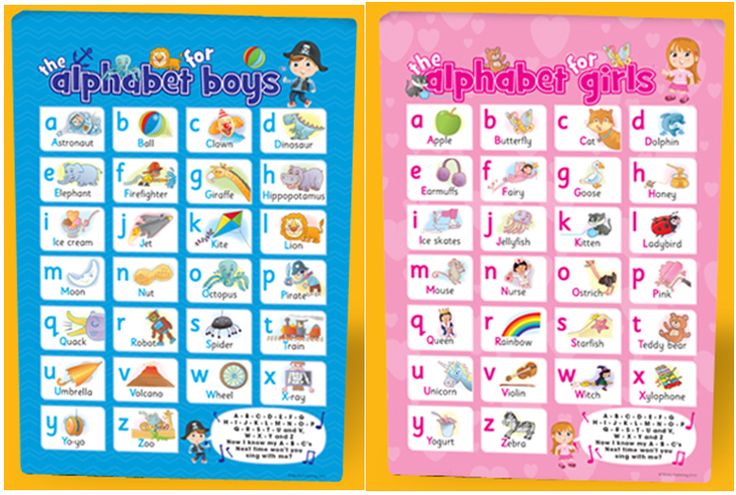
Pointlessly gendered alphabets:1 (2)

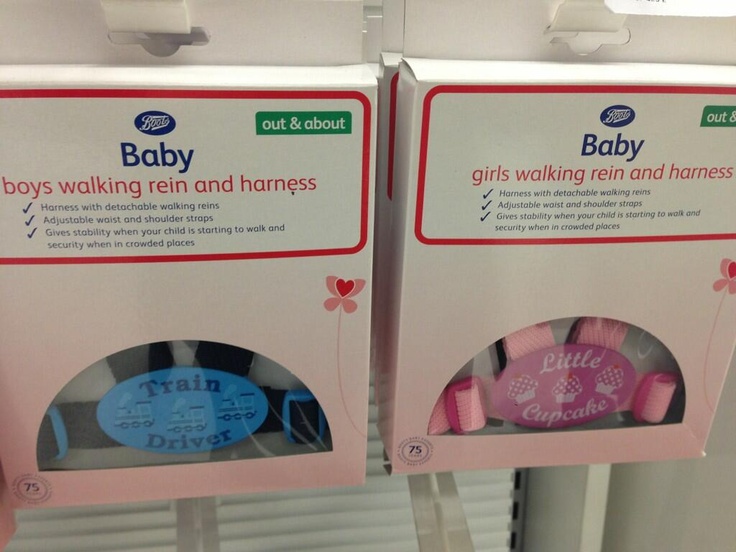
Pointlessly gendered child harnesses:

3

Thanks Sarah M., @day_jess, and @qaoileann!

GROWN-UP STUFF.

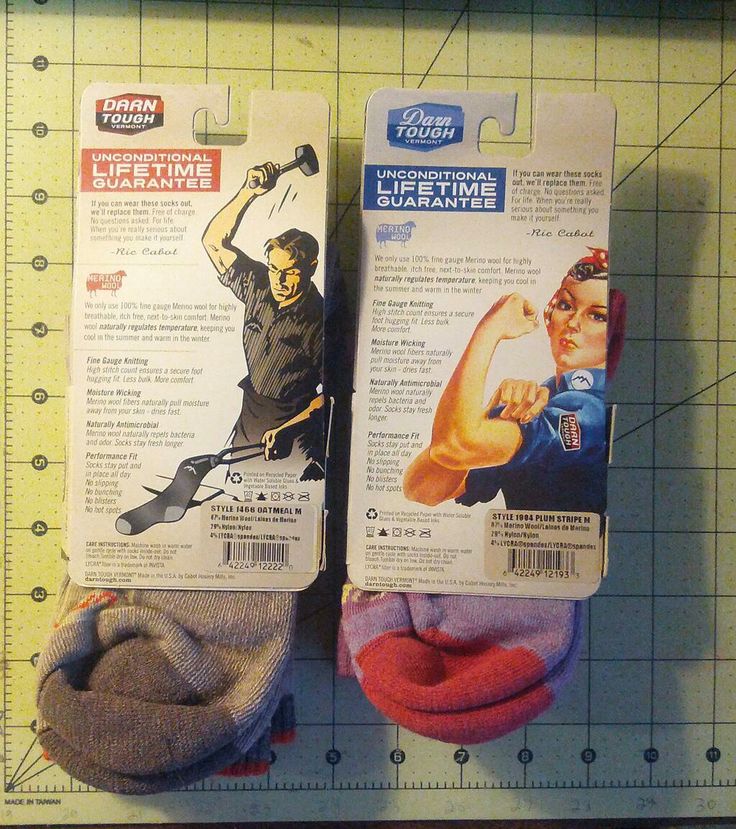
Pointlessly gendered socks:

1 (2)

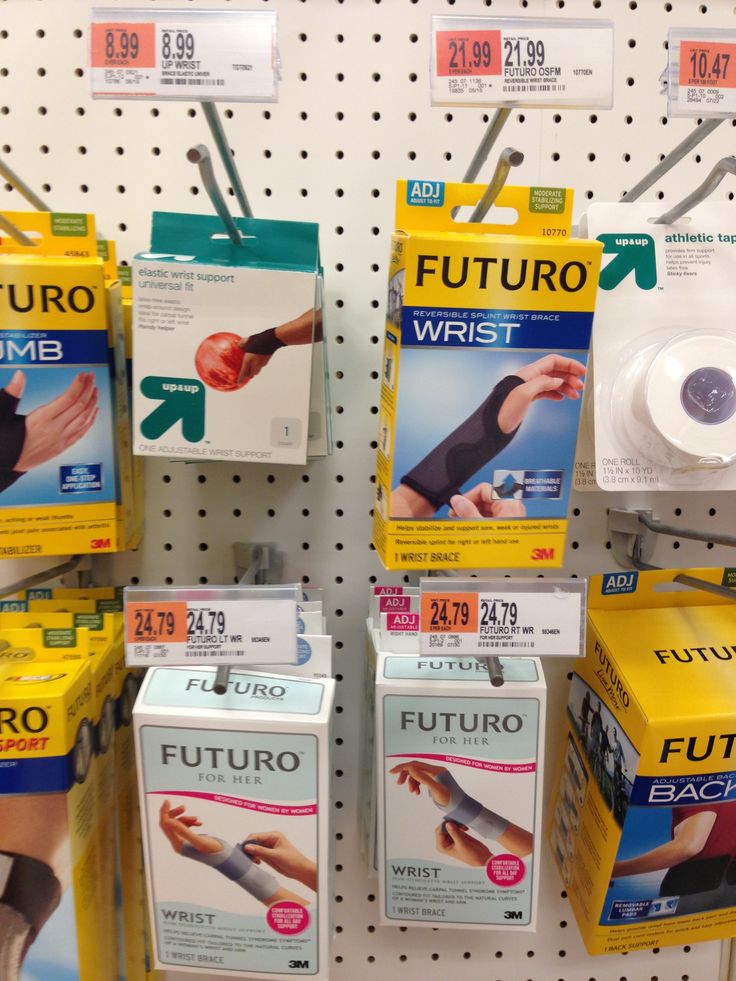
Pointlessly gendered wrist support:1 (4)

Pointlessly gendered job ads:1 (5)

Bonus! Pointlessly gendered pet shampoo:

2 (2)Thanks Jen T., Lisa S., @nayohmei, and @doubleemmartin!

That’s all for now!  Check out the entire collection on Pinterest.

Lisa Wade, PhD is an Associate Professor at Tulane University. She is the author of American Hookup, a book about college sexual culture; a textbook about gender; and a forthcoming introductory text: Terrible Magnificent Sociology. You can follow her on Twitter and Instagram.

“How could we get evidence for this?” I often ask students. And the answer, almost always is, “Do a survey.” The word survey has magical power; anything designated by that name wears a cloak of infallibility.

“Survey just means asking a bunch of people a bunch of questions,” I’ll say. “Whether it has any value depends on how good the bunch of people is and how good the questions are.”  My hope is that a few examples of bad sampling and bad questions will demystify.

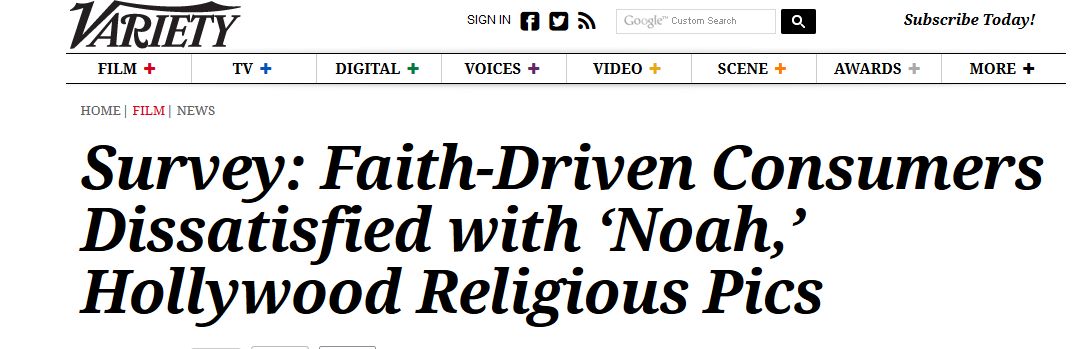
For example, Variety:

11

Here’s the lede:

Despite its Biblical inspiration, Paramount’s upcoming “Noah” may face some rough seas with religious audiences, according to a new survey by Faith Driven Consumers.

The data to confirm that idea:

The religious organization found in a survey that 98% of its supporters were not “satisfied” with Hollywood’s take on religious stories such as “Noah,” which focuses on Biblical figure Noah.

The sample:

Faith Driven Consumers surveyed its supporters over several days and based the results on a collected 5,000+ responses.

And (I’m saving the best till last) here’s the crucial survey question:

As a Faith Driven Consumer, are you satisfied with a Biblically themed movie — designed to appeal to you — which replaces the Bible’s core message with one created by Hollywood?

As if the part about “replacing the Bible’s core message” weren’t enough, the item reminds the respondent of her or his identity as a Faith Driven Consumer. It does make you wonder about that 2% who either were fine with the Hollywood* message or didn’t know.

You can’t really fault Faith Driven Consumer too much for this shoddy “research.” They’re not in business to find the sociological facts. What’s appalling is that Variety accepts it at face value and without comment.

Cross-posted at Montclair SocioBlog.

Jay Livingston is the chair of the Sociology Department at Montclair State University. You can follow him at Montclair SocioBlog or on Twitter.

Apparently universities are issuing guidelines to help professors consider adding “trigger warnings” to syllabi for “racism, classism, sexism, heterosexism, cissexism, ableism, and other issues of privilege and oppression,” and to remove triggering material when it doesn’t “directly contribute to learning goals.” One example given is Chinua Achebe’s “Things Fall Apart” for its colonialism trigger. This from New Republic this week.

I have no desire to enter the fray of online discussions on trigger warnings and sensitivity. I have used trigger warnings. Most recently, I made a personal decision to not retweet Dylan Farrow’s piece in the New York Times detailing Woody Allen’s sexual abuse. I was uncomfortable shoving a very powerful description at people without some kind of warning. I couldn’t read past the first three sentences. I couldn’t imagine how it read for others. So, I referenced the article with a trigger warning and kept it moving.

But, I’m not sure that’s at all the kind of deliberation universities are doing with their trigger warning policies. Call me cynical, but the “student-customer” movement is the soft power arm of the neo-liberal corporatization of higher education. The message is that no one should ever be uncomfortable because students do not pay to feel things like confusion or anger. That sounds very rational until we consider how the student-customer model doesn’t silence power so much as it stifles any discourse about how power acts on people.

I’ve talked before about how the student-customer model becomes a tool to rationalize away the critical canon of race, sex, gender, sexuality, colonialism, and capitalism.

The trigger warned syllabus feels like it is in this tradition. And I will tell you why.

In the last three weeks alone: a college student has had structural violence of normative harassment foisted on her for daring to have sex (for money), black college students at Harvard have taken to social media to catalog the casual racism of their colleagues, and black male students at UCLA made a video documenting their erasure.

It would seem that the most significant “issue” for a trigger warning is actual racism, sexism, ableism, and systems of oppression. Cause I’ve got to tell you, I’ve had my crystal stair dead end at the floor of racism and sexism and I’ve read “Things Fall Apart.” The trigger warning scale of each in no way compares.

Yet, no one is arguing for trigger warnings in the routine spaces where symbolic and structural violence are acted on students at the margins. No one, to my knowledge, is affixing trigger warnings to department meetings that WASP-y normative expectations may require you to code switch yourself into oblivion to participate as a full member of the group. Instead, trigger warnings are being encouraged for sites of resistance, not mechanisms of oppression.

At for-profit colleges, strict curriculum control and enrollment contracts effectively restrict all critical literature and pedagogy. We elites balk at such barbarism. What’s a trigger warning but the prestige university version? A normative exclusion as opposed to a regulatory one?

Trigger warnings make sense on platforms where troubling information can be foisted upon you without prior knowledge, as in the case of retweets. Those platforms are in the business of messaging and amplification.

That is an odd business for higher education to be in… unless the business of higher education is now officially business.

In which case, we may as well give up on the tenuous appeal we have to public good and citizenry-building because we don’t have a kickstand to lean on.

If universities are not in the business of being uncomfortable places for silent acts of power and privilege then the trigger warning we need is: higher education is dead but credential production lives on; enter at your own risk.

Tressie McMillan Cottom is a PhD candidate in the Sociology Department at Emory University in Atlanta, GA.  Her doctoral research is a comparative study of the expansion of for-profit colleges.  You can follow her on twitter and at her blog, where this post originally appeared.

Like a lot of moms, I faced the Barbie dilemma when my daughter was younger. Ultimately I  figured a little bit of Barbie would sate her appetite (and stop the nagging) without doing too much harm. Like a vaccination, or homeopathic inoculation against the Big Bad. I told myself my daughter didn’t use her dolls for fashion play anyway: her Barbie “funeral,” for instance, was a tour de force of childhood imagination. I told myself I only got her “good” Barbies: ethnic Barbies, Wonder Woman Barbie, Cleopatra Barbie. Now that she’s 10 and long ago gave the dolls away (or “mummified” them and buried them in the back yard in a “time capsule”), I can’t say whether they’ll have any latent impact on her body image or self-perception. It would seem ludicrous, at any rate, to try to pinpoint the impact of one toy.

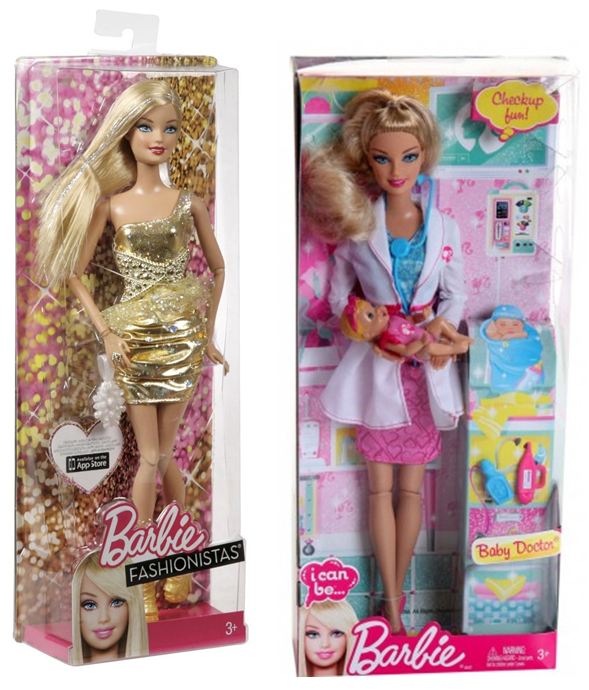
But now, according to a study published this week,  it turns out that playing with Barbie, even career Barbie, may indeed limit girls’ perception of their own future choices. Psychologists randomly assigned girls ages 4-7 to play with one of three dolls. Two were Barbies: a fashion Barbie (in a dress and high heels); and a “career” Barbie with a doctor’s coat and stethoscope. (NOTE: I just pulled these images from the web: I don’t know which actual Barbies they used.)

5

The third, “control” doll was a Mrs. Potato Head, who,  although she comes with fashion accessories such as a purse and shoes, doesn’t have Barbie’s sexualized (and totally unrealistic) curves.

So, after just a few minutes of play, the girls were asked if they could do any of 10 occupations when they grew up. They were also asked if boys could do those jobs. Half of the careers, according to the authors, were male-dominated and half were female dominated. The results:

Girls who played with Barbie thought they could do fewer jobs than boys could do. But girls who played with Mrs. Potato Head reported nearly the same number of possible careers for themselves and for boys.

More to the point:

There was no difference in results between girls who played with a Barbie wearing a dress and the career-focused, doctor version of the doll.

Obviously, the study is not definitive. Obviously, one doll isn’t going to make the critical difference in a young woman’s life blah blah blah. Still, it’s interesting that it doesn’t matter whether the girls played with fashion Barbie or doctor Barbie, the doll had the same effect and in only a few minutes.

That reminded me of a study in which college women enrolled in an advanced calculus class were asked to watch a series of four, 30-second TV commercials. The first group watched four netural ads. The second group watched two neutral ads and two depicting stereotypes about women  (a girl enraptured by acne medicine; a woman drooling over a brownie mix). Afterward they completed a survey and—bing!—the group who’d seen the stereo- typed ads expressed less interest in math- and science-related careers than classmates who had watched only the neutral ones. Let me repeat: the effect was demonstrable after watching two ads.

And guess who performed better on a math test, coeds who took it after being asked to try on a bathing suit or those who had been asked to try on a sweater? (Hint: the latter group; interestingly, male students showed no such disparity.)

Now think about the culture girls are exposed to over and over and over and over and over, whether in toys or movies or tv or music videos, in which regardless of what else you are—smart, athletic, kind, even feminist, even old—you must be “hot.” Perhaps, then, the issue is not “well, one doll can’t have that much of an impact,” so much as “if playing with one doll for a few minutes has that much impact what is the effect of the tsunami of sexualization that girls confront every day, year after year?”

Peggy Orenstein is the author of four books, including The New York Times best-seller Cinderella Ate My Daughter: Dispatches from the Front Lines of the New Girlie-Girl Culture.  You can follow her at her blog, where this post originally appeared, on facebook, and on twitter.