Archive: Apr 2009

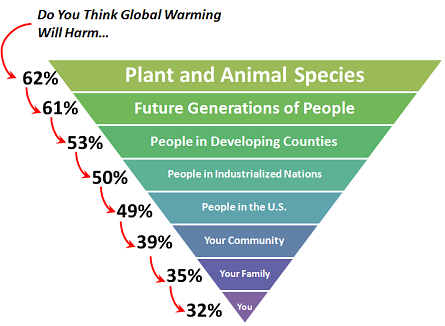
Nate Silver at FiveThirtyEight put up an image that illustrates the findings of a recent survey by George Mason University’s Center for Climate Change Communication.This inverted pyramid shows the percent of those polled who said they think global warming will hurt each group “a great deal” or “a moderate amount”:
warming

So as we see, the closer the question got to the person answering the survey, the less severe they thought the impacts of global warming were likely to be. Silver says,

These beliefs are not necessarily irrational. Climate change probably will have more impact on the developing world than the developed one, and it almost certainly will have more impact on our children than it does on ourselves.

But if individuals don’t perceive climate change to really have negative consequences for them or their families, they may not support climate change policies if they fear those policies will hurt jobs/business in the short-term, since they may be more likely to see the economic impacts as personally problematic.

UPDATE: An anonymous commenter pointed out that the 538 pyramid is a bit misleading. Brad Johnson at Wonk Room created a more representative one:

global_warming_perceptions

Thanks for the tip!

frankie-bioThis post is dedicated to Frankie Manning.  Frankie died this morning of complications related to pneumonia   He was one month shy of his 95th birthday.  I will really miss him.  Frankie is a lindy hop legend.  He choreographed the clip below and is the dancer in the overalls.
In the 1980s, there was a lindy hop revival.  Lindy hop is a partner dance invented by African American youth in Harlem dancing to swing music in the early 1930s. Named after the “hopping” of the Atlantic by Charles Lindbergh Jr., it became wildly popular in the 1930s and ‘40s, traveling from the East to the West Coast and from black to white youth. Since its resurgence, Lindy Hoppers have enjoyed a national scene with websites, workshops, competitions, and city-wide social events that draw national and international crowds.

Though lindy hop was invented by African Americans, lindy hoppers today are primarily white.  These contemporary dancers look to old movie clips of famous black dancers as inspiration.  And this is where things get interesting:  The old clips feature profoundly talented black dancers, but the context in which they are dancing is important. Professional black musicians, choreographers, and dancers had to make the same concessions that other black entertainers at the time made. That is, they were required to capitulate to white producers and directors who presented black people to white audiences. These movies portrayed black people in ways that white people were comfortable with: blacks were musical, entertaining, athletic (even animalistic), outrageous (even wild), not-so-smart, happy-go-lucky, etc.

So what we see in the old clips that contemporary lindy hoppers idolize is not a pure manifestation of lindy hop, but a manifestation of the dance infused by racism. While lindy hoppers today look at those old clips with nothing short of reverance, they are mostly naive to the fact that the dancing they are emulating was a product made to confirm white people’s beliefs about black people.  Let’s look at how this plays out:

This clip, from the movie Hellzapoppin’ (1941) is perhaps the most inspirational clip in the contemporary lindy hopper’s arsenal:

By the way, the dancers are in “service” outfits because of the way lindy hop scenes featuring black dancers were included in movies.   Typically they would have no relationship to the plot; they would occur out of nowhere and then disappear.  This was so that the movie studios could edit out the scene when the movie was going to be shown to those white audiences that were hostile to seeing any positive representation of black people at all.  If you want to see how the scene above emerged (black “help” suddenly discovering musical instruments and spontaneously congregating), you can watch the extended clip here.

The clip features a dance troop called Whitey’s Lindy Hoppers. You can see other famous dance segments in Boy! What A Girl! and Day At The Races.

The clip below, from the Ultimate Lindy Hop Showdown (2006), reveals how powerfully contemporary lindy hoppers have been influenced by clips like the ones above.  Watch for how the styling, moves, and trick reflects the clips above:

Another good example can be found here (but the angle, audio, and visual quality are not very good).

So we have a set of (mostly) white dancers who naively and wholeheartedly emulate a set of black dancers whose performances, now 70 to 80 years old, were produced for mostly white audiences and adjusted according to the racial ethos of the time.  On the one hand, it’s neat that the dance is still alive; it’s wonderful to see it embodied, and with so much enthusiasm, so many years later.  And certainly no ill will can be fairly attributed to today’s dancers.  On the other hand, it’s troubling that the dance was appropriated then (for white audiences) and that it is that appropriation that lives on (for mostly white dancers).  Then again, without those dancers, there would likely be no revival at all.  And without those clips, however imperfect, the dance might have remained in obscurity, lost with the bodies of the original dancers.

As a white lindy hopper myself, for over ten years now, who desperately loves this dance, I find this to be a deep conundrum.

I don’t know what Frankie would have had to say about this critique.  But I do know that he loved lindy hop to his last days and he was grateful for the revival.  Here he is dancing with Dawn Hampton, another legend of lindy hop, at the age of 94:

I’lll miss you, Frankie. And I’ll keep on dancing, embodying, with ambivalence, all the great contradictions of the dance and the history of this country.


UPDATE: A couple commenters asked how, exactly, the dance was changed in order to appeal to white audiences.  This is actually really difficult to say, since few films of social dancing (black dancers dancing only for other black dancers) exist.  But we have some theories.  Evan, in the comments, had this suggestion:

For white audiences of the time, Jazz was Hot Black jungle music – Black people were sex crazy hedonists, and you can see it in the moves, the exaggerated body undulation. the speed. the sweat. the rhythmical drum.

It was like watching a tribe around a fire.

I’m with Evan.  I’d like to also add that, as a person with a trained eye for lindy hop, I see two things in those clips:

(1) I see incredibly effective technique. Unbelievable strength and precision. It’s fantastic.  (By the way, Frankie explained that, by the time they got to the take you see in the Hellzapoppin’ clip, they’d performed that routine more than 20 times in a row… they were amazing athletes.)

(2) But I also see, layered onto and facilitated by that technique, an effort to make the dance appear more out-of-control than it is. They are wild-ing the dance.

At least, that’s how it looks to me.

More than that, though.  As a dancer who has also been inspired by those clips, I know how to do that.  I know how to exaggerate the out-of-control look.  I won’t go into the technical details (I did, and then deleted!), but it’s do-able.  And it’s not that it’s not cool… adding the drama is fun and exciting to watch… but there’s a historical reason why lindy hop has that dimension and that is worth thinking about.

Lisa Wade, PhD is an Associate Professor at Tulane University. She is the author of American Hookup, a book about college sexual culture; a textbook about gender; and a forthcoming introductory text: Terrible Magnificent Sociology. You can follow her on Twitter and Instagram.

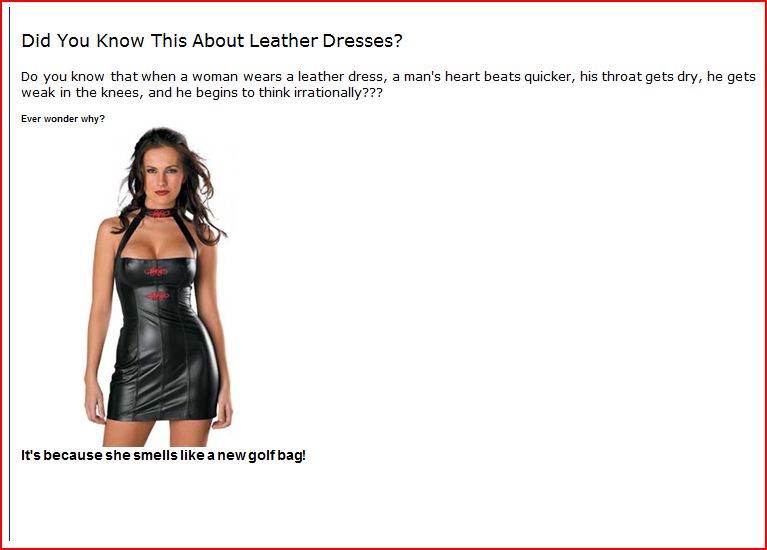
I presume, though I have never seen any evidence for this, that we don’t all get the same email forwards.  For instance, I never received this forward… but Steve W. did:

capture11

Text:

Did You Know This About Leather Dresses?

Do you know that when a woman wears a leather dress, a man’s heart bests quicker, his throat gets dry, he gets weak in the knees, and he begins to think irrationally???

Ever wonder why?

It’s because she smells like a new golf bag!

Why don’t I typically receive such forwards?  To suggest that it has something to do with my sex, which was my first guess, is probably too simple of an explanation.  I suspect it also has something to do with my class, politics, and occupation. 

What kind of forwards do you (not) get?  Do you think you might be surprised at what other people receive in their inbox? 

Do you selectively forward certain sentiments to some people and not others?  Do certain sentiments come from some people in your social network and not others?

What does the big wide world of forwarding look like?  Who forwards what to who?  Or, what part of the forwarding-whole is largely invisible to you?

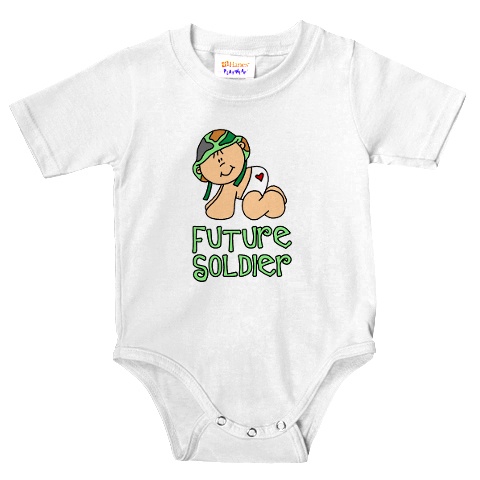
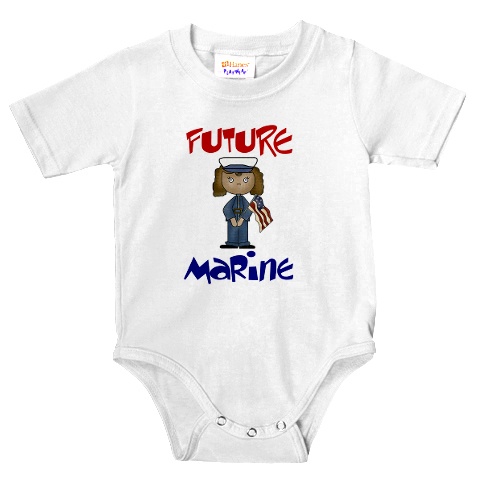
As I was digging around the internet for illustrations of mothers of service members claiming to be as tough as their enlisted children (I’ll save that for another post), I found the following “future service member” clothes for children, babies, and even pregnant women:

jitcrunch-1154477468v16_350x350_front_color-white

jitcrunch-2

jitcrunch-5

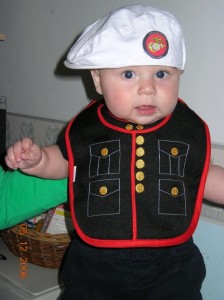
And a Marine bib/costume:

capton

And a couple maternity shirts:

jitcrunch-4

215814389v6_350x350_front_color-white

I have a few thoughts about these.

First, it’s interesting how the shirts (and the many more like them for other family members) enlist family members (and future family members) into military service along with the service member. Each branch of the military is considered a big extended family and members know they are “taken care of” to some extent by each other and by military programs that support the children and partners of those who are serving. Not only does it make practical sense to offer services to families who have a loved one deployed for months and years at a time, but it is also advantageous for the military as families are recognized as a key part of military success. Families are essential and are counted on to provide all kinds of support– from deployment readiness (moving at a moment’s notice etc.), to supplying their loved ones with emotional support, clothes and armor when they are deployed.

family

The military is also a profession that is often a viable choice for for many young people, and there are many families from strong military traditions– where multiple generations have served. It makes sense, then, that these families have a certain amount of pride in a career that has been in their families for generations. But, many who go into the military end up in combat situations where their lives and personal safety are put at high risk (especially during wartime). So, the idea of handing down the military as a profession doesn’t seem the same then as handing down pride in a university or in a sports team. Isn’t it much different to put a baby in a “future Badgers fan” outfit?

Finally, the pregnancy shirts make me think of how sociologists Nira Yuval-Davis and Cynthia Enloe talk about gendered and militarized citizenship. For Yuval-Davis, one of the primary ways women can be citizens is through reproduction– literally reproducing the people of the nation. Often reproducing soldiers to secure the nation is a part of pro-natalist policies. And Cynthia Enloe writes about the importance of mothers’ support (what she calls “militarized mothers”) for the continued recruitment and support of soldiers: “Militarizing motherhood often starts with conceptualizing the womb as a recruiting station.”

Jose at Thick Culture sent us this design for the Catholic Church’s Archdiocesan Youth Commission logo in 1973 (via The Daily Dish). 

6a00d83451c45669e201156f47782f970c-800wi

The logo nicely shows how images are polysemic.  That is, the same image can be read very differently by different people or, as this image illustrates, at different times.   Because of the shift in the social construction of the Catholic priesthood–from benevolent child chaperones to evil child molesters–the logo, though likely lovely then, would be very ill-advised today.

Two more good examples of polysemy here and here.

Something I read in another blog sent me digging into the statistics on homicide between husbands and wives or other “intimates.” I remembered from my days in the crim biz that the US was unique in that wives here killed their husbands almost as frequently as husbands killed wives. This statistic, the “spousal rate of killing” (SROK), was introduced in a now-classic 1992 article by Margo Wilson and Martin Daly. In most countries, that rate is 25-30%. In the US, Wilson and Daly pointed out, it was about 75%.

But something has happened, over the last thirty years or so (data here). And as far as I can tell from a quick search on the Internet, nobody seems to have noticed.

(Click on the graph for a larger view.)


Between 1976 and 2005, the number of women killed by their male partners decreased by about 25%, less than the decrease in all homicides nationwide. But the number of men killed by women dropped dramatically, from 1300 to 330, a 75% decrease (since the population increased in those three decades, the change in rates is probably even greater. The SROK fell from 82% to 28%.

My Internet search for explanations was cursory at best, but it turned up nothing. I have only two ideas:

1. Men Behaving Better. Men have stopped doing those things that made women want to kill them.

I offered this explanation to two women in the Justice Studies department here. They rejected it out of hand and without comment. (Maybe they didn’t like the blaming-the-victim assumption: if women kill men, it’s because of what men do. Or maybe they were using a convenience sample of anecdotal data on men’s behavior.). One of these women, Lisa Anne Zilney, offered a counter-explanation . . .

2. Women Having Options. Women’s shelters and other facilities have given women an alternative. Without these, the only way to escape an intolerable situation at home was to get rid of the cause. Providing abused and desperate women a safe place to go saves lives – and apparently not just the lives of women.

I’m not wild about either of these explanations for the steep decline in the SROK (and as I recall, Wilson and Daly weren’t wild about any of their explanations of why it was so high).

Any ideas?

———————————–

Thanks Jay!  Read his other guest post: When grown men loved teddy bears.

If you would like to write a post for Sociological Images, please see our Guidelines for Guest Bloggers.

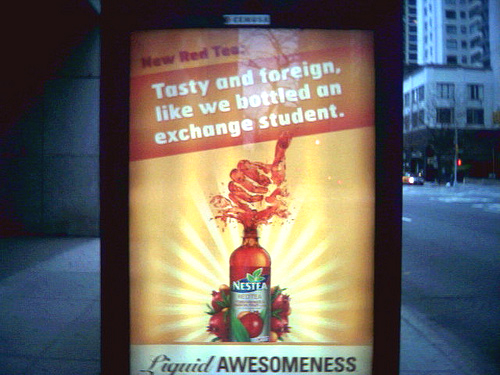
We have posted previously about how ethnic difference is made available for consumption through products (see here, here, and here).  This product, Nestea’s red tea, suggests that you can consume other people, not just their culture.

nesteaad

Text:

Tasty and foreign, like we bottled an exchange student. Liquid awesomeness.

Via Shakesville.

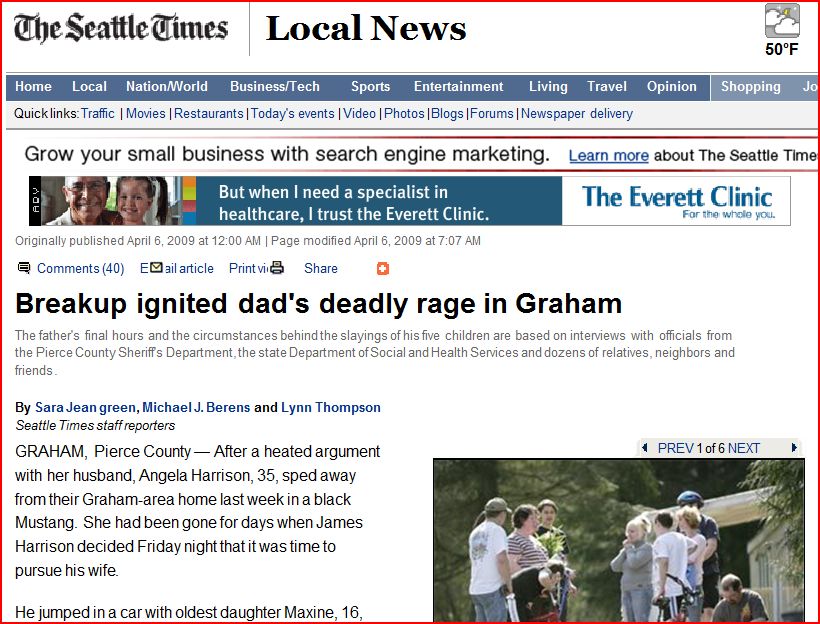
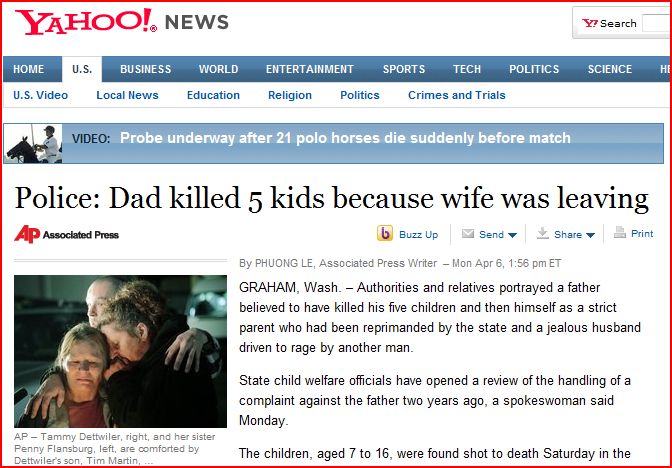
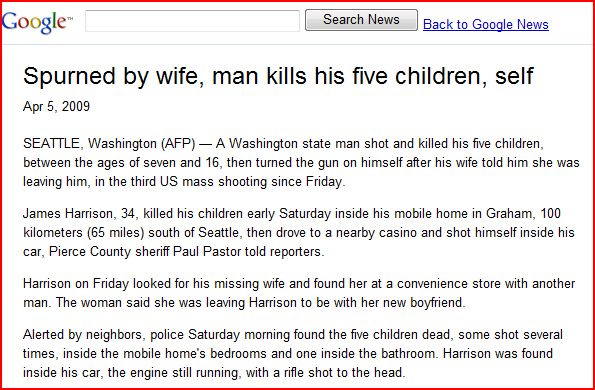
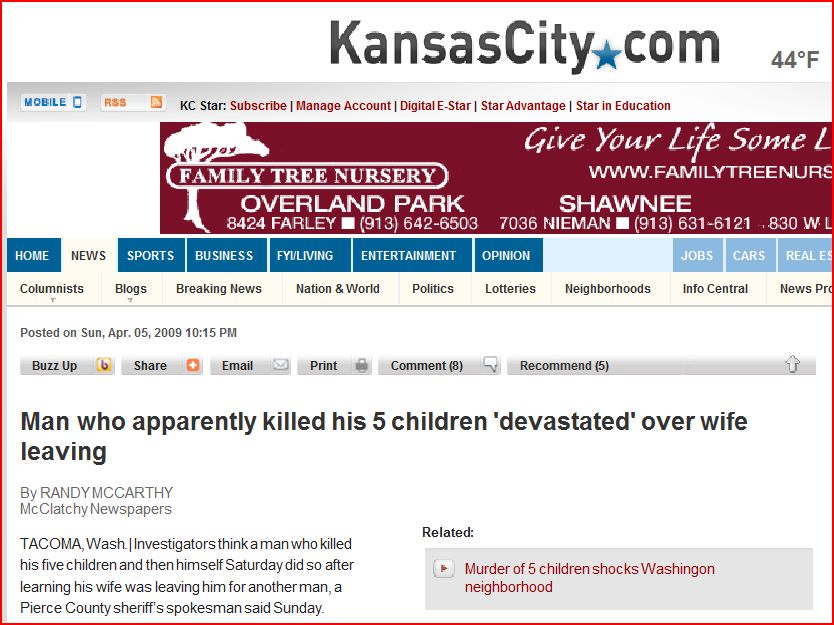
When Rihanna was beaten by Chris Brown, many people blamed Rihanna for enraging him.   Laura McDe sent in another example of victim-blaming in a case of domestic violence.  This time a man killed his five children, and then himself, after discovering that his wife had left him for another man.  Many headlines placed the blame on his wife (via Shakesville):

The Seattle Times:

capture4

Yahoo News:

yahoo

Kansas City.com:

kansas

Google News:

google

Instead of focusing on the husband’s abusive and frightening behavior, his mental instability, and his horrific decision to kill five children, the headlines focus on his wife’s behavior and how it “ignited” his own.  To complete the metaphor, if you are flammable, when you burst into flame, it is the match striker’s fault.

NEW! Shakesville highlighted another example of the excusing men’s violence against women:

actualheadline3

That’s right.  Poisoning your wife is an act of love.  You see, they were estranged and he wanted to make her ill so that he could nurse her back to health and have-her-no-she-can’t-get-away-I’ll-make-sure-of-it.  Story here.

Also in blaming the victim: mothers are responsible for their children’s addiction, renters are responsible for lead poisonous apartments, girls are responsible for internet predators, and women are responsible for preventing sexual harassment.