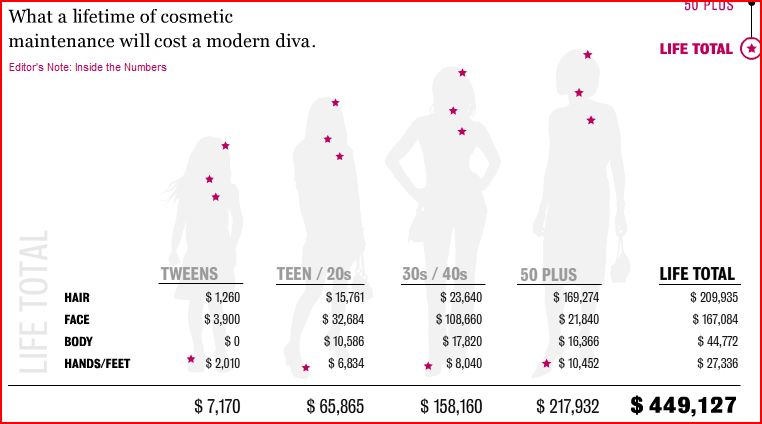
An interactive graphic at Newsweek allows us to explore the amount of money women spend on beauty by their tweens, teens, 30s/40s, 50s, and, then, over the course of their lifetimes. Below is a screenshots of the summary, click here to visit the graphic, and visit here for details on the numbers.
Food & Water Watch has an interesting interactive map that allows you to click on states and see how many factory farms it has per county, broken down into cattle (meaning beef, I assume), hogs, dairy, broilers, and layers (the last two are both chickens). You can look at number of facilities or number of animals. Here’s a screenshot of the number of cattle containment facilities in the U.S.:
Factory farms were identified using Census of Agriculture data and counting those that “best match the Environmental Protection Agency’s definition for a confined animal feeding operation…” based on the following guidelines:
There’s a very detailed description of the methodology available here and an explanation of the maps here.
Instead of affirming the idea that husbands and wives cooperate to raise a child, this commercial affirms the idea that women nurture their children alone. Her husband is not her partner; he is just another human in the home whom she is responsible for nurturing. Women, then, are mothers and wives whose sole job is to nurture children and husbands. Accordingly, the husband and the child are, inevitably, pitted against one another.
I know nothing about “fat camps,” but I have (rather thoughtlessly) simply assumed that they are oppressive places that punish and shame campers in support of a sizest status quo. But, after looking through Lauren Greenfield‘s photographs of kids at a weight-loss camp in the Catskills, NY (here), I’ve started to think differently. The pictures don’t seem to be of oppressed beaten-down kids. Instead, they seem to be having a pretty good time. Greenfield’s captions suggest that these kids feel more comfortable at weight-loss camp than they do in their “real” life because they’re around other people that are, in this important way, just like them. Images show them enjoying things they say they can’t do outside of camp (e.g., wearing a swimsuit), practicing (heterosexual) romance, and learning stuff that is fun or useful (e.g., tae bo, nutrition).
As Gwen pointed out, my critique of weight-loss camps was based on the idea that fat-shaming was more intense at weight-loss camp than it was elsewhere. If you think about it much, this is obviously false. There is plenty of fat-shaming everywhere. At least at camp, kids can potentially achieve a sense of normalcy and some solidarity with one another. So, without suggesting that there is nothing at all problematic about weight-loss camps, these images complicate simple condemnations.
Joshua F. sent in this image from the Des Moines Register of an individual protesting the state Supreme Court’s ruling to legalize gay marriage:
The Culver being told to “man up” is Iowa’s Democratic governor. Joshua says,
I just think it’s kind of telling that Culver is being urged to preserve the traditional definition of marriage with the phrase “man up.” Only by tapping into honest masculinity can Culver fend off effeminate men and mannish women who want to marry each other…
It is a great example of the assumption that masculinity automatically includes homophobia; being a “real man” means not just being straight, but being opposed to gays and gay rights.
Also…same-sex animals do mate and raise young; you can see several examples here.
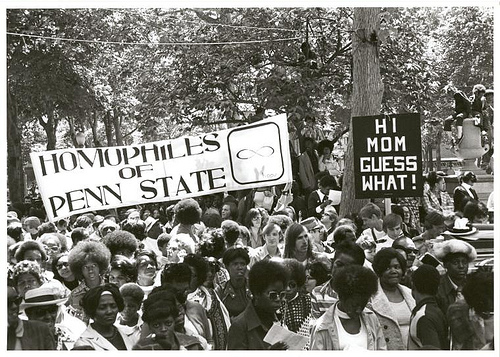
Toban B. sent in a link to a set of photos from the 1970s gay rights movement. Given that since the anti-gay-marriage Prop 8 passed in California in November, many people have argued that a) the African American community is particularly homophobic and voted against the bill (so it’s Black people’s fault Prop 8 passed) or b) gay rights organizations have failed to reach out to the African American community and win their support (so it’s elitist gay people’s fault Prop 8 passed), both positions that imply that gay rights and African Americans are at odds, I found this photo from Philadelphia (in 1972) particularly striking as a reminder that African Americans often did and do support gay rights, and the gay rights movement has often actively included them…oh yeah, and also there are gay Black people:
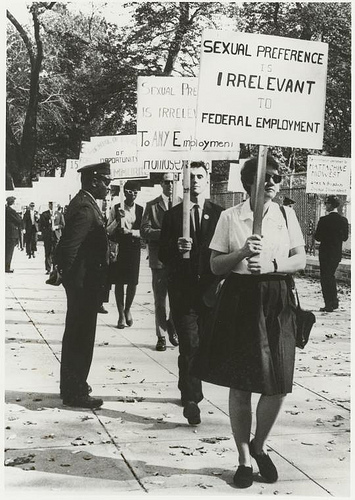
Here’s an image of people picketing the White House in the 1960s in support of legislation to ban discrimination against gays and lesbians in federal employment:
There are also quite a few vintage gay movement images mixed in to this set of photos. Thanks, Toban!
Jacob G. sent us a link to this slideshow hosted by Details magazine. As Jacob noted, not only are the women objectified (their naked bodies serve as furniture on which to display men’s accessories), the title of the slideshow makes a joke of it. It’s titled “Girl Not Included,” just in case viewers mistook the women for purchaseable products alongside the shoes, bags, and belts.
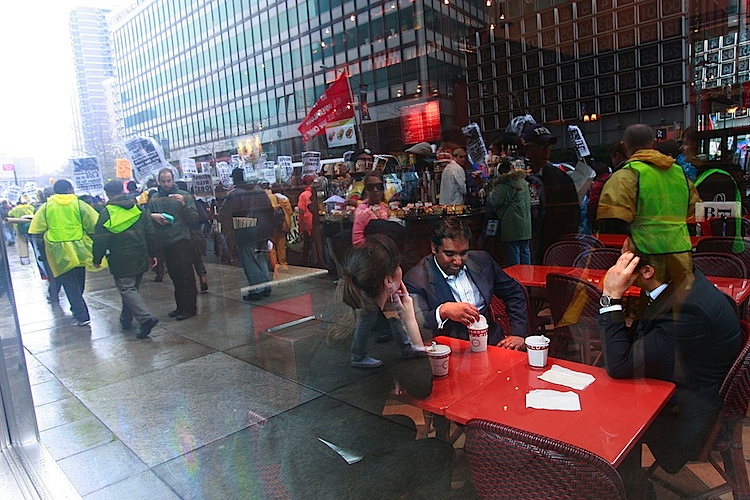
I came across this great photo at BAGnews NOTES, entitled, “Reflecting on the Meltdown”:
The author describes the photo and its meaning this way:
It captures a two-day anti-capitalist rally protesting the Wall Street bailout. Through the use of reflection (in this photo of a restaurant, as well as this one playing the street off against a corporate lobby), Mario [Mario Tama, Getty Photographer] portrays America’s class schism (note the guy in the lime-colored reflective vest overlapped with the guy in the jacket with the wristwatch); America flip-flopping between awareness and denial; and the strange disconnect these days between crisis and ‘business as usual.
This is a wonderfully telling picture, but perhaps in addition to “America flip-flopping between awareness and denial,” one could also interpret the artistic use of reflection as representative of the ever-widening chasm between the social classes in the United States – one that will most likely not be remedied or even addressed in the near future.
About Sociological Images
Sociological Images encourages people to exercise and develop their sociological imaginations with discussions of compelling visuals that span the breadth of sociological inquiry. Read more…