Archive: 2008

Please welcome Guest Blogger Elizabeth Allen.  Elizabeth wrote about commercial for a gastric band (found via Shakesville), an alternative to gastric bypass surgery, on her own blog, Blog of Eternal Stench.  We liked it so much (and like so much of her other stuff, too), that we asked to reproduce it here on Sociological Images.  Enjoy!

This horrid TV commercial on the Realize Gastric Band site equates the controversial stomach reduction surgery known as gastric banding with happiness, success and fulfillment. It does so with dramatized examples of 1) a fat man playing with his karate-learning kidsy and 2) a fat woman slow-dancing with her [also fat] romantic partner. The fat man in 1) says, “I want to watch my little warrior do karate” or something very similar. The fat woman in 2) says, “I want to kiss him [romantic partner] under the Eiffel Tower.”

The commercial goes on to tell viewers how the Realize Band can help them get what they want. “Ask your doctor if bariatric surgery is right for you,” the voiceover encourages. The commercial concludes with how wonderful the Realize Band is, especially since you can track your success and have a support group. Incidentally, “tracking your success” is accompanied by a picture on a user’s computer screen of a line graph showing a steady trend downward. We also see an animated female morphing from fat to less fat.

This ad is offensive for so many reasons. Where do I start?

1. The fat man and fat woman who have exciting goals in life do NOT have to undergo bariatric surgery in order to achieve them. In fact, bariatric surgery has nothing to do with their goals, which are about the people they love. Being fat does not impede one’s ability to love, support and show affection for one’s loved ones. Being less fat is not necessary in order to truly prove one’s devotion to another person.

However, the commercial for the Realize Band obviously wants to encourage potential consumers that, if they really loved their families, they would undergo controversial, risky and damaging surgery. In this way, the Realize Band perpetuates the old chestnut that a person’s weight/physicality/shape/size represents a moral issue. According to this commercial’s subtext, being fat is a deep personal failing and horrible vice.

2. I object to ads for medical procedures that motivate the consumer to say, “I want this product. Doctor, give it to me!” While I’m all for being an aggressive, assertive, inquisitive consumer and searching out a range of treatment options for any condition, I do not think that people who suggest treatments they have seen on TV are truly being informed consumers. As I illustrate in point 1, TV ads such as this one for the Realize Band work in impressions, rather than information. Realize Band’s commercial here exploits feelings of guilt, inadequacy and shame to motivate people to use its product. Feelings of personal worthlessness stemming from emotional manipulation never make a good basis for choosing a particular medical treatment.

3. The concept of “tracking your success” gives the false impression that the Realize Band will have a wholly beneficial effect on one’s life, which could not be further from the truth. Gastric reduction or bypass surgery creates a host of health effects in those who have it.

–For example, since one’s stomach has been drastically reduced and/or routed around, one loses the ability to easily absorb nutrients and minerals. One can’t just take supplements to combat these deficiencies. Anemia may result from iron deficiency. You may need intravenous iron infusions for the rest of your life.

–One’s stomach often becomes much more sensitive to spicy, hard or dense foods. One may get bad heartburn or what the business likes to call “productive burping.” Actually, “productive burping” isn’t just about embarrassing noises emanating from your gut; it’s about throwing up. Gastric bypass or banding surgery increases the chances of the survivor throwing up a whole lot.

–If a survivor of gastric surgery throws up a lot, stomach acid flows frequently across the teeth. Like people with bulimia, survivors of gastric bypass or banding may suffer rapid degradation of their dental enamel. This is not the picture of an unqualified success.

4. While the Realize Band commercial shows a picture of “success,” i.e., steady weight loss, in the form of the downward trending line graph and the shrinking woman, the story is rarely this straightforward. Gastric bypass or banding surgery often results in an initial weight loss. However, very few people keep off all of the weight that they shed. In fact, they may slowly gain it back. For example, one study associates laparoscopic bands, like the Realize Band, with “inadequate weight loss” and “uncontrollable weight regain” in some patients. Another recent long-term study of people who have had gastric bypass surgery found that about half of participants regained weight within 2 years after their surgery. A study with a 10-year perspective on gastric-bypass survivors notes, “Significant weight gain occurs continuously in patients after reaching the nadir weight.” It is very rare for a person who has had gastric surgery to go from size 22 to size 12, which it looks like what is happening in the commercial’s illustration.

5. The fat man and the fat woman look perfectly happy as they are. Maybe if they stopped internalizing the medical community’s hatred of their shapes and realized that their size does not limit their capacity for humane, compassionate, joyful existence, they truly would reach their stated goals.

The things here trivialized… not trivial. This ad made me shudder more than once. If you’ve ever been stalked, peeped, or sexually assaulted, you may want to skip this one.

It’s an ad for a cell phone kind of like the iphone (sorry iphone people, I’m sure it’s nothing like the iphone).

The phone doesn’t appear to be sold in the U.S. Via AdFreak.

In Elk City, Oklahoma, I saw this billboard for Howe Nissan car dealership:

In case it doesn’t make sense to you, it’s based on that stereotypical image you always see of Indians in buckskin posed like this saying “How” in greeting in movies and stuff. You know, “Howe” and “How.” If you didn’t know, whenever you meet an Indian, they raise their palm to you and say “How.” My mom does it all the time. It’s totally the Indian version of “talk to the hand.”

Anyway, I thought it was an interesting use of a stereotypical Indian image to sell stuff. You’ve got all the goodies–the universalized “plains Indian” outfit, the portrayal of Native Americans as though they all still run around in buckskins, the play on a made-up version of “Indian” language, and the stoic face.

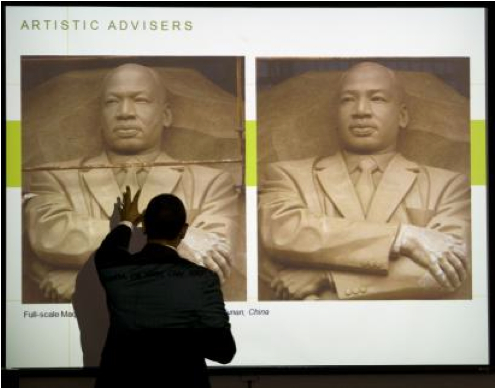
Speaking of the “angry black man” stereotype and the idea that being angry about racism is out-of-line (see point three after the block quote), a statue of Martin Luther King, Jr. commissioned by the U.S. government was considered too angry looking by the U.S. Commission On Fine Arts (see news stories here and here). Its sculptor was required to make him seem less “confrontational” before it was allowed to be installed on the National Mall in Washington D.C.

Via Gawker.

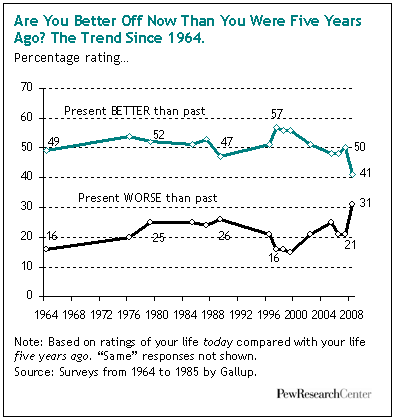
Jay Livingston over at Montclair Socioblog reports on a report by the Pew Center. First this image:

Jay writes:

When Reagan asked this question in the 1980 presidential debates, most people, according to Gallup felt that yes, they were better off – 52% vs. 25% who felt they were worse off. That’s puzzling, considering the apparent success of Reagan’s question – he won the election handily.

The interesting result from the Gallup numbers is that when Reagan left office – after the “Reagan recovery” cherished by anti-tax, anti-regulation conservatives – the numbers were identical. If you look at actual changes in median family income, you see a slight decline in the Carter years and an increase in the Reagan years. But these changes aren’t reflected in how people felt, at least not as measured by Gallup.

This year’s numbers show optimism at its lowest ebb since Gallup started asking the question in 1964. “Better off” still tops “worse off,” but by only 41% to 31%. Even more surprising to me was the proportion of these self-identified middle-class Americans who rate their quality of life as low (five or less on a ten-point scale).


From my hotel room in Gallup, NM: Katie H. sent in this picture of Jessica Simpson in a shirt that says “Real girls eat meat”:

Katie points out that this could be a really interesting contrast to the PETA PSAs using sexualized images of big-breasted blond celebrities to oppose eating meat and wearing fur.

But she also provided a link to PETA’s response to the photo, “Top Five Reasons Only Stupid Girls Brag about Eating Meat.” Note reason #4:

Meat will make you fat. All the saturated fat and cholesterol in chicken wings, pork chops, and steak eventually leads to flabby thighs and love handles. I hope the upcoming “Jessica Simpson’s Intimates” line comes in plus sizes! Going vegetarian is the best way to get slim and stay that way.

Katie pointed out that some of the other reasons play on the idea of attractiveness, too–compassion is “sexy” and the meat industry isn’t “hot.” It’s a very interesting connection between activism on behalf of animals and reinforcing ideals of femininity that focus on being thin and sexy above all else.

Thanks, Katie H.!

This five dollar bill ended up in someone’s pocket in Staten Island.  It reads: “Lets (sic) keep the white house white.”

Point:  Okay, so this means some guy is a real racist a-hole, no doubt. 

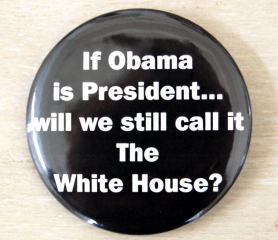
Counterpoint: Um, yeah, but this pin was sold at the Texas Republican Convention last week:

Sigh.

Via Jezebel.

Captain Crab sent in this image (found here) of pubic hair dye:

Here is a link to the betty website. According to the site,

In less than one year, over 100,000 happy customers are using betty to naturally match their hair above, cover gray or just for fun! Whether you’re a blonde (be a true blonde now!), radiant auburn, rich brunette, raven black or want to try hot pink for fun, our easy to use no-drip formula gives you the perfect finishing touch.

These might be useful for a discussion of the ever-increasing standards for personal beauty: once upon a time, you just worried about gray hair on your head. And taking care of things “down there” meant obsessing over odor and controlling evidence of menstruation. Now women get genital plastic surgery and “vaginal rejuvenation” (those sites aren’t work-appropriate) as they age or after childbirth, shave or wax their pubic hair, and apparently can now dye their pubic hair to be sure it doesn’t show signs of aging (or just doesn’t match their hair)–although the betty website FAQ link does mention that men also use the product. I can’t help but suspect that the mainstreaming of porn and increased access (especially online) to images of women’s genitals is providing average women with a new body part to compare to other women and find lacking.

At least the pink seems like something you’d just do for fun, not out of a concern to hide signs of aging. Although maybe there are 50-year-old women out there running around with pink pubes. What do I know?

Thanks, Captain!