Archive: 2008

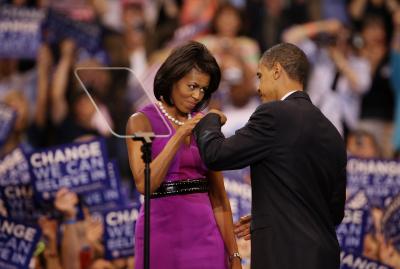
In case you haven’t seen the FOX News commentary in which the host suggests that a fist bump between Obama and his wife is a secret terrorist signal, you can see it here.  (And I thought this was bad.)

Here’s an image of the infamous terrorist signal:
evans-fistbump

NEW! It’s not an image, but Patrice Evans has an interesting essay on the “fist bump heard ’round the world,” arguing we should celebrate National Fist Bump Day.
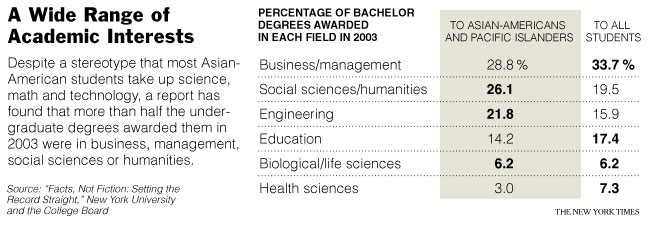
The graph below, from the New York Times, challenges a stereotype about Asian-Americans and their choice of major in college.  The author writes:

The report found that contrary to stereotype, most of the bachelor’s degrees that Asian-Americans and Pacific Islanders received in 2003 were in business, management, social sciences or humanities, not in the STEM fields: science, technology, engineering or math.


The article also discusses the way in which the category “Asian-American/Pacific Islander” makes invisible the dramatic discrepancy between the educational attainments of Asians who’s families immigrated from different places.  For example, they write:

…while most of the nation’s Hmong and Cambodian adults have never finished high school, most Pakistanis and Indians have at least a bachelor’s degree.

The SAT scores of Asian-Americans, it said, like those of other Americans, tend to correlate with the income and educational level of their parents.

And, to a great degree, the success of a given Asian immigrant group in this society is correlated with the wealth of the nation from which they immigrated.


Elizabeth A. at blogofstench sent us her post on this ad for “Disaboom, a site of news, networking and such for people with disabilities and their hangers-on.” 

She notes how the site and the ad challenge the stereotype of disabled people as asexual but, much like Viktoria in Bizarre magazine, does so by conforming to normative standards of attractiveness.  But I really liked her observations regarding the extent of his disability. She writes:

…not only is this guy the picture of modern white bourgeois hegemonic masculinity, but I can’t shake the feeling that he’s also passing as non-disabled. Tattoos aside, he looks like a non-disabled guy sitting down in a chair that just happens to have wheels. While some people indeed use wheelchairs with no back and no handlebars and a low-slung profile, other people with disabilities have much more obvious tools that they use; an electric wheelchair, for example, can have six wheels, headlights and tail lights, a control box with joystick and horn, storage pouches on either side, footrests, leg braces, head rest, reclining seat, adjustable cushions and posture support, a backpack on the back and an obvious computer on board, all of which are much more obvious than a discreet little set of wheels under your butt… I feel that the Disaboom ad downplays the unavoidable obviousness of some mobility aids in its attempt to make the guy in the picture seem more stereotypically “non-disabled.”

Not to mention, I might add, a disability that interferes with urination and defecation or one that caused involuntary body movements.

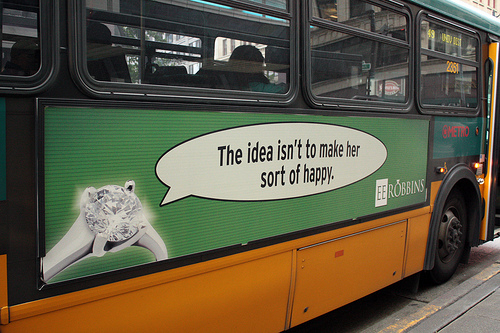
A while ago I posted a set of ads for engagement rings, asking what those ads had to sell you in order to also sell you a diamond ring (see the post here).  Then Miguel sent us the ad below, writing: “This ad is almost too honest.”  Indeed.  Notice that it also supposes that it is the quality of the ring, and not the quality of the groom, that makes a woman happy on the day she says “yes” to marriage.


The relationship between clear skin and sexuality has an interesting history.  In an effort to establish dermatology as a medical subspeciality, aspiring dermatologists strategically linked, in the popular imagination, young women’s acne and lasciviousness.  Doctors argued that acne was a sign of sexual desire or God forbid, masturbation or worse.  Parents worried, then, that this would make their daughters unacceptable marriage partners (at a time when that was disasterous for women) and so would pay a great deal of money to doctors who would promise to cure their daughters of this scarlet dot.  Thus, dermatology was born.

Later, of course, acne became seen as a boy’s issue… But since we had different expectations for boys (in terms of both beauty and sexuality), acne was seen as a “stage” to be endured instead of a “problem” to be cured.  This is more or less like it was when I was a kid in the 1980s.

But today, of course, clear skin is linked to sexual attractiveness, especially for women (thanks, in part, to our friend evolutionary psychology).  And, with dermatologists at their beck and call, upper class teenagers (and adults) no longer have to endure bad skin. Thus, science, sex and skin care seem like natural bed fellows.  Consider this ad:

It’s a subtle threat: “Why not wake up in great skin.” Why would we care?  Who is laying next to you?  Does he know what you look like without make-up?  Without beer goggles?  Without make-up and beer goggles!? And what happens if he finds you disgusting in the bright light of morning?  (This, of course, is a very effective marketing tool because sexual attractiveness is linked to happiness. There is a price to pay for not finding a mate and, we are told over and over and over, that price is very high.)

I also see in the ad a perpetuation of the medicalization of sexual desirability (whether that be “purity” or “beauty”). The “3-step skin care” and “consultation” is a subtle medicalizing and scientizing of the make-up industry.  Lots of make-up companies use the notion of “science” to market their product (i.e., “Prescriptives”) and many of them link this with what is “natural” as well (i.e., Aveda).

Thanks to Jason for sending along the image!

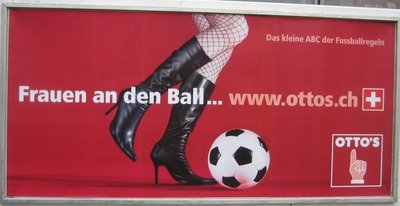
Andrea G. sent this Swiss billboard in after posting about it on her blog:

In her post, she said,

It seems to be related to the the UEFA08 European Soccer Championship which is being hosted here in Switzerland this month. My off-the-cuff translation of “Frauen an den Ball” was “women on the ball”…But when I actually looked closer, I realized that “an” is being used in the accusative, which (in German) implies motion or movement from one place to another rather than fixed location, so the translation is closer to “women coming to the ball”. It turns out if you go to the website advertised, you can download a brochure (pdf) which includes several similar images and a several page summary of the rules of soccer (“das kleine ABC der Fussballregeln” = “the small ABCs of football rules”) apparently targeted towards women to bring them up to speed on the game so they can enjoy the games too. The intro text, which I can’t entirely translate, discusses surprising your man with your knowledge of football so you can talk with him (rather than avoiding the topic as in years past). It certainly seems targeted towards enhancing his pleasure of the games by having an enthusiastic female at his side (rather than a party-pooper who doesn’t care about the games).

Thanks for the post and your encouraging comments, Andrea!

Daniel F. (who has a blog here) sent us this Temptation cookie ad from Mexico, which plays on the idea that men fear independent, strong women:

Daniel’s translation:

Host: Gentlemen, what we feared has happened. You have the new Mexican woman; she is more independent and gives more importance to what she wants.
First man: But, does she cool our beers?
Host: No, never again. And that’s not all. She also wants us to take our children to the pediatrician.
Second man: What’s that?
Host: Pediatrician is the doctor for kids.
Second man: No, the other thing, “children.”
Host: Children are the little people who call us dad.
Third man: And what is that she has in her hand?
Host: This, my friends, is the new Temptation cookie, because the new Mexican woman has her pleasures without guilt and, what’s worse, she doesn’t share.
Woman: Gentlemen, I’m leaving. I have things to do.
Narrator: There’s a new woman and she has new cookies.

The ad also connects sex and food and, in fact, replaces sexual pleasure (and men) with food, a theme Jean Kilbourne mentions in “Killing Us Softly 3”–that women are encouraged to use food to replace sex or console themselves when they have romantic troubles.

It’s also interesting that the ad plays on the idea of old-fashioned Mexican men who expect women to serve them.

Thanks, Daniel!

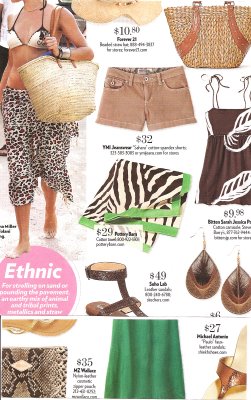
The other day I came upon this fashion spread in a magazine:

I’m not sure which magazine–I want to say Lucky, but I’m not certain. I just scanned in part of it–I cut out a few things that weren’t that interesting so I could get it in a single scan.

Anyway, I noticed it’s called “Ethnic,” and I started thinking about that label, what makes these “ethnic,” and the choice of that word to describe fashion. The most common element to the collection is animal prints–zebra, leopard, snakeskin, croc, peacock feathers. There were a couple of things that I believe were supposed to be recognizable as “African” prints. I guess those brown shorts are “ethnic” because of the material they’re made from.

But why do we call these fashions “ethnic”? Why not “global”? Or “nature,” since the main themes seem to be animal prints and natural fibers? Or “international”? Why do animal prints, feathers, and grass fibers = ethnic?

It made me think about the way that the things that certain groups do or have go unmarked–so here, there is a category of fashion that is “ethnic,” while apparently all other clothing is ethnicity-less. When I carry a woven bag or wear a shirt with tropical-looking leaves on it, I’m being ethnic, but if I put that purse down and pick up a blue leather one, or change into a shirt with a maple leaf on it, I’d stop being ethnic and go back to being…well, presumably plain-old white, the non-ethnic, non-marked category.

I just thought this might be interesting for a discussion about race and which groups are marked as having a race or ethnicity and which ones (in the U.S., primarily whites) are treated as though they do not have a race/ethnicity and thus aren’t relevant to discussions about racial issues. Or maybe when talking about race/ethnicity as a marketing tool, as something you can put on and take off at will.