Archive: 2008

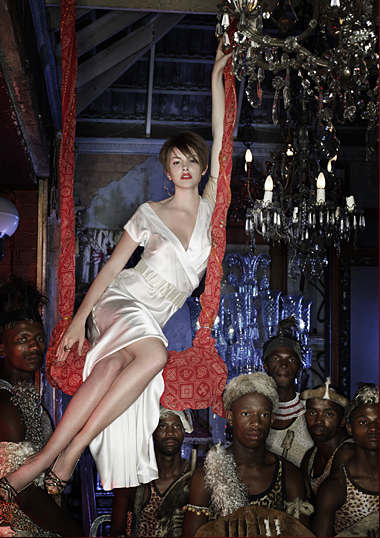
The image below is from the latest episode of Britain’s Next Top Model (image found here).  I would comment, except I just recently wrote almost exactly what I would write for this post here.  You might also want to look here and here and here and also here for historical context.

Dude, we are so not making this stuff up.
Thanks to an anonymous tipster in our comments!  Don’t forget you can always email us tips at socimages@thesocietypages.org.

Lisa Wade, PhD is an Associate Professor at Tulane University. She is the author of American Hookup, a book about college sexual culture; a textbook about gender; and a forthcoming introductory text: Terrible Magnificent Sociology. You can follow her on Twitter and Instagram.

Susanne T. sent in this photo she took at a gym in Bremen, Germany, of two ads for “Multipower Sportsfood,” a sports supplement of some sort:

Susanne writes:

It’s the same product for women and men, but the ad for women says what roughly translates to: ‘This way you look great.’ ‘Eine gute Figur machen’ in German means literally ‘making a good figure’. The ad for men says ‘Strong/powerful tips for your workout.’ Krafttraining means specifically working with weights. And then, of course, the woman looks sexy and flirty and the guy is made to look powerful and in charge. So the same product is supposed to make women look sexy but make men be strong.

Thanks, Suse!

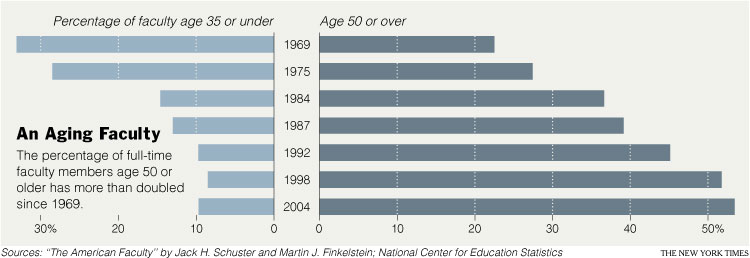
In a New York Times article today, Patricia Cohen describes the changing demographics of the American professoriate. It had two main points:

(1) Profs are WAY OLDER now then they used to be.

(2) The older ones appear to be more liberal than the younger ones, so we can expect academia to be more moderate as the older profs retire. This table shows how “liberal,” “moderate,” and “conservative” professors report being by age and academic field (click to enlarge so you can see it better).

Cohen summarizes this table as follows:

‘Self-described liberals are most common within the ranks of those professors aged 50-64, who were teenagers or young adults in the 1960s,’ they wrote, making up just under 50 percent. At the same time, the youngest group, ages 26 to 35, contains the highest percentage of moderates, some 60 percent, and the lowest percentage of liberals, just under a third.

I’m not sure I buy it.

First, notice that they’re comparing two groups (26-35 and 50-64) and making a claim about a trend instead of a claim about group difference. You can’t do that. Look at the data on the age group between them (36-49), they are all over the place, not neatly sitated between the age groups that sandwich them. (This also points to the always interesting question of how the data looks if you chop up your continuous variables–in this case, age–differently.)

Second, if you stick to group differences, they are comparing the youngest group and the second to oldest group in their data. Why? If you compare the youngest to the oldest group, the data looks a bit different.

Third, their interpretation of the overall “trend”–that is, the average difference across all fields–is obscuring some really interesting variation by subfield! So maybe the overall interpretation works for the social sciences, but wow look at the physical and biological sciences! Again, here we see a choice about reporting that obscures one finding in favor of another. The choice to emphasize averages/means/medians versus ranges/variety has consequences for how we understand our world.

Finally, there is the possibility that what it means to be “liberal,” “moderate,” and “conservative” differs in a systematic way across age groups. The reporter doesn’t address this at all.

There’s are also some really interesting assumptions about what counts as “political” in the article. Cohen points to the fact that quantitative research is somehow thought to be inherently less ideological than pure theory or qualitative research. And she quotes Marxist sociologist Erik Olin Wright saying: “in the late ’60s and ’70s, the Marxist impulse was central for those interested in social justice.” “Now,” Cohen adds, “it resides at the margins.” But it seems to me that it is Cohen who is assuming that quantitative research isn’t justice-oriented. Her example of a not-so-politicized younger professor is Sara Goldrick-Rab, also a sociologist, who says, “My generation is not so ideologically driven.” But whose projects, detailed in the story, include college opportunities for low-income students and the way that welfare reform decreased college attendance by the poor. Goldrick-Rab also complains about the lack of support for women academics who are also mothers. Those all sound damn political to me. But Cohen writes, partially quoting Goldrick-Rab: “They [older professors] want to question values and norms; ‘we [younger professors] are more driven by data.’ ” In this sentence, Cohen puts values and data on opposite ends of a spectrum. (It’s also interesting how she opposes Goldrick-Rab’s quote to her own words, we have no idea what Goldrick-Rab meant to oppose to being data-driven.)

I am troubled by the reproduction of the binary between “objective” and “normative” “science.”

I love, however, seeing the places and people of my alma mater described! Go Wisconsin!!!

I don’t know how “real” any of this is, but this what I’ve been able to collect on this matter…

If you are connected to the internets, you have probably heard these messages left on some unsuspecting woman’s answering machine.

The messages have been attributed to Dmitri the Lover, a professional seducer of women and teacher of seducers of women. Here is a screen shot of his wholly misogynistic website:

Here, too, is a news article detailing how he lost his medical license due to inappropriate sexual advances and has been accused of rape many times ‘n other great stuff.

Thanks to Jason S., Brett W., and CoRri V. for the links and info!

NEW!  Still at it, a reader alerted us to Dmitri’s “meeting” this January:

THERE IS ONLY ONE OPPORTUNITY EACH YEAR FOR HORNY MEN TO SEDUCE WOMEN THIS INSECURE, GROSSLY UNDERFUCKED, AND HIGHLY IMPRESSIONABLE.

More (his emphasis):

As a MEDICAL DOCTOR, Dimitri The Lover is extremely cognizant of the fact that studies have show over 60% of women worldwide suffer from a psychological disorder at some time during their lives.  In Canada’s northern climate, January is the worst month of the year for psychological symptoms, primarily because a decrease in the level of sunlight and shortened hours of daylight cause “Seasonal Affective Disorder”.  Exacerbated by both the post-holiday psychological letdown from unrealistically high pre-holiday expectations, and the effects of alcohol withdrawal on the neural pathways, this condition causes many women to fall into a MILD REACTIVE DEPRESSION.  Therefore, these once proud sluts become insecure and begin to doubt the value of their existing relationships, which even in the best of times are just barely adequate to meet their psychosexual needs.

Culture-sharing, of course, is nothing new. But with new forms of media, they are intensified and, increasingly, we get to see what “they” do with “our” art forms. Jenelle N. sent in this fascinating music video of artists in Bulgaria appropriating American hip hop and, correspondingly, elements of “Black” culture (highly produced and largely invented by music executives) and blending it with more “indigenous” art forms (please do note all of my scarequotes).

This duet is, as Jenelle explains, “between two of Bulgaria’s hottest chalga performers, Azis and Malina called Iskam, Iskam (I Want, I Want).”

[youtube]https://www.youtube.com/watch?v=Z_uHa8gTyxU[/youtube]

See also the Google sari.

Lisa Wade, PhD is an Associate Professor at Tulane University. She is the author of American Hookup, a book about college sexual culture; a textbook about gender; and a forthcoming introductory text: Terrible Magnificent Sociology. You can follow her on Twitter and Instagram.
Thanks to Daniel G. for sending this in!

In a recent post I discussed ways in which companies market beauty products to men, who traditionally aren’t supposed to worry about things like their pores. Here are a couple more examples.

Axe has a body scrubber for men (pointed out by akamarkman):

To differentiate it from girly body scrubbers, it’s called the Axe Detailer Shower ToolAxe Shower Scrub (or body wash, if you’re female) comes in varieties including Snake Peel, Skin Contact, and Glacier Water (scroll a little less than halfway down to see the varieties).

Here is an ad for the Detailer Shower Tool that shows a man being treated like a car in a car wash (cleaned by futuristically-attired women):

Gillette 2-in-1 Body Wash helps men prevent skin dehydration. And that helps them get hot girls at work:

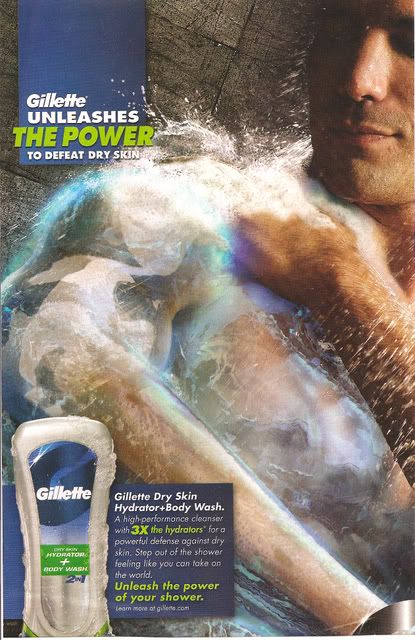
This Gillette ad tells men to unleash “power” to “defeat dry skin:

Notice how buff he is. We also learn that this body wash is a “hydrator” (not a moisturizer) and that it’s “high-performance” to provde a “powerful defense” that leaves you with the sense you “can take on the world.” So macho!

Andrew F. sent in a link to a post at DirectDaily about the Axe Schedule ad. In it, we see that a set of dorm rooms is overlaid with a calendar, the idea being that you get a different girl each day:

preview_600_424


Gwen Sharp is an associate professor of sociology at Nevada State College. You can follow her on Twitter at @gwensharpnv.

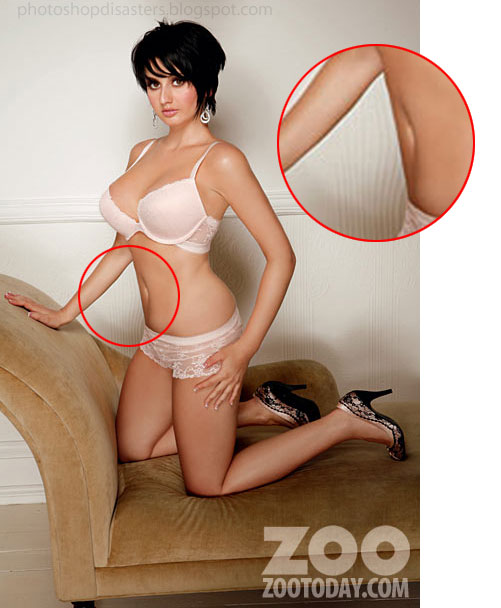
Look for how the striation on the wall bends in towards her belly where they thinned her midsection:

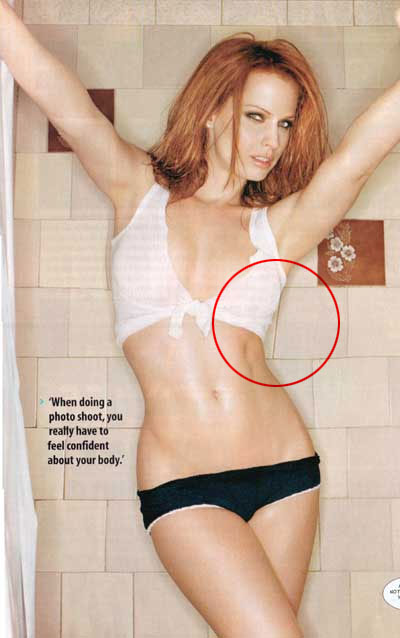
Like in the above photo, here the square tiles in the wall are warped, reflecting where they tapered her waist:

Check out the shadow to see her pre-photoshop profile:

These women are, of course, genuinely thin.  Much photoshopping isn’t about correcting “faults” (like a blemish), it’s about creating an unrealistic image.  These images remind me of Gwen’s post on the “fat” supermodel, Karolina Kurkova.  Kurkova is still incredibly thin!  The problem is that her body is betraying its humanness.  Like in the image above, where her body (god forbid) reacts to the string squeezing her midsection, Kurkova’s body reacts to the way she is moving it (with the squishing of her mid-back and buttocks).  There is no amount of thinness that will make you not human, but this is what we’re supposed to be aiming for.  And, if we get there, we’re not supposed to look skinny!  You might remember this photoshop example in which bones protruding from Cameron Diaz’s body are photoshopped out to make her thinness look more “healthy.”  So it’s not enough to rid yourself of the fat part of you, now they are ridding us of our very skeletons with photoshop. 

In Unbearable Weight, Susan Bordo argues that compulsory thinness for women isn’t just a standard of beauty, it’s literally about making women less.  How much of us do they want to get rid of?

All three found at Photoshop Disasters.