Archive: 2008

Only recently in U.S. culture have rigid and narrow beauty standards for women extended to their vulvas. With the ascendance of cosmetic surgery (and its profits), marketing (and its effectiveness), and the visibility of pornography (and its mainstreaming), there is now cultural pressure on women to have the perfect vulva (see here and here).  This post shows before and after pictures of labiaplasty. 

When teaching about this phenomenon, I find that my students balk at the idea that there isn’t, in fact, a “normal” vulva.  They are incredulous that vulvas would vary.  This incredulity is somewhat understandable.  If the women are heterosexual, they are unlikely to have seen many, or any, other than their own (and likely not even their own).  Gay men are in a similar predicament.   Gay women and straight men, being so young, are also unlikely to have seen many.   In any case, showing them that vulvas do, in fact, vary is helpful. 

The image after the jump is an art project (image found here).  The artist cast women’s vulvas, so what you will see is 28 plaster vulvas made from molds.   The image is after the jump because it is not safe for work… not likely, frankly, safe for home either!  But it surely does make the point.
more...

One topic we cover in my sociology classes is the way the nature vs. nurture debate treats those two categories as though they are completely separate entities: “nature” is this fixed biological reality and “nurture” is all the social stuff we use to tinker around with nature as best we can. I point out to students that biology isn’t as fixed as we often think it is, and that seemingly “natural” processes are in fact often highly influenced by social factors.

One good example of this is the age at which girls have their first periods (menarche). In the U.S. today, the average age at menarche is a little over 12 years (see source here), and that seems normal to us. But historically, this is odd; until quite recently, girls did not begin menstruating until well into their teens. Because girls have to develop a certain amount of body fat in order to menstruate, access to food affects age at menarche. And access to food is generally an indicator of all types of social factors, including societal wealth and the distribution of wealth within groups. In general, economic development increases access to sufficient levels of food, and thus reduces average age at menarche.

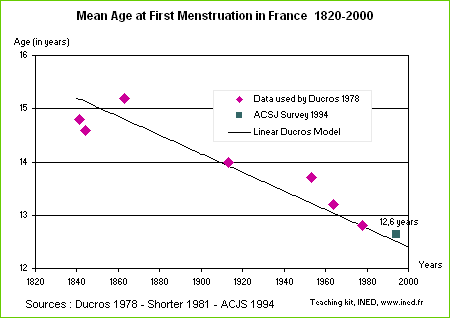
This graph of average age at menarche in France from 1840-2000 (found on the French National Institute for Demographic Studies website here) shows a clear decline, starting at over 15 years and now standing at under 13:

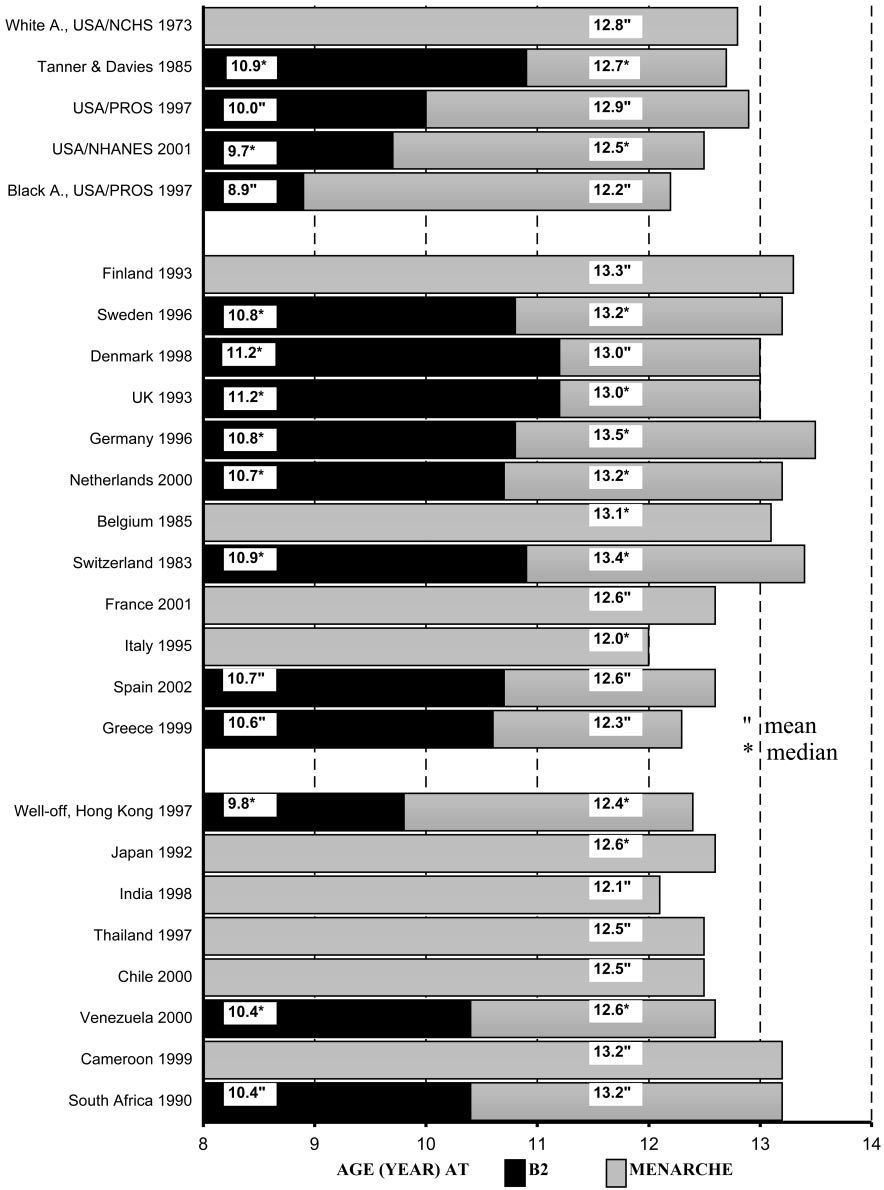
Below is a bar graph showing average age at menarche for a number of countries (found here; age at menarche is the grey bar); we see the oldest average age is 13 and a half years, in Germany. Note that the data are not all from the same year, and while most report mean age at menarche, some report median age, so though they show a general trend, they are not stricly comparable:

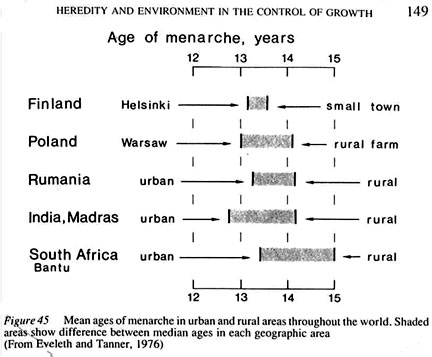
However, these average ages obscure the fact that access to resources is not equal within nations, and as we would expect, though average age at menarche has fallen for most nations over the past century, we continue to see differences in average age among groups within nations that seem to mirror differences in wealth. For instance, this graph (found at the Museum of Menstruation website here) shows differences in average age at menarche between urban and rural areas in several countries:

The example of the quite dramatic fall in average age at menarche, as well as continued differences within societies, is a very helpful example for getting across the idea that biology is not fixed. I explain to my students that though we have many biological processes (i.e., the ability to menstruate), social factors such as economic development and social inequality affect how many of those processes are expressed (i.e., how early girls being to menstruate, on average). For other examples of how social factors affect biology, see this post on average lifespan and this post on increases in height over time.

I’m currently pairing these images with the chapters “The Body’s New Timetable: How the Life Course of American Girls Has Changed” and “Sanitizing Puberty: The American Way to Menstruate” from The Body Project: An Intimate History of American Girls, by Joan Jacobs Brumberg (1997, NY: Vintage Books) in my women’s studies course. Brumberg argues that the decreasing age of menstruation has created new social pressures as there is an increasing gap between girls’ biological maturity (that is, being able to get pregnant at age 12 or so) and their mental and emotional maturity (they’re still 12 year old girls), a point activists were trying to make in these misguided PSAs about statutory rape. Brumberg argues that just as this was happening, American cultural understandings of menstruation turned it into a hygiene problem, not a maturational milestone, meaning we give girls information about tampons and sanitary pads but not much about what these changes really mean.

Just for fun, here is “The Story of Menstruation,” an animated cartoon put out by the Disney company in 1946. Millions of girls learned about menstruation from it in the ensuing decades, including that they could throwing their schedules off by getting too emotional or cold and that it’s ok to bathe as long as the water isn’t too hot or cold. It illustrates Brumberg’s point about how discusses of menstruation turned to scientific explanations of what was happening and advice about what was and wasn’t ok to do while menstruating, while mostly ignoring it’s emotional or social significance.

I also like the explanation at the beginning of why we refer to “Mother” nature–because she does all her work without anyone even noticing, just like moms. How nice.

Ben O. sent in this picture from the store Wet Seal:

As Ben says,

…as long as your body is between XS and XL, or no larger than size 15.  (For non-US readers, that’s a waist of no more than about 75cm.)

This might be useful for a discussion of which groups are made invisible in our society (who isn’t part of “everybody”), as well as the more obvious issues of the arbitrary division of clothing into “normal” and “plus” sizes.

Thanks, Ben!

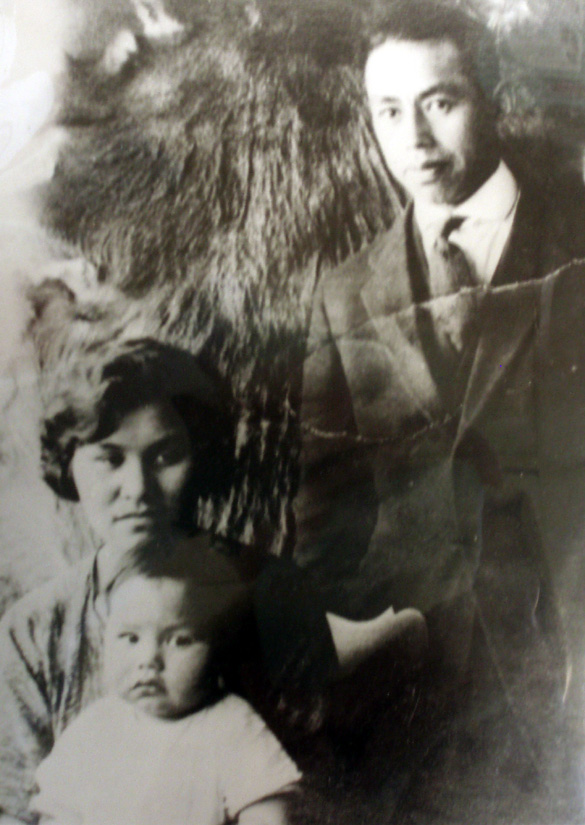
Kay W. took these images in a museum in Sitka, Alaska.   This is David P. Howard, an Alaskan Native, and his family in 1917 (or so).  Notice how Howard and his family appear to have shed every possible sign of “native-ness” in this picture.  The conquest of American Indians was achieved, in part, through forced and coerced assimilation (see this post on American Indian boarding schools in Canada).

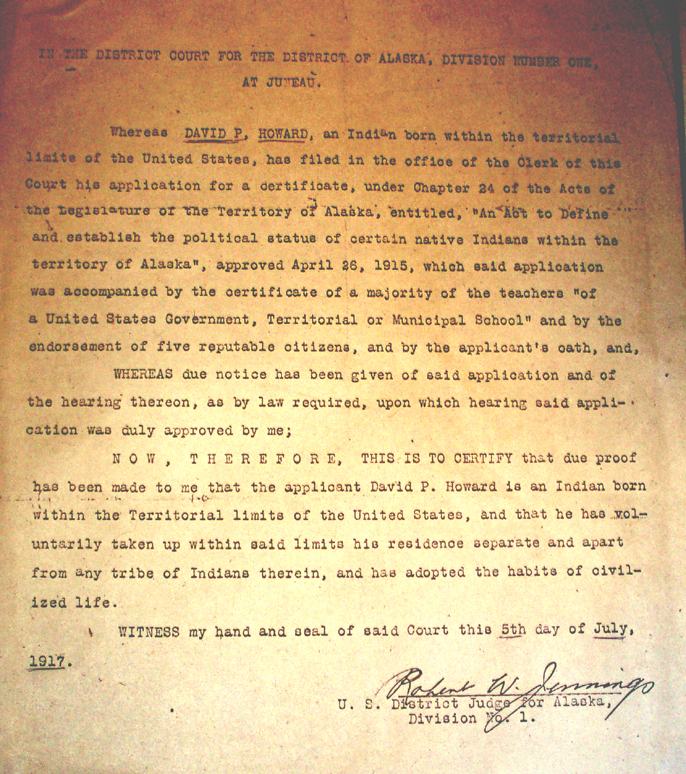
The family had to appear assimilated because Howard was seeking U.S. citizenship and citizenship was contingent on Howard abandoning his “Indian” ways.  The document below testifies to Howard’s assimilation.  The last paragraph reads:

NOW, THEREFORE, THIS IS TO CERTIFY that due proof has been made to me that the applicant David P. Howard is an Indian born within the Territorial limits of the United States, and that he has voluntarily taken up within said limits his residence separate and apart from any tribe of Indians therein, and has adopted the habits of civilized life.

You might want to use it for a discussion of the forced assimilation of American Indians in particular, of course (as well as the insanity of the fact that they would have to petition to be a part of the nation existing on their own land; American Indians did not become citizens until 1924), but also for a more general conversation about how immigrants to the U.S., including European immigrants, were required to adapt themselves to certain standards of middle-class White American society in order to be welcomed into full social, as well as legal, citizenship (and clearly non-Whites often found that even assimilation to White middle-class norms wasn’t enough, though it worked for the Italians, Irish, Polish, and other European ethnic groups, who no longer differ on any important social indicators from Whites of Northern or Western European origin).

In a related example, see this cartoon mocking German attempts at assimilation during World War I.

Lisa Wade, PhD is an Associate Professor at Tulane University. She is the author of American Hookup, a book about college sexual culture; a textbook about gender; and a forthcoming introductory text: Terrible Magnificent Sociology. You can follow her on Twitter and Instagram.

I recently heard that Marlboros were originally marketed to women.  Amy L. sent in these examples from the 1950s (found here).  She writes:

Notice how “in one picture the baby actually asks mom to have a cigarette instead of scolding him. It plays up the women-as-hysterical stereotype and also shows changing expectations about good motherhood.”

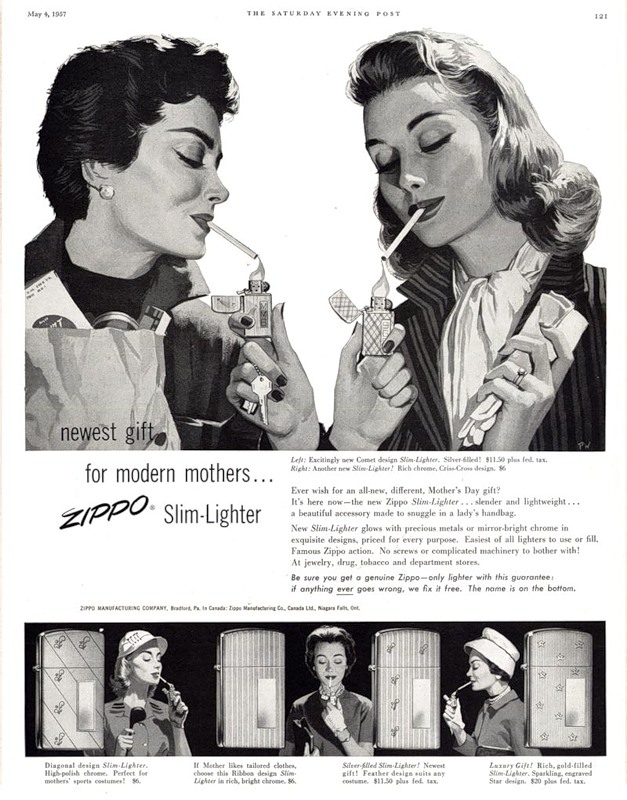
NEW! Vintage Ads featured this 1957 ad suggesting that a Zippo Slim-Lighter is the perfect gift for a modern mother:

0_28f57_acb78a49_XL

This website contains links to a lot of Census Bureau maps showing where different racial and ethnic groups (including White ethnics) are concentrated in the U.S. They also have “absence of” maps showing counties with less than 25 people from different racial grops, which are fascinating. They’re all available from the Census, but it’s nice to have them all collected here for easy access and comparison.

Thanks to Kelly V. for pointing it out!

Angela B. brought our attention to an animated map showing, over the space of some seconds, the growth of Walmart across the United States from 1962 to 2007.  Below is the final image.  It’s worth a click to watch the growth yourself.

Many believe that all women involved in prostitution are desperate for rescue and that being rescued always and inevitably leads to a better life for women and their families.  Myra M. F. sent us a link to this poster, made by brothel workers in Thailand, begs for an end to attempts to rescue them. Laura Agustin, who took this picture (and blogged about it here), writes:

This poster comes from the EMPOWER centre in Chiang Mai, Thailand, where brothel workers gathered to discuss recent raids and rescue operations. On the left they have written a list of reasons why they do not wish to be rescued by police, ngo or charity workers.

The text (as transcribed by Agustin):

• We lose our savings and our belongings.
• We are locked up.
• We are interrogated by many people.
• They force us to be witnesses.
• We are held until the court case.
• We are held till deportation.
• We are forced re-training.
• We are not given compensation by anybody.
• Our family must borrow money to survive while we wait.
• Our family is in a panic.
• We are anxious for our family.
• Strangers visit our village telling people about us.
• The village and the soldiers cause our family problems.
• Our family has to pay ‘fines’ or bribes to the soldiers.
• We are sent home.
• Military abuses and no work continues at home.
• My family has a debt.
• We must find a way back to Thailand to start again.

Many activists in the U.S. similarly argue that the policing of prostitution, ostensibly to “protect” women,” serves to criminalize them (and not so much their johns) and ultimately makes their lives more difficult and dangerous than they would be otherwise. (See, for example, Call Off Your Old Tired Ethics or COYOTE.)

See also posters against the criminalization of prostitution.