
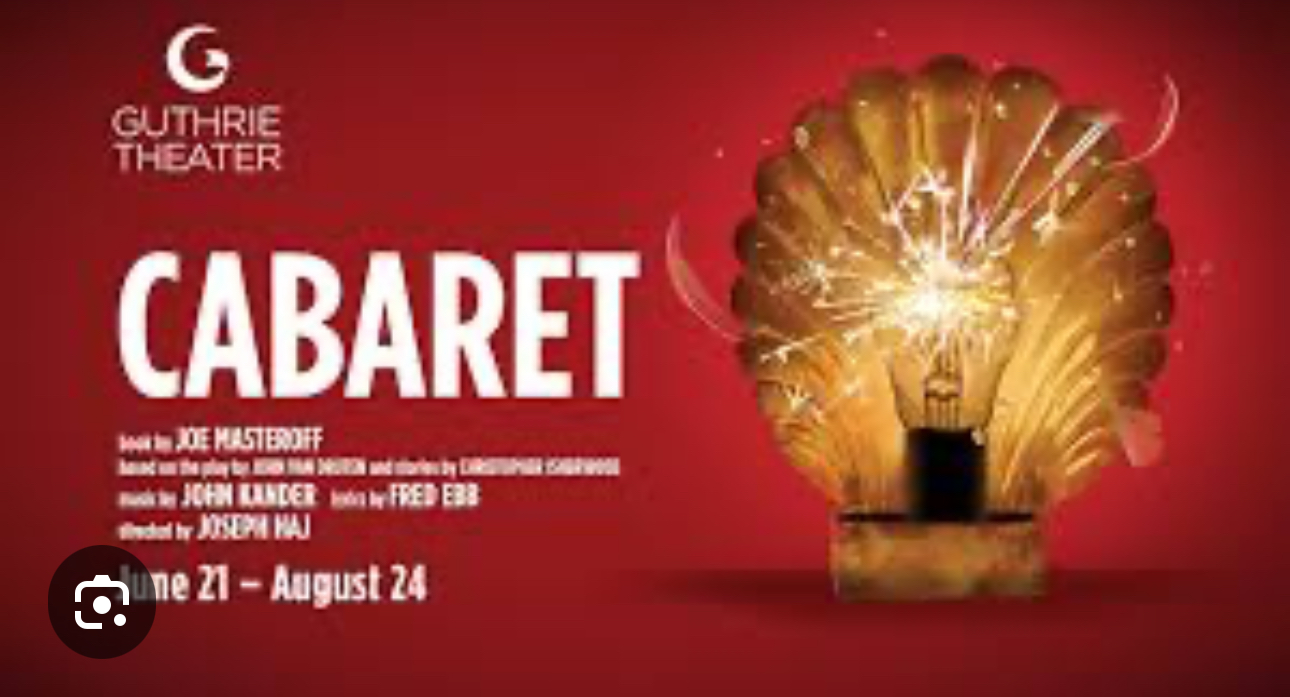
(This post contains spoilers for Cabaret.)
Following a co-hosted symposium on the Weimar Republic, the Guthrie generously invited the Center for Holocaust and Genocide Studies to attend a performance of Cabaret. We went last weekend, and it was simply exceptional. If you stop reading here, or take nothing else away from this post, see the show!
—
Act I. The play opens. “Wilkommen.” Soft chugging of a train as Cliff arrives in Berlin.
Act I of Cabaret is everything a real cabaret should be: decadent, sultry, and dazzlingly hedonistic. It is a modernized—and more carnal—version of Lautrec’s famed portraits of gaudy nightlife, but recontextualized through the sort of Brechtian self-awareness made possible by good directing. However, this illusion of the perfect cabaret splinters at the end of the act, when the Emcee recoils in horror as their gramophone begins playing an eerie and increasingly disconcerting “Tomorrow Belongs to Me.” As an audience, we sense a change; we just don’t know what it is yet.
Sounds of a train, growing louder, intermingle with the ghoulish lilt of the gramophone.
Director Joseph Haj reinforces the thematic division between Acts I and II by moving the intermission from its usual placement* amid the darker part of the show forward, to follow immediately after “Tomorrow Belongs to Me.” This change punctuated the final moment of Act I and intensified the descent into darkness that defines the rest of the show.
Before this moment, the audience is given no hint of what is to come. As Cliff states at the very end of the show, “It was the end of the world, and I was dancing with Sally Bowles, and we were both asleep.” So too is the audience: asleep. Blissfully, and deliberately unaware of what lies ahead. In this asleep-ness, the audience becomes complicit in the events that follow. It is Haj’s intentional and unflinching focus on this complicity that makes his production of Cabaret such a powerful portrayal of the years preceding World War II and the Holocaust.
Act II. The train whistle grows louder. All eeriness from the end of Act I is gone, replaced by an almost mechanical normality.
Guests gather for Fraulein Schneider’s (gentile) and Herr Schultz’s (Jewish) engagement party. One of the guests removes his coat to reveal a swastika armband (at this point, there was an audible collective gasp from the audience; in theater, as in “real” life, we can lull ourselves into believing that somehow the story ends differently this time). As the party guests grow uneasy, he begins to leave, but a woman persuades him to stay and begins singing a passionate rendition of a nationalist folk song (“Tomorrow Belongs to Me” (reprise)). The other guests join in, one by one, leaving the hosts, along with Cliff and Sally, stunned to discover what their neighbors believe–or, at least, the individuals and ideologies they follow without question.
A new scene. The train is careening toward us now. The Emcee, dressed in leather and buckles, dons two glittering swastika armbands. The Kit Kat Klub dancers join and form a kick line– a grotesque spectacle that mocks the absurdity of Hitler and the Nazi party. (Unlike The Producers, I find Cabaret to be uniquely equipped to grapple with something deeper: the true tragedy and human cost of fascist ideology and hate.)
The ability to relay this ridiculousness without making light of the subject depends on a capacity to convey tragedy, making it essential that the production communicate the true devastation of the Holocaust. The final scene did so brutally, beautifully, and without compromise.
The Emcee’s role in Cabaret’s messaging is immense. In the original 1966 Broadway production, Joel Grey’s Emcee “represented the city of Berlin itself, their malevolence most obvious in the dark conclusion” (Blum 2024). However, the 1993 London and 1998 Broadway revivals shifted away from portraying the Emcee as a perpetrator.** While there have been many interpretations of the Emcee since, this production returned to portraying the Emcee as a victim. Part of the production’s emotional power lies in Haj’s decision to reclaim this version of the Emcee– one that underscores the tragedy and loss at the heart of the story.
In the final scene, the Emcee drops their train conductor’s coat and removes a wig to reveal cropped hair and a striped prisoner’s uniform—the kind worn in concentration camps. They bear a striking resemblance to the famous photographs of Czesława Kwoka, a fourteen-year-old Polish girl murdered at Auschwitz. Still performing a cabaret song, the Emcee grows more frenzied by the minute. The lights go dark. When they come up, everything else has vanished: the performers, the band, the props– even the lights themselves. The dim, sparkling glow of the cabaret has been replaced by a stark white light. It is cold and clinical. The illusion has lifted, replaced by the brutal clarity of reality. Was any of it real? Or was the entire performance imagined– an invention of the Emcee’s mind as they performed for fellow prisoners in the camp? Maybe it doesn’t matter.
Part of the set transforms into train cars. The cast returns, clutching small suitcases, and silently takes their places inside. The doors slam shut with a terrible finality. Blinding white lights shine through the cars and flood the audience. Lights out. The train leaves the station.
The lights come back up for bows, and the accompanying jaunty cabaret music is grating. It is harsh after the vulnerability and violence of the previous scene. The message is loud and clear. As Joseph Haj stated in one interview: “Cabaret reflects a society that is determined to dance as fast as it can, to keep the lights twirling as long as possible, to turn the volume up as loud as possible, to keep from seeing the train that is thundering toward them.”
–
*For theatre nerds, this was between “Tomorrow Belongs to Me (Reprise)” and “Kick Line.”
**As many people know, the lines between perpetrator/victim/bystander are often blurry, and at times, nonexistent– but this is not the focus of Cabaret.
Sources:
Gillian Blum, “Cabaret 2024 Musical Ending Explained”, The Direct, June 29, 2024.
URL: https://thedirect.com/article/cabaret-2024-musical-ending-explained
Kyra Layman is a recent graduate of Macalester College and is excited to be working with CHGS this summer. She believes that Holocaust and genocide education is more important now than ever and is honored to be assisting the Center in supporting educators and developing genocide education curriculum. Her areas of academic study primarily center on individual and collective resistance in mass atrocities, altruism amidst genocide, and the use of collective memory in transitional justice efforts. In addition to her academic work, she is active in the theatre world and weaves her interests together wherever possible.
Comments