The Stonewall Monument is situated in the heart of Greenwich Village in Lower Manhattan. The 7-acre site preserves the location of the 1969 Stonewall Riots, a pivotal moment in the LGBT rights movement and American history, when the NYPD raided the Stonewall Bar, a popular gay bar, setting off days of protesting that were violently suppressed by the police. In 2016, President Obama formally declared the area a National Monument. The next year, the site was the first National Monument to fly a rainbow flag.
Days after taking office for his second term, President Trump issued Executive Order 14168, or Defending Women from Gender Ideology Extremism and Restoring Biological Truth to the Federal Government. Among the consequences of Executive Order 14168, many of the references to LGBT identity were stripped from the Stonewall website. On February 9, 2026, the rainbow flag at Stonewall was also removed, a public and visible testament to the continual erasure of what the Administration has labeled “corrosive ideology.”
What is “corrosive ideology”? In March 2025, Executive Order 14253, or Restoring Truth and Sanity to American History, was signed by President Trump. It described “corrosive ideology” as any “descriptions, depictions, or other content that inappropriately disparage Americans past or living (including persons living in colonial times), and instead focus on the greatness of the achievements and progress of the American people or, with respect to natural features, the beauty, abundance, and grandeur of the American landscape.”
Executive Order 14253 has given the Department of the Interior the ability to functionally censor plaques, signs, and sites across the country, in most cases minimizing or even erasing the contributions of many historically marginalized groups. In his book Erasing History, Jason Stanley points to the revision of the historical record as a hallmark of an authoritarian regime, as it strengthens state power by disconnecting citizens from understanding the historic struggle for rights.
In the year since Trump issued his executive orders, several groups have filed lawsuits against the changes. Still others are working tirelessly to preserve these signs into the future. One of these projects, Save Our Signs, is based here at the University of Minnesota. I talked with one of the project leads, Jenny McBurney, about the project and its aims.
Why is preserving these signs so important?
The National Park Service (NPS) has been called “America’s largest classroom,” and its purpose is to preserve historic and geographically important locations for the education and enjoyment of the American public. Educational signs, interpretive panels, and exhibits at National Park sites help to tell visitors the story of that place and why it is important to our shared history. These signs are often the result of years of dedicated work by park rangers, community members, and historians. Plus, they are paid for by our tax dollars – this information should stay in the public’s hands. National Park signs aren’t necessarily perfect, and it’s normal to update their content over time as we learn about the history and science behind particular sites. But this work should be done at individual parks by experts and community members working in collaboration, not as an ideologically-driven federal mandate to scrub uncomfortable truths from our history across the board. This is why Save Our Signs is asking the public to visit National Parks, take photos of any signs they see, and submit them to our project at SaveOurSigns.org. Together, we can preserve a snapshot of what the parks look like today, and help us track ongoing removals in our parks.
What has been the response to Save Our Signs?
We have had such an overwhelmingly positive response! It’s been really wonderful. We have received over 13,000 photos across over 400 NPS sites so far, and we are continuing to collect photographs. We have also heard from people all over the country that they appreciate this work, and that they want to help to preserve our history and scientific knowledge for future generations. One of the bright spots in all of this has been getting to connect with and learn from people from all walks of life. It’s clear that so many people care deeply about our National Parks.
What are some of the trends you’ve seen in removed signs? Are there some themes that are more common than others?
The main targets so far have been content relating to slavery, Indigenous people, and climate change.
One of the biggest sites of censorship has been at Independence National Historical Park in Philadelphia. The President’s House: Freedom and Slavery in the Making of a New Nation is an open-air exhibit in that park that sits at the location of the presidential mansion that Presidents Washington and Adams lived in between 1790 to 1800, while Washington DC was not yet built. The President’s House exhibit tells the stories of the nine people who were enslaved by George Washington and worked in that house. The site was created in 2010 after advocacy from local activists. The site is a powerful and moving exhibit that forces visitors to confront the dissonance of slavery and freedom during the founding era of this country. But on January 22, 2026, every interpretive panel at the President’s House site was removed. Local activists stepped up and filed a lawsuit, and a few of the panels have since been restored, but the future of the site is still uncertain.
Beyond the President’s House, other signs and displays about slavery have been removed from the Virgin Islands National Park, while others describing historical injustices and harms against Indigenous people have been removed from Grand Canyon National Park, Grand Teton National Park, and Muir Woods National Monument.
Additionally, signs and exhibits about climate change have been removed from Muir Woods National Monument, Acadia National Park in Maine, Fort Sumter and Fort Moultrie National Historical Park, Glacier National Park, and Gateway National Recreation Area in New York City.
Other content relating to Japanese internment camps, Civil Rights Era events, and other topics has been ordered to be removed from more parks. We have a comprehensive removal tracker available at https://z.umn.edu/removedNPSsigns.
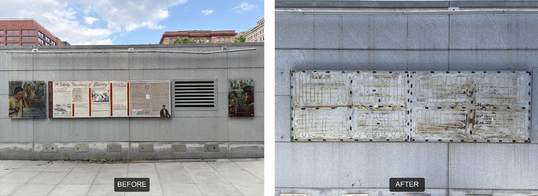
Submitted to the Save Our Signs project
Have you noticed many in Minnesota?
We are not aware of any signs that have been removed at NPS sites in Minnesota.
You’re probably still very much in the collecting phase, but have you thought about the long-term use of the collection?
Yes! All photos that have been submitted to the Save Our Signs Archive, or SOS Archive, are in the public domain. We include this question as part of the submission process because it was really important to us that these photos would be publicly available and free to reuse by anyone. This information is supposed to be for the people, so these photographs are a way to help keep this information public. We hope that people will take these photos and reuse them in creative ways, maybe for an art project or a local effort to share the story of a particular NPS site.
On our end, we continue to collect photos, and our work is not yet done. We are currently working on an updated database on the backend, which will enable us to publish photos much more quickly after volunteers submit them. We hope to have that new process up and running soon.
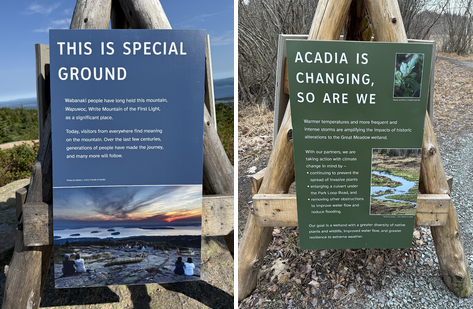
Submitted to Save Our Signs
One of the really interesting parts of the project is its grassroots approach to collection. How can people contribute to it?
This project would not be possible without volunteers from all over the country who visit the parks, or look at their vacation photos, and find photos to submit to the SOS Archive. We are so incredibly grateful for every person helping to preserve our history and scientific knowledge!
We are currently looking for three types of photos. First, we still need more photos of signs at NPS sites. On our website, we have a map and a spreadsheet that show where we still need photos and how many we already have. We hope that folks will visit the NPS sites where we only have a few photos, or no photos at all, and help make sure that we have photographs of every single sign, no matter the topic. We’ve even seen videos posted online of people using the SOS Archive on their phones while they walk around a park to see if we are missing any signs, and then taking photos for us to add to the collection.
Second, we are now also asking for people to submit photos of censored signs. This might be a blank space where a sign used to be, or a picture of a sign that has been altered in some way to comply with Executive Order 14253. We want to be able to show the public before-and-after photos of censored signs.
Third, we also invite submissions of creative resistance, such as art that is a clear act of protest at an NPS site. For example, at the President’s House site, when the panels were removed, the community taped up paper signs saying things like “History was real” and “Tell the truth” on top of the blank spaces where the panels had been. We believe that this type of community pushback is an important part of the story of this effort to censor our National Parks.
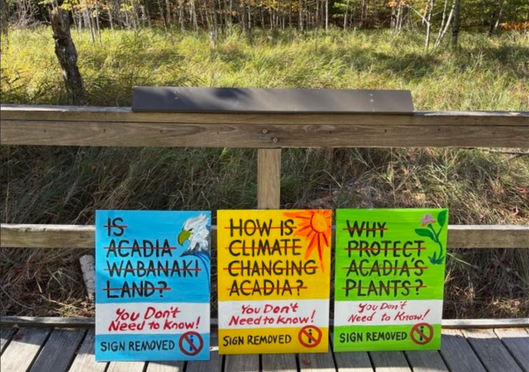
Submitted to Save Our Signs
We’re both in Minneapolis and living through a time that’s been scary for many Minnesotans, many of whom have taken to creating public art that speaks to the fear, anger, and anxiety many people are facing. Is that something you’ve considered adding to the collection?
We have had discussions about how this crowdsourcing model could be reused and modified to collect public art in Minnesota. But we’re just a small team with limited capacity. We encourage anyone else who is interested in taking on a project like this to do so. We already have one sister project – the Citizen Historians for the Smithsonian (https://www.citizenhistorians.org/). They are a wonderful group of folks who documented all the exhibits at the Smithsonian museums with photographs in a similar project. We talked with them while they were getting their project off the ground, and have continued to support each other since then, such as through advertising each other’s projects on our respective websites. We welcome and encourage other sister projects, and we would be happy to consult with you to get you started!
More broadly, how has being in Minnesota shaped this work?
Living in Minnesota during this federal occupation has impacted our work with Save Our Signs in direct and indirect ways. The majority of our team is based here in the Twin Cities. At a minimum, the federal occupation and horrific murders and abductions have made it incredibly hard to just function on a day-to-day basis. Especially in early January, right after Renee Good was killed by ICE agents, many of us felt overwhelmed and scared. Our children’s daycares and schools were closed, and businesses across the cities were shuttered. It was hard to focus on anything, let alone the SOS project. But indirectly as well, it can be hard to remember why this work is important. What does it matter if a sign at a National Park is removed when our neighbors are dying and disappearing?
Then, throughout January and February, we saw more signs and displays removed from National Parks around the country. The focus on censoring uncomfortable truths about slavery, in particular, was highlighted by the removals at the President’s House on January 22. Two days later, Alex Pretti was killed by ICE agents in Minneapolis, and we were told by the federal government not to believe the truth we saw with our own eyes. More educational signs at National Parks across the country continued to be removed into February. These events are not directly related, but they have a thread in common: the suppression of documentation and an effort by the federal government to control the narrative, no matter the cost.
At National Parks, the current administration is attempting to erase documentation of past injustices and atrocities. At the same time, in our city streets, the administration is trying to stop people from recording evidence of current injustices and atrocities happening each day to our immigrant friends, family members, and neighbors.
So, even when it feels hard, our team has decided to continue our work as best we can, with a renewed sense of purpose. We will continue to collect photographs to preserve our National Park signs and make them accessible to the public. We will also collect photographs of the people’s resistance to censorship in our National Parks, as well as evidence of the blank spaces where signs used to stand. And we will track these removals publicly, and share what we know, to ensure that this censorship is not allowed to happen in the dark. Instead, this censorship must happen in broad daylight, so we can all judge it and start our own conversations with our neighbors: whose history should be told, and how?
Joe Eggers is the Interim Director of CHGS
Comments