While growing up in Germany in the 1960s and 1970s, being evangelisch meant above all that you were not katholisch and therefore had to wait five years longer for your Confirmation presents. This was a little annoying, but in hindsight, it may qualify as my first encounter with the inner-worldly asceticism that Max Weber describes in The Protestant Ethic and The Spirit of Capitalism. Delayed gratification aside, the German evangelical church at the time came across as benign, even reasonable, open to critical discussion and staffed with laid-back, progressive pastors. It was the seventies after all. Nobody would have spelled evangelical with a capital “E” back then, at least not in Europe. That Protestantism in the US could take on a very different flavor didn’t occur to me until I moved to California in the early 2000s and it was my daughter’s turn for Confirmation class. There was a lot about Satan in the curriculum and all the things you could go to hell for, like not showing up for class at Bethany Lutheran Church.
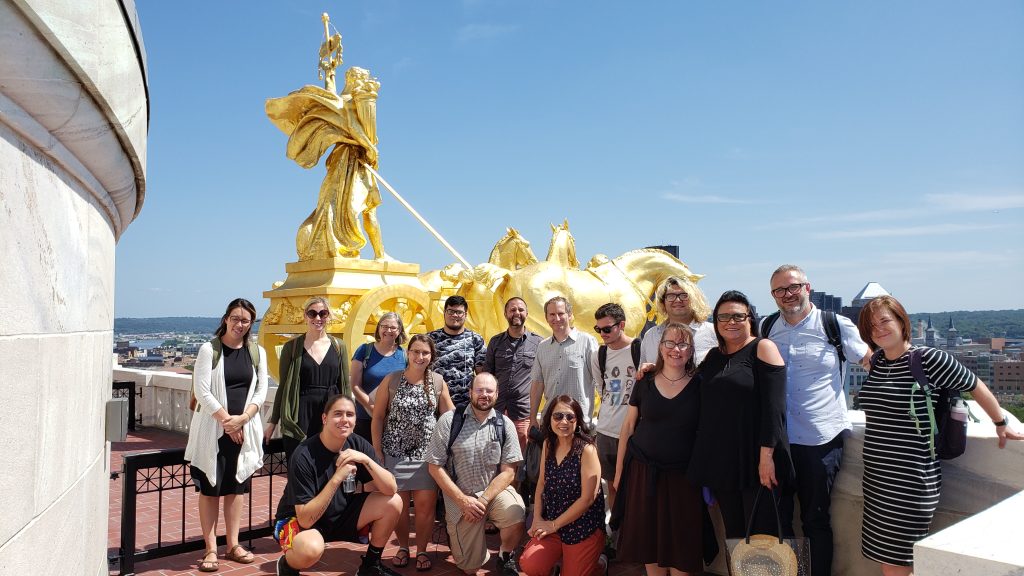
In 2019 I attended a summer workshop for teachers held by the CHGS, titled “Teaching About Genocide.” As part of the workshop, we, along with two Native American activists-teachers, toured the Minnesota State Capitol with a docent. Entering the main chamber of the capitol, our guide gestured toward several portraits of white males who colonized Minnesota. She, an employee of the state, noted they were the men “who discovered Minnesota.” Here, in the most prominent institution of Minnesota government, a guide had normalized colonialism, except the normalization was now being heard by a critical audience. The statement seemed bracingly out of step with our appreciation of multiculturalism, the celebration of ethnic and racial diversity, and acknowledgment of the centrality of indigenous peoples to the shared fabric of American history.
Attendees of the 2019 CHGS Educator Workshop on the Minnesota Capitol dome.
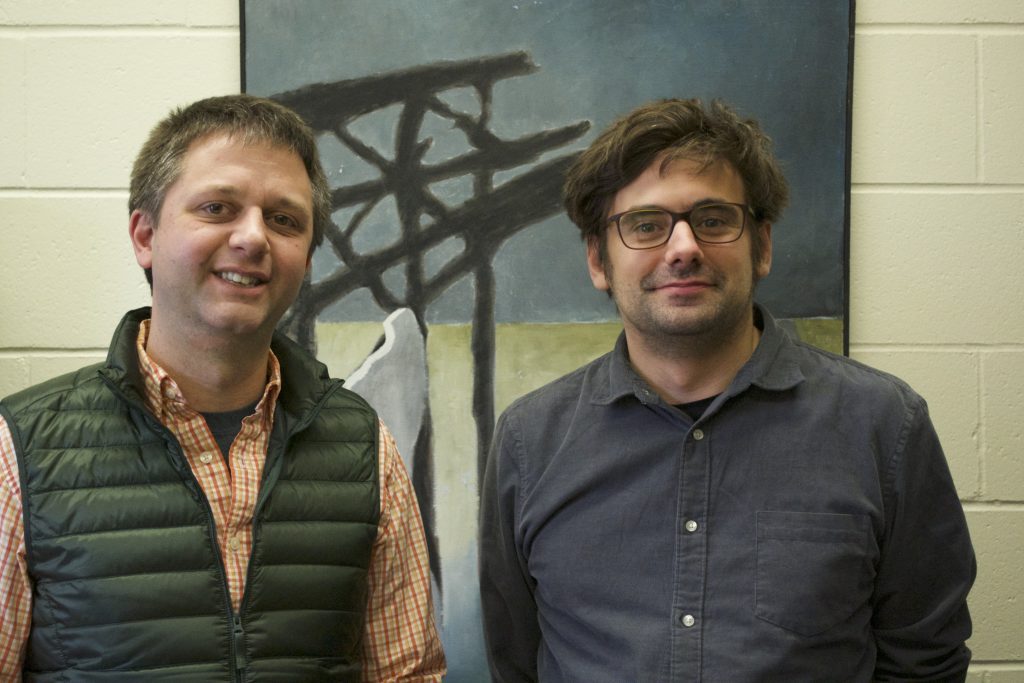
Max Breger, a doctoral candidate and visiting scholar from the University of Siegen, Germany, was recently hosted by the Center for Holocaust and Genocide Studies. Breger has been in the United States for the past roughly two months, conducting research on torture committed by U.S. agencies, especially in connection with the larger so-called “War on Terror.” His work is part of a larger comparative research project led by Professor Dr. Katharina Inhetveen. Breger presented on the project and shared initial findings from his work with members of the Holocaust, Genocide, and Mass Violence Studies (HGMV) Interdisciplinary Graduate Group in a talk entitled: “Violent Interrogation, Psychology, and Body Knowledge: Torture in the ‘War on Terror.'” I sat down with Breger for an interview to learn more about the project.*
“Ah, American,” she answers with a slight chuckle.
With the simple change in the pronunciation of my surname, the panel chair was able to identify my nationality, and in so doing, indirectly created a border between us. She was German, and perhaps I could have passed as German as well, if only I had gone along with her pronunciation – the one I knew was the “correct” form of my surname but not my name. Regardless, her comment made me pause and think: how could such a slight pronunciation change signify so much? As soon as I was marked as an American, a corpus of assumptions and stereotypes became accessible. It’s not to say that such a corpus would not be present if I were German; it would be, but it would simply be a different corpus.
The Center for Holocaust and Genocide Studies at the University of Minnesota-Twin Cities promotes academic research, education and public awareness on the Holocaust, other genocides and current forms of mass violence. It was established in 1997 by Dr. Stephen Feinstein as an interdisciplinary research center. Read more…