When I first saw Fritz Hirschberger’s paintings in art storage, I was struck with cognitive dissonance. In the time that I’ve worked for CHGS, I looked at Hirschberger’s paintings and read about the artist quite a bit, but only in print or online in CHGS’ digital collection.
This was my first encounter with a Hirschberger painting in its physicality. Five feet tall, painted in translucent layers of bright oils, there, before me, stretched a saturated orange and purple canvas filled with the a war horseman brandishing deadly weapons. Hirschberger chose the Fifth Horseman precisely because it could not be discerned through physical senses,* yet here in my first encounter seeing this piece in person, it was arresting precisely because of its physical nature.
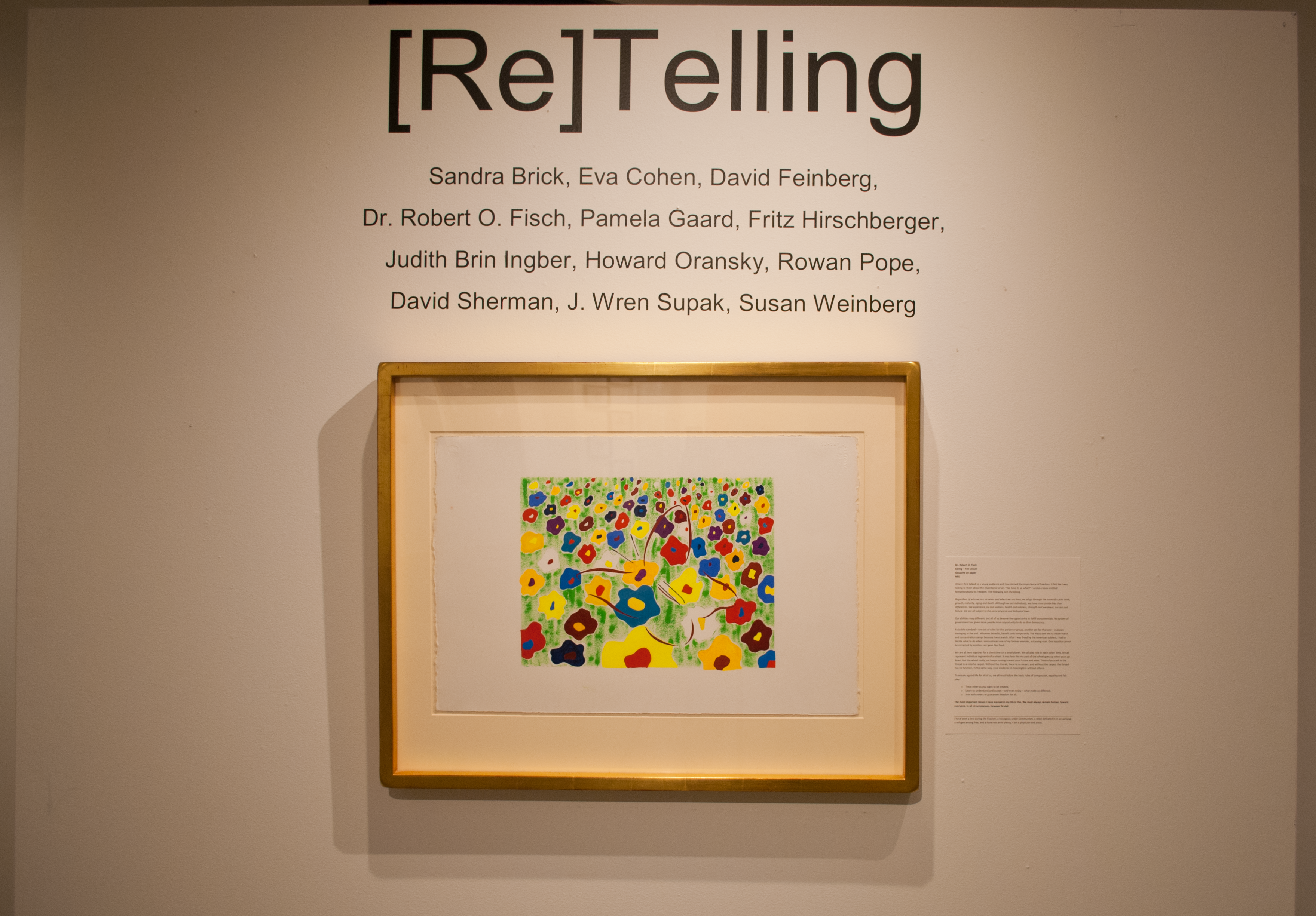
Weeks later, the paintings were installed and ready as part of [Re]Telling, an exhibition of Holocaust art, narrative, and contemporary response, held in the Tychman Shapiro Gallery at the Sabes JCC. Yehudit Shendar, retired Deputy Director and Senior Art Curator of Yad VaShem, Israel’s Holocaust memorial and museum, gave remarks at the opening reception of [Re]Telling featuring seven paintings by survivor Fritz Hirschberger selected from the CHGS permanent collection.
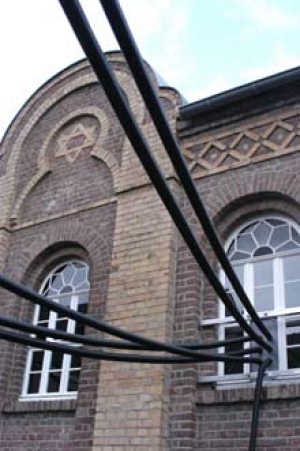 In March 2006, performance artist Santiago Serra constructed a homemade gas chamber inside a former synagogue in the Cologne area and invited Germans to be symbolically gassed. Exhaust pipes from six cars were hooked to the building, which was then filled with deadly carbon monoxide and visitors entered the space wearing protective masks. What was the artist’s intention? Serra said his aim was to give people a sense of the Holocaust. The Jewish community was furious. It was considered a provocation at the expense of Holocaust victims, an insult to survivors and the whole community. “What’s artistic about attaching poisonous car exhaust into a former synagogue?” said writer and Holocaust survivor Ralph Giordano (1923-2014), “and who gave permission for this?”