
culture

Photo by R/DV/RS, Flickr CC

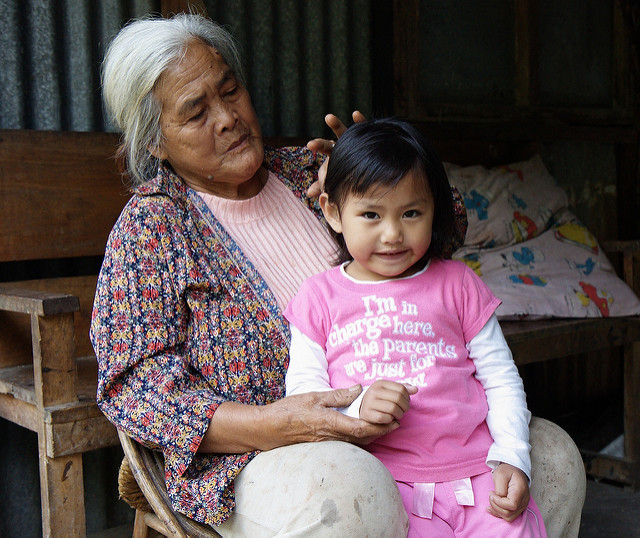
Intimate depictions of human suffering often make headlines. When 12 young boys became stuck in a cave in Thailand for over two weeks, media across the globe dedicated extensive coverage to their precarious rescue. In an interview with Vox, sociologist Tim Recuber explains why so many people watch coverage of disasters. According to Recuber, the key to this puzzle is “empathetic hedonism.” Recuber explains,

“There’s a certain kind of pleasure in really feeling for someone else, even if those feeling are bad. That’s what that term is trying to name. In a culture that tries to venerate empathy, being able to say, ‘I saw that footage, it’s really horrible, I feel horrible for those kids’…it does mark you as a moral person…People get to demonstrate they have this ability.”

However, not all victims of disaster receive the same level of empathy. People generally feel more empathy towards people they can relate to:

“Empathy is really partial. We’re more inclined to be empathetic to people who we feel are like us. Identifiable victims, relatable victims. And oftentimes racial, class, and gender biases get in the way of empathetic identification. There are even studies that show that people viewing a person’s skin being pricked by a needle will have more of a [physiological] reaction when the skin is the same color as theirs.”

In his interview, Recuber also grapples with the ethics of such media consumption. What may be most important, he concludes, is to allow victims the agency to decide whether or not to be in the spotlight. Recuber finds no harm in caring about suffering kids, but cautions that privacy invasions can deepen trauma.

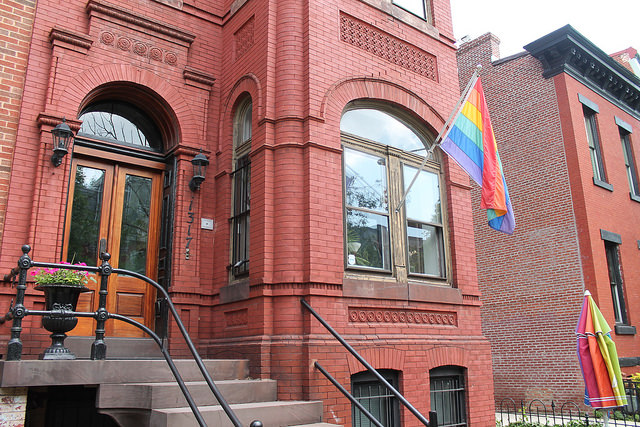
Photo by ShironekoEuro, Flickr CC

Among America’s history of race and racism, one particularly ugly violent memory is the practice of lynching in the late 19th and early 20th centuries. White mobs would often capture and kill Black men on false accusations as part of a system of racial domination and oppression. While lynching is often cast as a distinctly Southern problem, a recent article in The New York Times by sociologist Charles Seguin discusses how newspaper coverage in both the South and the North used racist language and symbolism when reporting on lynching incidents.

Seguin argues that work by activists — including sociologist Ida B. Wells and especially newspaper coverage on American lynchings around the globe — led to international embarrassment for the United States, questioning America’s image as an advanced nation and model democracy. With this increased scrutiny in the international spotlight, many Northern newspapers became more critical of lynchings, framing it is a shameful part of the South. As he describes,

What these outside agitators — Wells, the British press and the Italian Embassy — accomplished was to embarrass the Northern newspapers, which eventually denounced lynching communities as barbarous and anarchic with headlines like “More Southern Savagery.”

Seguin’s article provides a rich discussion of how the intersections of racism, region, and press shaped the history of newspaper coverage surrounding lynching in the United States. Though Southern newspapers such as the Montgomery Advertiser have made public apologies for their role in racist coverage regarding lynchings, it is important to remember that this issue was not just confined to the South.

Photo by Elvert Barnes, Flickr CC

Pride month, with all its fun and flair, has come to a close as various parades and festivals to celebrate LGBTQ rights and inclusion finished up around the world. But now that Pride is over for another year, this doesn’t mean we can forget about LGBTQ communities. While the social acceptance of LGBT communities has increased in recent decades, this does not necessarily mean these communities receive support in practice. 

In a recent Op-Ed for the Los Angeles Times, sociologist Amin Ghaziani discusses his research on heterosexual attitudes towards same-sex relationships. While heterosexuals are willing to extend ‘formal rights’ to gay couples, like hospital visitation and family leave, studies reveal that straight people are less willing to demonstrate political engagement or material support for LGBTQ communities. In their research on ‘Gayborhoods” — urban districts with a prominent LGBT presence — Amin Ghaziani and Adriana Brodyn find that increased liberal attitudes towards homosexuality may actually mask the persistence of discrimination and prejudices among straight residents.

While Ghaziani’s participants generally accepted gay rights, the residents often did not make a concerted effort as allies to help improve LGBTQ livelihoods. Ghaziani describes the concept of ‘privilege fatigue’ — frustration that stems from the coexistence between progressive attitudes about homosexuality and conservative-to-apathetic behavior towards the LGBTQ community. Ghaziani’s research demonstrates that prejudice remains, and that acceptability does not necessarily translate into advocacy for queer lives. As Ghaziani concludes,

“We are mistaken if we interpret — or celebrate — straight people moving into gay neighborhoods as evidence that we have made significant strides toward equality. True progress would be things like employment and housing non-discrimination laws, closing the sexual orientation wage gap, addressing anti-gay and anti-trans hate crimes, and other pressing social problems. Unless progressive straights are helping on those fronts, they may be gays’ neighbors, but they aren’t their allies.”

Photo by Dreamfish, Flickr CC

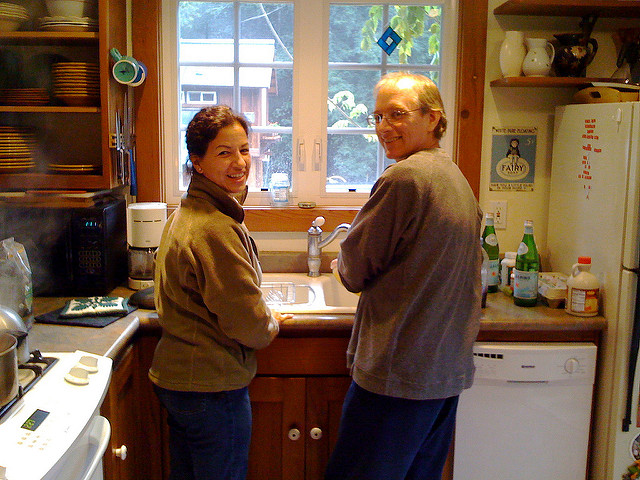
What is your least favorite household chore? According to a report from the Council on Contemporary Familiesrecently profiled in NPR and The Atlantic, washing dishes is a common answer — and how they end up getting done could be affecting your relationship.

Dan Carlson, the study’s lead author, told NPR,

“Most research sees housework as an omnibus thing, but it varies in qualities: how pleasurable or unpleasurable, how often it needs to be done, how gendered it is.”

The team’s research considered whether sharing household tasks within heterosexual couples changed over the past few decades. They found that younger couples share more of the routine household tasks, especially dishwashing and laundry, than couples a decade prior. How couples divide the household labor strongly affects relationship quality — for better or for worse — among couples in the more recent cohort. And doing dishes was more likely to affect relationship quality than any other chore.

Both in housework and in the labor market women have often done the jobs that involve cleaning up after someone else — and doing the dishes can be an especially gross job. As more couples share housework, women who feel like they are stuck doing the undesirable chores are more likely to feel disrespected. As Carlson notes, “The more often a task is shared, the worse it is for you not to share it.”

The relationship consequences of dishes aren’t going away, but then again neither are the dishes.

Star of David marker at Bikernieku Forest mass grave site in Latvia. Photo by Adam Jones, Flickr CC

The White House recently published a press release decrying the violent behavior of MS-13 members, referring to the group as “animals” 10 times throughout the short post. In response, researchers Aliza Luft and Daniel Solomon wrote a Washington Post article discussing how dehumanizing language can enable violence. They draw upon historical examples, referencing animalistic rhetoric used in Nazi Germany and the 1994 Rwandan genocide. As Luft and Solomon explain, dehumanizing language alone cannot directly incite violence:

“Recent research suggests that promoting negative views of others can go only so far in motivating people to kill. In Rwanda, for example, Hutu militants issued calls on the radio to exterminate inyenzi, the Kinyarwanda word for ‘cockroach.’ But some Hutus refused to kill, saved Tutsis, or shifted stances from killing to not killing neighbors. This suggests that the decision to commit murder and other violence was difficult for Hutu civilians. Dehumanizing propaganda alone didn’t persuade Hutus to suddenly turn on their Tutsi peers.”

However, the researchers describe a number of ways dehumanizing language can, in fact, heighten tensions or lessen the cost of violent behavior:

“Language is not innocent. Dehumanizing propaganda helps to normalize extreme perspectives on how to address social problems. It grants legitimacy to those who do believe that certain others are inherently threatening, dangerous and ought to be eliminated from the community…Dehumanizing propaganda alters norms of what is and isn’t perceived as acceptable views or behavior. Even when people don’t believe what they hear on the radio or on TV, dehumanizing propaganda might make them hesitate more to speak out against it.”

In closing, Luft and Solomon argue that public action can counter the negative potential of dehumanizing language. They note, for example, that protest by Catholic leaders in Nazi Germany mobilized otherwise complacent members of the public into resistance. In an American context where communities of color face daily systemic violence, protest against dehumanizing language may serve a protective function.

Photo by Art01852, Flickr CC

U.S. census estimates indicate that babies of color are now the majority and that by 2020, the majority of children under 18 will be non-white. Despite this growing diversity, many parts of the United States remain deeply segregated by race. A recent article in the Washington Post draws on U.S. census data and insights from sociologists Michael Bader, Kyle Crowder, and Maria Krysan to visually depict and explain the persistence of residential segregation in the United States.

Bader points out that the persistence of segregation is tied to the history of slavery, Jim Crow, and redlining practices against Black communities. Cities that have large African American populations, like Chicago and Detroit, have entrenched patterns of segregation. However, Krysan and Crowder argue in their book that housing policies and practices do not alone reproduce segregation. Daily routines and connections to others can also result in inequalities. As Krysan describes,

“We don’t have the integrated social networks. We don’t have integrated experiences through the city. It’s baked-in segregation, [Every time someone makes a move they’re] not making a move that breaks out of that cycle, [they’re] making a move that regenerates it.”

On the other hand, diversity in many suburbs has increased over the past decades. The D.C. metro saw a 300 percent increase in Hispanic American and a 200 percent increase in Asian American populations from 1990 to 2016. Bader connects this diversity in the suburbs to policy, arguing that both lower housing costs and the implementation of the Fair Housing Act helped to circumvent segregation,

“A lot of those areas were developed after the Fair Housing Act was implemented…If you’re building housing and you’re subject to the Fair Housing Act, you shouldn’t have, in those particular units, the legacy effects of segregation.”

While policy cannot address all residential segregation, it may lessen its reach.

Photo by James Palinsad, Flickr CC

A recent public focus on workplace discrimination against women has inspired heightened attention to the effects of gender inequality. Previous research shows that sexual harassment at work disrupts women’s employment, causing various economic harms. New research, recently featured in Salon, shows it also makes women sick. Researchers Catherine Harnois and Joao Luiz Bastos studied the relationship between workplace discrimination and health — both physical and mental — and their findings indicate the two are strongly linked for women:

“Among women, perceptions of gender discrimination are significantly associated with worse self-reported mental health. Women who perceived sexual harassment also reported worse physical health. We did not find a significant association between gender discrimination and sexual harassment with health outcomes among men, but this may be a result of the small number of men reporting these forms of mistreatment.”

In this study, women reported an average of 3.6 days of poor mental health compared with men’s 2.8 days, and an average of 2.7 days with poor physical health, compared with men’s 2.2 days. Certain factors increased the risk of negative health:

“Respondents who perceived multiple forms of mistreatment reported significantly worse mental health than those who perceived no mistreatment, or just one form of mistreatment. Among women, the combination of age and gender discrimination was particularly detrimental for mental health. Women who reported experiencing both age and gender discrimination had an average of 9 days of poor mental health in the past 30 days.”

Based on their findings, this health gap could be significantly reduced by decreasing the amount of gender discrimination in the workplace.

Photo by Stefan Munder, Flickr CC

While U.S. society often valorizes the nuclear family — two-parent households with children — many families do not fit this model. In honor of Mother’s Day this past weekend, Ms. Magazine highlighted the long history of collective mothering in the United States. Social scientists demonstrate how the individualized, biological model of mothering emphasized in the United States can be a problem:

“Many feminist sociologists have pushed back against narrow understandings of parenting. Sharon Hays argues that pressures for mothers to “do it all” though intensive mothering styles alienates and emotionally depletes women…Sharing care-work can alleviate some demands of what sociologist Arlie Russell Hochschild calls the ‘second shift,’ or the household labor usually left to women after the formal workday ends.”

Further, certain groups rely more heavily on collective mothering. For African Americans, collective mothering has been important for survival:

Patricia Hill Collins describes how blood mothers, ‘other mothers,’ grandmothers and community mothers have collectively cared for Black children since slavery, playing integral roles in Black community survival. The mainstream media tends to associate these mothering practices with working-class and poor mothers of color, but Collins points out that Black middle-class mothers also rely on community mothering to protect their children from everyday forms of racism.”

Mothers who immigrate to another country for work also depend on collective parenting — often by family and friends — if their children remain in their country of origin. While many Native American families rely on collective child-raising practices as well, the U.S. government rarely recognizes them as valid forms of parenting. Social workers have taken away thousands of Native American children and placed them into mostly White, nuclear families.

So, when we celebrate Mother’s Day, we must keep more than individual mothering in mind.

Photo by kgroovy, Flickr CC

“Boy or Girl?” — It’s one of the most common questions people ask new parents. But some parents are trying to avoid that question altogether by raising their children in a “gender open” or “gender affirmative” environment. A recent article in New York Magazine highlights the decisions made by these parents — including some parents who are sociologists.

Kyl Myers is one of these parents. For Myers, “the point was not to have a genderless child.” Instead, Myers wanted her child to come to their own understanding of gender without viewing toys and activities as “boy” and “girl” things. Myers’ concerns are certainly valid — according to Elizabeth Sweet’s research, toys are more gendered today than they were during all of the 20th century. Myers goes on to explain,

“A part of why we are parenting this way is because intersex people exist, and transgender people exist, and queer people exist, and sex and gender occur on a spectrum, yet our culture loves to think people, all 7 billion of them, can and should be reduced to either/or.”

Andrea — also a sociologist — had a partner that was in the middle of a gender transition at the time, which led them to talk extensively about gender and parenting strategies. Andrea believed her child’s anatomy did not matter for their gender, yet her partner was changing their body to match their gender. Andrea says,

“We know that people often experience gender through their bodies and through the meaning that our society has attached to bodies…In our society, breasts are feminized, so it makes sense for someone like my partner to have their breasts removed. When we say gender is a social construct, I am certainly not arguing that bodies and hormones play no role in people’s gender identification.”

These parents — informed by social science research that shows the importance our society places on a gender binary — are doing their best to break out from this binary to include more opportunities for children to explore their gender identities. As Myers says,

“You have to give people the benefit of the doubt that they are trying to love their children in the way that they know best, and that really looks different for different families. This is how we know to love our child best.”

Photo by Mobilus In Mobili, Flickr CC

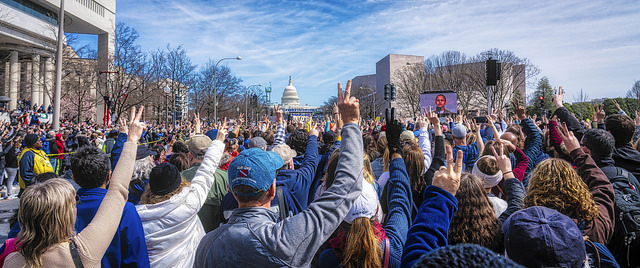
Recent mobilization around gun control — epitomized through the recent March for Our Lives protests across the country — is largely associated with youth and liberal political ideologies. But sociologist Dana R. Fisher, who has been studying large-scale protests since Trump’s inauguration, challenges this assumption. In a recent article in the Washington Post, she discusses research she and her team conducted during the March for Our Lives protest in Washington, D.C. Fisher explains,

“Only about 10 percent of the participants were under 18. The average age of the adults in the crowd was just under 49 years old, which is older than participants at the other marches I’ve surveyed but similar to the age of the average participant at the Million Moms March in 2000, which was also about gun control.”

Further, Fisher found that fewer protesters were driven by politically liberal values than we might think:

“Only 12 percent of the people who were new to protesting reported that they were motivated to join the march because of the gun-control issue…Instead, new protesters reported being motivated by the issues of peace (56 percent) and Trump (42 percent), who has been a galvanizing force for many protests. Protesters were also more likely to identify as ideologically moderate. About 16 percent did so, higher than at any other protest event since the inauguration.”

While the media might have us believe differently, March for Our Lives successfully mobilized a wide crowd — both in age and political ideology.