
inequality

"Proto-Professor," by Liz Lawley, Flickr CC.
“Proto-Professor,” by Liz Lawley, Flickr CC.

Parenting is hard, whether you’re an academic or not. But when you’re a professor, there is one surefire way to help stay in the field, get tenure, and even score a pay bump. Be a man.

The message is clear: women with children in academia are at a disadvantage compared to both men with children and women without them. A recent article in Jezebel compiled findings from several studies to demonstrate this. According to sociologist Michelle Budig, high-income men get the biggest pay bump from having children in any job category, and low-income women lose the most.

A US News article, likewise reports that male professors with young children are more than three times as likely as women with young children to get tenure-track positions. Notably, women without children come in a close second: they are just under three times as likely as women with children to get tenure.

Along the same lines, women who have a baby as a graduate student or postdoctoral fellow are more than twice as likely as men who have children during this time to leave academic research. When it comes to having children in academia, women pay a harsh “baby penalty.”

Patrick Sharkey's 2013 book traces generational reproduction of wealth and poverty.
Patrick Sharkey’s 2013 book traces generational reproduction of wealth and poverty.

Democratic presidential candidate Bernie Sanders stated that he is against reparations for African Americans, and the declaration has spurred a fair number of back-and-forth pieces between authors on the political left. One notable article by writer and recent MacArthur “Genius” Grant winner Ta-Nehisi Coates responds to an open letter by Cedric Johnson, a professor of African American studies and political science who critiqued Coates’ call for reparations. Johnson tries to make the case that those who call for reparations are missing the main point: if broad class inequality is addressed, the economic and other inequalities faced by blacks will fall away. Further, Johnson characterizes liberals who disagree with him as uninterested in promoting solidarity. As Coates explains, however, race is far more complex. Whiteness and white identity still confer privilege, and that enduring system is another form of “solidarity,” a historical collection of forces that reinscribe inequality.

Using research from, among others, sociologists Patrick Sharkey of NYU and Robert Sampson of Harvard, Coates shows that white and black poverty are distinct. First of all, blacks are more likely to live in poor neighborhoods in which structural issues such as limited access to healthy groceries and banking are more heavily felt. After all, living in a poor neighborhood can have independent effects on poverty, effects which disproportionately affect African Americans. For example, Sampson’s research shows that incarceration rates in poor black neighborhoods can be forty times higher than in poor white neighborhoods, and incarceration rates are tied to further poverty in many ways. Trying to reduce issues of race to issues of class is, Coates explains, a disservice to both dynamics. Race and class intersect and overlap in ways left untouched by Johnson’s black-and-white characterization of poverty, reparations, and inequality.

Photo by Abhisek Sarda via Flickr.

For years, legislators and employers have framed guaranteed parental leave as a “women’s issue.” Women serve as the primary advocates for policies that allow more flexibility between work and family life, while fighting stereotypes that paint them as less committed to their jobs than men. In a recent article for Fast Company, sociologist Michael Kimmel discusses how the U.S. lags behind every other industrialized country in policies that guarantee parental leave and how he believes this contradicts “family first” ideals. “Supporting families is the very definition of family values,” writes Kimmel. “How can we possibly lecture others about loving and supporting families when we value our own so little?”

One key to the gradual change that’s come to cities including New York, Washington D.C., and Chicago may be a shift in male perspectives of household work. Recent surveys suggest many men want to be more involved in household duties. Despite that willingness, however, women still bear much of the burden. Consequently, fathers are often praised for more public acts of parenting, like taking children to soccer practice, while mothers are more likely to take care of unsung housework, struggling to also meet the demands of their careers. Further, researchers note that demanding careers cause increased risks of physical and mental illnesses such as heart disease, diabetes, and stress for everyone, not just fathers or mothers.

As legislators craft a new wave of parental leave policies, many question how employers can provide a working environment to support parents and families. In a recent study, Phyllis Moen and Erin Kelly studied the Star Initiative program that allowed for increased flexibility for 700 employees at a Fortune 500 company. The aim was to provide employees with more flexibility in attending meetings, working from home, and communicating via instant messenger. After one year, those involved in the initiative reported greater job satisfaction and lower rates of poor mental health. According to Kelly, “One important implication of this research is that workplaces can change to bring some relief to stressed out workers. It’s not up to an individual to figure out how to balance everything. Challenges come up with work, but organizations can change to bring some relief.”

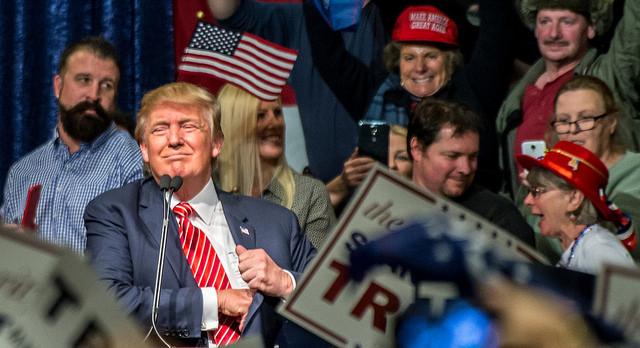
Trump at a Nevada campaign stop, 2016. Photo by Darron Birgenheier via Flickr.

Tonight, we’ll see the 7th GOP Presidential Debate, but how will the public parse truth from fiction? Recently The Conversation asked four scholars to choose and fact-check one statement from the 6th GOP debate. Stealing the show was tonight’s ostensible no-show, The Donald, conflating refugees with immigrants, and both with crime.

To be fair, nearly all the candidates conflate immigrants and refugees, and, in the 6th Debate, they reduced the topics to one: national security. According to sociologist David Cook Martin, refugees are a legal category defined by United Nations, and they undergo an extensive screening process, while immigrant status is determined by U.S. law. The emphasis on immigrants and refugees as a security threat thus leaves no room for acknowledging the ways  migration has helped the U.S.:

To reduce immigration and refugee policy to a matter of national security overlooks the considerable extent to which the cultural, social and economic success of the United States has been linked to migration, including that of the families of five of [the GOP] debate participants. Immigration policy is a complex weighing of security matters, but also of geopolitical interests, economics and the diversity of people and perspectives that have informed U.S. success.

Trump also claimed that migrants coming to the U.S. are primarily “strong, powerful men,” again drawing on stereotypes of immigrants and refugees as threats (previously, he had notoriously said that Mexican immgirants, in particular, were rapists and drug dealers). Hadar Aviram, professor of law, points out that this is plain old wrong. First, of the 1,682 Syrian refugees entering the U.S. last year, 77% were women. And while immigrants are often associated in the popular imagination with criminality, scholars agree—and sociologist Ruben Rumbaut has shown time and time again—that immigrants actually commit less crime than native-born Americans. Aviram argues that Trump is distracting the public from other issues, like the tax breaks for the wealthy he plans to make and that might actually harm middle-class and working-class Americans, by drawing attention to a “demonized ‘other.’”

Photo by Charlotte Morrall via Flickr CC. Click for original.

Gender bias in the workplace may not be breaking news, but its negative impact on mental health among powerful women might surprise you. A new study highlighted in Fast Company magazine suggests that women in high-ranking positions experience increased symptoms of depression. Lead author, sociologist Tetyana Pudrovska, describes the unexpected findings that came out of the WILLSHE project on the experiences of highly successful women:

What’s striking is that women with job authority in our study are advantaged in terms of most characteristics that are strong predictors of positive mental health. These women have more education, higher incomes, more prestigious occupations, and higher levels of job satisfaction and autonomy than women without job authority. Yet, they have worse mental health than lower-status women.

Men do not seem to suffer similar negative mental health consequences when in powerful occupations. Marianne Cooper, sociologist at the Clayman Institute for Gender Research at Stanford University, explains:

Women leaders are viewed as being less competent than men, they’re evaluated in performance reviews on personality traits while men are evaluated on accomplishments, and they’re interrupted more often during team meetings. The day-to-day interactions can become tiring to deal with—it’s like death by 10,000 paper cuts.

From an antiviolence PSA created for a Zurich women's organization coalition, Frauenzentrale, via Coloribus, an online advertising repository. http://www.coloribus.com/adsarchive/prints/unknownadvertiser-against-domestic-violence-5378305/
From an antiviolence PSA created for a Zurich women’s organization coalition, Frauenzentrale, via Coloribus, an online advertising repository.

Attention to violence against women has improved significantly within the legal system since feminists pushed for recognition of what had once been considered “personal problems”—like violence by an intimate partner—as part of a larger system of gender inequality. Even into the early 1990s, laws discrediting the possibility of rape within marriage remained on the books for some states.

Some discrepancies remain. According to recent study by Myrna Dawson, men who kill their wives, girlfriends, or female family members often face shorter prison terms and fewer first degree murder charges than men who kill female strangers. Dawson calls this an “intimacy discount.” Among many possible explanations for these disparities include that women may still be viewed as men’s property, therefore partner deaths aren’t taken as seriously as other killings. Another possibility is that crimes against intimate partners tend to be easier to solve, prosecute, and bring to a guilty plea, perhaps resulting in a lighter sentence, since the killer took responsibility for his crime.

Read the full article here.

For many, the "American Dream" seems beyond possibility. Zhang Yu, Flickr CC.
For many, the “American Dream” seems beyond possibility. Zhang Yu, Flickr CC.

Immigration is a hot topic, especially with elections coming up. Donald Trump has called immigrants “rapists” and “criminals”, perpetuating anti-immigration rhetoric. Common immigration myths include that immigrants are taking Americans’ jobs, burden the economy, and refuse to speak English. The Washington Post covers a report written by a group of Harvard professors, led by sociologist Mary Waters.

  1. “Immigrants are picking up English just as quickly as their predecessors”
In fact, today’s immigrants are learning English faster than their predecessors. This is partially due to how global English is, which means that immigrants are more likely to have been exposed to it or to have taken English classes already. Additionally, American schools are becoming better at teaching English to immigrant students.
  1. “Immigrants tend to have more education than before”
Historically, immigrants were low skilled workers from southern and eastern Europe in the early 1900s. Recently, however, immigrants are more likely to have four years of education on average. Approximately, 28% of recent immigrants hold a bachelor’s degree or higher, which is a 19% increase since 1980.
  1. “Immigrants are much less likely to commit crimes—but they soon learn”
In fact, immigrant neighborhoods are considered to be some of the safest neighborhoods as immigrants are least likely to commit crimes. Native-born men aged 18-39 are 5 times more likely to end up in jail than immigrants. While immigrants are initially fearful of picking up criminal influences, by the second and third generation, they are more likely to engage in criminal behavior.
  1. “Immigrants are more likely to have jobs than the native-born”
Immigrants are determined to find employment, and they are more likely to be employed than their native-born counterparts. Between 2003-2013, 86% immigrants were employed compared to 82-83% native-born Americans. This also holds true for men who have not earned a high-school diploma, where 84% immigrants are employed compared to 58% native-born Americans.

While the report combats common myths about immigration, it does not give a concrete answer as to whether today’s immigrants have the same opportunities as earlier generations of new Americans, despite being educated, staying away from crime, holding jobs, and paying taxes.

Mizzou's players have power on the field and off. Photo by Mitch Bennett, flickr.
Mizzou’s players have power on the field and off. Photo by Mitch Bennett, flickr.

Social science can help us make sense of activism and the dynamics behind it and within it as protests break out at schools across the country. One article by Dave Zirin in The Nation borrows concepts from sport sociology to discuss Mizzou’s football player protests in particular.

As described in the article, University of Missouri President Tim Wolfe resigned after weeks of racial tension on campus, including a hunger strike and protest, was met with institutional denial of lived realities. The pivotal moment came when the school’s football team refused to practice until Wolfe was gone. It’s estimated that their refusal to play could have cost the school up to a million dollars. Zirin highlights how often student athletes are characterized as powerless or exploited, and so their capability for activism can be overlooked. At Missouri, however, the players showed their power to affect change as agents rather than mere actors for change.

Zirin’s article draws on research from UC-Berkeley emeritus professor Harry Edwards, a pivotal name in sport sociology, on the racial dynamics of college football, in which teams are often much more black than their fan bases. As #BlackLivesMatter and similar initiatives continue, Zirin believes we can expect more activism in such sites, where institutional racism is stark.

Protest at the closing of the Chowchilla Valley State Prison for Women in CA, 2013. Daniel Auraz, Flickr CC.

Women account for about 7% of the U.S. prison population. Compared to men, they are much more likely to experience poverty, mental health issues, and various forms of victimization prior to being incarcerated. And while they’re in prison, women are more likely to experience mental health problems, chronic medical conditions, and sexual misconduct by staff members. These issues do not disappear after release, but are coupled with difficulty finding adequate employment, public assistance, and health care.

Sociologist Susan Sered was recently featured in Sojourners, which explored her advice to faith communities helping formerly incarcerated women. Drawing on eight years of research with criminalized women in the Boston area, Sered suggests churches and communities of faith can provide shared knowledge and support in the form of information about housing, employment, health systems, and social networks. She believes faith communities can help women make meaning out of their suffering by reframing their incarceration as experience that can provide them with special insight, rather than a reason to blame or ostracize them. Sered says, “criminalized women need to hear these powerful messages from religious communities.”

Read the full article here.

Wikipedia is the largest source of free information on the Internet. According to the digital analytics website Alexa, it’s is the 6th most popular website in the United States and 7th in the entire world. What is troubling is that between 84 and 91% of its editors are male, and the site’s few female editors face regular harassment and marginalization. This imbalance means the content often reflects a strong gender bias. Emma Paling recently explored the problem for The Atlantic, interviewing Julia Adams, a professor of sociology at Yale University.

“Most people look at Wikipedia, and see the text, and assume that it’s unproblematically produced by volunteers and always on a trajectory to improvement,” said Adams. “But that is simply not the case.”

Read the full article here.