
inequality

Photo by miriampastor, Flickr CC

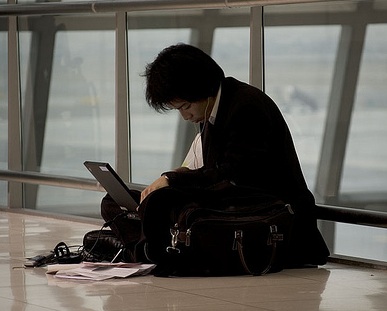
More and more women are becoming the primary income earner for their families. Conservative commentators have been quick to claim that women working and earning more than their male partners has negative effects on marriages, children, and the home. But new research shows that both men and women are happier when the woman is the primary breadwinner.

As described in a Washington Post article, sociologist Christin Munsch found that men who bring in a larger share of household income are more likely to have low psychological and physical well-being scores. However, when women bring in a larger share of household income, both men and women reported higher scores. Though this finding seems to defy conventional wisdom, it is driven by gender norms, as Munch explains.

“Gendered expectations often pull people into making different career decisions … Men are more likely to blindly take on responsibilities with work because they’re associated with more income. Women are more likely to ask: Do I like this? Do I want to do this?”

In other words, women are more likely to take a high-paying job because they’re interested in the work. Men, on the other hand, are more likely to feel that they have to take a stressful, high-income job because that’s their role. These new findings show that changing long-held gendered expectations surrounding work and earnings is in everyone’s best interest.  
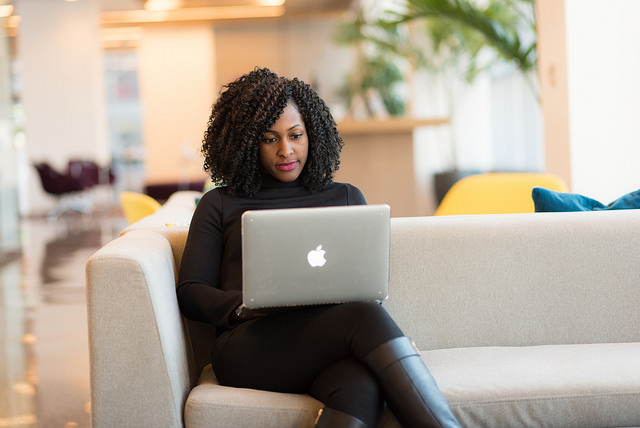
Photo by WOCinTech Chat, Flickr CC

A lot of things go into making your appearance – fashion, accessories, grooming … and race? As described in an article on Vox, research by Duke sociologist Robert L. Reece shows that black people are seen as more attractive if they tell others that they’re mixed-race. A research team conducted over 3,200 interviews with black people and ranked their attractiveness on a scale of 1-5. Those who said they were mixed-race received a higher score. Reese concluded that these findings are not a result of physical attributes or colorism; rather, they are about perceived racial identity. Vox reports,

“[Reece said] results could be partially explained by the fact that people think ‘being exotic is a compelling idea.’ But, he added, ‘It’s also partially just racism — the notion that black people are less attractive, so being partially not-black makes you more attractive.'”

This is not the first research to address this troubling dynamic; numerous studies have shown that resumes with white names are more likely to receive callbacks than those with black names. Other research has shown similar results for college applicants, those seeking health care, and people looking for mortgages or loans. This new research, however, shows that the effects of race go beyond the above-described settings, and that who’s considered “good-looking” is itself a product of racial hierarchies. 

Photo by verkeorg, Flickr CC

We tend to think of the world wide web as a place of equal opportunity, granted everyone has access to it. But NYU’s At A Glance recently covered Charlton McIlwain’s new study that reveals how systemic racial inequality forms and operates on the internet. The study looks beyond lone bigots who make racist comments and analyzes how site traffic steers users to certain kinds of pages. People who visit non-racial sites tend to visit other non-racial sites, more than just by chance, while those who browse pages with race-specific content find themselves jumping to other race-specific sites. McIlwain says,

“The evidence suggests a tendency toward racially segregated site navigation. Web producers seem to build pathways providing equitable access to sites, without concern for the racial nature of the site.”

While segregation may not be the intention of site builders, user’s personal preferences and search engines intervene to influence how web surfers get from point A to point B.  

“These results, along with disparities in website traffic rankings, show how a race-based hierarchy might systematically emerge on the web in ways that exemplify disparate forms of value, influence, and power that exist within the web environment.”

Photo by Henry Burrows, Flickr CC

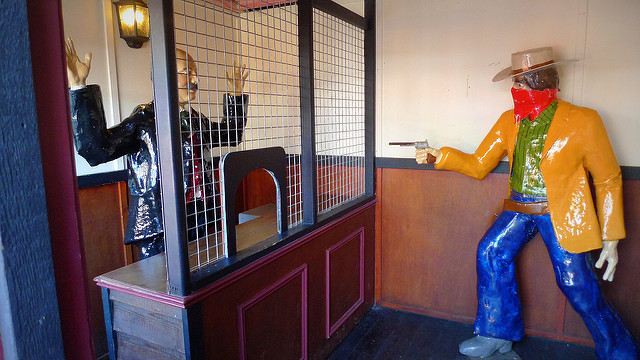
A masked figure enters the bank, pulls out a gun and screams, “Everyone on the ground!” The tellers frantically scoop cash into a sack as the robber holds them at gunpoint, roaring instructions through a black ski mask while sirens blare in the distance. This is a scene most of us know well, as it is depicted in almost every cheesy heist flick ever made.

Now, here’s a question: as you played out this scene in your head, was the bank robber a man or a woman?

Chances are, you were thinking of a male bank robber. But this popular stereotype might be changing. An article in The Orlando Sentinel reports that the latest FBI Statistics show a surge in bank robberies committed by females. In 2005, about 6% of bank robberies were committed by women, but by 2015 that number had risen to 7.5%, representing a quarter increase in the number of female bank robbers. In the article, sociologists Darrell Steffensmeier and Rosemary Erickson explain how changes in strategy and motivation might contribute to the increased participation of women in bank robberies. 

Today’s bank robbers don’t always run in and cause a spectacle; they often blend in with other customers at the bank, standing in line or filing paperwork. The infamous “gun-slinger” bank robbery is becoming less common, and instead of using a firearm, more and more bank robbers quietly pass a note to a teller with their demands. Erickson explains this shift in strategy is in large part to the increased number of women committing these crimes, as women are less likely to commit violent crimes than are men.

Steffensmeier and Erickson point to the “feminization of poverty” as a major driver of this gender shift in bank robberies. Women have come to represent a disproportionate percentage of the world’s poor, and combined with a rise in single motherhood and homelessness among women, women have started to resort to crimes that were once committed mostly by men as they struggle to make ends meet. If the pattern observed in the data becomes a trend, we might be seeing more women taking charge of robberies and other crimes—and you can take that to the bank.

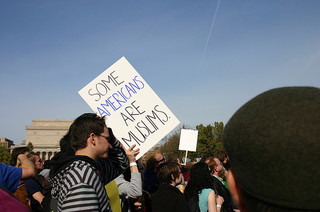
Photo from the 2013 Rally to Restore Sanity and/or Fear in Washington, DC, by Ryan Somma via flickr.com

Over the course of the primary season and the beginnings of the general election, there has been a lot of inflammatory rhetoric surrounding Islam in America, mostly propelled by politicians on the political Right such as Donald Trump. Such shifts in political discussion can often have a ripple effect, and as described in an article by Vox, even the narratives and language used by politicians on the left begin moving in this direction. With help from sociology professors of Erik Love of Dickinson College, Charles Kurzman of University of North Carolina, Chapel Hill, and Neda Maghbouleh of University of Toronto, we get an inside look at how discussion surrounding American Muslims takes on problematic features.

As Islamophobic arguments move through the airways, it changes the dominant ideas about judging the “line” in political discussions. For example, alongside more extreme comments made by politicians like Newt Gingrich, Hillary Clinton’s discussion of “peace-loving Muslims” becomes a more acceptable norm. However, these narratives still function at the core by suggesting that Muslim and American identity are incompatible, or that American Muslims are unduly obligated to earn their right to respect and safety. Consider research described in the article below:

“[F]ocus groups with Muslim American communities show that Clinton’s comments also “resonate poorly,” Charles Kurzman, a University of North Carolina sociology professor, said.

“When [Clinton] frames the choices this way, it means that for Muslims to be ‘good’ and worthy cultural and political citizens of America, they have to pledge fealty to the same law enforcement, media, and politicians that have been surveilling, jailing, and abusing them based on their names, their faith, and their physical appearances.”

The Vox article is quick to point out that Hillary Clinton hasn’t always made problematic statements regarding Islam, nor is this shift in rhetoric limited to her or to this presidential race. Rather, it seems likely that as inflammatory rhetoric targeted at Muslims continues, it simply normalizes problematic, unfair characterizations and opens the door to exclusionary attitudes.

https://flic.kr/p/C1sEq2
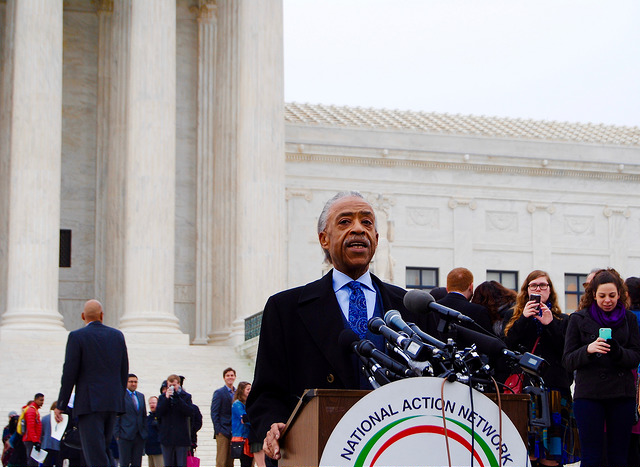
Al Sharpton speaks outside the Supreme Court as it hears arguments in Fisher v. University of Texas Austin. Photo by Jordan Uhl, Flickr CC.

After a series of decisions and appeals, Abigail Fisher’s infamous case against UT Austin (dating as far back as 2008) concluded with the U.S. Supreme Court’s 4-3 decision that the school’s admission policies were constitutional. Fisher had made the case that her rejected application was due to her race, as minority applicants who were supposedly less deserving had taken spots from her. This case is one in a long line of litigation by white women against affirmative action, as discussed in an article on Vox; ironically, however, white women are among affirmative action’s primary beneficiaries.

As detailed in the article, research shows how affirmative action for women translated into job advances: as benchmarks for gender enrollment are met, representation for white women has increased dramatically in certain sectors. Often, opponents of affirmative action state that race shouldn’t play a factor in application decisions, but research from sociologists Thomas J. Espenshade and Alexandria Walton Radford shows how this works against Asian-Americans, who are three times less likely than whites to be admitted to selective schools even with the exact same scores. Furthermore, affirmative action has also enabled the existence of legacy application processes, meaning people whose parents went to a certain school are more likely to be accepted there—a system that disproportionally helps whites. It seems affirmative action is safe for the time being, but the details may still need an overhaul.

Photo by Michael_swan via flickr.com CC

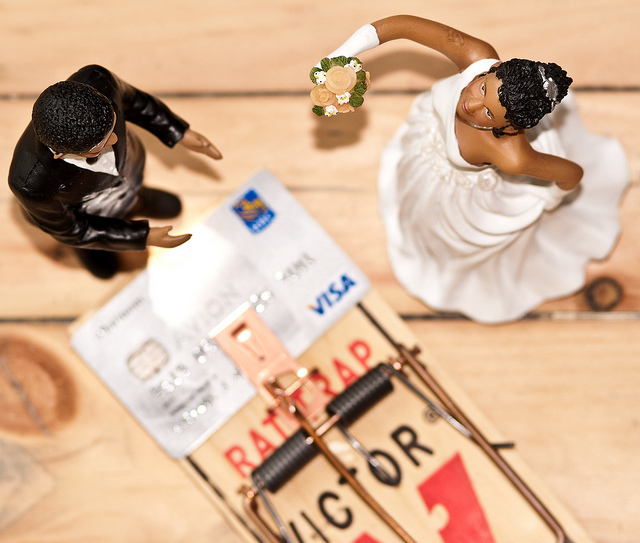
The “traditional family,” many would have us believe, is imperiled by everything from women in the workplace and same-sex couples in the bedroom. What these “traditionalists” fail to name among the various threats is income inequality. As described in research published in the American Sociological Review and discussed on Fortune.com, observed increases in the rate of couples having children before marriage can be explained by changing social landscapes.

It’s no surprise to anyone that the middle-class is shrinking or that finding a job can be a tough gig. Andrew Cherlin, David C. Ribar, and Suzumi Yasutake’s research shows people are more likely to postpone marriage, but not parenting, if they can’t get a job. So, with a distinct shortage of available living-wage jobs and growing income inequality, more and more American families are comprised of unmarried couples with children. As the class system becomes even more polarized, it seems marriage boosters might want to consider a different means to their favored end: reducing inequality.

Photo by @Saigon via flickr.com

Some believe Asian-Americans face a “gentler” sort of racism than other minority groups—that they are even treated with admiration as a “model minority” group. That said, the “model minority” stereotype doesn’t have negative consequences. In an Atlantic article, sociologist Adia Harvey Wingfield discusses the multiple ways Asian identities are subject to subtle but impactful experiences in everyday life.

For example, consider the “model minority” stereotype, especially as it pertains to how Asians are supposed to excel at school. What this can mean, however, is that Asian-American high school students can feel deterred from seeking help when they need it, which can lead to peer isolation, among other problems, as in research by UW Madison’s Stacy Lee. Furthermore, Asian Americans are more likely to downplay racism that they face due to the implicit understanding that Asians are stereotyped in “good ways”, as descried by the Georgia State University sociologist Rosalind Chou.

That second dynamic is a part of The Racial Middle by Eileen O’Brien of Saint Leo University, a book that tackles some arguments that non-white, non-black racial identities will be subsumed into black and white, though these groups, like Latinos and Asians, are made up of sub-groups with unique histories and challenges. Consider that Asian Americans do not have a long history of organized struggle or civic action, which may reinforce the caricature of Asian groups as passive and well behaved. Collective action may raise racial consciousness in more ways than one.

To read more about Asian Americans and the Model Minority myth, see Jennifer Lee’s TSP special features “From Unassimilable to Exceptional” and “Asian American Exceptionalism and “Stereotype Promise.‘”

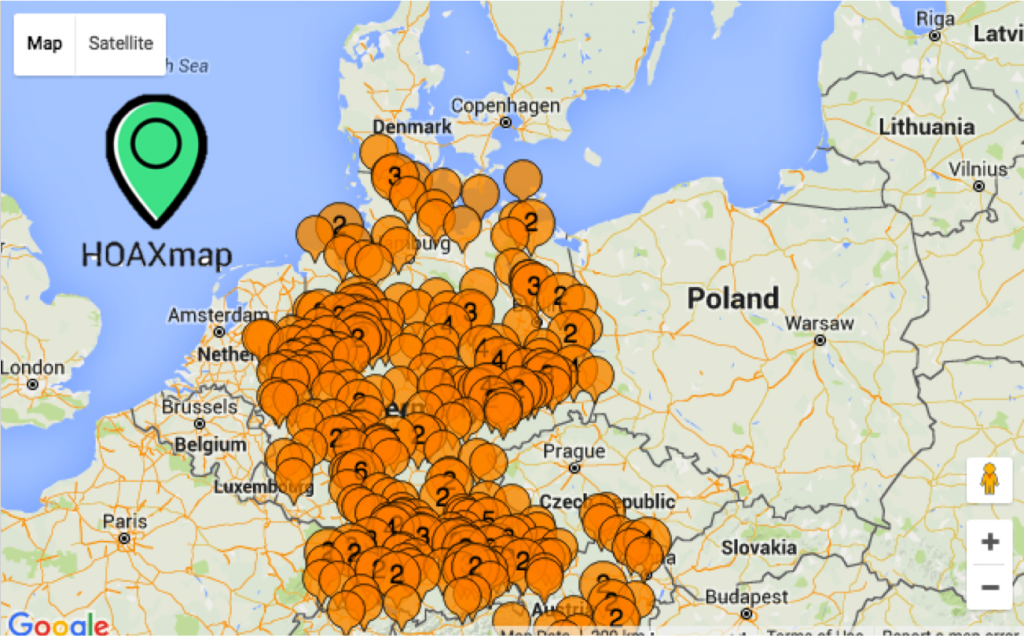
Click to visit Hoaxmap.

Over a million migrants and refugees entered Europe in 2015, leading many to dub this mass migration a “crisis.” Many are seeking asylum, especially those from countries experiencing considerable violence like Syria, Afghanistan, and Iraq. Many Europeans have reacted to the influx with fear, spreading stories that associate refugees and migrants with crime (something social scientists like to call “crimmigration”). In response, two German women created Hoaxmap to track and dispel rumors about refugees in Germany (a country that has been particularly welcoming to immigrants, per its Chancellor Angela Merkel’s directives). Of the 40 types of rumors tracked on Hoaxmap, most pertain to theft or sexual assault.

The discrepancy between documented and rumored crimes may reflect the way rumors spread and their connections to real events that people believe are plausible. Sociologist Gary Alan Fine, recently featured in an Atlantic article, agrees: “Once you have a plausible story then the criteria for information you need in order to believe [a new story] is much lower, because you would say ‘this is like what happened elsewhere.’” In fact, almost half of the rumors about sexual assault and rape associated with the contemporary immigrants cropped up in the two months following reported New Year’s Eve assaults on women in Cologne. Sociologist Mar Warr concurs that “even a small increase in apparent risk (like a locally reported rape or rapes) can generate substantial and widespread fear.” In reality, most crime in destination locations appears to have been directed at asylum seekers, rather than perpetrated by them.

Virtual reality still sees sexism. Photo by Nan Palmero, Flickr CC.

Star Wars conventions: one place where everyone is equal (if they hate Jar-Jar Binks). Or maybe not. As it turns out, even Star Wars has become a controversial area for discussing the place of feminism and powerful women in society. Work by sociologists CJ Pascoe and Tristan Bridges sheds more light on how sexism has infiltrated nerd culture. Following their recent book release, Pascoe and Bridges were interviewed by Broadly to help explain sexism in an unlikely arena.

Pascoe explains that “nerds” are consistently emasculated in society because they don’t participate in the same types of gendered dominance displays expected of young men. That might make it seem they exist away from expected dichotomies of gender roles. Bridges adds, however, that nerdy activities have become more mainstream due to popular television and media, so now the traditional nerd versus jock relationship is more nuanced.

Bridges said,

Nerds are, as a cultural “type,” emasculated… But it’s also true that there is a lot of toxic masculine behavior in nerd cultures. Think about it: #GamerGate happened among the nerds, not the jocks.

Pascoe agreed, explaining that fandom cultures create a space for men to be dominant even if they do not follow mainstream masculine pressures. The presence of women in these spaces might constitute a threat to the men within them. Still, Pascoe concludes that feminism is still a benefit for nerd culture overall. She says hopefully,

Increasing including and visibility of women, trans folk, and LGBQ folk in fandom communities will result in less damaging gender socialization for everyone—men included—and will help to change the way in which nerds themselves are placed on the bottom rung of some masculinity hierarchy.