
inequality

Photo by mahalie stackpole via flickr.com.

“Pomp and Circumstance” is no longer ringing in the rafters at college arenas across the country, and many members of the Class of 2013 are searching for their first post-graduation jobs. One wrinkle: though more than half of those graduates are female, according to a report by the American Association of University Women (AAUW), men working full-time one year after graduation will receive salaries that are 18% higher.

The study pushes back against notions that women’s wages are lower because of decisions now made later in the life course (such as leaving the corporate ladder to have children, for example). Researches found that approximately two-thirds of the pay gap just one year after graduation can be explained by field of study, grades, hours worked, and occupation, but the remaining portion is unexplained—that is, the only commonality is that the people getting the lower salaries are women.

The fact that so much of this pay gap escapes explanation poses a problem for rectifying the situation. Christianne Corbett, a senior researcher with the AAUW and one of the study’s authors, explains:

The pay gap cannot be solved by individual women alone. The bulk of the work has to be done by employers because it’s a systemic problem.

Learning is good, but doing will be better.

Photo by DearPioneer via Flickr.com

Our society has a bad habit of making the most important jobs–and the workers that keeps us healthy, happy, and comfortable–the least visible. As a recent article in The Atlantic points out, while citing work from NYU anthropologist Robin Nagle, this invisibility hides some dire issues faced by one essential group of service workers: the folks who make your trash disappear.

Sanitation workers, it turns out, have twice the fatality rates of police officers, and nearly seven times the fatality rates of firefighters. And their work has similarly life-or-death consequences in the long term… “A study done in 1851,” Nagle writes, “concluded that fully a third of the city’s deaths that year could have been prevented if basic sanitary measures had been in place.”

However, these issues aren’t likely to hit the spotlight until the work itself grinds to a halt. After all, nobody notices the role of the garbageman until their trash fails to be collected and lingers sadly on the curb. While the rest of the working world attempts to balance their lives via telecommuting and flexible schedules, sanitation workers are on a strict schedule in order to service the community. Is the honor of being a staple in a functioning society enough?

One of the things that struck me very early on and that continues to puzzle me is the way in which some forms of knowledge are considered more valuable than others…If I stop working tomorrow, I’m not sure New York City will suffer. If the Department of Sanitation, for whatever reason, stops working tomorrow, the city will suffer immediately. So whose work is more important here?

Without a total work stoppage, it seems garbage collectors and the work they do will remain dangerously invisible.


—–

For another take on the invisibility of workers, you can check out an old guest post I wrote over at Sociological Images.

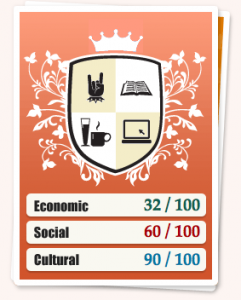
One survey participant's "coat-of-arms" generated by taking the Great British Class Survey. Click for image source.
One survey participant’s “coat-of-arms” generated by taking the Great British Class Survey. Click for image source.

Step aside, Downton Abbey, the British social hierarchy is astir again. The BBC Lab UK, with Manchester University’s Fiona Devine and Mike Savage from the London School of Economics, has conducted a class study of more than 161,000 people: the Great British Class Survey. In addition to studying each individual’s economic capital, the researchers also looked at respondents’ social capital (their social status and connections) and cultural capital (the nature and extent of their cultural interests and activities). According to Devine, this extensive survey allowed for “a much more complete picture of class in modern Britain” than previous work has captured.

The team’s results found that the traditional model of class was losing its relevance, with only 39% fitting into the working, middle, or upper class. According to the BBC, the team proposes “a new model of seven social classes ranging from the elite at the top to a ‘precariat’—the poor, precarious proletariat—at the bottom.”

The researchers believe the working and middle classes have waned because of the rise of the information age:

They say the new affluent workers and emergent service workers appear to be the children of the ‘traditional working class,’ which they say has been fragmented by de-industrialisation, mass unemployment, immigration and the restructuring of urban space.

In other words, information-age Britons don’t fit into industrial class structures. The people aren’t obsolete, but the categories may be.

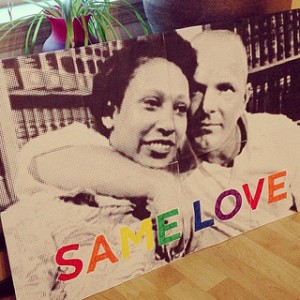
One sign, made to be displayed outside the Supreme Court as it hears arguments on DOMA and Prop 8, hearkens back to the days of arguments about interracial marriage, using a photo of Mildred and Richard Loving, who famously won their case, Loving v. Virginia, before the Supreme Court. Photo by Reed Probus via flickr.com.

Last week, the Supreme Court began hearing arguments regarding California’s Proposition 8, a ballot initiative that became a constitutional amendment legally defining marriage as an institution solely for the benefit of one man and one woman. On March 26, Justice Anthony Kennedy suggested the Court might simply dismiss the case, Hollingsworth v. Perry, without a ruling, so as not to dive into “uncharted waters,” particularly when the Court is considering another, related case.

Minnesota Public Radio invited Kathleen Hull, a sociologist at the University of Minnesota, to discuss the Court’s apparent willingness to side-step the case. She cited the results of a new PEW study showing that the younger generation was about 75% in favor of legalizing same sex marriage. She confessed:

Increasingly I find it difficult to engage the 18-22 year-olds on the same-sex issue. They are bored by it… They don’t know what there is to talk about.

Hull told MPR that California’s law not only lags behind public attitudes, but also behind the business and entertainment worlds. She also refutes claims that there isn’t enough data to rule on the subject if it’s considered through the lens of child-rearing:

I was a little stunned when one of the justices said something to the effect of “yeah, we don’t have any information on this.” […] We have decades of research now on the effects of same-sex parenting on children and it is all kind of in the same direction: That there is no difference from being raised by heterosexuals.

In fact, there is such a great deal of research in this area that the American Sociological Association went on to file an amicus curiae (that is, a “Friend of the Court”) brief outlining the social scientific consensus around the quality of parenting across different family forms. Interestingly, Justice Scalia then went on the record stating that there is no such consensus; he appears to have taken his cue from another amicus brief coauthored by Mark Regenerus, who has stirred up controversy with his own findings that children of homosexual parents do not fare as well as those raised by heterosexual couples. Clearly, this fight isn’t over.

Photo by Jeremy Richardson, via flickr.com.

In light of recent media buzz over research on how much sex husbands may or may not be “getting” for helping with the housework, the question of an equal-gender split of chores is back on the table (or maybe just stuffed it behind some bills and takeout menus on the counter).

Academic work on this topic often wanders into big, macro-level thinking about gender roles and social structures, but a recent article in The Atlantic pushes us to think about this issue in terms of the small, everyday choices that make home better for everyone. Alexandra Bradner outlines the problem for heterosexual families:

Because no one can afford to fully replace themselves at home while they are at the office… working mothers have famously picked up the slack for both partners, subsidizing our market with their free labor… this means that mothers are important, in all of the ways in which socially conservative forces routinely note. But it could also mean that [they] are exploited… to do more than their fair share of the family’s work, all without compensation.

Bradner offers three possible explanations for this problem:

  1. Men don’t see the work that needs to be done
  2. Men see what needs to be done, but don’t think they can do it as easily or effectively as their wives can
  3. Men’s workplace structures won’t let them take the extra time to do their share of the chores

Instead of arguing for a large-scale overhaul of “women’s responsibilities” or workplace regulations, Bradner addresses all three issues with one simple suggestion: Men should ask their partners, “Do I do half the laundry? Do I change half the diapers?” Then, couples can make conscious choices about work distribution.

When husbands and colleagues come through with these “small acts of heroism,” splitting the work, Bradner, agues we get closer to a society that cares about caring for people:

It’s not, exclusively, a conversation for and among women. This is a conversation about families and about babies and their care, which makes it a conversation about kindness, responsiveness, and our nation’s collective future.

Sure. Why not? Totally reasonable option there, Walter.
Sure. Why not? Totally reasonable option there, Walter. Easier than asking for help?

Our lives are often defined by the impossibilities we face, and that can lead to some strange decisions. Take, for example, the hit TV show Breaking Bad: a middle aged chemistry teacher with inoperable lung cancer decides it’s easier cook and deal meth than to ask others for help with his treatment. That’s the whole premise, and a new article in The Sunday Times suggests Mr. White’s decision may be the result of a heavy dose of the “masculine mystique.”

First published by W.W. Norton & Co. in 1963, Betty Friedan’s The Feminine Mystique argued that the dissatisfaction women felt with their lives wasn’t due to a “modern lifestyle” driving them away from an ideal feminine identity, but rather their inability to even imagine living full, independent lives. Friedan called upon women to recognize this possibility: a life free of gendered expectations.

Today, Stephanie Coontz suggests the media blitz over the “crisis of boys” (lower grades, reduced college graduation rates, and slipping economic prospects for men) stems from a similar problem with gender roles:

In fact, most of the problems men are experiencing today stem from the flip side of the 20th-century feminine mystique—a pervasive masculine mystique that pressures boys and men to conform to a gender stereotype and prevents them from exploring the full range of their individual capabilities.

The masculine mystique promises men success, power and admiration from others if they embrace their supposedly natural competitive drives and reject all forms of dependence. Just as the feminine mystique made women ashamed when they harboured feelings or desires that were supposedly “masculine”, the masculine mystique makes men ashamed to admit to any feelings or desires that are thought to be “feminine”.

Coontz also uses research on men’s shame around femininity and its impact on boys’ ability to imagine excelling in the classroom. Sound familiar?

In a book to be published next month, the sociologists Thomas DiPrete and Claudia Buchmann demonstrate that most of the academic disadvantages of boys in education flow not from a “feminised” learning environment, as is often claimed, but from a masculinised peer culture that encourages disruptive behaviour and disengagement from school. As Debbie Epstein, the British researcher, puts it, “real boys” are not supposed to study. “The work you do here is girls’ work,” one boy told an educational ethnographer. “It’s not real work.”

Gender roles create impossibilities for men and woman. And, while Breaking Bad takes the masculine drive for independence to a fictional extreme, the new lag in boys’ educational and economic achievement can be a new century’s call to get everyone to, in Coontz’s words, “act like a person, not a gender stereotype.”