
health

Photo of a pregnancy test by Johannes Jander, Flickr CC

New York recently changed their abortion laws to allow late-term abortions when the circumstances put the mother or the fetus at risk. The law has since spurred controversy, causing a backlash in many states to limit abortion access and curb women’s reproductive rights. The law and its political backlash highlight how we often think about pregnancy as a yes-or-no answer, an all-or-nothing commitment. But a recent article in The Upshot emphasizes how this binary view of pregnancies as either “planned” or “unplanned” is inaccurate. Recent research shows that in 9 to 19% of pregnancies the mother was not sure what she wanted at the time. However, most service providers do not account for this kind of ambivalence.

Sociologist Heather Rackin argues that the distinction between  “unintended” vs. “unwanted” pregnancies is important:

“It might not be that unintended pregnancy has all these negative consequences that we think about…for some people, it might have positive consequences.”

However, when pregnancies are unwanted, mothers tend to lack resources needed to raise a child. Family planning services can address this distinction by providing continual care depending on the needs and desires of their patients. To reduce the number of unwanted pregnancies, doctors have been encouraged to ask patients about their desires to become pregnant. For those that may not want to be pregnant, contraceptive methods with more efficiency than birth control may be ideal. On the other hand, doctors can provide prenatal guidance and a contraceptive method that is reversible for patients who are uncertain.

In short, pregnancy and parenthood are complex — decisions to raise a child cannot be reduced to whether a pregnancy is planned or unplanned.

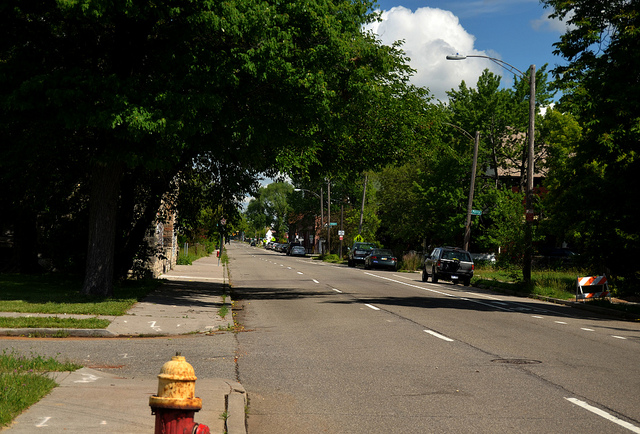
Photo by Joka Madruga, Flickr CC

As troops leave the military in droves, Nicolas Maduro appears to be losing his grip on the presidency in Venezuela. Presiding over a long running national crisis, Maduro remains in power nearly a year after an election that much of his political opposition, the United States, and many U.S. allies deemed fraudulent. Much of Maduro’s opposition claims the presidency should go to his political rival, Juan Guaidó. Possible intervention of the United States remains on the table, and there is a long history of U.S. intervention in the nation, which, if it happens again, could garner more support for Maduro.

As Guaidó now calls for national protest against Maduro, top military generals and a significant portion of Venezuelans, the chavistas remain at the president’s side. A recent article in The Nation by sociologists Tim Gill and Rebecca Hanson argues Guaidó should attend to the plights of chavistas — historic backers of Maduro’s far-left predecessor Hugo Chávez –for any presidential transition to be successful.

Gill argues that Guaidó’s initial rise was due in part to the U.S. influence on student movements that Guaidó was a part of meant to rid Chávez of his office, and enable the U.S. to retain a foothold in political and economic matters in Venezuela. Guaidó’s association with the United States comes at a price.

Hanson’s decade-long work with Venezuelans in Caracas suggests that even though many have continued to oppose Maduro, “some would prefer that [Guaidó] ‘put his house in order’ without outside intervention—that he demonstrate his ability to generate support within Venezuela.”

Whether it is Guaidó or Maduro in power, many Venezuelans believe that their country will be under the service of the United States or Russia and China, respectively.  

Gill and Hanson argue that Guaidó should instead attend more to his own people — such as offering free healthcare and the protection of human rights — which would serve the poor and working class through and after his transition into power. They also state this strategy should include aligning himself with former president, Hugo Chávez and his followers, the chavistas. Chávez remains a political icon beyond his death due to his legacy as an advocate for the poor and his outspokenness against American intervention in Venezuela. To these ends, Gill and Hanson conclude:

“There is no political future in Venezuela without chavista participation, and, one way or another, the opposition and chavismo will eventually need to work together toward a new future.”

Photo of a street lined with trees in Detroit. Photo by Nic Redhead, Flickr CCi

Evidence shows that trees and green spaces in urban areas offer a number of benefits, such as reducing stress and improving air quality. Despite these benefits, many residents of Detroit refused to allow the city to plant trees in front of their houses during a recent city “greening” initiative. An article appearing in CityLab draws from sociological research to demonstrate how a history of government abuses and lack of inclusivity of communities of color in key decisions explains why many Detroiters had this reaction.

Sociologist Dorceta Taylor published a report in 2014, arguing that white environmentalists make environmental justice projects less effective when they assume they know what is good for a neighborhood. By leaving communities of color out of the planning process, they are not able to anticipate or overcome challenges along the way. This proved true in Detroit. A recent article by Christine Carmichael and Maureen McDonough examined the reasons why Black residents resisted the city’s trees. CityLab reports: “It’s not that they didn’t trust the trees; they didn’t trust the city.”

Carmichael and McDonough found that Black residents were aware of the many benefits of living near trees. However, to some, the trees were a symbol of the city’s unwanted intervention in their lives. Amidst racial tension in the 1960s, the city began clearing trees from Black neighborhoods — ostensibly to combat Dutch elm disease, but some interviewees. Yet, some people believed the city cut down trees to increase police surveillance. This memory triggered their reaction to the modern tree-planting. Carmichael says:

“In this case, the women felt that [after the race rebellion] the city just came in and cut down their trees, and now they want to just come in planting trees. … But they felt they should have a choice in this since they’ll be the ones caring for the trees and raking up the leaves when the planters leave. They felt that the decisions regarding whether to cut down trees or plant new ones were being made by someone else, and they were going to have to deal with the consequences.”

This failed initiative in Detroit highlights the social forces that environmental organizations must consider when working in marginalized neighborhoods. Recruiting volunteers and administrators who come from the communities they are serving (something Detroit did not do) could help improve the process. As CityLab reports:

“[E]nvironmental justice is not just about the distribution of bad stuff, like pollution, or good stuff, like forestry projects across disadvantaged communities. It’s also about the distribution of power among communities that have historically only been the subjects and experiments of power structures.”

Photo of parents cheering on the sidelines by MSC U15 Green, Flickr CC

After the holidays, many parents breathe a collective sigh of relief. The holidays and their many challenges — travel, presents, and time with extended family — are so stressful that they make people wonder whether raising children has always been this hard. A recent The New York Times piece by Claire Cain Miller confirms that parenting has indeed gotten more time-consuming and expensive. Miller draws upon an arsenal of sociological research to illustrate how and why parenting has become so relentless.

Much of the pressure parents feel stems from wanting to pass on advantages to their children — especially since American children today are less likely to be as affluent as their parents. According to Phillip Cohen,

“As the gap between rich and poor increases, the cost of screwing up increases. The fear is they’ll end up on the other side of the divide.”

As a result, parents use “intensive parenting,” a child-rearing style that demands a great deal of their own time and resources. Sharon Haysdescribes intensive parenting as “child-centered, expert-guided, emotionally absorbing, labor intensive and financially expensive.” And according to Jennifer Glass, intensive parenting is rooted in the American view of child rearing as an individual — not societal — task, though it has begun to gain popularity in England and Australia.

But not all parents engage in these efforts equally, nor are they expected to. Jessica Calarco explains that intensive parenting allows affluent white mothers to ensure their children remain advantaged in society. Middle-class black mothers also use intensive parenting strategies, but for different reasons. According to Dawn Dow,

“They’re making decisions to protect their kids from early experiences of racism. It’s a different host of concerns that are equally intensive.” 

The demands of intensive parenting affect mothers’ lives far more than fathers. Liana Sayer’s research on American time use diaries shows that the time women spend parenting cuts into their sleep, time alone with their partners and friends, leisure time and housework. Moreover, while fathers today have increased the amount of time they spend with their children, mothers still spend significantly more.

So, drawing on research by over a dozen sociologists, Miller shows us that we are not wrong to find intensive parenting problematic. Not only does this parenting style disproportionately burden lower income families — and mothers in particular — but we’re not even sure it is effective in passing advantages on to the next generation. By stressing the importance of individualistic approaches to parenting, we fail to seek structural solutions that could ease the burdens of working mothers. In the words of sociologist Caitlyn Collins, intensive parenting “distracts from the real questions, like why don’t we have a safe place for all kids to go when they’re done with school before parents get home from work?”

Photo by Sandra Cohen-Rose and Colin Rose, Flickr CC

Originally published March 6, 2018.

In the United States, poor parents face intense scrutiny for their purchasing decisions, especially for buying unhealthy food for their children. New research sheds light parents’ decisions to buy or not buy junk food for their kids. In a recent op-ed for the Los Angeles Times, Priya Fielding-Singh explains that junk food consumption is an emotionally-rooted decision for impoverished parents.

Fielding-Singh observed the food-purchasing habits of 73 families. Families experiencing poverty honored their children’s requests for junk food more often than affluent parents. For poor families, junk food was one of few affordable luxuries. It was sometimes the only chance for parents to say “yes” to something their kids asked for. Fielding-Singh notes,

For parents raising their kids in poverty, having to say ‘no’ was a part of daily life. Their financial circumstances forced them to deny their children’s requests — for a new pair of Nikes, say, or a trip to Disneyland — all the time. This wasn’t tough for the kids alone; it also left the poor parents feeling guilty and inadequate.”

More affluent parents, on the other hand, had the means to grant these more indulgent requests. Saying “no” to junk food was their way of encouraging their children to have better dietary habits, as well as discipline and willpower. This doesn’t mean poor parents were unconcerned with their children’s nutrition. According to Fielding-Singh, “poor parents honored their kids’ junk food requests to nourish them emotionally, not to harm their health.” So, health disparities are not just about lacking healthy options or resources. This research shows that we also need t0 consider the emotional side of decision-making related to health. 

Photo of a an overturned wheel barrow in front of a solid metal fence. Photo by Michael Coghlan, Flickr CC

Addressing gun violence in the United States is often a heated political issue — polarizing constituents around what solutions are best to address it. Reducing the thousands of firearm homicides and nonfatal shootings that occur each year will require some serious debate and complex solutions. But there is one surprising factor that may reduce gun violence — cleaning up neighborhoods. A recent study featured in Huffington Post shows that this simple strategy of “cleaning and greening” vacant lots may have some far-reaching impacts on reducing crime.

The researchers partnered with the Pennsylvania Horticultural Society’s LandCare program to randomly select lots in Philadelphia for either a full transformation (picking up trash, putting up a fence and grass seed, and maintenance), a partial makeover (trash removal and mowing only), or left untouched.The researchers then measured shootings in the area from 2011 to 2015.

They found that areas that received the full “cleaning and greening” saw a 7% reduction in shootings, and the partially treated areas a 9% reduction, when compared to areas with no cleaning or maintenance. John Macdonald, one of the study authors, notes that this cleaning strategy did not appear to displace shootings to other blocks, and that cleaned up lots could have other health and safety benefits. He also noted that the solution has its limitations and needs more research to understand the impacts of “cleaning and greening”:

“You couldn’t green a city and just eliminate the chronic problems of gun violence that are highly concentrated in city blocks just by doing remediation to places.” 

Sociologist Eric Klinenberg notes “broken windows” theory — the idea that visible signs of crime, like broken windows, creates an environment that encourages further crime —  is the main impetus behind this experiment. However, he also points out that broken windows theory has been used to justify policing of low-level crimes like public drinking — particularly against people of color and homeless people. These policing practices were not only severely misguided, but completely overlooked the environmental aspects of the original theory:

“What’s so striking is that the [original 1982 article The Atlantic] was actually much more about broken windows than it was about bad people…For decades now, we have fought crime by trying to crack down on people.”

Rather than reducing crime “by punishing people,” Klinenberg suggests that we need more resources and social infrastructure in communities that are heavily impacted by crime. As he concludes, “What we have not done is invest in places and rebuild places where crime is concentrated.”

Photo of a wall of polaroid pictures representing discharged patients. Photo by midiman, Flickr CC

No, absolutely not. But married patients often receive more aggressive cancer treatment than those who are unmarried. Joan DelFattore, author of a recent article in The Washington Post, believes it might have something to do with doctors’ perceptions of unmarried people — specifically that unmarried people are less able to handle aggressive treatments than married people. DelFattore connected with sociological and medical experts to explore the potential importance of marital status in cancer treatments.

Some researchers speculate that overall unmarried patients may be starkly different than their married counterparts in terms of social support, depression, and social isolation. Sociologist Linda Waite, who co-wrote a book on the social benefits on marriage, concurs with these claims:

“In the U.S., where people have plenty of options for marriage, it’s likely to be those who are disabled or otherwise at a disadvantage who don’t marry….And so, they might indeed do worse in health care because of the underlying issues that caused them not to marry.

Others, like Susan Brown, point out that these perceptions are based on the assumption that social support comes primarily from spouses, rather than other family and friends. Instead, Brown argues that care providers should be open to patient support coming from people other than spouses or romantic partners. She says,

“Frame the discussion in terms of what the patient actually needs, rather than focusing on whether it’s provided by people in specific roles…Our whole system is built around traditional family roles, and that doesn’t work for many people.”

Good social support certainly matters for surviving cancer treatment, especially aggressive treatment. Where it comes from matters much less than the fact that it’s there.

Photo of a person with their back to the camera facing a train as it rushes past. Photo by Georgie Pauwels, Flickr CC

Despite growing research that people are having less sex in the United States, the perception that “everyone is doing it” persists, especially for young people. In a recent article, The Atlantic asked social scientists why young people aren’t having more sex.

Lisa Wade, author of the book, American Hookup Culture, says that one of the reasons for is that young people are more likely to have sex within relationships than in hookups, and always have been:

“Go back to the point in history where premarital sex became more of a thing, and the conditions that led to it…Young women, at that point — [the 1940s and 50s] — innovate ‘going steady.’ If you [go out with someone for] one night you might get up to a little bit of necking and petting, but what happens when you spend months with them? It turns out 1957 has the highest rate of teen births in American history.”

Part of the reason young people today are having sex more in relationships than in hookups — at least for women — might be that they are avoiding bad sex. According to Paula England, women report sex in hookups is less pleasurable than sex in relationships. Based on recent trends, it appears as though fewer young people are actually having relationships at all, marriage or otherwise. And the rise of online dating apps means that people meeting online are marrying more quickly, which might mean they are dating less overall, according to Michael Rosenfeld.

Despite a decline in sex overall for young people, this decline likely does not affect all young people equally. Since research shows that a good sex life appears to contribute to happiness and other health benefits, this also means that those who do not have a fulfilling sex life also do not reap those benefits. The article’s author, Kate Julian, concludes,

“Like economic recessions, the sex recession will probably play out in ways that are uneven and unfair. Those who have many things going for them already — looks, money, psychological resilience, strong social networks — continue to be well positioned to find love and have good sex and, if they so desire, become parents. But intimacy may grow more elusive to those who are on less steady footing.”

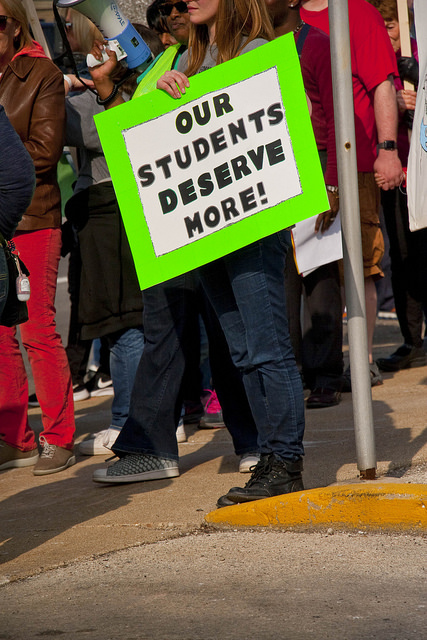
Photo of a protest sign that reads, “our students deserve more.” Photo by Charles Edward Miller, Flickr CC

In 2013, the abrupt closing of fifty Chicago public schools largely impacted people of color in West and South Side neighborhoods. Reasons for closures included under-enrollment and poor performance, but according to Chicago-based sociologist Eve Ewing, there is more to the story. In a recent interview with Morning Shift radio, Ewing describes systemic issues that contributed to under-enrollment, like the demolition of 22,000 public housing units across the city as part of the Chicago Housing Authority’s “Plan for Transformation.”

Subsequent school closings have disproportionality harmed students of color, and while these policies may not be intentionally racist, Ewing argues they reflect persistent structural racism in Chicago. For example, the school closings risk students’ safety, as many are now forced to trek through areas with perilous gang activity to reach their new schools. The emotional impact of school closings can also be devastating, comparable to family separations. Ewing observed close familial relationships between black students and their teachers and classmates, and thus the resulting separation can feel like losing a family member. And for “legacy” students, whose families have attended the same school for generations, the devastation is felt by entire families. To emphasize the severity of these school closings, Ewing makes a powerful connection between historical racism and policies today:

“A principal who was speaking at a school closure meeting, a black woman, stood up and said, ‘I feel like I’m at a slave auction right now.’… And I think that obviously there are many important distinctions between this kind of separation and chattel slavery, but I do think it’s important to think about, for black children, what it means to take them away from situations of stability, where they have deep, meaningful bonds with the adults and the other children in their lives.”

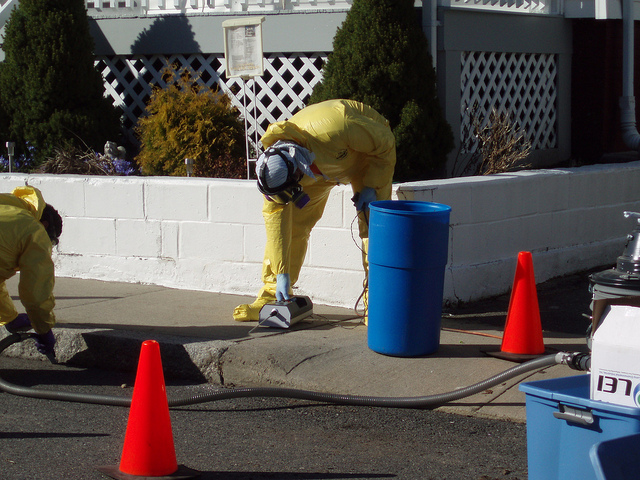
Photo of emergency worker on a street responding to a release of mercury. Photo by Massachusetts Dept. of Environmental Protection, Flickr CC

Gentrification is rapidly transforming once-industrial cities into trendy urban neighborhoods.  However, the dangers that lie below the surface – “hundreds of millions of pounds” of hazardous wastes released by small and large businesses each year – fail to be addressed at the same rate. In a recent interview in The Guardian, sociologists Scott Frickel and James R. Elliot discuss findings from their book about the limitations of current data on environmental hazards and how gentrification has diversified the types of people at risk of exposure to toxic waste.

Frickel and Elliot explain that government databases on hazardous sites only appeared in mid 1980s, and databases often exclude manufacturers that have few employees or release under a specified threshold of pollutants. Reporting is also completely voluntary, meaning the databases only contain the information facilities choose to report. In their research, Frickel and Elliot use old manufacturing directories to address these limitations by creating their own database. They found manufacturing to be heavily concentrated in certain “legacy sites,” or areas where you would expect to find heavy industry with large concentrations of factories or other facilities. However, these site boundaries also spread out slowly over time, and so too did the hazardous wastes. While disadvantaged social groups are more typically exposed to these pollutants, gentrification has disrupted this to some extent.  Elliot explains,

“We do also find things that we’ve come to unfortunately expect from the vast research on environmental injustices… These larger facilities are opening up and disproportionately concentrating in areas of ethnic minority and low-income settlement. But when we begin to consider the spread and the accumulation across cities as land uses change, that picture also changes. We begin to see, as one of our colleagues put it, that we’re all in this together. Many different types of neighborhoods are exposed.”

To remedy this exposure to hazardous materials, Frickel suggests that urban planners seriously consider the history of pollutants that exist below our cities when addressing sustainability. It remains to be seen how gentrification will impact citizens’ ability to hold businesses and government officials accountable for these environmental hazards, but recent events such as the water crisis in Flint should serve as a key example of how far we have left to go to address toxic hazards.