culture

OTA Photos via Flickr.


With the baby boomer generation hitting retirement ages, it’s important to consider how retirement affects this enormous cohort and their families. One unique aspect of today’s retirement is the occasional retirement overlap: both parents and children are retired at the same time. In an interview with The New York Times, Phyllis Moen of the University of Minnesota says,

This is still historically unprecedented, where you have older people and their still-older parents. Families are having to figure out those intergenerational relationships.

This may be a situation unique to the current time period, though. For the trend to continue, the younger generation must retire while their parents are still alive. Since expected and actual retirement ages have been rising for more than a decade, future generations may not be able to afford to retire at all, let alone alongside their parents. Then again, “by the time their children retire, we may have even more medical advances to help us live even longer,” says Professor Moen.

One potential downside of dual-generation retirements is that they can add retirement stress in the form of caregiving for older family members. As Moen states, “The pressures are less intense while the younger generation is still employed,” because “work can offer an escape from the stress of caregiving and the stress of that family relationship.”
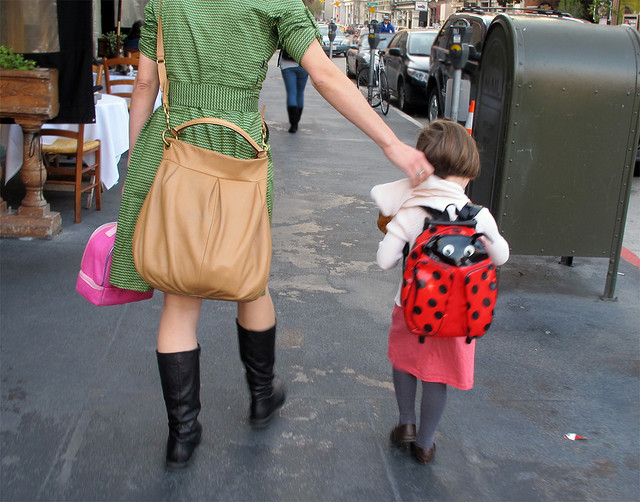
Photo by Anita Hart via Flickr CC


Sociologists Jamie Seabrook and William Avison’s research shatters the myth that children from single parent homes have worse outcomes than kids living with both parents. They told Northumberland Today that other factors better predict the future than whether a child lives with one versus two parents. “Instability really is the risk factor,” said Avison. “When there is a lot of transitioning in the family environment, that kind of instability doesn’t seem good for kids’ educational development and growing up to be adults.” They found that family structure had no impact on a child’s educational achievement or income, as long as the family structure remained consistent over time. When single mothers partnered and re-partnered several times, the researchers saw negative impacts on child outcomes compared to kids whose single mothers consistently single. Another interesting finding of the study is that children who grew up in stable single parent homes are less likely to divorce or separate than children who grew up in two-parent homes.

“The overarching conclusion is we have to be very careful saying the type of family you grow up in predicts kids’ success,” Seabrook said. Even if single parent homes are economically less advantaged than two-parent households, less money does not translate to differences in child education.

Ian Philp, director of the Clean Energy Institute, shares a maxim his mother taught him: "Have a clear, tangible idea of what success---or your goal---looks like when you set out." Photo by MaRS Discovery District, Flickr CC.
Ian Philp, director of the Clean Energy Institute, shares a maxim his mother taught him: “Have a clear, tangible idea of what success—or your goal—looks like when you set out.” Photo by MaRS Discovery District, Flickr CC.

It’s March, and many people’s well-intentioned New Year’s Resolutions have long gone out the window. Making lifestyle changes can be difficult, but in an interview with Washington Post, sociologist Christine Whelan sheds light on how to make a fresh start.

Her first piece of insight comes straight from sociologists’ time use surveys: consider a new habit as not only adding to your schedule, but also subtracting time from other activities. “If I said ‘I want to go the gym for an hour three times a week,’ the first thing I’d have to figure out is, what am I not going to be doing during those hours. But we don’t tend to think about that,” Whelan points out. Prioritization is key. Weighing the costs and benefits of sacrificing an hour spent sleeping or watching House of Cards for an hour at the gym will help determine if your goal is manageable or needs reworking.

Whelan also stresses the importance of making sure the new goal is something you want to accomplish, rather than something you feel like you should be doing. “You’re much less likely to accomplish a change if you don’t want to do it, and it’s not in keeping with your values.”

Finally, she advises against creating a laundry list of goals in favor of developing one new habit at a time. Specific goals are more likely to become habits because, according to Whelan, distinct aspirations are “SMART”:

Specific

Measurable

There’s a Reward for sticking to it

Progress is Trackable

After 90 days of practice, it’s likely that your concerted lifestyle change will pay off: “The longer you stick with it, the more likely it is you’ll develop a habit that you don’t have to think about. It doesn’t require self control, there’s not a lot of active internal debate. You just do it.”

Click to pre-order the book.Sociology and stand-up comedy have a lot in common: both reveal deep truths about life experiences and reveal the connections and disconnections of humanity. One just has more citations.

For his upcoming book Modern Romance, stand-up comic and Parks and Rec star Aziz Ansari teams up with sociologist Eric Klinenberg to tackle modern dating in the age of technology. Klinenberg is well known for his work on culture and media, as well as his recent book Going Solo: The Extraordinary Rise and Surprising Appeal of Living Alone. Ansari’s stand-up often pokes fun at the cultural shifts in relationships, but he recently told Time that academic research, including that of MIT sociologist Sherry Turkle, inspired him to delve deeper into the science behind modern relationships:

“I thought it would be kind of interesting to take my point of view and a conversation with someone from an academic field and put that together. If I could do that as a book, I would be able to go deeper into this area than I can in my stand-up.”

For the study, Ansari and Klinenberg interviewed hundreds of people worldwide about relationships, marriage, social networks, and technology. The end result uses Ansari’s comedic spin to explore the sociology behind the changing course of modern relationships. And on stage, it means getting to see Ansari act out a line graph of relationship intensity. How could you resist?

Click here to listen to an Office Hours interview with humorist and story-teller Dylan Brody about his work as “stand-up sociology”.

By Thomas8047 via flickr cc.


Picture a family holiday dinner. Food is on the table, everyone is gathered together, and a high school or college student is text messaging under the table. Upon prodding questions about the recipient—“Are you dating?”—the irritated adolescent might glance up just long enough to mumble, “We’re just talking.”

Sociology professor Kathy Hull shares her thoughts about the changing relationship landscape with the Star Tribune. A generation or two ago the word “dating” often meant a casual, nonexclusive relationship involving the occasional dinner and movie without commitment. That idea has changed. Hull explains,

“Going on a date now has more significance, when the option of hooking up or just hanging out in a group-friend setting is more prevalent. When people say they’re dating someone, it usually means they’re in a relationship.”

Hull suggests the shift in terms has come out of an extended transition to adulthood, with more young adults pursuing college and delaying marriage and family until they’ve secured a stable job. After graduation, Hull says, many millennials decide to start dating in the traditional sense.

“It’s not until they leave college that some people go back to the idea of using dates as a way to check out potential partners, rather than a way to get into a committed relationship.”

With so many waiting to play the game of love, it appears they may, to some degree, forget how—perhaps one more driver behind the rise of online dating.

The 2015 Oscar nominees are announced. Photo by RedCarpetReport via flickr cc. https://flic.kr/p/qwEuL7
The 2015 Oscar nominees are announced. Photo by RedCarpetReport via flickr cc.


Following the whitest Academy Awards in nearly 20 years, UCLA’s Ralph J. Bunche Center for African American Studies released its 2015 Hollywood Diversity Report. Sociologist and center Director Darnell Hunt described the findings to The Hollywood Reporter: “Hollywood is not progressing at the same rate as America is diversifying.”

The study, which surveyed the top 200 worldwide box office films and 1,105 television series in 2012 and 2013, found that racial minorities and women were substantially underrepresented in both acting and directing roles. Those films with at least 30% diversity, however, did best in the worldwide box office tallies.

Study co-author Ana-Christina Ramon believes these numbers show that, “audiences, regardless of their race, are clamoring for more diverse content.” So what’s the holdup?

“It’s a high-risk industry,” says Hunt. “People want to surround themselves with collaborators they’re comfortable with, which tends to mean people they’ve networked with—and nine times out of 10, they’ll look similar. It reproduced the same opportunities for the same kind of people: You’re surrounding yourself with a bunch of white men to feel comfortable.”

Hunt suggests that emerging digital platforms like Netflix and Amazon could create more opportunities for on-screen diversity. Still, he is hesitant to make grand claims about progress: “It’s getting better, but it’s not getting better fast enough. And it’s still a big problem.”

A screenshot from a Sesame Street clip about parents in prison.

If you happen to be watching Sesame Street, you may notice a new Muppet named Alex. The child’s father is in prison. Many viewers may consider Alex’s incarcerated parent an unusual, heavy topic for the program that has taught generations of kids their ABC’s and 123’s. But children across the country, particularly African-American children, are in Alex’s position.

The Nation consulted sociologists Christopher Wildeman, Sara Wakefield, Kristin Turney, and John Hagan about the effects of parental incarceration on children. They found that children with incarcerated parents had significantly higher rates of aggression, mental-health issues, behavioral problems, and risk of homelessness than peers whose parents had never been to prison. However, although they have identified a key link between parent imprisonment and children’s mental health, researchers like Turney are still figuring out how and why this connection exists. “Is it stigma, attachments, income loss, parents breaking up and relationships not surviving? We don’t know,” Turney reports.

More than a decade ago, Hagan stated that effects on children might be “the least understood and most consequential” results of incarceration. According to Wildeman, 1 in 30 white children and 1 in 4 black children born in 1990 experienced a parent going to prison before turning 14. The surge in incarceration rates disproportionately affects African-American children. Even if their fathers have a college degree, these kids are twice as likely as white children with parents who didn’t finish high school to have a parent in prison. And regardless of whether incarceration rates decline in the next few years, the effects of current imprisonment rates will last for several generations. That means that optimism about any decline in mass incarceration “must therefore be set against the backdrop of the children of the prison boom—a lost generation now coming of age,” according to Wildeman and Wakefield.

Courtesy the Boston Public Library.

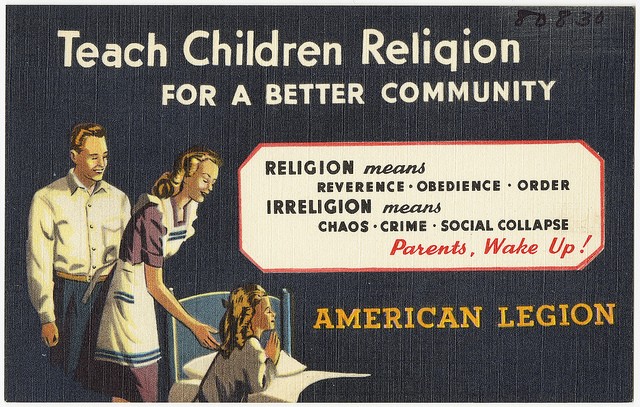
Sociologist Penny Edgell discussed the changing landscape of religion in public life over the past decade with Houston Matters. Since 2003, issues of religion in public life have shifted less than was previously expected. However, around three-quarters of the population worries that religion is divisive presence, and not just between religious and growing non-religious groups. People who embrace non-mainstream, mainly non-Christian religious beliefs in the US feel left out of discussions around key issues in public life, Edgell explained. Even generic references to “god” usually refer to the Christian God. Still, there is increasing support for religious pluralism and for teaching religious diversity in public schools. Edgell says that Americans generally have a broad sense of unease with religion in public life, but value freedom of religious expression and an understanding of the tenets of other faiths.

Aside from being a civil liberty, religious expression acts a marker of morality in public life. This, Edgell explains, can mean trouble for the estimated one-third of Americans who don’t claim a religious identity. About half of Americans believe that being religious is important for being a good citizen, and they are more likely to trust religious people because they assume they share the same values. Edgell found that 27% of Americans agree that “atheists don’t share my moral values.”

Photo by WoodleyWonderworks, Flickr.com.

School segregation has been the topic of social science research and public debate for decades. Still, the average person may think than in the post-Civil Rights era, when the law explicitly forbids racial discrimination, school segregation is an issue of the past. In fact, sociologists of education point to changes in demographics, living arrangements, and school funding that have lead to unforeseen issues increases in school segregation. One city in particular, San Francisco, is seeing a resurgence; the number of schools considered “racially isolated,” or over-representative of one race, has climbed there in the last few years.

A recent article in the San Francisco Public Press describes new practices that determine where students get placed and how such mechanisms can undermine diversity. Parents can apply for placement across San Francisco’s public schools, meaning that many students don’t go to school in the area they live. This enrollment fluidity may seem helpful for increasing diversity, but the ability to make informed and effective choices within school system application is nuanced and heavily influenced by who you know, what you know, and what matters to you. Parent choices, especially within particular racial or ethnic groups, can exacerbate school segregation.

The article quotes Prudence Carter, a Stanford sociologist who studies inequality and education and was involved in creating the San Francisco school-choice system (implemented in 2010). Carter uses Asian families as a case in point: “there’s a lot of pride in the Chinese community in having created educational enclaves.” For example, a Chinese family is more likely to send their children to a school with a certain reputation; replicated across a community, it can lead to a school with a disproportionate number of Chinese students. Similarly, disproportionate concentration of students from certain income backgrounds can lead to a racially segregated student body.

If parents want to be part of segregation solution, Carter advises, “You have to think grander, and beyond your own self-interest… So long as we live in an individualistic and self-interested country, we’re going to probably continue to have this problem.” In her view, policy makers will have to adapt legislation to account for the sociology of parent choice when trying to increase diversity in education.

The Preiser Project, Flickr CC.

Who doesn’t love a four (or five!) day weekend? An extra day or two away from the desk means more time for leisure activities and to disengage from work. But Scott Schieman, sociology professor at University of Toronto, warns that consistently short work weeks may not help work-life balance in the long run. In an interview on CBC’s Daybreak South, Schieman said,

I think what we have to really look at are the nature or the demands of the job—and how those demands can either be compressed in particular time periods, or whether they actually need to be spread out, and that’s when you get to some of the cons.

When the same amount of work needs to be done in three days instead of five, it means longer hours. It’s like cramming for a college exam, when it’s physically tiring and harder to process information. Even if three days of intense work seems like a good trade for four days at home, it’s still unlikely that “days off” mean not working, Schieman points out: “What if there’s a deadline, what if there’s an ongoing project? Can you really break from that fully?” Additionally, people with families may find the long hours associated with shorter work weeks incompatible with obligations like carpool, and non-stop work is unlikely to happen in a house with a demanding toddler. Savoring the occasional holiday might provide a better balance, aligning with kids’ school days and taken-for-granted “business hours,” while adding in a “bonus” day of leisure intermittently.