
culture

Image by Ginny Washburne via FLickr CC


Most people think of sociology as marriage-neutral, or even anti-marriage because the institution has been linked to patriarchy, heteronormativity, domestic abuse, and a general suppression of women’s rights; however, the field has seen a shift toward a pro-marriage point of view (see, for instance, scholars like Andrew Cherlin). In the Boston Globe, Philip Cohen from University of Maryland College Park says, “Criticism of marriage as a social institution comes from the universal and basically compulsory system of marriage in the 1950s.” Since ‘50s-style marriage is no longer necessarily true, it makes sense to see an evolving scholarly outlook on the issue.

Those who say matrimony matters point to its advantages for low-income children. According to Sarah McLanahan, children with unmarried parents spend less time with their fathers and receive less financial support. Cherlin, for his part, says marriage, more so than cohabitation, contributes to family stability that leads to better child outcomes.

The evidence doesn’t necessarily mean that marriage causes the “good things” attributed to it, either. Yes, unmarried mothers tend to make less money than their married counterparts, but marriage thrives among the more educated. Those with college degrees wait longer to marry and have more resources to give their children. This means the specific people who marry make it look like married people have better outcomes, when usually they were privileged before exchanging vows. Putting a ring on it will not automatically make people healthier, wealthier, or wiser.

This disparity in findings and even recommendations about marriage points to an issue bigger than family values: “This class divide in marriage and family life is both cause and consequence of the growing inequality in American life,” said W. Bradford Wilcox, a sociologist at the University of Virginia and director of the National Marriage Project. Kristi Williams elaborates that economic circumstances can influence marriage, so trying to change marriage without fixing economic disparities is wrong-headed. Philip Cohen agrees, saying, “The idea that the culture is going downhill and we need a cultural revival happens to be very closely related to the idea that we should not address poor peoples’ problems by raising taxes and giving poor people money,” he said. “So there’s a political element” in marriage promotion efforts.


 

Photo by Juan Luis via Flickr.


Chin-Strap, Fu Man Chu, Burt Reynolds, or Full Marx. National competitions honor it. Hockey players grow it. Dress codes may moderate it, and now finally, sociologists weigh in on it. We’re talking beards.

In early April, a men’s fashion article in The Guardian explored the historical significance of beards, describing, for example, how early Egyptian pharaohs wore fake beards as a symbol of power. Since then, facial hair’s place in men’s fashion has waxed and waned, at times symbolizing political power while at other times representing radical lifestyles and rejections of social norms. French sociologist Stéphane Héas explained the political and social connotations of beards.

“Being hairless and clean-shaven, or not, is far from neutral,” Héas said. “Social norms determine how far a beard should be allowed to grow, when it should be trimmed or shaved off.”

He goes on to explain how facial hair has reinforced gendered power in modern western cultures:

The patriarchal, male-dominant nature of western society in the 19th and 20th century almost certainly explains the appeal of sophisticated beards and moustaches. Policymakers made their presence felt through their discourse and facial hair.

Yet despite the power and authority associated with having facial hair, Héas notes that, “being completely hairless has become almost mandatory for western women and is spreading to men.” The beloved beard may be on its way out yet again.

moynihanSince the 1965 “Moynihan Report,” conversations about disproportionate inequalities between white and black communities have historically focused on “black culture”—that is, explanations of racial discrepancies as products of different values, social norms, and cultural practices within black communities. The study, formally titled “The Negro Family: The Case for National Action,” saw black poverty as the result of non-nuclear family structures and absentee fathers. Now, University of Maryland sociologist Philip N. Cohen tells Vox that academics are leaving the argument behind because it simply doesn’t hold up:

The predominant view now is that there is a specific condition of inner-city concentrated poverty especially in black communities, because of racial segregation and racism, and the structural conditions are very damaging to family life, family relationships. People lose jobs and housing because of incarceration, job discrimination, etc., which create real obstacles to family stability, which in turn is a challenging condition for children’s development.

Indeed, as social science has matured and issues of race and racism have come under scrutiny and greater focus, more people are aware that structural issues, rather than personal ones, best explain advantage and privilege by race. Hopefully 1960s-era thought is well on its way to being replaced with more nuanced understandings of the factors behind racial discrepancies.

A climber on El Capitan. Photo by Naotake Murayama via Flickr.


“You remind us that anything is possible,” President Obama tweeted at Tommy Caldwell and Kevin Jorgeson after they summited El Captain in Yosemite National Park. The pair “free climbed” the world’s largest block of granite, only using ropes and harnesses in the case of emergency. Many of the world’s best climbers are those who take the biggest risks—and most of them happen to be from the United States.

To kick off the “What It Means to Be American” event “Are Americans Risk-Takers?” TIME featured a roundtable discussion about why risk-taking seems unique to American culture. Zulema Valdez, sociologist and author of The New Entrepreneurs: How Race, Class, and Gender Shape American Enterprise, said that the risk-taking mentality in the United States comes from the common belief that America is the land of opportunity: “where anyone with a good idea, a positive attitude, and a willingness to work hard can own a business and succeed.” Indeed, the U.S. has the highest percentage of entrepreneurship among industrialized nations.

What the achievement ideology leaves out, however, is that the United States is highly stratified, and successful people rarely achieve the American dream through hard work alone. The most successful business owners tend to be white, middle-class men. While they surely worked hard and took risks, most were not risking total failure. Valdez told TIME:

The reality… is that risk-taking, while perhaps a necessary ingredient for entrepreneurship, is not sufficient in the absence of human capital (education and work experience), social capital (business networks), and financial capital (personal savings, wealth, access to credit or loans).

In other words, even if a person takes a risk, the right resources act as a safety net and diminish the consequences of failure. For Caldwell and Jorgeson, free climbing El Captain, back-up plans and high-tech gear lowered the risk of plummeting to their deaths—and enabled them to take more risks to proudly reach the summit. Those aiming to achieve the American Dream need human, social, and financial capital rather than ropes and harnesses.

Image via Camilla Eriksson.


Swedish nursery school teachers and LGBT groups have banded together over the addition of a gender-neutral pronoun to the official Swedish language. It all started five years ago. These two groups were among the first to use the gender-neutral hen as an alternative to the female pronoun hon and the male han. Now the common, conversational use of hen has led the Swedish Academy to include it in the newest edition of the country’s official.

In the Washington Post, linguist Sofia Malmgård explains that there are two ways to use the new pronoun:

First, if the gender is unknown or not relevant (as in: “If anyone needs to smoke, ‘hen’ may do so outside”). Second, it can be used as a pronoun for inter-gender people (as in: “Kim is neither boy or girl, ‘hen’ is inter-gender”).

In other words, the pronoun provides a way to talk about someone and disregard hen’s gender when it doesn’t matter or doesn’t conform to the traditional masculine/feminine binary.

In Sweden, ranked fourth on the World Economic Forum’s 2014 gender equality report, gender-neutral education is in vogue. Nurseries, kindergartens, and preschools have been at the forefront of the movement to help children grow up without feeling the impact of gender biases. At Egalia, a preschool in Stockholm, traditionally gendered toys and games are placed side-by-side to encourage children to choose by preference rather than convention; students are not referred to as male or female; and gender-neutral books line the shelves.

LGBT groups have also embraced the new pronoun as a way to raise awareness. Experts are cautiously optimistic that officially recognizing the word will encourage more people to use it., Lann Hornscheidt, a professor of Scandinavian languages and gender studies, believes hen really will help fight sexism and gender biases. As he told the Post,

The introduction of a pronoun which challenges binary gender norms has been an important step, following a more thorough debate over the construction of gender within the last 10 years.

Screen Shot 2015-04-09 at 12.34.39 PM


In debates about whether to ban porn, it’s interesting to consider what a world without legal “adult entertainment” would look like. Sociologist Chauntelle Tibbals, author of the forthcoming book Exposure: A Sociologist Explores Sex, Society and Adult Entertainment, talked to MTV after the show “Guy Code” made a video called “Life Without Porn.” The video, embedded below, mocked the mundane situations that often serve as the opening for pornographic films—a visit to the auto repair shop, a pizza delivery, or a visit from the TV cable provider—where, instead of ending in an erotic encounter, the actors’ teasing dialogue ultimately ends with advice on how to reheat pizza or another item to add to the car repair bill.

Tibbals argues that a world completely devoid of porn is not possible. From cave drawings and carvings to Renaissance paintings to avant-garde photography, humans create images of sex and sexuality:

“Us wanting to visually represent sex has been around since humans have been around, and porn is just another medium to do that. I don’t think it’s possible for there to be no erotic representation,” Tibbals told MTV.

But what if we bracketed erotic representation and just eliminated commercial porn? Tibbals says it’s not so simple. Billions of people watch billions of dollars worth of porn:

…if you limit other people’s capacity to professionally produce and legally produce that content, the demand for it is not going to go away.

Instead of disappearing, she believes a black market would expand, putting people who work in pornographic film creation at higher risk of sexual exploitation:

Right now, when people watch porn legally made, they know that they’re watching consensual sex on a safe set run by professionals. That’s not to say that every set is perfect, but consumers can watch that content and know that the people working on it want to be there.

Photo by JD via Flickr. Click for original.


Parents often equate good parenting with spending as much time with their children as possible. The idea is that, in those hours, parents will cultivate particular characteristics in their children that will contribute to bright futures. But is helicopter parenting really worth it? Sociologists Melissa Milkie and Kei Nomaguchi share the findings of their recent study with the Washington Post: “I could literally show you 20 charts, and 19 of them would show no relationship between the amount of parents’ time and children’s outcomes. . . . Nada. Zippo,” says Milkie.

It’s not the number of hours, but quality of time spent together that matters. Interactive activities like reading to a child, sharing a meal, and talking one-on-one benefit kids, while just watching TV together may be detrimental, as Amy Hsin found. Still, Milkie and Nomaguchi’s study did find that teenagers who engaged with a parent for six hours per showed lower levels of delinquent behavior and drug use than peers who spent less time with their parents.

The authors dug deeper, finding that when a parent was overly-tired, stressed, cranky, or feeling guilty, spending time with their children could lead to more behavioral problems and lower math scores. Nomaguchi says, “Mothers’ stress, especially when mothers are stressed because of the juggling with work and trying to find time with kids, that may actually be affecting their kids poorly.” This particularly impacts parents from low-income households who often lack access to social resources for improving mental health, but still feel the pressure to be “good” parents by spending time with their children. In fact, Milkie and Nomaguchi found that the biggest indicators of child success were mothers’ income and education levels:

“If we’re really wanting to think about the bigger picture and ask, how would we support kids, our study suggests through social resources that help the parents in terms of supporting their mental health and socio-economic status. The sheer amount of time that we’ve been so focused on them doesn’t do much,” says Milkie.

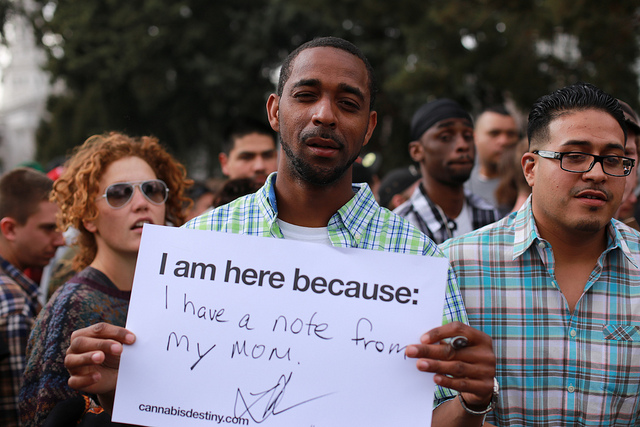
This 2013 Denver rally attendee probably still needs that note from his mom. Photo by Cannabis Destiny, Flickr.


“Spark it up!” Sure, next time you’re in Colorado, you might want to stock up on Cheetos and take advantage of the state’s legalized marijuana. That is, if your skin’s the right color.

According to a new report by the Drug Policy Alliance, a pro-legalization collective, it’s already apparent that there are still racial disparities in the enforcement of the new drug laws in CO. As explained in an Associated Press article, laws that penalize carrying amounts in excess of 1oz of marijuana and the public use of the substance have disproportionately affected blacks compared to whites. Total marijuana arrests have dropped by nearly 95% since legalization, but blacks are twice as likely as whites to face sanctions under laws that criminalize illegal cultivation, public use, and excess possession. In Washington, the same phenomenon can be seen at work, the report states. In Seattle in 2014, one-third of the marijuana citations were issued to blacks, who only make up 8% of the city’s population.

According to University of Wisconsin sociologist Pamela E. Oliver, this discrepancy is indicative of African Americans’ overall treatment under the law, even after policy shifts: “Black communities, and black people in predominantly white communities, tend to be generally under higher levels of surveillance than whites and white communities… this is probably why these disparities are arising.” This discrepancy shows up in nearly all crime policing, from homicide to drug laws to robbery. In Colorado, it’s really killing the buzz.

Purple Sherbet Photography via Creative Commons


Sociologists are quite familiar with the combination of marginalized identities that can lead to oppression, inequalities, and “double disadvantages.” But can negative stereotypes actually have positive consequences?

Financial Juneteenth recently highlighted a study showing that gay black men may have better odds of landing a job and higher salaries than their straight, black, male colleagues. Led by sociologist David Pedulla, the study sent resumes and a job description to 231 white employers nationwide, asking them to suggest starting salaries for the position. Resumes included typically raced names (“Brad Miller” for white applicants and “Darnell Jackson”) and listed participation in “Gay Student Advisory Council” to imply the applicant’s sexuality. Pedulla found that gay Black men were more likely to receive the same starting salaries as straight white men, whereas gay white men and straight black men were offered lowered salaries.

Pedulla’s findings have sparked a conversation among scholars and journalists about the complexity of stereotypes surrounding black masculinities and sexualities. Organizational behavior researcher and Huffington Post contributor Jon Fitzgerald Gates also weighed in on the findings, arguing that the effeminate stereotypes of homosexuality may be counteracting the traditional stereotypes of a dangerous and threatening black heterosexual masculinity.

Read Pedulla’s entire study, published in Social Psychology Quarterly, here: The Positive Consequences of Negative Stereotypes: Race, Sexual Orientation, and the Job Application Process.

Photo by Alan Levine via Flickr Creative Commons.

In years following the 2008 recession, many Americans are still scrambling to find enough work hours to make ends meet. One emerging trend is “clopening,” when an employee works the closing shift, then opens the same business a few hours later. Piled on top of commuting, trying to get some sleep, and attending to family duties, the few remaining precious hours between shifts are overbooked. That can have negative consequences on health. Sociologist Gerhard Bosch tells the New York Times about the European Union’s required 11-hour rest period between shifts: ““If a retail shop closes at midnight, the night-shift employees are not allowed to start before 11 o’clock the next morning.”

Even though some unions in the United States have negotiated similar required “between shifts” time, there is not yet a national labor law. However, several states have taken steps toward Right to Work laws some hope will alleviate the long, inconsistent hours many employees face.

Some business owners claim that some employees prefer “clopening” to working 9 to 5, pointing, for example, to students with busy daytime class schedules. However, one student worker told the Times that working on the clopening schedule meant quitting his pursuit of a master’s degree—he’d lost focus and developed chronic exhaustion.