
culture

Paxson's new book, available from UCPress.
Paxson’s new book, available from UCPress.

American cheeses—not just the individually-wrapped slices—are making a comeback, as documented by MIT’s Heather Paxson, who recently published The Life of Cheese: Crafting Food and Value in America. The anthropological work details her research into the people and processes behind artisan cheeses in the U.S. Looking over the last 50 years, Paxson indentifies a host of factors behind the re-emergence of American artisanal cheese: environmentalism, feminism, markets (both local and international), and 9/11, among others. In an interview with the Boston Globe, she commented:

Like most social movements, it only looks like a movement in retrospect… Cheesemaking appealed to people the way that some start-up dot-coms did. It was the rural counterpart to that.

Paxson, who studies “how people craft a sense of themselves as moral beings through everyday practices, especially those activities having to do with family and food,” became curious about artisanal cheese after eating a sample of Hooligan, a Connecticut cheese, and asking the questions that are the genesis of so much social science research: Who? How? Why?

Working from home photo by Victor1558 via flickr.com.

Best Buy has ended its Result Only Work Environment (ROWE) program, which famously allowed employees to telecommute, working in the office on a set schedule, or have the flexibility to do both. Evaluations were based solely on job performance, with no consideration of attendance. Best Buy’s policy change follows a similar change at Yahoo, where CEO Marissa Meyer no longer allows staff to work from home.

Executives at both companies cite a need to improve competitiveness, and they argue that requiring employees to come to the office will enhance collaboration and innovation. Erin Kelly, a sociologist at the University of Minnesota, is skeptical. She argues that ROWE is not to blame for the companies’ struggles:

“I’m concerned that these flexibility initiatives and telework initiatives are getting blamed for what may be other problems those organizations are facing in the broader market,” Kelly told the Star Tribune.

Jennifer Glass, a sociologist at the University of Texas, similarly disputes research claims that required attendance improves innovation among employees.

In an op-ed for the New York Times, Glass writes:

[M]uch of this “research” simply shows that workers who collaborate with others in loose networks generate better ideas. It doesn’t suggest that the best way to create new products and services is by isolating your employees in the silo of a single location.

Best Buy and Yahoo are calling for all hands on deck, but do all hands need to be on deck at the same time?

Step One in the Chemistry.com system.

Despite being a word (and act) that’s tricky to time, perhaps love can be deciphered by an algorithm. Increasingly, online dating sites are using the results from user surveys to try to do just that. Helen Fisher, a biological anthropologist at Rutgers who advises Chemistry.com, uses a questionnaire to identify people as Negotiators, Directors, Builders, or Explorers. Directors, for example, tend to match well with Negotiators.

And whether the sites are actually helping people find “the one,” their personality tests and post-date reviews are providing a treasure trove of data for social scientists. In an interview with BuzzfeedMichael Rosenfeld, a sociologist at Stanford, raises methodological questions about the value of the data—for example, people who create profiles on data sites are not a random sample of the population.

Still, sampling aside, Rosenfeld points out the cultural implications of the rise of online dating, noting:

The Internet has increased the decline of family but also of friends and coworkers and school, because [it’s] an efficient marketplace, especially if you are looking for something particular.

If people continue to turn to the online marketplace, larger sample sizes and more feedback may make matchmaking websites more efficient and give researchers more insights into the science of attraction (including people’s attraction to such sites).

You've got to know how your product is used. Photo by FourTwentyTwo via flickr.com.
You’ve got to know how your product is used. Photo by FourTwentyTwo via flickr.com.

The era of bothersome consumer surveys and robo-calls may be coming to a close, as these shallow techniques of data collection just don’t cut it in the information age. In a recent article in The Atlantic, Graeme Wood describes a growing trend in market research: big business hiring social scientists to do fieldwork. Corporations have long researched the quantitative aspects of their sales, but qualitative knowledge about the use of the products has been somewhat limited. Social scientists and those business researchers known as “consumer behavior” (vs. “quantitative”) economists—long since part of the business discussions within academia—are now being hired to uncover how products are used, as well as who uses them and how those users feel about the products.

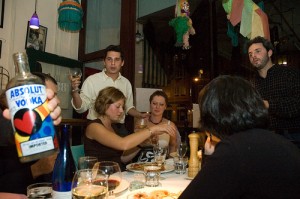
After realizing that they new little about the home consumption of their product, for instance, Absolut Vodka commissioned ReD, a forerunner in what we might think of as anthropological market research, to study the home party scene and the rituals and norms of drinking. One consultant on the project, former Yale anthropology Ph.D. student Min Lieskovsky, noted some party trends that Absolut quickly applied to their marketing:

‘One after another, you see the same thing,’ Lieskovsky told me. ‘Someone comes with a bottle. She gives it to the host, then the host puts it in the freezer and listens to the story of where the bottle came from, and why it’s important.’ And then, when the bottle is served, it goes right out onto the table with all the other booze, the premium spirits and the bottom-shelf hooch mixed together.’

The quality and status of the liquor seemed to be much less important to the consumer than their personal association with it. Despite years of market research, without this use of social science, the social significance and human connection of the product might have gone overlooked—and fewer bottles of Absolut might have gotten sold.