culture

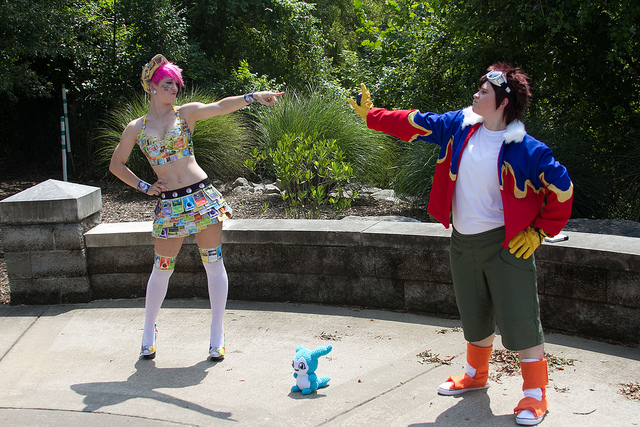
Harassers question a woman's validity as "a person and as a real nerd." Photo by PhantmDark via Flickr CC.
Sexual harassment questions a woman’s validity as “a person and as a real nerd.” Photo by PhantmDark via Flickr CC.

“What are you supposed to wear to a convention if your comic book idol’s costume is a corset and thong?” asks sociology professor Dustin Kidd from Temple University in an interview with Philly.com.

Given the dress code at Wizard World Comic Con, the absence of a safe haven for nerds and geeks came as no surprise to HollabackPHILLY, a group aiming to end street harassment. They found an alarming amount of harassment directed at female cosplayers.

Cosplay is a chance to dress up in costume to honor or represent a character, usually from a comic book or similar medium. Unfortunately, many of the female characters are hypersexualized and the women who portray them can get brutally harassed at the conventions. As Kidd puts it,

Women in those kinds of outfits get read by men as displaying themselves for sexual reasons, as opposed to representing a superhero.

Some of the problems harken back to how people view female superheroes. A lot of female characters are portrayed wearing tight clothing or not much at all. Instead of being portrayed as strong and dignified like many of the male characters, they are portrayed as sexual.

As one woman who experienced harassment at AwesomeCon in Washington, D.C., describes,

…A man asked to take a photo with her and her friend. Then, he grabbed their breasts and urged his friend to snap the picture before they could wriggle free.

Psychology professor Kimberly Fairchild from Manhattan College talks about the negative consequences of harassment at conventions, saying

It makes women more likely to self-objectify. They start to think of themselves as body parts, objects, not full intelligent human beings . . . Objectification, in turn, has been linked to depression and anxiety.

To combat harassment, artist Erin Filson along with Rochelle Keyhan and Anna Kegler have created an advocacy group determined to make conventions a safer place. Under their banner of Geeks for CONsent, they have been lobbying for anti-harassment policies, trained volunteers and counseling for victims. Hopefully their efforts will serve as a new kind of kryptonite against nerd culture misogyny.
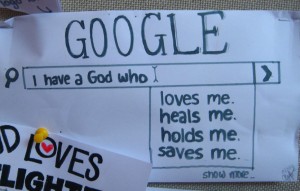
But can He get you a job? Photo by David Woo via flickr CC.

It’s summer job hunt season. As a new batch of college grads looks for every edge on the market, sociologists have found a surprising barrier to getting hired: your religion. Vox and The Washington Post both picked up new research from Michael Wallace, Bradley R. E. Wright, and Allen Hyde, in which the authors distributed 3,200 resumes for job applications around two major southern U.S. cities (a follow up to earlier work in New England). The resumes were designed to look like those of recent college graduates, and they were essentially identical except for the applicants’ membership in a particular campus religious group. The authors found that putting any kind of religious affiliation on a resume reduced the chances that an applicant would receive a call back. From Vox:

Wallace said he thinks the US has a “schizophrenic attitude” when it comes to religion. “On the one hand, we have a high tolerance of religious freedom and diversity, people are free to practice whatever religion they want,” he told me in an interview. “On the other hand, there are certain boundaries on where it can be practiced.”

While including a religious affiliation did reduce call backs across the board, not every religious group faced the same barriers. Who faced the most hiring discrimination? According to the authors’ article:

In general, Muslims, pagans, and atheists suffered the highest levels of discriminatory treatment from employers, a fictitious religious group and Catholics experienced moderate levels, evangelical Christians encountered little, and Jews received no discernible discrimination.

These findings are consistent with other research and polling efforts to capture Islamophobia and anti-atheist attitudes in the United States, and they show that while employers may not enjoy religion in the workplace, we should also be concerned about which religious groups they will tolerate.

first step to success
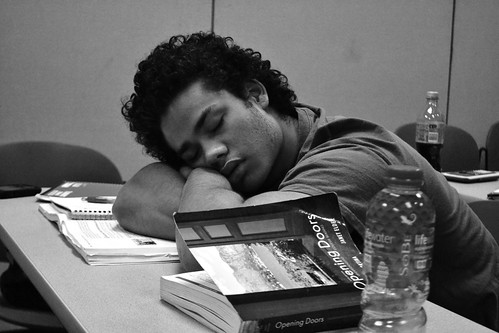
Photo by CJ via Flickr CC.

College students are tired of sleeping, according to a BBC interview with Catherine M. Coveney. She’s a British sociologist who recently explored the sleeping practices and subjective sleep experiences of two notoriously sleep-deprived groups: shift workers and college students. After conducting 25 semi-structured interviews with individuals dispossessed of rest, she concludes that our social context impacts how we understand the meaning of sleep and how we manage our sleeping schedules as a result.

The hospital-based doctors, nurses, police officers, call center employees, and other shift workers Coveney interviewed describe actively managing their sleep schedules around work patterns, finding childcare, and spending time with their partner. It is something that is constantly at the back of their mind. To illustrate why they view “broken sleep” as part and parcel of the job, Coveney explains how sleeplessness is built-in to the work structure:

There are some occupations where nothing is sanctioned…. The two nurses that I spoke to, they had to work waking nights. So even on their break, they weren’t allowed to go to sleep during the night. That’s not to say it didn’t occasionally happen, but that it was not a sanctioned practice. That was something that was seen as going against the rules of their profession.

On the surface, the sleep patterns of the college students look identical to the shift workers: “They did describe a kind of similar pattern; they did describe taking naps during the day, having a shorter sleep at night, having a two hour nap the next day.” Yet because they see sleep as an  “expendable luxury,” they don’t view their own erratic sleep as “broken.” According to Coveney, for the college students,

…it was more flexible, it was more their choice, so in a sense they were customizing their sleep patterns to fit around their social activities…. I suppose it was seen as disposable in a sense, they could cut back on sleep if they chose to, they could indulge in sleep if they chose to.

Although both groups thought of sleep in functional terms—the necessary amount determined by what was needed to get them through what they had to do the next day—Coveney reports, “None of the students I spoke to said they would prioritize a night in bed because they thought they hadn’t had enough sleep. If there was something else they wanted to do, they‘d do that. And they’d catch up later, they’d sleep longer the next day, they’d take a nap…. Some of them did go as far as to say if they could get rid of their need for sleep, it would give them much more time to do other things.” Even the value of sleep depends on supply and demand.

To learn who else is getting more sleep than you are, check out these TSP classics on the gender sleep gap and on segmented sleep.

m_350_oc_1sht_V1.inddThe comedy Obvious Child hit theaters last Friday, and it’s been praised as “the most honest” abortion movie Slate‘s Amanda Hess has ever seen. Honest, in that the film’s protagonist Jenny Slate decides to have an abortion and goes through with it. Her relationship does not implode, she does not suffer crippling guilt, and she survives. Her life goes on. It turns out that this kind of straightforward portrayal is a rarity in American film and television, though millions of women have abortions every year (the Guttmacher Institute pegs the number of worldwide procedures at about 42 million per year). In a recent Contraception article, a pair of sociologists report that pre-Roe v. Wade era plotlines disproportionately featured the death of women characters who even thought about abortion. After abortion’s legalization, portrayals came to suffer from a different distortion: “These movies tell us that it was wrong [before Roe] for laws to dictate what a woman ought to do with her body, but now that she has the choice, she should choose to give birth except under the most extenuating of circumstances,” Hess writes. Obvious Child rejects, well, the obvious.

Watch the trailer for the film here.

Courtesy the Boston Public Library.

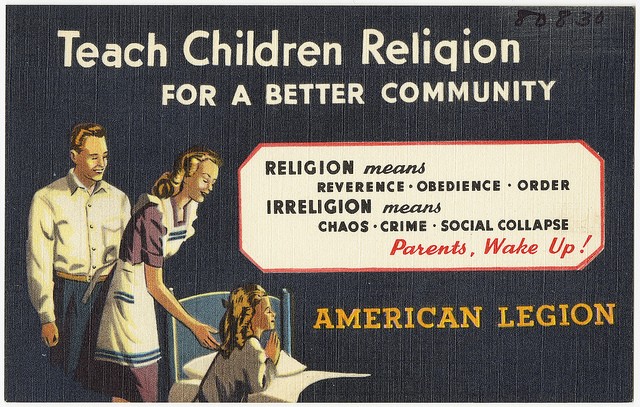
It’s been a busy time for social facts on religion in American life. First, The Washington Post reported new data from the Pew Forum suggesting that more Americans would be willing to vote for an atheist president. While the original report noted that atheism is still a “top negative” for voters—with more respondents saying it would make them less likely to vote for a candidate than drug use, political inexperience, or an extramarital affair—there is still some optimism in the fact that this number has declined by 10% since 2007.

Second, a new report from the Public Religion Research Institute found that Americans are still over-reporting their church attendance, moreso in phone than in online surveys. The Huffington Posthosted a roundtable on the issue, and a take in The Atlantic emphasized the political implications of this data—liberals are more likely to inflate their church attendance than conservatives, and this may be because of negative stereotypes that liberals are “anti-religion.”

In a journalistic trifecta, all three stories noted research from Minnesota sociologists Penny Edgell, Joseph Gerteis, and TSP’s own Doug Hartmann on the continued stigma faced by atheists in American culture. From The Atlantic:

When three University of Minnesota sociologists surveyed American religious attitudes in 2006, they found “not only that atheists are less accepted than other marginalized groups but also that attitudes toward them have not exhibited the marked increase in acceptance that has characterized views of other racial and religious minorities over the past forty years.” Americans are today more likely to say they would vote for a Muslim or a gay or lesbian for president than an atheist.

Edgell also discussed current trends in church attendance on The Huffington Post and updated her 2006 research in The Washington Post:

A 2006 study by University of Minnesota sociologist Penny Edgell found atheists were the most mistrusted minority in the U.S. Edgell said Tuesday that an updated study based on a 2014 online survey would be released soon. Preliminary results show the mistrust meter hasn’t budged.

Despite an inclusive trend in what Americans say they look for in a candidate, religious identities are still an important marker of who can lead the flock(s).

For more on the cultural factors that may be driving these trends, check out this classic TSP feature: The Social Functions of Religion in American Political Culture.

Photo by Eduardo Hulshof, Flickr CC.

Ubisoft has been trying to find out what makes its gamers tick. Nick Yee, a researcher fronting the company’s internal “Daedalus Project,” now has a new book, The Proteus Paradox, bringing together some of the major findings from the years of interviewing and observing gamers. Perhaps most interesting, as Bryan Alexander points out in Reason, is that, no matter how otherworldly the games might be, players tend to import their offline behavior and attitudes.

For instance, Yee explains in a chapter called “The Labor of Fun,” many gamers come to see gaming as a second job, demanding hours of boring drudgery contributing to fleeting achievements. Some even exploit other gamers to do the “grinding” work of leveling-up and repay it with racism toward those willing to do the work.

Gender figures interestingly, too:

Proteus outlines how male players denigrate, harass, and drive off female players. But Yee offers two twists to this sadly familiar story. First, women report wanting to play for the same reasons men do—achievement, social interaction, and immersion—going against essentialist expectations of gender behavior difference. And second, MMOs [massively multiplayer online games] offer a pedagogical benefit of sorts to male gamers who play under female avatars.

Males do this switching with some frequency… mostly to enjoy the eye candy of an attractive female avatar displayed in a game’s third-person perspective. That gaze is then reversed, as it were, as other players ogle the same avatar from their avatar’s perspectives. It’s a surprising opportunity to experience the kinds of sexual harassment that real-world women know to well.

Love, death, and helping others all come into play. “For all the criticisms that can be made of gamers’ behavior,” Alexander writes after reading Yee’s book, “these worlds are not bleak places entirely devoid of pleasure and fellow-feeling.” Between levels, it seems, some Putnam, Goffman, and Addams have snuck into the online realm.

For more in the Reason series on gaming, click here. For more on race in gaming, check out “The Whiteness of Warcraft,” here on TSP.

Photo by J.K. Califf via Flickr.com

In this era of social media, increasingly, our lives are being lived on the internet. Advertisers are taking note and mining our status updates and internet searches for information about our personal lives, targeting online advertising to our interests and identities.

Janet Vertesi, an assistant sociology professor at Princeton, has attempted the impossible: she tried to hide her pregnancy from the internet. It’s a lot harder than it sounds. Jezebel.com details her attempt to keep information out of the hands of advertisers while also explaining how this phenomenon is affecting women.

The tiniest bits of information, an Amazon order or an internet search, contribute to the web of data that companies are buying to target individuals. Data about pregnant women is fifteen times more valuable to companies than information about the average person, as parenting has increasingly become a consumer market. (See previous Citings about the economic investments of parenting and the luxury market for baby goods.)

In order to keep her pregnancy a secret, Vertesi and her husband paid for everything in cash or gift cards, asked their friends and family to keep all news off social media, and even searched for baby products using private browsing. The steps they took to avoid discovery could be seen as ‘suspicious.’ They even ended up paying cash for gift cards to spend online, a strategy that can trigger alarms when the prices get higher.

Jezebel.com discusses her experience saying, “In short, if you want to hide your pregnancy from big data, you’ve got to operate like a drug dealer.”

One concerning factor is what this means for pregnant women. Pregnancy status can be very personal and women can choose not to divulge their pregnancy for a wide range of reasons. If pregnancy is no longer private, what is?

Photo by Nicholas via flickr.com

Many romantic couples who live together without being married do so out of wariness about the high divorce rate. Cohabiting, for these couples, can be a “trial” relationship period in which they decide their compatibility before marrying.

Until recently, previous research conclusions and popular conception held that cohabiting couples who eventually married experienced higher divorce rates than those who did not live together before marriage.

A new study by University of North Carolina-Greensboro sociologist Arielle Kuperberg proves this assumption false. Using data from the National Survey of Family Growth, Kuperberg analyzed the divorce rate among 7,000 people who had been married at least once. Kuperberg also incorporated other variables, such as the date the couple moved in together. Contrary to 1970s research, Kuperberg found no link between cohabitation and divorce.

Cornell University sociologist Sharon Sassler, in pursuit of research for her book on cohabitation, interviewed more than 150 cohabiters. She found that persons with college degrees date longer before moving in together. Those with degrees date for an average of 14 months compared to 6 months or less for non-degree holders.

As cohabitation becomes more common among couples, sociological research is investigating and dispelling myths about the intricacies of romantic relationships, turning common (and fallacious) knowledge on its head.


trust fall
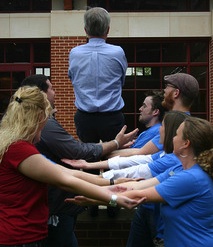
The Infamous Trust Fall; Photo by klndonnelly via flickr.com

Trust is something that can be difficult to give to others. It must be carefully cultivated and protected. But what is behind someone’s ability to trust? New research has found that survey participants that showed high intelligence levels were also more likely to trust others. The research, lead by sociologist Noah Carl of the University of Oxford, used General Social Survey data to compare participant’s intelligence measures with their behaviors and social attitudes.

The researchers found that participants who scored highly on measures of intelligence were more likely to trust others, compared with those who had low scores on intelligence levels. This finding remained even after the team accounted for the participants’ socioeconomic characteristics, including marital status, education, and income.

The researchers say this may be because smarter individuals are better judges of character. They may be better at finding and developing relationships with people who are worthy of their trust and less likely to betray it. The investigators also point to past research linking trust with increased health and happiness and call for future research to be directed at how trust could lead to greater well-being.


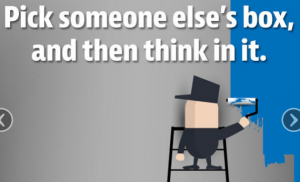
Burt says playing pretend is a useful tool for innovators. Artwork via Blue Sky Innovation. Click for original.

“There’s always someone more ignorant than you!” Ronald Burt, a professor of sociology and strategy at the University of Chicago’s prestigious Booth School of Business is definitely up for looking on the bright side. In fact, that opening mantra? It’s his way of saying maybe there isn’t anything new under the sun—but if it’s new to you? You can work with that.

According to the Chicago Tribune’s “Blue Sky Innovation,” Burt says there are two good ways to network that to support your ideas. Those who need to work on nitty gritty improvements—say getting production processes fine-tuned—need “closure,” or a tight social network of specialists. But those “charged with innovation need to branch out and build brokerage,” or a diverse network of people and insights from different fields and even different mindsets. more...