Tag Archives: race/ethnicity: American Indians/Aboriginals

Jay Smooth: “Don’t Freak Out” about Trends in Births

Last week, the Census Bureau announced that as of July 1, 2011, for the first time the majority (50.4%) of babies under age 1 in the U.S. were not non-Hispanic Whites. Animal New York posted a video by Jay Smooth discussing the reactions to and implications of this news:

You can see the NYT article Jay Smooth parodies here, but note that the graph is mislabeled. The line labeled “White” actually only represents the data for non-Hispanic Whites, while the line labeled “Non-White” includes births to White Hispanics, so the terminology they used doesn’t accurately reflect what the graph illustrates.

Social Media and the Fight over Urban Outfitters’ Appropriation of Native American Cultures

Yesterday Native Appropriations featured a presentation about Urban Outfitters, cultural appropriation in fashion, and the struggle to get the clothing chain to stop labeling clothing as “Navajo.” The presentation is great both for explaining this particular case — which included the Navajo nation sending a cease-and-desist letter demanding that Urban Outfitters stop using the term Navajo in its marketing — and also because it shows how one particular story spread through social media, which increasingly have the ability to bring mainstream media attention to stories that otherwise might have gone unnoticed.

Depp’s “Tonto” Costume Based on a Non-Native Artist’s Wild Imagination

Johnny Depp will be playing the character of “Tonto” in the 2013 movie re-make of The Lone Ranger.  Critics of the original series have observed that Tonto, the American Indian sidekick of the White hero, was a negative racial stereotype.  He was subservient to the Ranger, spoke poor English, and seemed generally dumb (his name translates into “stupid” in Spanish).  Depp has insisted that he wants to play a different kind of Tonto and reinvent the characters’ relationship.

So far so bad, as least according to recently released publicity photos revealing Depp’s costume and make up (coverage suggests that Depp himself is designing the character’s appearance).  Thanks to YetAnotherGirl and Dolores R. for sending in the tip.

Depp’s look was inspired by the art of a man named Kirby Sattler.

Sattler is famous for painting images of Native Americans, but has been criticized for stereotypical representations.  “Indian art” is a contentious issue: many non-Indian artists have made careers painting the “noble savage” and the “young girl with wolf.”  According to Native Appropriations, Sattler “…relies heavily on stereotypes of Native people as mystical-connected-to-nature-ancient-spiritual-creatures, with little regard for any type of historical accuracy.”  Sattler himself has written that his paintings come out of his own imagination or, as NA puts it, “he makes these subjects up based on the (heavily stereotyped) images in his own head.”  Here’s a Google image search for the artist’s name:

This, unfortunately, is playing out an all-too-common story.  It goes like this:

  1. There are very few roles for non-White characters in Hollywood.
  2. When we have a non-White character, a White actor is cast into the role (e.g., The Last Airbender and Iron Eyes Cody, the crying Indian).
  3. That actor shows a lack of understanding of the real issues at hand. Depp, for example, has claimed a right to play the role because he has a little bit of Indian in him.  ”Cherokee or maybe Creek,” he says, because he doesn’t actually know.
  4. So, the portrayal is consistent with harmful stereotypes.  In this case, when deciding on a costume, Depp doesn’t choose to represent a tribe as they really were (“are” is out of the question), but instead draws on the work of an artist who admits that he makes up an idea of “the Indian” that appeals to him, a White man with no interest in true-to-life portrayals.

So, there you have it.  Again.

For more, see Representations of the “Primitive” Indian and Anachronism and American Indians.

—————————

Lisa Wade is a professor of sociology at Occidental College. You can follow her on Twitter and Facebook.

From Appearance to Identity: How Census Data Collection Changed Race in America

Cross-posted at Global Policy TV.

Publicizing the release of the 1940 U.S. Census data, LIFE magazine released photographs of Census enumerators collecting data from household members.  Yep, Census enumerators. For almost 200 years, the U.S. counted people and recorded information about them in person, by sending out a representative of the U.S. government to evaluate them directly.

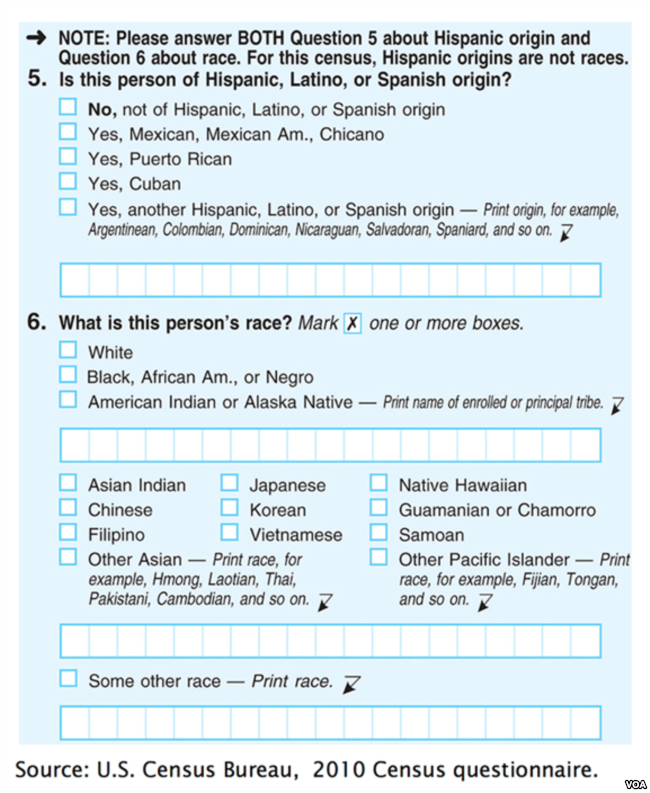
By 1970, the government was collecting Census data by mail-in survey. The shift to a survey had dramatic effects on at least one Census category: race.

Before the shift, Census enumerators categorized people into racial groups based on their appearance.  They did not ask respondents how they characterized themselves.  Instead, they made a judgment call, drawing on explicit instructions given to the Census takers.

On a mail-in survey, however, the individual self-identified.  They got to tell the government what race they were instead of letting the government decide.  There were at least two striking shifts as a result of this change:

  • First, it resulted in a dramatic increase in the Native American population.  Between 1980 and 2000, the U.S. Native American population magically grew 110%.  People who had identified as American Indian had apparently been somewhat invisible to the government.
  • Second, to the chagrin of the Census Bureau, 80% of Puerto Ricans choose white (only 40% of them had been identified as white in the previous Census).  The government wanted to categorize Puerto Ricans as predominantly black, but the Puerto Rican population saw things differently.

I like this story.  Switching from enumerators to surveys meant literally shifting our definition of what race is from a matter of appearance to a matter of identity.  And it wasn’t a strategic or philosophical decision. Instead, the very demographics of the population underwent a fundamental unsettling because of the logistical difficulties in collecting information from a large number of people.  Nevertheless, this change would have a profound impact on who we think Americans are, what research about race finds, and how we think about race today.

See also the U.S. Census and the Social Construction of Race and Race and Censuses from Around the World. To look at the questionnaires and their instructions for any decade, visit the Minnesota Population Center.  Thanks to Philip Cohen for sending the link.

—————————

Lisa Wade is a professor of sociology at Occidental College. You can follow her on Twitter and Facebook.

Happy Africans and Smiling Indians

Sociologists sometimes use the word “overdetermine” to describe the ability of the dominant group to control representations of less-powerful groups.  White people, we might say, overdetermine representations of racial minorities, they exert an out-of-proportion influence.

In this vein, we’ve previously featured objections to simplistic portrayals of the enormous continent of Africa, especially as a place that is primitive and hopelessly burdened by death, disease, poverty, corruption, and other problems.  Chimamanda Adichie, for example, objects to the “single story of Africa” and Binyavanga Wainaina tell us how not to write about Africa.  Elsewhere, we’ve illustrated how the bustling city of Nairobi is portrayed as a savanna with giraffes and elephants.

An organization called Mama Hope, sent in by Jennifer C., seeks to challenge this perception.  They want the world to think of Africa as a place of hope and possibility.  To this end, Mama Hope is producing videos that “…feature the shared traits that make us all human— the dancing, the singing, the laughter…”  They look like this:

The effort reminds me of the “Smiling Indians” and “More Than That” videos, sent in by Katrin and Anna W.  The first addressed the stereotype of the “stoic Indian,” while the second is designed to counterbalance the common portrayal of reservations as miserable places full of one-dimensional hopeless people (something we are certainly sometimes guilty of).

Smiling Indians:

More Than That…:

These videos are examples of the way that the democratizing power of new technologies (both the internet in general and the relatively easy ability to take video and edit) are offering marginalized peoples an opportunity to contest representations overdetermined by dominant groups.

UPDATE: Commenters are pointing out that “overdetermined” is also used to mean determined by many factors.  Mirriam-Webster agrees, although they also include the definition “excessively determined.”  So… I hope I’ve been using the term right!  Thoughts?

—————————

Lisa Wade is a professor of sociology at Occidental College. You can follow her on Twitter and Facebook.

Racial Bias in Presidential Pardons

In analysis of Presidential pardons during the George W. Bush administration, ProPublica has found that whites were four times as likely as non-whites to be granted a pardon.  Pardons were granted to 12% of whites, 10% of Hispanics and Asians, and zero percent of Blacks and Native Americans. The disparity remained even when investigators controlled for type of crime.

ProPublica explains:

…President George W. Bush decided at the beginning of his first term to rely almost entirely on the recommendations made by career lawyers in the Office of the Pardon Attorney.

The office was given wide latitude to apply subjective standards, including judgments about the “attitude” and the marital and financial stability of applicants…

Bush followed the recommendations of the pardons office in nearly every case… President Obama — who has pardoned 22 people, two of them minorities — has continued the practice of relying on the pardons office.

Sometimes disparate decisions in pardon cases were eyebrow raising:

An African American woman from Little Rock, fined $3,000 for underreporting her income in 1989, was denied a pardon; a white woman from the same city who faked multiple tax returns to collect more than $25,000 in refunds got one. A black, first-time drug offender — a Vietnam veteran who got probation in South Carolina for possessing 1.1 grams of crack – was turned down. A white, fourth-time drug offender who did prison time for selling 1,050 grams of methamphetamine was pardoned.

ProPublica traces the disparity to age, leniency given to people who are seen as “upstanding” members of society (e.g., they’re married, have little debt), the influence of money and politics (letters from Congresspersons and donations to lawmakers by convicts’ spouses), and simple prejudice.  Nevertheless:

When the effects of those factors and others were controlled using statistical methods, however, race emerged as one of the strongest predictors of a pardon.

—————————

Lisa Wade is a professor of sociology at Occidental College. You can follow her on Twitter and Facebook.

Thinking through Korean Appropriation of American Indians with James Turnbull

In an interesting example of cultural borrowing/appropriation sent in by Catherine H., the Korean all-girl pop band T-ara imitates stereotypes of American Indians in their music video for their (strangely catchy) song, YaYaYa.

It’s difficult (for me) to know how these stereotypes of native North Americans “work” in Korea. It appears to mean something to Koreans, otherwise why use the imagery and narratives, but what? And how should Americans who oppose the stereotyping (and erasing of modern) Native Americans talk about this “borrowing”?

To get some perspective, I turned to James Turnbull.  Turnbull is behind the blog, The Grand Narrative, where he writes about Korean Sociology through the prism of pop culture.  This is what he had to say:

First, please note that T-Ara’s Yayaya is actually just one of several recent Korean music videos that have used Native-American imagery, and by no means the most offensive at that. For a list, see here, which points out that Indian Boy by MC Mong is much more problematic.

Second, so many Korean groups are being formed these days – over 30 new girl-groups in 2011 alone – that their management companies (most well-known Korean groups are completely “manufactured”) are in a constant battle to gain media attention for them. One way to do so is to regularly come up with new “concepts” for the group, of which a “cute” one incorporating Native-American imagery is just one possibility of many.

But thirdly and most importantly, it is no exaggeration to say that Korea is one of the least politically-correct societies out there, particularly in the ways in which non-Koreans are represented in popular-culture.

Often, this is completely innocent, most Koreans being ignorant of the connotations of Blackface for instance, or the passions Nazi imagery arouses in Western countries, to the extent that both are regularly found in popular culture and advertising. Indeed, I was especially struck once by reading of university students performing in Blackface at a festival because they thought Black audiences would like it, and would appreciate the interest in “their culture”. As the person who saw this wrote, this was not “offensive” per se, but it was certainly shocking.

Alternatively however, the ignorance can be willing. For example, last year the the Korean Overseas Information Service (KOIS) part of the Ministry of Culture, Sports and Tourism, produced an expensive “Visit Korea” ad which played on the likes of CNN and BBC World and so on, but which relied so heavily on patronizing stereotypes of non-Koreans that it would likely have put off more potential tourists than attracted them. Non-Koreans in the KOIS were consulted in the making however, and did warn the producers of this, but unfortunately their advice was rejected, either because a) Korean advertisers are notorious for producing things that would appeal primarily to Koreans, despite the actual target audience, and/or b) it didn’t jibe with the advertisers’ perceptions of non-Koreans and their wants or needs. (Both are persistent problems with Korean tourism advertisements.)

Finally, for the source of those perceptions, consider Korea’s extremely exclusionary “bloodline”-based nationalism andextremely homogenous population (less than 3% of Korea’s population are “foreign residents”, a third of which are ethnic Koreans from China). Consequently, Korean society is really only just beginning to grapple with the concept of multiculturalism, albeit with much urgency because of the sudden huge influx of brides from Southeast Asia in the last decade or so, with the populations of many rural communities close to becoming a third or even half non-ethnic Korean. Certainly, a great deal of progress has been made in integrating them and acknowledging what their cultures have to offer, but when Korean school textbooks extolled the virtues of being an ethnically homogenous society until as recently as 2006 (and see here for how Blacks and native-Americans were portrayed in school picture dictionaries at that time), then I’m sure you can appreciate that much still remains to be done to prevent prejudice against them, especially in how non-Koreans and cultures are portrayed in the media.

Which to be fair, nobody outside of Korea was at all concerned with until K-pop became popular!

Thank you, James!

We’re happy to hear your thoughts in the comment threads. The video (I apologize for the ad):

See also, Are They Racist or Are We Ethnocentric?

—————————

Lisa Wade is a professor of sociology at Occidental College. You can follow her on Twitter and Facebook.


Government Neglect of First Nation Welfare

According to Federal Parliament member Charlie Angus, leaders of the Attawapiskat First Nation have declared a state of emergency. Living conditions are so terrible on the reserve that members of the community are at significant risk of illness and death.  Many residents have no electricity, heat, or running water.  They are living in uninsulated tents and shacks.  Many of these residences are filled with black mold and prone to quick-spreading fires.  Some use buckets as bathrooms; with no facilities, they dump their sewage into the streets.

Angus writes:

When it comes to the misery, suffering and even the death of First Nations people, the federal and provincial governments have developed a staggering capacity for indifference.

Try to imagine this situation happening in anywhere else in this country. We all remember how the army was sent into Toronto when the mayor felt that citizens were being discomforted by a snowstorm. Compare that massive mobilization of resources with the disregard being shown for the families in Attawapiskat.

The government waited a month to respond, but has now accepted some responsibility for the health and welfare of the residents.  Attawapiskat leaders are now trying to raise awareness of the other First Nation communities in Northern Canada with similar conditions.

A typical residence (home to a family of six):

Interior:

Rash caused by contaminated water:

More in this ten-minute video: