Twitter Revolution

This is part of a series of posts highlighting the Theorizing the Web conference, April 14th, 2012 at the University of Maryland (inside the D.C. beltway). See the conference website for information as well as event registration.

Experiencing global events through social media has become increasingly common. For those in the West, the uprisings over the past few years in the Middle East, North Africa and elsewhere were especially striking because social media filled an information void created by the lack of traditional journalists to cover the dramatic events. By simply following a hashtag on Twitter, we tuned into those on the scene, shouting messages of revolution, hope, despair, carnage, persistence, misinformation, debate, sadness, terror, shock, togetherness; text and photos bring us seemingly closer to the events themselves.

But of course the Twitter medium is not neutral. It has shaped what we see and what we do not. Where is the truth in all of this? The intersection of knowledge, power, struggle and the radically new and transformative power of social media begs for intense theorizing. How we conceptualize, understand, define and talk about this new reality lays the path forward to better utilizing social media for journalistic and political purposes.

This is why the keynote for Theorizing the Web 2012 conference (College Park, MD, April 14th) features Andy Carvin (NPR News) and Zeynep Tufekci (UNC) in conversation. Carvin (@acarvin) has become well known for his innovative use of Twitter as a journalistic tool. Tufekci (@techsoc) has emerged as one of the strongest academic voices on social movements and social media and brings a theoretical lens to help us understand this new reality. Together, insights will be made that have impact beyond just journalism but to all researchers of technology as well as those outside of academic circles.

Who is Andy Carvin; and What Do We Call Him?

Without a deep background in professional journalism, Carvin’s actual title at NPR is “Senior Strategist.” However,  more...
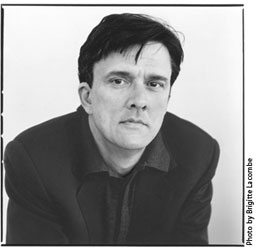
Kurt Anderson, writer, critic, and public intellectual

Kurt Anderson’s recent article in Vanity Fair titled “You Say You Want a Devolution.” contends that the past 20 years have seen a total stagnation in the production of new cultural aesthetics. In other words, the end of the 50s looked nothing like the end of the 70s, but 1989 looks remarkably similar to 2009. Anderson concludes:

We seem to have trapped ourselves in a vicious cycle-economic progress and innovation stagnated, except in information technology; which leads us to embrace the past and turn the present into a pleasantly eclectic for-profit museum; which deprives the cultures of innovation of the fuel they need to conjure genuinely new ideas and forms; which deters radical change, reinforcing the economic (and political) stagnation.

This is concerning, since that means the entirety of our blog is nothing more than the fungal growth sitting upon the neutral technological substrate that we impregnate with decaying cultures of past decades. Tattoos, Facebook, Burning Man, the iPhone, Twitter, sex dolls, wifi, internet memes, reality TV, geek culture, hipsters, video gamesfaux-vintage photographs, and dubstep are all popular topics on our blog, and (along with blogging itself) are products of the last 20 years. Anderson assumes that cultural objects are made possible through technology, but refuses to admit that technologies can also be cultural objects in and of themselves. more...

There is an important space between old and new media. This is the grey area between (1) the top-down gatekeeping of old media that separates producers and consumers of content and (2) the bottom-up nature of new, social media where producers and consumers come from the same pool (i.e., they are prosumers).

And in the middle are projects like Global Voices, what might be called curatorial media: where content is produced by the many in a social way from the bottom-up and is then mediated, filtered or curated by some old-media-like gatekeeper.

The current protests in Syria can serve as an important example of how curatorial media works. Especially because foreign journalists have been banned from the country, creating a dearth of information for old media. Alternatively, more...

Given the recent events in the Middle East (and elsewhere, as protests continue in Wisconsin and ominous rumblings begin to issue from the direction of China) a great deal has been written in the past few weeks on the topic of social media and social movements/revolutions. Some of it has been a bit frothy, while much of it—including this, this, and this commentary on the Cyborgology blog—has been very insightful. However, while commentators have come at this issue from various angles, there hasn’t yet been much in the way of writing that seeks to wed an analysis of these forms of social action with existing theories of social movements and contentious politics.

The speed at which events have moved is a point on which a number of people have remarked. The wave of political anger expressed as protest that spread from Tunisia to Egypt, Yemen, Libya, Bahrain, and points beyond has been likened to dominoes falling—or, and this is more appropriate to the point I want to make, to the spread of a contagious disease. Democracy, it has been said, has “gone viral”. more...

As many of you already know, the Cyborgology editors decided to throw a conference called Theorizing the Web. The conference will be in College Park, MD (just outside of Washington, D.C.) on April 9th. Today we are excited to announce the program for the conference and attach a flier that we hope you all can distribute to those who you think might be interested.

As you will see, the response was terrific. We built 14 panels out of the 56 papers we accepted (from the over 100 submissions). There will be three invited panels (on feminist activism, race, and methods). There will be two symposia (one on the role of social media in the Arab uprisings and another on social media and street art). There will be two plenaries (one by Saskia Sassen and another by George Ritzer). And we are excited to have danah boyd deliver our keynote.

If that was not enough, we have plenty of art-related surprises in store for those who attend. We have invited artists of all types to display and perform art specifically tailored to the themes of the conference. This will be one busy carnivalesque day for those who love technology and/or theory!

The program is found here: http://www.cyborgology.org/theorizingtheweb/program.html

Last, a flier for the conference [.pdf here]. Please distribute widely!

TtW2011 Flyer


Twitter users, likely from outside of China itself, are calling for people to “stroll” in Chinese public areas. The strolling protestors are not to carry signs or yell slogans, but instead to blend in with regular foot traffic. Chinese officials will not be able to identify protestors who themselves can safely blend in anonymity. [Edit for clarity: the idea is that foot traffic will increase in the announced area, but officials won’t know which are the protesters.]

This tactic is reminiscent of those French Situationist strategies of May ’68 to create chaos and disorder (note that strolling is akin to, but not exactly the same as, DeBord’s practice of “the derive“). The calls to “stroll” have had impact in China with the government shutting down public spaces and popular hangouts. Even a busy McDonald’s was closed. These gatherings announced over Twitter have been highly attended by many officials, police and media, but, importantly, not by many protestors themselves.

This is slacktivism at its best. If this slacker activism is often defined by more...

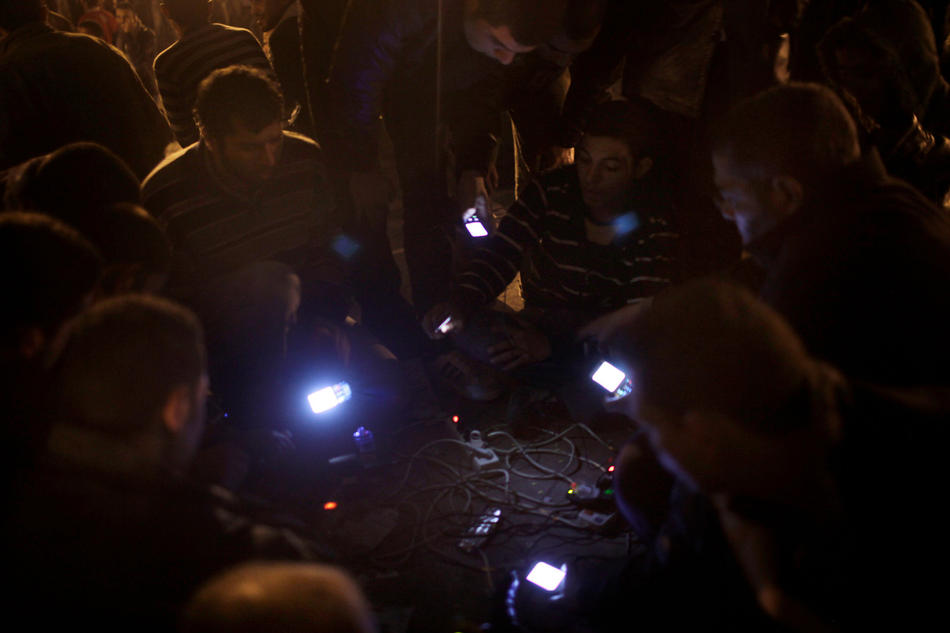
Protesters charge their mobile phones in Tahrir Square in Cairo.

In my previous post on “Digital Dualism Versus Augmented Reality,” I lay out two competing views for conceptualizing digital and material realities. Some view the physical and digital as (1) separate, akin to the film The Matrix, or (2) as an augmented reality where atoms and bits are increasingly imploding into each other.

I prefer the latter, and want to apply this augmented paradigm to the revolutions occurring in the Arab world that have been taking place this winter as well as the subsequent debate over the causes. I, like many others, am equally frustrated by those who give either all or none of the credit for these uprisings to social media tools and argue instead that what is occuring is an augmented revolution.

On one side there are those that promoted the phrase “Twitter revolution” during more...

Maryland Morning host Sheilah Kast interviewed Cyborgology editors Nathan Jurgenson and PJ Rey about social media’s role in the recent protests in the Middle East.  Here’s a brief synopsis:

Citizens of countries throughout the Middle East were risking their lives to air grievances against their rulers long before Facebook founder Mark Zuckerberg even enrolled at Harvard nine years ago. This year, though, they’ve taken to the streets in unprecedented numbers, and they’re using social media to organize themselves.

The phrase “Twitter Revolution” is now being thrown around in the media. Is that overstating it? Or is social media fundamentally changing the dynamic between governments and their citizens?

Listen to the full interview: http://mdmorn.wordpress.com/2011/02/18/218112-social-media-in-the-middle-east/