prosumer


“Prosumption” is a bit of a buzzword here at Cyborgology.  It refers to the melding of production and consumption. Although prosumption is not unique to the contemporary connected era, it flourishes within it. One slice of prosumption theorizing focuses specifically on identity. I first coined identity prosumption in an American Behavioral Scientist article (un-paywalled on my academia.edu page). Since then, references to identity prosumption have appeared periodically on the blog. For example, Nathan Jurgenson (@nathanjurgenson) applied identity prosumption to the asexual identity movement, Dave Paul Strohecker (@dpsFTW)  mused about the role of identity in Star Wars fan fic., and I pondered the liberatory versus categorically constraining role of identity prosumption.

Identity prosumption refers to the identity meanings associated with prosumed content. What we create reflects and constructs who we are, just as who we are reflects and constructs what we create. Identity prosumption is a merging of prosumed objects and prosuming subjects. It applies:  (a) when that which is prosumed can be connected to the prosumer in a defining way and (b) when the process of prosumption incorporates social interaction.

Today, I want to add a bit more nuance to the identity prosumption model. Specifically, I want to demonstrate that sites of identity prosumption (both online and offline) affect the identity prosumption process in non-uniform ways. I focus here on two key variations: collective vs. individualist orientation, and degree of control over identity meanings. I explore these variations through a comparison of two identity prosumption sites: Facebook and FetLife. The former is the preeminent social network platform, the latter an (ironically) mainstream social network site for people who like BDSM. To employ a twist on the Hipster trope, “FetLife: you’ve probably heard of it.” more...


Screenshot of 50shades.com in 2010.

When the novel Fifty Shades of Grey was published, it sparked a wide range of slightly frothy responses, from the (shocking!) truth about its history as Twilight AU (Alternate Universe) fanfiction to the (even more shocking!) indication that many women like to read erotic fiction and that sometimes that erotica can get pretty kinky. Much of the press coverage that paid attention to the fandom aspect of the story focused on the copyright issues inherent in fanfiction and other transformative works, which is still up for some debate —  and which, thanks to Fifty Shades, will likely continue to be debated into the foreseeable future.

To the extent that people seem willing to own that there might be something ethically amiss with the publication and subsequent success of Fifty Shades, the copyright issues seem, again, to be the primary focus. These rest not only with the fact that Fifty Shades began life as a work of freely available fanfiction and was then “pulled to publish” (removed and altered) — this is not an entirely uncommon phenomenon in publishing or in fandom, though opinions regarding its integrity as a practice vary somewhat in both spheres — but with the extent to which Fifty Shades appears to be different from its fandom incarnation. Which is to say, hardly at all, as the book blog Dear Author demonstrated.

more...

On this blog we often talk about the role of the prosumer, or actors that are both producers and consumers and that serve to muddy the longstanding distinction between production and consumption. For example, Jenny Davis and Nathan Jurgenson wrote on prosuming identity online, and how Web 2.0 technologies (especially social media) have allowed for the creation of new identities like transability and asexuality. Similarly, Nathan Jurgenson has written extensively on how social media has contributed to the “participatory, prosumer, dissent” of the Occupy Movement, playing into the much larger atmosphere of augmented dissent that has gripped the Middle East and other parts of the globe for some time now. And finally, Jenny Davis and I have written on the “Jailbreak the Patriarchy” Chrome Application, which allows users to genderswap the content they read on the internet.

Occupy DC encapsulates our "atmosphere of augmented dissent." Photo by Nathan Jurgenson.

Each of these examples reveals the tight association between social media and prosumption. That is, social media has greatly expanded the role of the prosumer in contemporary (augmented) society. This is because the individual voice is amplified through the digital networks of Web 2.0 technologies like Facebook, Reddit, and Twitter. Just as the Arab Spring and Occupy have changed the conversation regarding participatory democracy, prosumers are continually reworking culture through the creation of memes, identities, and new online content, blurring the distinction between the production and consumption of cultural forms. A great example of the prosumption of culture is fanfiction.

And this brings me to Star Wars. Finally.

This feature-length fanfilm titled “Star Wars Uncut” is a shot-for-shot remake of Star Wars Episode IV: A New Hope, produced entirely from 15 second film clips sent in by fans. Casey Pugh, a 26-year-old web developer from Brooklyn created the film after posting on his blog asking for submissions. These fans each prosume Star Wars as both a brand and a cultural artefact (Bruns 2007) when they rework iconic scenes with a “twist,” allowing for the expression of new cultural forms and greater participatory expression from the larger Star Wars fan community.

The film, which won the 2010 Emmy for Interactive Media, is also an example of what Nathan Jurgenson has called “curatorial media”, where old media forms (eg: print newspapers) are augmented by new crowdsourcing capabilities of social media. The film above is an example of curatorial media because centralized gatekeepers (ie: Casey Pugh himself) selected which film clips to include. He then edited the film shot for shot, splicing together disparate scenes produced by widely different fans around the globe. I myself watched the first 45 minutes of it, mostly because I was curious and also because I was a huge Star Wars nerd as a kid.

Darth Vader and her stormtroopers.

Although the film clips can be a little jarring at times (especially when jumping from live action to crudely animated MS Paint images and back in a matter of a few seconds), it does serve as a humorous reworking of an extant cultural forms. That is, many film clips reveal anachronistic revisions to the actual film.For example, the entrance of Darth Vader onto the rebel starship (arguably one of the most iconic scenes in the original film), has been replaced by an all female squad or storm troopers, Vader himself briefly appears as a female.

Throughout the film we get several more examples of this sort of literary prosumption (Olin-Scheller and Wikstrom 2010), bolstering my claims that social media and Web 2.0 have allowed for an effervescence of collective cultural production and consumption. Fanfiction has long used extant cultural forms for the creation of new cultural forms, the homoerotic revision of Spock and Kirk’s relationship on Star Trek as but one iconic example.

Homoerotic tension between Kirk and Spock has been a treasure trove for fan fiction revisionism.

Although this film is not the first of its kind, it is a great example of participatory filmmaking. As new technologies continue to incorporate more and more social media capabilities (cell phones, tablets, etc), it is likely that we will see increasingly utility of the term “prosumer.”

“Jailbreak the patriarchy!” is a new Chrome extension from Danielle Sucher. The neat little project allows you to reframe the information you encounter on the internet by switching the gender of the content presented. The extension basically replaces instances of man with woman, he with she, and various other nouns and pronouns with their gendered equivalent (although it doesn’t always retain proper grammar). As Sucher herself states:

Jailbreak the Patriarchy genderswaps the world for you. When it’s installed, everything you read in Chrome (except for gmail, so far) loads with pronouns and a reasonably thorough set of other gendered words swapped. For example: “he loved his mother very much” would read as “she loved her father very much”, “the patriarchy also hurts men” would read as “the matriarchy also hurts women”, that sort of thing.

This makes reading stuff on the internet a pretty fascinating and eye-opening experience, I must say. What would the world be like if we reversed the way we speak about women and men? Well, now you can find out!

more...

Can an identity have a homepage?

Many have long argued that identity is the result of both  (1) performative work on the part of the individual as well as (2) the influence of society with all of its history, structures, institutions, norms and so on. We do not produce our identities in a vacuum, they are influenced by society. And we do not blindly consume our identities from the options given to us; humans are complex beings who creatively tweak, mix and remix to achieve something always unique. Not just producers or consumers,  it is best to think of ourselves as identity prosumers. Here, we will show how this process is made most explicit when identities are prosumed through social media technologies. more...

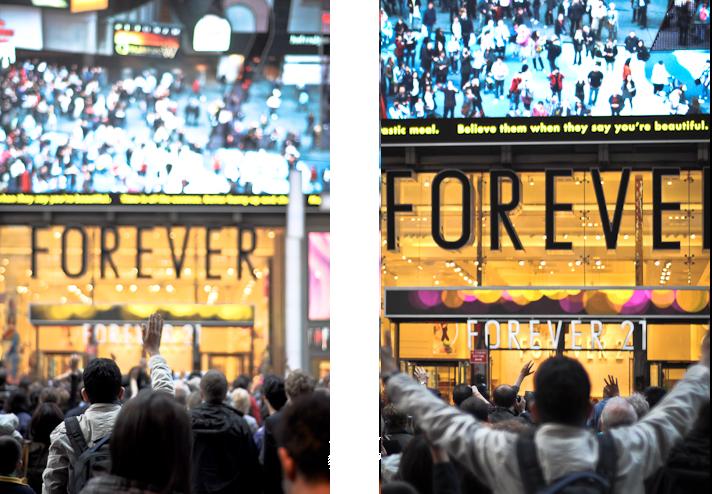
Crowds in Times Square waving at themselves on the big screen. Photos in this post by nathan jurgenson.

Something interesting has been happening in Times Square this summer. As has been occurring for a century, the crowds gather with necks perched upward looking at all the famously illuminated billboards. But now there is a new type of buzz in the crowd: they stand together facing the same direction, cameras held high and their hands waving even higher. They are not just watching celebrities or models in this the most expensive ad-space in the world; today, they are watching themselves on the big screen.

This is all part of a new billboard for the company Forever 21 currently in use in Times Square in the heart of New York City. It struck me that this billboard is nothing short of a consumer-capitalism-happening, and started snapping photos and thinking about what this all might mean. more...

Google Maps has a new tool to help the consumers of its popular maps also be producers. Users-generated improvements will be a benifit to many, but probably most to Google itself. While the Google video below paints all of this in light of personal or civic empowerment (“leave your mark”), we should also understand that this move towards us becoming “prosumers” of these maps is also about the company taking advantage of our free labor in hopes of earning greater profits. Does that bother anyone?

This book brings together a selection of key tweets in a compelling, fast-paced narrative, allowing the story of the uprising to be told directly by the people in Cairo’s Tahrir Square.

The prosumer is one who produces what they consume and visa versa. Tweets from Tahrir places traditional consumers of content, the many faces in the crowd, as also content producers. What utility does having these tweets in book form have?  more...

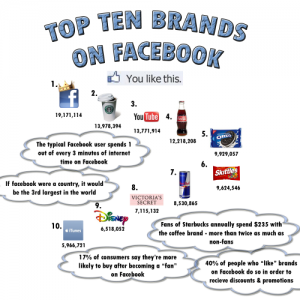
Advertising on social media is more than those segregated paid-for-spaces that display ads paid for by companies (e.g., on the far-right of your Facebook screen). This sort of paid-advertising has been shown to be so highly ineffective that some have predicted it will be the downfall of the social web. However, these predictions do not understand that the fundamental point of the social web (2.0) is that users are prosumers; they are simultaneously both consumers and producers of content. And advertising is no different. Advertisements that we simply consume worked in a consumer medium, like television. However, social media is a prosumer medium, and today we are the ones doing the advertising work of integrating corporate logos and branding into our profiles and news feeds.

Facebook’s ubiquitous “like” button reflects our modern task of self-presentation (and distinction) based on our taste in just about anything and everything, documented and compared to the various “likes” of any other visitor to your profile (and remember: what someone “likes” may not be what they actually like but what they want others to see that they like). In modern consumer culture, this collection of displayed “likes” will include corporate brands that one identifies with. This might mean clicking “like” on the Starbucks or Victoria’s Secret pages, which then becomes a part of your profile. more...