inequality

For the first time since 2006, the Census finds a .5 percentage drop in the poverty rate, with children and Hispanics seeing the biggest declines. Before taking these encouraging statistics at face value, it is important to put them into context. Briefs produced by the Stanford Center on Poverty and Equality and the Center for American Progress outline important factors that often get ignored when focusing on the poverty rate alone, including the consistent struggle for young adults and minorities to find work and the ever-increasing working poor that often get left out of the poverty conversation entirely.

The high poverty rate among young adults is cause for concern. Experiencing poverty in early adulthood has been found to hinder future earnings, especially within minority populations. Young people may stay hungry if our definition of poverty doesn’t grow up with them.
While the poverty rate may have dropped slightly, this is largely due to the increase in the working poor. Millions of families are trapped in the middle, earning just enough to be considered above the poverty line but making far from enough to be considered economically secure. Poverty among working adults is linked to a broader decline in labor unions.
Most of the discussion around the poverty rate centers on what David Cotter calls “person poverty” as opposed to “place poverty.” In his analysis of Census data, Cotter finds that, regardless of any individual characteristic, households in rural America are more likely to experience poverty than their metropolitan counterparts.

Our partner Scholars Strategy Network has tons of great briefs on this issue, including this one on the need for a more comprehensive measure of poverty.

Recent shootings in Missouri, Utah, and South Carolina keep us asking how racial bias affects the use of deadly force by the police. How and why does differential treatment by race continue to persist in law enforcement? Part of the answer has to do with the culture and history of policing (see our pervious post Reflecting on Ferguson). Another part involves what psychologists call “implicit biases.” Implicit biases are the unconscious ways in which people treat others differently. Studies of implicit bias have consistently shown that people tend to prefer white to African-American, young to old, and heterosexual to gay. Many social scientists conclude these implicit biases reflect societal biases, because continuous exposure to these assumptions in media and daily interactions leads to biased cognitive associations like “white-innocent” or “black-criminal.”

Implicit biases are most clearly exposed when people are forced to make quick decisions, like when an officer is deciding to shoot or holster their weapon.
Psychologists study the shoot/don’t shoot scenario with video game simulations that require civilians and police to make decisions about a person removing an object (either a weapon or non-weapon) from their pocket. Generally, police make better decisions than civilians, but a racial bias still persists.
Social scientists have several suggestions on how to reduce biases in law enforcement, including increasing the diversity of police forces and management, removing stereotypic images from the workplace, and requiring training to develop counter-stereotypic cognition.

If you are interested in learning about your own implicit biases you can take the Implicit Association Test (IAT) at Project Implicit.

Image via Annette Burnhardt via Flickr Creative Commons

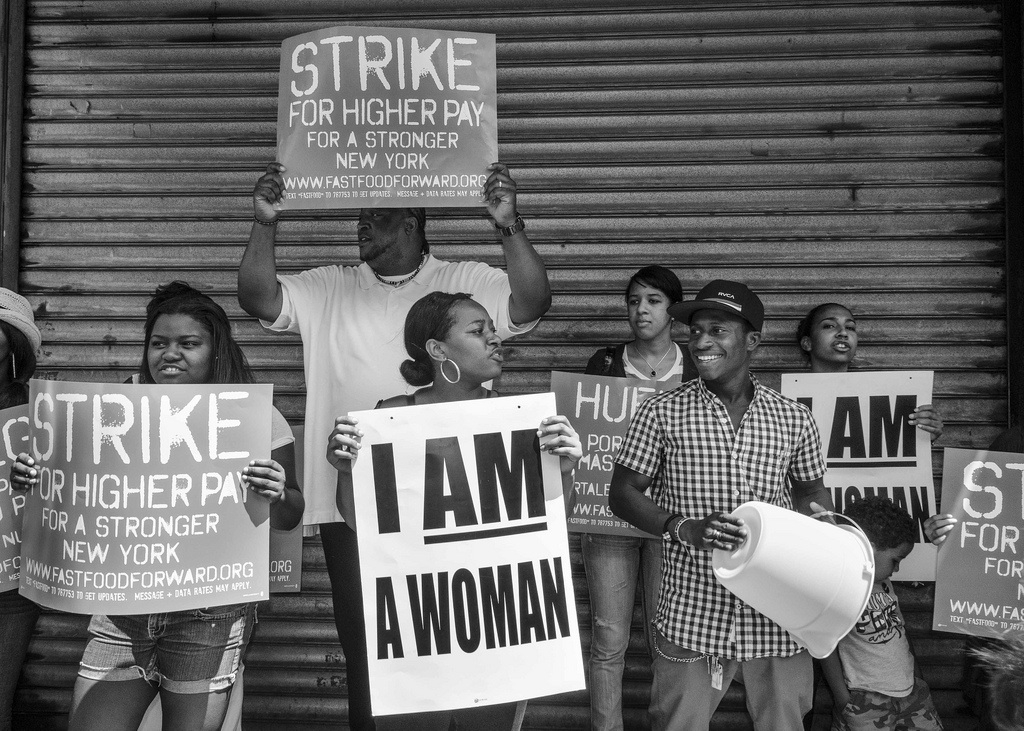
Flipping burgers at McDonald’s is the iconic dead-end job of the U.S. service economy with low-wages, few benefits and certainly no labor unions. But now a national movement of fast-food and other low-paid workers is growing and organizing to improve working conditions. In the past two years there have been seven national fast-food strikes, which reflect a broader resurgence in the U.S. labor movement and new forms of social mobilization from Occupy Wall Street to the Walmart Black Friday strikes. These recent protests have mobilized often marginalized communities in ways that question the service economy model based on cheap non-unionized labor.

Service work, and fast-food in particular, is a growing sector of employment that is indicative of larger trends in the U.S. economy towards contingent, temporary employment and low wages. Violations of workplace laws like mandatory overtime and minimum wage are part of corporate cost-cutting and common in low-wage industries, and unionization could help give workers power to resist these practices.
This revitalized labor movement is also mobilizing women, people of color and immigrants who were largely left out of the traditional craft and industrial unions.
Broader decline of unionization and decrease in the minimum wage has contributed to rising income inequality, and so attempts to organize low-wage workers could help all U.S. workers and reduce this inequality. Union membership provides a wage boost for workers, especially women, people of color and those with less education.

For more on the inclusive power of unions, check out this Girl w/Pen! post.

Miley Cyrus’ VMA activities recently hit the news again – but this time it wasn’t for twerking. Instead, Miley took the spotlight off herself and put it on the issue of homeless youth. Passing her award acceptance on to 22-year-old Jesse Helt, a formerly homeless youth, Miley brought attention to severe social inequality across the U.S. The move raised over $200,000 for Los Angeles homeless youth. However, sociologists show that increasing media awareness of a stigmatized group can have both positive and negative consequences.

Regardless of Miley’s intentions, her effort to give voice to the homeless population is a step in the right direction. Sociologists show that increased awareness of and contact with stigmatized populations can help decrease that stigma.
The media also plays a large role in which issues get deemed “social problems”—problems we feel responsible for helping to fix. Positive media attention given to homelessness at the VMAs, while fleeting, may have some positive impact on social perceptions of homelessness.
However, raising awareness of what many see as a deserving segment of the homeless population—white, healthy, homeless youth—may also detract from what many sociologists call the “undeserving poor.” This equally important group of minority populations and welfare recipients will have a much harder time finding its way into an awards show.

In the wake of protests responding to the killing of Michael Brown by police in Ferguson, Missouri, sociologists began building a large body of resources to explain how these events fit into a broader pattern of racial bias in the United States’ criminal justice system. Sociologists for Justice has both a public statement on the matter and a syllabus on source material related to racialized policing. Sociology Toolbox has recent data on racial disparities and militarized police departments in Ferguson and nationwide. In addition to the conversation about racial injustice, Ferguson also calls into question our assumptions about how to maintain public safety.

Policing in communities of color presents a paradox. The state offers very little attention for social services, but also embeds itself in residents’ everyday lives through strong policing practices.
While there isn’t much research on the effectiveness of policing tactics, we do know that a militaristic approach which maximizes coercion does little to make a community feel safer. In fact, this approach may actually increase future crime and conflict as community members start to resist coercion.
In addition to racial bias in policing, there is also a gendered dimension to military tactics. Precincts develop a sense of male solidarity through military scorn of feminine traits, and even manufacturers of nonlethal police weapons appeal to these masculine sensibilities to sell their products.  

News and images of an influx of unaccompanied child migrants have swept across the nation in recent weeks. In late June, USA Today reported that since Oct. 1, 2013, “more than 47,000 migrant kids primarily from Guatemala, Honduras and El Salvador” have been caught entering country through the U.S.-Mexico border. More recently, government officials have estimated that this population could grow to 90,000 by the end of September. These children, many of whom have journeyed to the U.S. hoping to reunite with family, are being held in numerous southwestern detention facilities while awaiting trials to determine their fates. Most will be deported back to the countries that they fled.

Child migrants locked up and awaiting deportation, feared as future voters, pushes us to think about how the idea of “immigrant child threat” reveals the ongoing negotiation over the value of different kinds of children. So, while Clay Jenkins, a Democrat elected Dallas County judge in 2010, argues that “these are children—they are precious children,” he is expressing a contested view.

This is not the first time children have come to the U.S. based on rumors that they would be allowed to stay. Today it is cause for alarm and a desire to close borders; in the 1950s, the faulty rumors were CIA-sponsored tall tales of Communist child-eaters during Operation Peter Pan, rumors that served to get thousands of Cuban families to give up their children to foster families in Miami, never to be reunited after the Cuban Revolution.
We see how immigrant children are devalued when we compare them to another group of child migrants: transnational adoptees. Research on legislation regarding children’s citizenship argues that adoptees were granted the privilege of their adoptive parents’ citizenship while children of immigrant parents, who had arrived through official channels, could not access social citizenship rights because of their parents’ non-native status.
Society’s “value” of children changes over time and in different situations. While children were once members of household production in the 19th century—say, just another worker on the family farm—they may now be “sacralized” as priceless, if economically worthless, in the 20th century. However, as adoption scholar Laura Briggs writes on the children of deportees from the U.S., “[T]his is still a fight, a question; immigrant children are not seen as a cute, innocent, victimized population.”

For more on how immigration to the U.S. has changed over time, check out this roundtable.

Eric Shinseki resigned last Friday as head of the Department of Veterans Affairs, stating that “the VA needs new leadership”. This comes in the wake of scheduling issues at VA medical centers leading to extended delays for veterans’ healthcare—issues he now recognizes as a “systemic lack of integrity” involving a widespread cover-up. According to a new VA audit report prompted by a series of CNN investigationsdeadly delays in care were being suppressed by clinics driven to meet performance targets. The VA report concluded that the 14-day wait time performance target was “simply not attainable,” and it called for a “long-term, comprehensive reset” of the broken system. While  Shinseki acknowledges these problems, how reasonable is it to expect his successor to fix them? Research shows that scheduling issues are only one barrier among many to veterans’ accessing care.

When predicting which people will seek care, sociologists take into account patients’ prior experiences with the system such as health outcomes and customer satisfaction. Poor service doesn’t just hurt the veterans who seek care—it may keep them from seeking care in the first place!
Some veterans are eligible for both Medicaid and VA services. The largest group of these vets relies on Medicaid rather than VA care or a combination of the two.
Issues with gender in the military also have an effect. Female veterans have less access to VA healthcare relative to males, with 19% of women reporting delayed health care or unmet needs. Knowledge gaps about VA care, perceptions that providers are not gender-sensitive, and a history of military sexual assault predicted women’s likelihood to delay or forgo treatment.


2014 has been a triumphant year for gay professional athletes. Earlier this year, Jason Collins was the first openly gay player to sign a contract with the NBA. More recently, Michael Sam became first openly gay player drafted into the NFL. In a team sporting culture where camaraderie and success have traditionally been tied to masculine overtones and homophobic gestures, these and other moves have undoubtedly ushered in a new era of professional sports­­–one in which a greater number of athletes, teams, and leagues are willing to take a stance against the exclusion of players based on their sexual orientation.

Collins and Sam are bringing to light a public issue that sociologists have seen coming in a wide range of sports and social settings.
These athletes’ stories are a particularly important development in a social arena which is traditionally dominated by men and masculinity.

These trends also reflect broader shifts in gender and sexuality over the past few years. For more information on shifting norms regarding sexual orientation in other institutions, check out Kathleen Hull’s recent TSP white paper on the changing public perception of same-­sex marriage in the US.


There have been a spate of new books lately advising women how to turn inward, change their behavior, and remake themselves to be more successful and ‘leap over’ gender barriers in the workplace. If a woman is not paid what she is worth, passed over for promotion, or even harassed, the solution, it seems, is to lean in – because eventually (soon, in fact) everyone will realize that women really should rule the world. The latest is a book by Katty Kay and Claire Shipman, The Confidence Code, in which the authors argue that the primary barrier to women’s success is not sexism but rather women’s own lack of confidence. And in one way, they are right. Confidence is gendered. Women are less confident than men (and men tend to be over- confident relative to their abilities). Of course confidence matters. But trying to solve a problem of structural sexism with a good night’s sleep, a self-help book, and a smile is a losing proposition.

In their focus on the therapeutic and their emphasis on self-help, these books foster the kind of high-cost, alienating emotional labor sociologists have been writing about since the early 1980s.
These books either completely ignore or actively downplay the structural causes of the confidence gap, including the way that primary schools teach girls that their opinions aren’t as valuable as boys’ opinions.
They also turn a blind eye to the fact that rational actors engage in behavior that is rewarded. Women who show the kind of confidence that men show, and who “negotiate like a man,” are often punished, not rewarded, in America’s workplaces.
Thus, authors like Kay and Schipman are encouraging women to fight with the weapons of the weak instead of helping us all to tackle the more difficult task of breaking down the structural barriers to women’s real and durable success.

Penny Edgell is a Professor in the Sociology department at the University of Minnesota. She studies culture, religion, gender, family, symbolic boundaries, and inequality. 

This week’s Supreme Court decision to uphold Michigan’s ban on affirmative action in college and university admissions stirred up a lot of legal controversy, and will likely lead to more court cases about these policies in other states. In the wake of conversations about constitutionality, however, it is often easy to miss the problems that affirmative action is meant to be correcting.

Racial inequality, especially in the workplace, is very real. Employers regularly make decisions based on race which clash with existing civil rights law.
Most Americans tend to think of diversity in very general, open and optimistic terms, but this “happy talk” often makes it difficult to directly address underlying racial attitudes—and the inequalities they produce—with policy changes.

Picture 2