culture

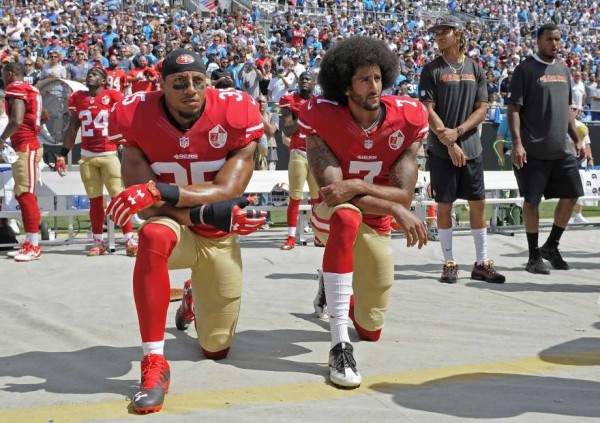
San Francisco 49ers' Colin Kaepernick and Eric Reid kneel during the national anthem. Mike McCarn, Associated Press.
San Francisco 49ers’ Colin Kaepernick and Eric Reid kneel during the national anthem. Mike McCarn, Associated Press.

More and more athletes are joining the San Francisco 49ers’ Colin Kaepernick in kneeling during the “Star Spangled Banner” at the beginning of sporting events. Though this phenomenon has spurred controversy and heated exchanges, sports stars using their celebrity for civic action is not entirely new. After the police shootings of Eric Gardner, Michael Brown, Tamir Rice, and other unarmed black people, numerous members of the NBA and NFL wore hoodies that read “I Can’t Breathe,” (Eric Gardner’s last words); others entered the game while making the “Hands Up, Don’t Shoot!” gesture championed by #BlackLivesMatter. Indeed, today we are witnessing a resurgence of athlete advocacy.

A common criticism of these athletes is that “they should just stick to sports!” or that “they aren’t supposed to talk about politics!” In reality, however, athletes have been at the forefront of protests and civic action for some time now, particularly in the 1960s. TSP Editor Doug Hartmann’s popular book describes how the Civil Rights Movement provided the context for athletes to begin using their celebrity for greater causes. Similarly, Ben Carrington describes how racism has shaped the international black-athlete-experience. Colonialism and contemporary globalization have made sports a site where racism is enacted and solidified, meaning athletes have had to think about these concepts–and fight against them–for a long time.
After the Civil Rights movement, athlete protests became less common, especially as athletes expanded into areas like merchandising and marketing, which meant that they were more likely to avoid “rocking the boat” and jeopardizing their business. But because of #BlackLivesMatter and a greater national focus on police killings of unarmed black people, athletes are once again getting into the fray. As Herbert Ruffin describes, politicizing college sports has led student athletes to protest for their own rights and demands — remember the events at Ole Miss last year? Similarly, Emmett Gill describes actions (and reactions) surrounding the “Ferguson Five” — the St. Louis Rams football players who showed solidarity with protesters in Ferguson, Missouri. 

This research shows that while athlete activism is often met with criticism, it does not mean that their tactics will prove unsuccessful. If history or recent events have shown us anything, the opposite may be truer. One thing is for sure — athlete protest in the contemporary era is just warming up.

For even more readings on race, sports, and athlete activism, check out the  #ColinKaepernickSyllabus created by NewBlackMan (in Exile).
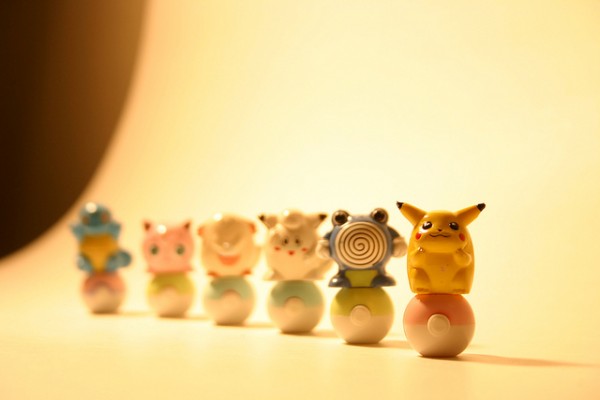
Photo by Shannon, Flick CC

From Brooklyn to Brazil, Pokémon Go has taken the world by storm. And with its popularity has come a media frenzy — Thieves are luring defenseless children! Those troublesome millennials are playing while driving! The game is even banned in Iran.

Popular games have long sparked moral panics and public anxiety about the well-being of our youth and their distinctive cultural tastes and subcultural practices. But we shouldn’t be so quick to panic. In an overview of the game over at Cyborgology, Marley-Vincent Lindsey argues that casting the game as “good” or “bad” ignores important social context. He explains,

Èmile Durkheim would have called it the collective effervescence of the 1990s: an activity as much about the affect and socialization produced as it was about the game. Nintendo may have designed it, but people made it real.”

And in fact, social science research gives us a more measured perspective on the good, the bad, and the Poké. Games create powerful social spaces where people can share a common emotional focus. This draws us in, and it is a foundation for all kinds of human social behavior. Rituals lived out through interactions create powerful shared social experiences that bring people together; we see this in everything from smoking to social media.
And if previous sociological research suggests concerns about games like Pokémon Go, they have more to do with inequality and social control than moral chaos. Too often, we assume everyone can approach public space in the same way, which can blind us to the ways in which patterns of play mirror and reproduce residential segregation. Research also shows how legal systems work to “banish” certain people from public spaces. On this front, it is useful to think critically about who the police allow at the Pokéstop next to that park fountain just after dusk.  

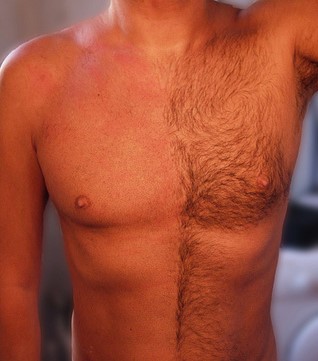
As a woman, summer means more than just bike rides and swimming at the lake. It also means deciding whether or not to shave my body hair. In 2014, some declared that “the bush was back,” and in 2015 armpit hair had its moment in the spotlight as women sported photos of their hair on Twitter and Instagram. While the stigma of being a hairy lady does not seem to be waxing, it is certainly far from over.

Photo by Luca Vanzella, Flickr CC
In the U.S., mass armpit hair removal began only after the introduction of the first women’s body razor in 1915, and shaving pubic hair took off after the bikini was popularized in the late 1940s. Since the 1960s, women’s body hair has come in and out of fashion. For many women in countries like the US and the UK, removal of leg, underarm, and pubic hair is an everyday practice. A recent US survey shows that 84% of women surveyed engaged in some form of pubic hair removal. Women who choose not to shave these areas often face policing from family and friends that reinforces heterosexuality and homophobia. For instance, family and friends promote heteronormativity when they voice concerns over whether potential male partners would find unshaved women attractive.
While people often view men’s body hair as more natural than body hair for women, they also express disgust for “gorilla like” male body hair. Many men–both gay and straight–report removing body hair, citing appearance and attractiveness as primary motivations. Media outlets like men’s lifestyle magazines promote body hair removal as a way to increase sexual appeal, appear healthy, and control nature by controlling the body. Thus, for both men and women, constructions of acceptable and unacceptable body hair are closely linked to cultural norms surrounding sexuality.
Photo by Helen Cassidy, Flickr. https://flic.kr/p/6mghmy

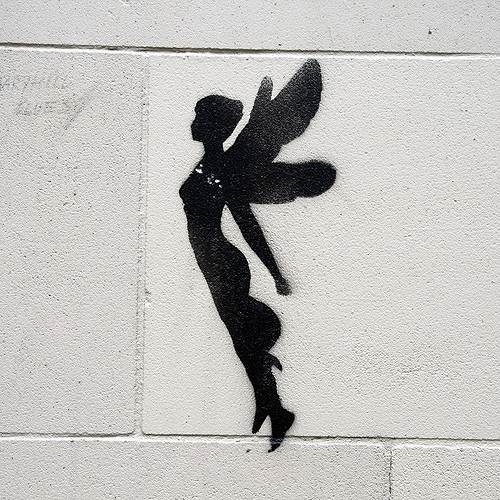
In case you missed it, new fossil evidence suggests that a creature known as the “Siberian Unicorn” may have lived alongside humans some 29,000 years ago. Perhaps that eccentric fellow you’ve seen in the aluminum-foil hat wasn’t so eccentric. In fact, research suggests an openness to phenomena like UFOs, unicorns, and elves is downright normal.

Consider how Scott Draper and Joseph O. Baker describe a wide variety of people across different religious subgroups who all believe in angels. Folklore-phenomena can provide people with emotional comfort and compelling stories.
Such narratives can be transposed across many belief systems and subcultures. Quite a few people believe chasing spirits is a spiritual experience, as discussed by Marc Eaton in his examination of ghost hunters and “paranormal investigators.” Other research looks at the popular pursuits of Bigfoot and alien crash sites.
Sociology has always shown how belief in the paranormal, the fantastical, or the spiritual is a social process (consider founding father Durkheim’s pivotal Elementary Forms of Religious Life). Influential scholars, such as Percy Cohen, who tackled the sociology of myth from a functionalist view, and Richard C. Crepeau, who describes how sport myths and “heroes” help sharpen a society’s moral and aesthetic values, show that the paranormal isn’t losing popularity.
"Drinking for Two" via Edmonton Fetal Alcohol Network
“Drinking for Two” via Edmonton Fetal Alcohol Network

Pregnant women are under attack—or so it seems. Actually, according to the Center for Disease Control (CDC), all women who might become pregnant ever are at risk. In February, the CDC released a report estimating that around 3 million women “are at risk of exposing their developing baby to alcohol because they are drinking, sexually active and not using birth control to prevent pregnancy.” Since then, many have bashed the CDC for advising women to live as though they are “pre-pregnant,” abstaining from drinking if they are not on birth control or if they are even considering getting pregnant. Coupled with growing threat of the Zika virus and its links to birth defects, such suggestions have propelled discussions of women’s roles in preventing catastrophic disability. Sociologists suggest that perceptions of women’s behavior are closely tied to ideas about the morality of motherhood. In particular, women who appear to resist common conceptions of what it means to be a “good” mother are subject to greater social control.

In American culture, motherhood is inextricably tied to morality. Moral arguments against abortion often rely on particular conceptions of sexual behavior, family life, and care for children. The ideology of “intensive mothering” demands that women be self-sacrificing and devote extensive time and energy to their children’s wants and needs — time and energy that many working women cannot afford.
This emphasis on mothers’ devotion to their children places them under considerable scrutiny, not only while raising children, but also during pregnancy. For instance, the “discovery” of Fetal Alcohol Syndrome heightened concerns over drinking during pregnancy. This made pregnant women the individual bearers of responsibility for the well-being of future children, and made them susceptible to moral outrage for behaviors like drinking. (Bucking the trend, the New York City Human Rights Commission has just recommended that visibly pregnant women cannot be discriminated against if, for instance, they order a glass of wine in a bar.)
Poor women, especially poor women of color, face a greater burden under dealized conceptions about what it means to be a “good” or “fit” mother. Not only are they regularly depicted as immoral or unfit, they are also criminalized and sanctioned at higher rates. Historical analyses show pregnant women are arrested for stillbirths, miscarriages, using drugs while pregnant, as well as incarcerated to prevent abortion. Poor women labeled “high risk” are prosecuted for failing to comply with medical advice when their fetus or baby dies, thus they are ironically discouraged from seeking care during pregnancy. Just as the “crack baby” became a symbol of the irresponsibility of poor, black women in the 1980s and ‘90s, Zika exposure and alcohol use are invoked today to place mothers and potential mothers under continued scrutiny.
Among many Minneapolis landmarks lit purple, the Lowry Bridge frames downtown on the night of Prince's death. Tony Webster, Flickr CC.
Among many Minneapolis landmarks lit purple, the Lowry Bridge frames downtown on the night of Prince’s death. Tony Webster, Flickr CC.

When music icon Prince died on April 21st, it affected millions of fans around the world. Famous and non-famous alike flooded social media, expressing their shock at the tragic loss of a superstar, while thousands gathered at the gates of Prince’s home and recording studio, Paisley Park, in suburban Minneapolis and in front of First Avenue in downtown, where many memorable scenes in “Purple Rain” were filmed. Some left purple flowers, letters, and stuffed animals, while others danced and sang. Similar worldwide rituals followed the passings of Michael Jackson, Whitney Houston, and David Bowie, despite most celebrants never having known them personally.

Death and loss are difficult experiences for the loved ones of the deceased. These losses may be compounded by ambiguous losses—those without closure—thought to delay the grieving process and strain the everyday lives of loved ones. Mourning, however, is not restricted to those we know personally. Masses mourned England’s Princess Diana, because they felt they knew her on a personal level, writing condolences such as “I feel as though I’ve lost a dear sister.” People also mourn the death of celebrities who hold connections to emotional events; that is, people do not solely grieve the loss of that celebrity, but also the loss of the memories associated with that celebrity.
Death and grief are private events as well as social rituals. Mass media and technology have helped increase such public mourning: many first hear about the death of celebrities via television, the Internet, and social media, and they often respond with online tributes. Not all celebrity deaths are equal, however: the extent to which the public mourns is an indication celebrity’s status.


Vintage postcard via Blue Mountains Library, Flickr CC.

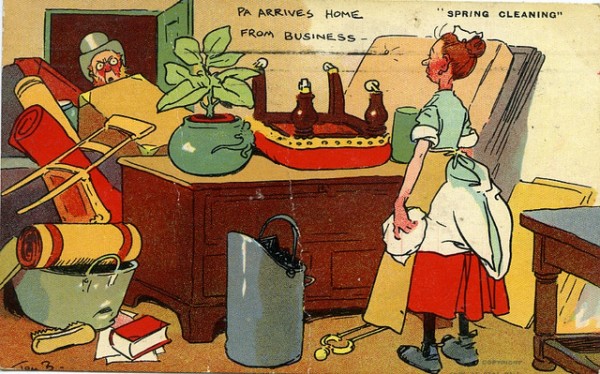
This is the time of year that many people throw open their windows and begin their yearly spring cleaning. Long ago, springtime cleaning had religious significance and coincided with holidays such as Passover and Easter. By the 19th century, spring cleaning had become more about practicality than piety. Particularly in places that suffered cold, wet winters, March and April were a perfect time for dusting because it was warm enough to open windows, but still too chilly for bugs to fly in the house. Ideally, the wind would help blow the dust out of the home instead of swirling it around the rooms.

The blame for a dusty shelf tends to fall on women’s shoulders because the home has traditionally been “her place” in society. Although the 1950s vision of June Cleaver has shifted and more women now participate in the labor force, women still tend to take on the bulk of the housework. Women employed outside the home have a “second shift” of cooking, cleaning, and childcare when they come home from work.
Women who work in more masculinized jobs tend to do more cooking and cleaning, and men with feminized professions engage in more “manly” tasks like yard work and auto repair to neutralize their gender-atypical occupations. Even in couples that are not comprised of a cis-man and a cis-woman, the gendered division of household labor persists. In couples consisting of trans*-men and cis-women, the women end up taking on the “Cinderella roles,” which they often link to personal preference rather than socialization or gender roles.
And what of the sociological significance of dust? A dusty book can show a lack of interest in the material, and the old adage “cleanliness is next to godliness” speaks to the moral implications of a dust-free, spotless home. Dust and dirt are out of place in the well-tended home, and their presence highlights a lack of control over the environment. Additionally, a lack of cleanliness has long served as a social indicator of moral disorder in Western Culture, acting as rallying point of social solidarity over what is socially acceptable.
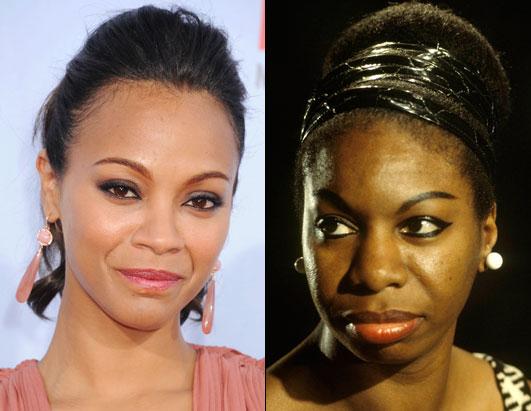
Zoe Saldana, left, and Nine Simone, right. Image via ABC News Entertainment.

Zoe Saldana’s portrayal of singer and activist Nina Simone in an upcoming biopic has proven controversial, even before the film’s premiere. In press photos, Saldana, a light-skinned woman of color, is clearly wearing dark makeup and a prosthetic nose to appear more like the late singer. Some argue using “blackface” in order to cast Saldana is particularly troubling considering Nina Simone’s own life-long dedication to encouraging the acceptance and embrace of dark skin tones. It also ignores the realities of colorism, which reproduces social inequalities and hierarchies among people of color.

Several studies address the benefits that accrue to light-skinned women. Employers, for example, often evaluate women applicants on physical attractiveness, regardless of job skills. This includes privileging physical features that suggest lighter-skinned women are friendlier and more intelligent. Lighter skin tones also make their female bearers more likely to marry spouses with higher incomes, report less perceived job discrimination, and earn a higher income. In schools, studies find that teachers expect their lighter-skinned students to display better behavior and higher intelligence than their darker peers, and public health research shows lower rates of mental and physical health problems among lighter-skinned blacks.
Colorism may provide socioeconomic, educational, and health benefits to light-skinned women, but it also challenges their identity as black women. Other blacks may perceive them as not “black enough,” assuming that they are more assimilated into white culture and lack awareness of black struggles. Those with lighter skin may feel isolated as members of their ethic group openly question their authenticity and belonging.
Peter Sarsgaard as Stanley Milgram in "Experimenter."
Peter Sarsgaard as Stanley Milgram in “Experimenter.”

Late last fall, Experimenter brought classic experimental social science to Hollywood (it’s currently streaming on Netflix). The film depicts Stanley Milgram’s classic experimental obedience studies, where participants were asked by an experimenter to deliver a series of escalating shocks to a “learner” when he/she committed an error on a test. Unbeknownst to the participants, the “learner” was actually a confederate, and no shocks were actually delivered. Milgram found that 65% of the participants escalated to “delivering” the final 450-volt shock—far past dangerous levels. Milgram performed 19 variations of the experiment, including increasing the proximity of the participant and learner (that is, making them better known to each other, which decreased participant compliance) and using only females (which yielded similar results). Apart from the studies’ success at demonstrating the social forces that shape behavior, they have been a cornerstone of ethics in research debates in the social sciences.

Early critics claimed that the participants’ well-being was put at risk, due to the “distress [that] may have resulted from shock at what the experimenter was doing to them as well as from what they thought they were doing to their victims” (Baumrind 423).
  • Stanley Milgram. 1963. “Behavioral Study of Obedience,” Journal of Abnormal and Social Psychology 67: 371–378.
  • Stanley Milgram. 1974. Obedience to Authority: An Experimental View. London: Tavistock Publications.
  • Diana Baumrind. 1964. “Some Thoughts on Ethics of Research: After Reading Milgram’s ‘Behavioral Study of Obedience,'”American Psychologist 19(6): 421.
Numerous quasi-replications of the study have tweaked Milgram’s methodology to match contemporary ethical considerations. Milgram’s findings have been corroborated in replications that do not go to high voltage levels and in virtual simulations of the experiment. More recent work has added nuance, as well, finding variance in “obedience” based on the legitimacy of the “teacher” and the personality propensities and beliefs of the participant.
From the AirBnb website's section for prospective hosts.
From the AirBnb website’s section for prospective hosts.

A recent working paper from Harvard found that hosts of the room/house renting service Airbnb discriminate against renters with Black-sounding names. The study revealed that “requests from guests with distinctly African-American names are roughly 16% less likely to be accepted than identical guests with distinctively White names.”

Unfortunately, racial discrimination based on names is nothing new.
Racialized housing discrimination also has a long history. Once overt, such as in the outright denial of mortgages, housing discrimination has shifted toward micro-aggressions that are harder to spot, such as the private decision not to offer an Airbnb to people of color.